How to Say Good Night in Portuguese: Boa Noite & More
Last updated: March 19, 2026

Learning Portuguese good night phrases is essential if you're planning to visit Brazil or Portugal, or just chatting with Portuguese-speaking friends. The main phrase you need is "Boa noite," which works for both greeting someone in the evening and saying goodbye at night. But like most languages, Portuguese has some nuances and alternatives that make your conversations sound more natural. Let me walk you through everything you need to know about nighttime greetings in Portuguese.
The basic phrase for good night and good evening: Boa noite
The most common way to say good night in Portuguese is "Boa noite." This phrase literally translates to "Good night" in English, where "boa" means good (feminine form) and "noite" means night. Pretty simple, right?
Here's the thing though: "Boa noite" serves double duty in Portuguese. You can use it both as an evening greeting when you meet someone and as a farewell when you're heading to bed or leaving at night. This makes it incredibly versatile compared to English, where we typically separate "Good evening" and "Good night" into different contexts.
The pronunciation sounds like "BOH-ah NOY-chee" if you're speaking Brazilian Portuguese. The "boa" part rhymes with "Noah," and "noite" has that soft "ch" sound at the end that's characteristic of Brazilian pronunciation. In European Portuguese from Portugal, you'll hear it more like "BOH-ah NOYSH," with a sharper "sh" sound at the end instead.
When to use boa noite
You'd typically start using "Boa noite" once the sun goes down or around 6-7 PM in most Portuguese-speaking regions. Before that time, you'd use "Boa tarde" (Good afternoon), which covers the afternoon hours roughly from noon until early evening.
If you walk into a restaurant at 8 PM, you'd greet the staff with "Boa noite." If you're leaving a friend's house at 11 PM, you'd also say "Boa noite" as you head out. This dual function makes it really practical because you don't need to overthink which phrase to use.
Some people get confused about whether to say "Boa noite" or "Boa tarde" during that transition period around sunset. Honestly, both are acceptable during those in-between hours, and native speakers don't stress about it too much. If you're unsure, going with "boa noite" after 6 PM is a safe bet.
Alternative ways to say good night
While "Boa noite" covers most situations, Portuguese has several other phrases you can use when saying good night, especially when you're specifically wishing someone well before bed.
- "Durma bem" means "Sleep well" and is a really warm way to wish someone a good night's rest. You'd use this when someone is going to bed, not as a general evening greeting. It's informal and friendly, perfect for family members or close friends.
- "Tenha uma boa noite" translates to "Have a good night" and is slightly more formal than just "Boa noite." You might hear this from hotel staff or in professional settings where someone wants to be extra polite.
- "Até amanhã" means "Until tomorrow" or "See you tomorrow." This works great when you know you'll see the person the next day. It's casual and commonly used among coworkers, classmates, or friends you see regularly.
- "Bons sonhos" literally means "Good dreams" and is similar to saying "Sweet dreams" in English. This one's particularly nice for kids or romantic partners. It's affectionate and caring.
Brazilian vs. European Portuguese variations
The core phrase "Boa noite" remains the same whether you're in Rio de Janeiro or Lisbon, but pronunciation and some informal variations differ between Brazilian and European Portuguese.
Brazilian Portuguese tends to be more open and melodic in pronunciation. Brazilians might also use shortened or informal versions in casual settings, though "Boa noite" is already pretty informal. You might occasionally hear just "Noite" among very close friends, though this is quite casual.
In Portugal, European Portuguese speakers use the same phrase but with that distinctive accent I mentioned earlier. The consonants are sharper, and vowels sometimes get reduced or dropped in rapid speech. The formality level tends to be similar, though Portugal generally maintains slightly more formal speech patterns in professional contexts.
The word "bem" (well) appears in both variants when you want to elaborate on your good night wishes. "Boa noite e durma bem" (Good night and sleep well) works perfectly in both Brazilian and European Portuguese.
Formal vs. informal usage
The phrase "Boa noite" sits comfortably in the middle ground between formal and informal Portuguese. You can safely use it with your boss, your grandmother, a store clerk, or your best friend.
- If you want to be extra polite or formal, you might add a title or name: "Boa noite, Senhor Silva" (Good night, Mr. Silva) or "Boa noite, Doutora" (Good night, Doctor). This shows additional respect in professional or formal social situations.
- For informal situations with friends and family, "Boa noite" on its own is perfect. You might follow it up with "Durma bem" or "Bons sonhos" to add warmth, but the base phrase works everywhere.
There's no super formal alternative to "Boa noite" that you need to worry about learning. Unlike some languages, where you have completely different formal and informal greeting systems, Portuguese keeps it relatively simple with this phrase.
Using boa noite in real conversations
Let me give you some practical examples of how you'd use "boa noite" in everyday situations.
- You walk into a hotel lobby at 8 PM: "Boa noite! Tenho uma reserva." (Good evening! I have a reservation.)
- You're video calling a friend in Brazil at night: Start with "Boa noite! Como você está?" (Good night! How are you?)
- You're leaving a dinner party: "Boa noite, pessoal! Obrigado pela noite maravilhosa." (Good night, everyone! Thanks for the wonderful evening.)
- You're tucking in a child: "Boa noite, querido. Bons sonhos!" (Good night, dear. Sweet dreams!)
- A shopkeeper greets you as you enter their store at dusk: "Boa noite! Posso ajudar?" (Good evening! Can I help you?)
The phrase fits naturally into all these contexts. Once you get comfortable with it, you'll find yourself using it multiple times a day when interacting in Portuguese.
Learning Portuguese greetings effectively
- The best way to learn these greetings is through actual use and immersion. Watching Portuguese shows, listening to podcasts, or chatting with native speakers helps you understand the natural rhythm and context of when to use each phrase.
- Pay attention to how native speakers transition between "Boa tarde" and "Boa noite" in real life. You'll notice it's not super rigid. Context and personal preference play a role, and that's totally fine.
- Practice the pronunciation out loud, even if you're just talking to yourself. Your mouth needs to get used to forming these sounds. Record yourself and compare it to native speakers if you want to fine-tune your accent.
Anyway, if you want to actually practice Portuguese with real content and pick up phrases like these naturally, Migaku's browser extension and app let you look up words instantly while watching Brazilian shows or reading Portuguese articles. Makes immersion learning way more practical. There's a 10-day free trial if you want to check it out.
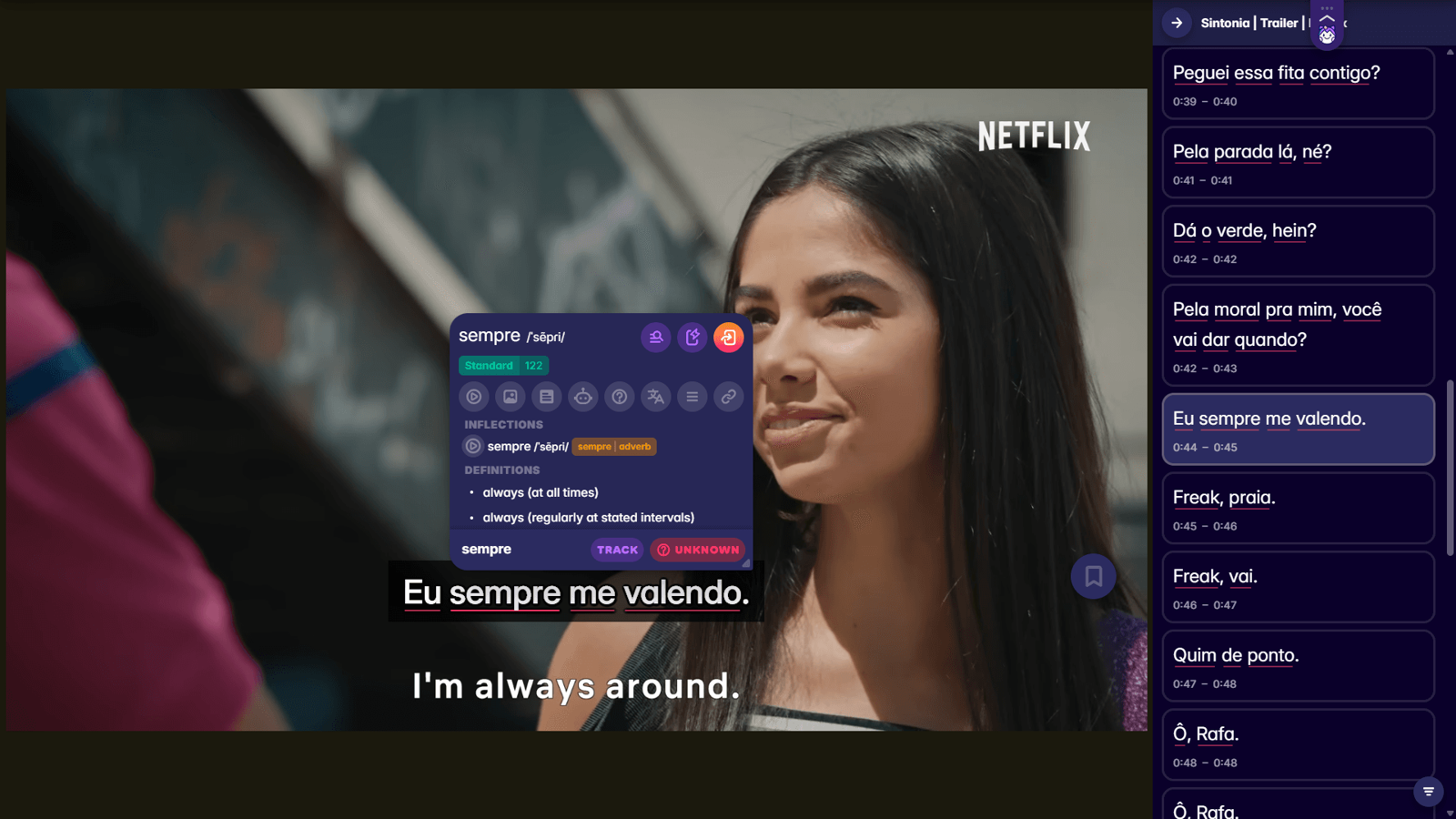
Greetings set the tone for the entire interaction
Greetings like "Boa noite" are often the first words you exchange with a person. Using the appropriate greeting shows cultural awareness and respect. Pay attention to greetings when consuming Portuguese media content, and you can learn many relevant greeting phrases besides "Good night."
If you consume media in Portuguese, and you understand at least some of the messages and sentences within that media, you will make progress. Period.
Stay curious, and keep going!