How Are You in Portuguese: 10+ Different Ways to Greet and Give Responses
Last updated: March 19, 2026

So you're learning Portuguese and want to know how to ask someone how they're doing? Good news: there are way more options than just one formal phrase. Portuguese speakers, especially in Brazil, have tons of casual and friendly ways to greet people and check in on them. Some are super informal, others work in professional settings, and a few are specific to certain regions. I'll walk you through the most common expressions, when to use them, and how people actually respond in real conversations.
- The most common way: "Tudo bem?"
- Formal greetings: "Como vai?" and "Como está?"
- Super casual: "E aí?" and street greetings
- Regional and cultural variations in the way to ask "how are you"
- European Portuguese differences
- How to respond when someone asks how you are
- Describing your emotional and physical state
- Learning Portuguese greetings in context
- FAQs
The most common way: "Tudo bem?"
This is probably the first greeting you'll hear when you start speaking Portuguese. "Tudo bem?" literally translates to "everything well?" but it functions exactly like "how are you?" in English. You'll hear this everywhere in Brazil, from casual hangouts to semi-formal situations.
The cool thing about "tudo bem?" is that it works both as a question and as a response. Someone asks you "tudo bem?" and you can just reply "tudo bem!" back. Pretty simple, right?
Here are some variations you'll encounter:
- Tudo bom?
Everything good? (essentially the same meaning, just slightly different wording) - Tudo legal?
Everything cool? (more casual, used among friends) - Tudo certo?
Everything right? / Everything okay? (common in everyday conversation)
These all get the same types of responses. You can say "tudo" (All good), "tudo bem" (Everything's well), or "tudo bom" (Everything's good). If things aren't great, you might say "mais ou menos" (So-so) or "não muito bem" (Not very well).
Formal greetings: "Como vai?" and "Como está?"
When you need to be more polite or formal, Portuguese has you covered. "Como vai?" means "how goes it?" and "como está?" means "how are you?" Both work in professional settings, with people you don't know well, or when showing respect to elders.
The difference between them is subtle.
- "Como vai?" asks about how things are going generally.
- "Como está?" asks more about your current state. In practice, Brazilian speakers use them pretty interchangeably.
For maximum formality, especially with older people or in business contexts, you'd use:
- Como o senhor está?
How are you, sir? - Como a senhora está?
How are you, ma'am?
These show serious respect. You'd use "senhor" for men and "senhora" for women when addressing someone older, in a position of authority, or when you want to be extra polite.
To respond formally, you'd say "estou bem, obrigado" (I'm well, thank you) if you're male, or "estou bem, obrigada" if you're female. You can also say "vou bem" (I'm going well) as a response to "como vai?"
Super casual: "E aí?" and street greetings
Now we're getting into the informal stuff you'll hear among friends, young people, and in relaxed settings. "E aí?" literally means "and there?" but it's basically "hey, what's up?" in Portuguese.
This greeting is super common in Brazil. You'll hear it constantly in casual conversations, especially among younger people. It's not appropriate for formal situations, but with friends and peers, it's perfect.
Some other informal greetings include:
- Beleza?
Beauty? / Cool? (very casual, common greeting) - Firmeza?
Firmness? / Steady? (slang, mostly used by younger Brazilian speakers) - Tranquilo?
Tranquil? / Calm? (asking if everything's chill)
Responses to these are equally casual. You can say "beleza" (Cool), "tranquilo" (Calm/Good), "suave" (Smooth/Easy), or just "e aí?" right back.
Regional and cultural variations in the way to ask "how are you"
Here's the thing about Portuguese in Brazil: the country is huge, and different regions have their own preferred expressions. While "tudo bem?" works everywhere, you'll notice local flavor depending on where you are.
- In Rio de Janeiro, you might hear "tudo em cima?" (Everything on top?) or "tudo na paz?" (Everything in peace?).
- In São Paulo, "como cê tá?" is super common, which is a shortened version of "como você está?" The "você" gets compressed to "cê" in fast, casual speech.
Down south in states like Rio Grande do Sul, you'll encounter "bah" as an interjection, and greetings might sound a bit different due to regional accents and word choices. Up north and northeast, you'll hear different slang terms mixed into greetings.
The Brazilian way of greeting tends to be warm and friendly. People often greet with a kiss on the cheek (or two, depending on the region) along with their verbal greeting. This physical warmth matches the language itself.
European Portuguese differences
Portuguese from Portugal has some different expressions, though the basics like "tudo bem?" still work. In Portugal, you're more likely to hear "como estás?" (with the 's' at the end) instead of "como está?" when speaking informally. The "tu" form is way more common in Portugal than in Brazil.
Some Portuguese greetings you'll encounter in Portugal:
- Como estás?
How are you? (Informal) - Como está?
How are you? (Formal) - Está tudo bem?
Is everything well?
The pronunciation is also quite different. European Portuguese tends to eat vowels and sound more closed compared to the more open, musical sound of Brazilian Portuguese. If you learn one variety, you'll understand the other, but the accent and some vocabulary will take getting used to.
How to respond when someone asks how you are
Knowing how to ask is one thing, but you also need to know how to respond naturally in Portuguese language. Portuguese speakers don't always give detailed answers to "how are you" questions, just like in English, it's often more of a greeting than a genuine question about your wellbeing.
Basic positive responses:
Portuguese | English |
|---|---|
Bem | Well / Good (short and simple) |
Tudo bem | All well (standard response) |
Muito bem | Very well (when things are going great) |
Ótimo | Excellent (feeling awesome) |
Beleza | Cool / Good (casual response) |
If things aren't perfect:
Portuguese | English |
|---|---|
Mais ou menos | More or less (so-so) |
Poderia estar melhor | Could be better (things are rough) |
Cansado | Tired (if you're male) |
Cansada | Tired (if you're female) |
Não muito bem | Not very well (having a bad time) |
After responding, it's polite to ask back. You can say "e você?" (and you?) or just "e aí?" in casual situations. This back-and-forth is part of the natural flow of Portuguese conversation.
Describing your emotional and physical state
Sometimes you want to be more specific about how you're actually feeling. Portuguese has plenty of ways to talk about your state beyond just "bem" or "mal" (bad).
Emotional states:
Portuguese | English |
|---|---|
Estou feliz | I'm happy |
Estou triste | I'm sad |
Estou animado / Estou animada | I'm excited |
Estou estressado / Estou estressada | I'm stressed |
Estou chateado / Estou chateada | I'm upset / annoyed |
Physical states:
- Estou com fome.
I'm hungry. (literally "I'm with hunger") - Estou com sede.
I'm thirsty. (literally "I'm with thirst") - Estou com sono.
I'm sleepy. (literally "I'm with sleep") - Estou doente.
I'm sick. - Estou com dor de cabeça.
I have a headache.
Notice that for hunger, thirst, and similar states, Portuguese uses "estou com" (I'm with) rather than just "estou" (I am). This is a quirk of the language that you'll pick up with practice.
Learning Portuguese greetings in context
- Pay attention to how people greet each other in different situations. Notice the tone, the body language, and what response comes back. Portuguese speakers are generally friendly and patient with learners, so don't stress about making mistakes. Jump in and try using these phrases.
- Start with "tudo bem?" since it's the most versatile and widely understood. As you get more comfortable, add in the casual expressions with friends and the formal ones in appropriate settings. You'll develop a feel for which greeting fits which situation pretty quickly.
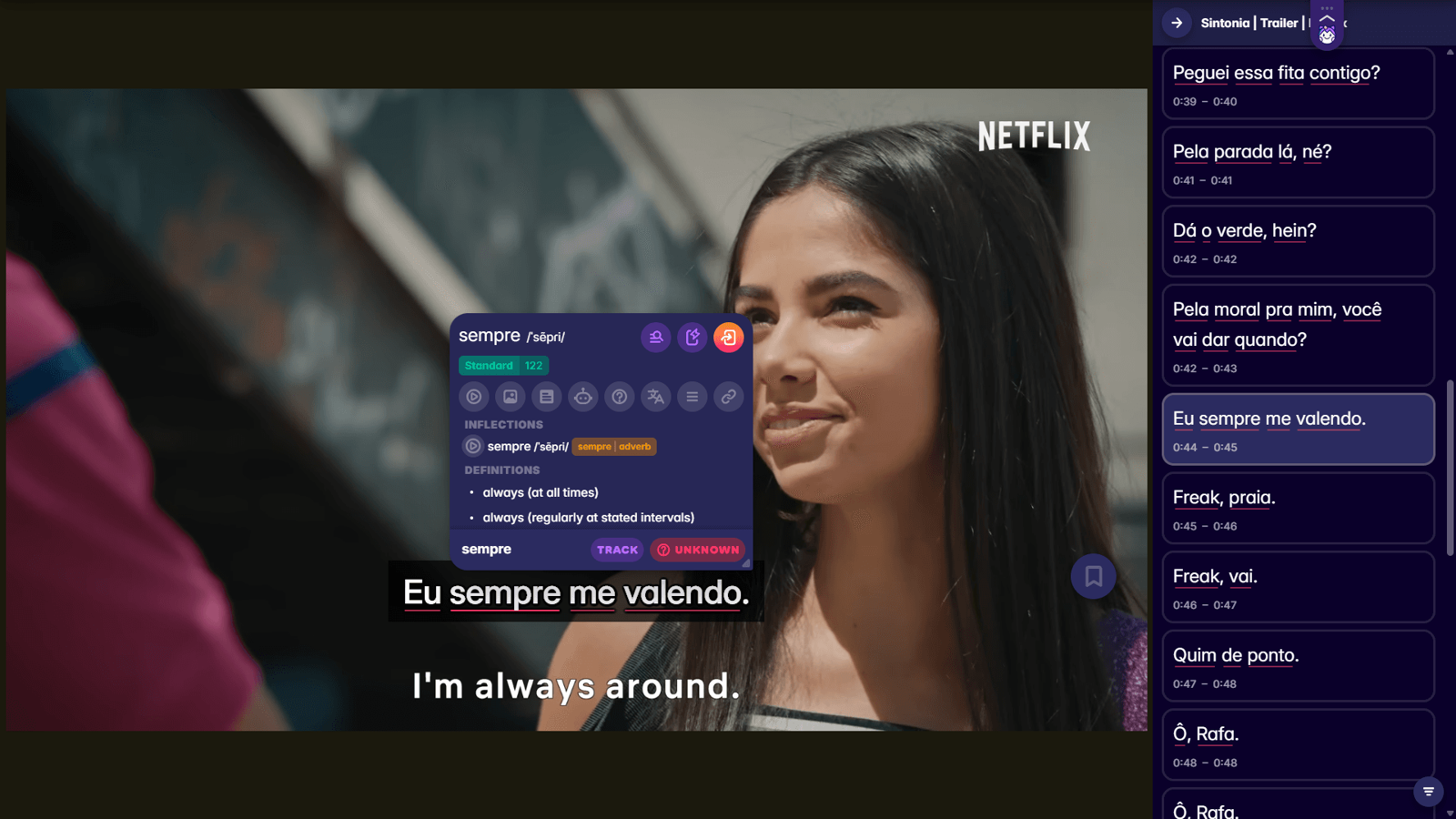
Anyway, if you want to practice Portuguese with real content, Migaku's browser extension and app let you look up words instantly while watching Brazilian shows or reading Portuguese articles. Makes learning from actual conversations way more practical. There's a 10-day free trial if you want to check it out.
FAQs
Practice your Portuguese greetings this way!
The best way to learn these greetings is to hear them in actual conversations. Watching Brazilian shows, listening to Portuguese podcasts, or chatting with native speakers will help you understand the natural rhythm and usage way better than just memorizing phrases.
If you consume media in Portuguese, and you understand at least some of the messages and sentences within that media, you will make progress. Period.
Greet kindly.😀🤝