Pronunciation Practice for Learning Any New Language (2026 Guide)
Last updated: March 13, 2026

Learning a new language is exciting, but there's this moment when you realize that knowing the words isn't enough. You can memorize thousands of vocabulary items and nail the grammar, but if people can't understand what you're saying, you're stuck. Pronunciation gets overlooked way too often because it feels intimidating or less important than vocabulary. Here's the thing though: clear pronunciation makes everything else easier. Native speakers understand you better, conversations flow naturally, and you actually feel confident speaking. Let me walk you through the techniques that work for improving pronunciation in any language you're learning.
- Why pronunciation matters more than you think
- Start by learning the sound system
- Learn pronunciation by recording yourself speaking
- Tips to improve pronunciation with shadowing
- Focus on prosody and intonation, not just individual sounds
- Practise the spelling and sound relationships
- Work with a native speaker or tutor
- Improve your English pronunciation specifically
- Speak English better through immersion content
Why pronunciation matters more than you think
Most language learners focus heavily on vocabulary and grammar while treating pronunciation like an afterthought. That's backwards. You could have perfect grammar and a massive vocabulary, but if your pronunciation is unclear, native speakers will struggle to understand you. I've seen people get frustrated because they're saying the right words but getting blank stares in response.
Good pronunciation also helps your listening skills. When you can produce sounds correctly, you recognize them better when native speakers use them. Your brain starts connecting the sounds you make with the sounds you hear, which speeds up your overall comprehension.
Plus, clear pronunciation just makes you feel more confident. You stop second-guessing yourself before speaking, and conversations become less stressful. That confidence pushes you to practice more to improve pronunciation, which creates this positive feedback loop.
Start by learning the sound system
Every language has its own set of sounds, and some of them probably don't exist in your native language. Before you can improve your pronunciation, you need to know what sounds you're actually aiming for.
- Look up the phonetic inventory of your target language. For English pronunciation, there are about 44 distinct sounds (phonemes) that you need to master. Other languages have completely different inventories. Japanese has around 20 basic sounds, while languages like Georgian have way more consonants than English.
- Spend time listening to minimal pairs, which are words that differ by only one sound. In English speaking, "ship" and "sheep" are minimal pairs that help you distinguish between the short 'i' and long 'ee' sounds. Finding these pairs in your target language helps you train your ear to hear differences that might seem invisible at first.
- I'd recommend using resources that show you exactly how to position your tongue, lips, and jaw for each sound. YouTube has tons of videos breaking down individual sounds with visual diagrams. The International Phonetic Alphabet (IPA) looks intimidating at first, but learning the basics helps you look up exactly how any word should sound.
Learn pronunciation by recording yourself speaking
This technique feels awkward, but it works incredibly well. Most people have no idea what they actually sound like when speaking a foreign language. Recording yourself and listening back reveals pronunciation issues you didn't even know you had.
Pick a short text or dialogue in your target language. Listen to a native speaker say it, then record yourself saying the same thing. Play them back to back and notice the differences. Your rhythm might be off, certain sounds might be completely wrong, or your intonation could sound flat compared to the native version.
Do this regularly, maybe once or twice a week. Keep your recordings so you can track progress over time. After a few months, listening to your old recordings shows you how far you've come, which is pretty motivating.
Some apps let you compare your pronunciation directly with native speakers using visual waveforms. That visual feedback makes it easier to spot where you're going wrong.
Tips to improve pronunciation with shadowing
Shadowing means listening to native speech and repeating it immediately, trying to match everything: the sounds, the rhythm, the intonation, even the emotion. You're basically becoming an echo of the native speaker.
This technique is used by interpreters and polyglots because it trains multiple skills at once. You're improving your pronunciation while also working on your listening comprehension and your speaking speed.
Start with content slightly below your current level. If you pick something too difficult, you'll spend all your energy trying to understand the words instead of focusing on how they sound. Podcasts, audiobooks, and TV shows all work great for shadowing practice.
Here's how I do it:
- Play a sentence, pause, and repeat it while trying to mimic everything about how it was said.
- Then play it again and try to speak along with the audio in real time.
At first you'll stumble constantly, but after a few sessions, you'll notice your mouth getting used to the rhythm and flow of the language.
Focus on prosody and intonation, not just individual sounds
Prosody includes rhythm, stress, and intonation. These elements often matter more than getting every single sound perfect. A native English speaker will usually understand you better if your rhythm and stress patterns are correct, even if some of your individual sounds are a bit off.
Different languages have completely different prosody patterns.
- English language is stress-timed, which means stressed syllables come at roughly regular intervals and unstressed syllables get compressed.
- Japanese is mora-timed, where each unit gets roughly equal time.
- French is syllable-timed.
If you apply your native language's rhythm to your target language, you'll sound foreign no matter how good your individual sounds are.
Pay attention to which syllables get stressed in words. In English, "PREsent" (noun) and "preSENT" (verb) are different words based purely on stress. Many languages use pitch changes to convey meaning or emotion. Getting these patterns right makes a huge difference.
Practice with longer phrases and sentences instead of just individual words. Words change when they're in sentences. Native speakers link words together, reduce certain sounds, and change their pitch. You need to practice these connected speech patterns to sound natural.
Practise the spelling and sound relationships
Understanding how your target language's writing system connects to its sounds helps tremendously. English spelling is famously irregular, but there are still patterns. Knowing that "ough" can be pronounced at least seven different ways ("through," "though," "rough," "cough," "thought," "thorough") helps you stop assuming you know how to pronounce written words.
For languages with more regular spelling systems like Spanish or Korean, learning these rules gives you a huge advantage. You can see a new word and pronounce it correctly without hearing it first.
Make a list of spelling patterns that trip you up. In English, words ending in "-tion" are pronounced "shun," not "tee-on." Foreign learners often get this wrong until someone points it out. Every language has these patterns that seem obvious to native speakers but confuse learners.
Work with a native speaker or tutor
Getting feedback from someone who actually speaks the language natively is incredibly valuable. They can hear mistakes you don't even know you're making and give you specific corrections.
You don't need expensive formal lessons. Language exchange partners work great. You help them with your native language, they help you with theirs. During your practice time, ask them to focus on correcting your pronunciation specifically.
When working with a native English speaker or any native speaker, ask them to slow down and exaggerate the sounds you're struggling with. Have them show you exactly how they position their mouth. Sometimes just seeing how a native speaker's lips move reveals what you've been doing wrong.
Online tutors through platforms like italki or Preply can focus entire sessions on pronunciation if you ask them to. Tell them upfront that you want pronunciation correction, otherwise they might let small errors slide to keep the conversation flowing.
Improve your English pronunciation specifically
Since English is probably the most commonly learned language worldwide, let's talk about some English-specific challenges.
- English has more vowel sounds than most languages, which causes problems for learners whose native languages have fewer vowels.
- The "th" sounds in English (both voiced as in "this" and unvoiced as in "think") don't exist in most languages. Many learners substitute "d" or "z" for the voiced "th" and "t" or "s" for the unvoiced "th." You need to practice putting your tongue between your teeth and pushing air through. Feels weird at first, but that's the correct position to pronounce words.
- English also has this thing called the schwa, which is the most common vowel sound in the language. It's that unstressed "uh" sound that appears in tons of words like "about," "taken," and "supply." Learning to reduce unstressed syllables to the schwa makes your English sound way more natural.
- Word stress in English can change meaning completely. "REcord" versus "reCORD," "PERmit" versus "perMIT." If you're trying to improve your English speaking skills, drilling these stress patterns helps a lot.
Speak English better through immersion content
Watching shows, listening to podcasts, and reading out loud all contribute to better pronunciation in language learning. The more you expose yourself to native speech, the more your brain internalizes the correct patterns.
When you learn English or any language through immersion, you pick up natural rhythm and intonation automatically. Your brain is really good at pattern recognition when you give it enough input.
Try to mimic characters from shows you watch. Pick someone whose voice you like and try to sound like them. Actors usually have very clear pronunciation, which makes them good models. Plus, it's more fun than repeating boring textbook dialogues.
Reading out loud helps connect written and spoken language in your brain. Pick articles or book passages and read them aloud, focusing on pronunciation. Record yourself speaking occasionally to check your progress.
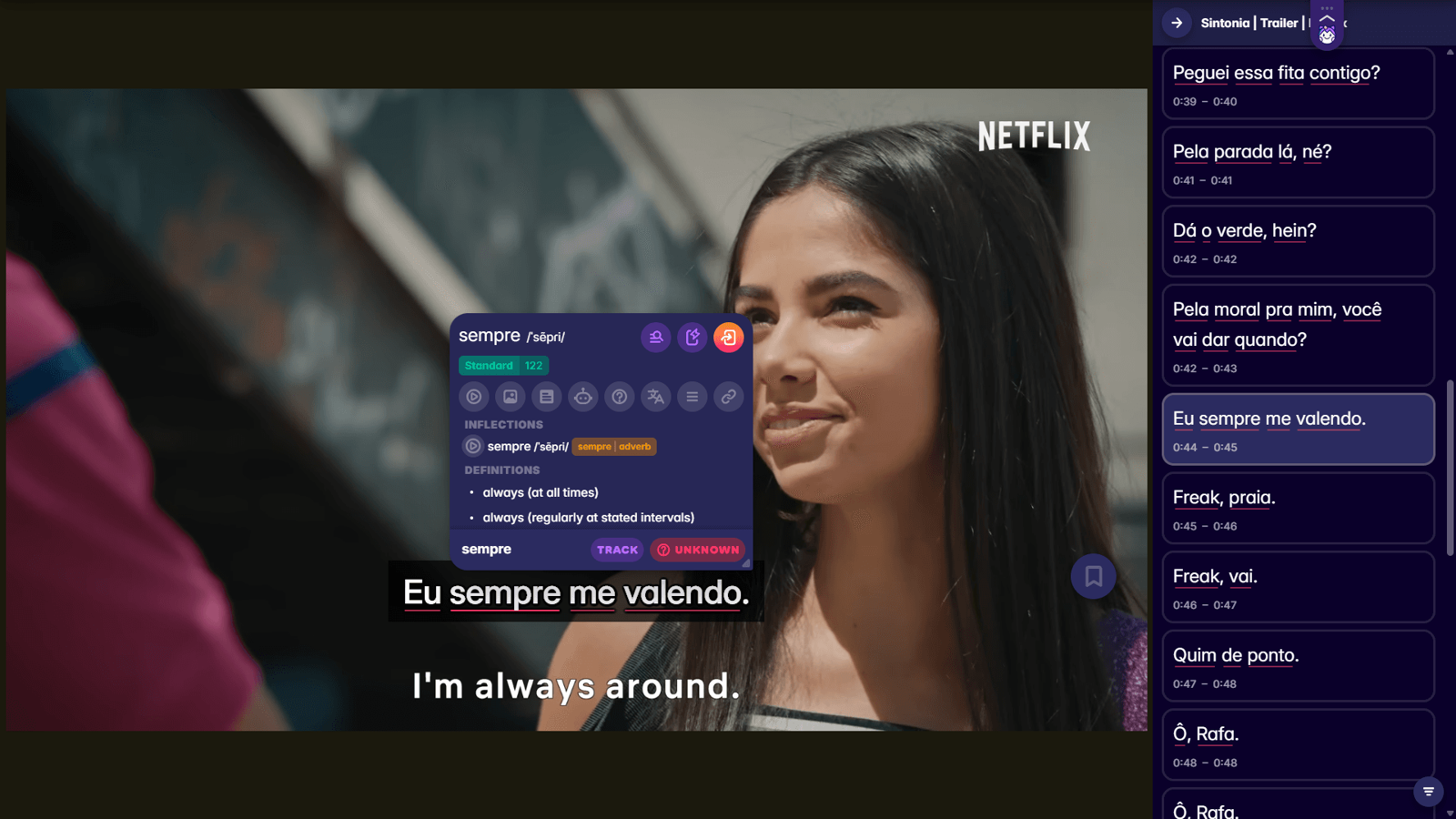
Anyway, if you're serious about improving pronunciation through real content, Migaku's browser extension and app let you look up words instantly while watching shows or reading articles in your target language. You can hear native pronunciation for any word with one click. There's a 10-day free trial if you want to check it out.
Pronunciation skills develop slowly
If you want to improve your English or any other language, you need to treat pronunciation as a core skill, not an optional extra. Clear pronunciation opens doors in conversations, job interviews, and social situations. It's worth the effort. Make use of immersion practice and consume media content in your target language from day 1, and expose yourself to the target language used in real life consistently. You will gradually get used to the pronunciation and notice more and more pronunciation nuances.
If you consume media in the language you want to learn, and you understand at least some of the messages and sentences within that media, you will make progress. Period.
You will make mistakes, but what's important is to correct them.✅