Italian Banking Vocabulary: Italian Phrases You Need at the Banks
Last updated: April 1, 2026

If you're planning to live, work, or even just spend a few months in Italy, you'll eventually need to deal with Italian banks. And honestly? Banking vocabulary is one of those practical language areas that textbooks kind of skip over. You won't find "I need to make a wire transfer" in your typical beginner Italian course, but you'll definitely need it when you're standing at a bank counter trying to open an account. So let's dive into the essential Italian banking vocabulary you'll actually use, from opening your first conto corrente to navigating ATMs and understanding your bank statements.
- Basic Italian banking terms you'll use constantly
- Account types and opening a bank account in Italy
- Cards and payment methods
- ATM vocabulary and using cash machines
- Banking transactions and operations
- Understanding your bank statements and documents
- Italian words for online and digital banking
- Formal Italian for banking interactions
- Getting comfortable with financial conversations in Italian language
Basic Italian banking terms you'll use constantly
The foundation of Italian banking vocabulary starts with understanding what you're actually dealing with. The word for bank is "banca" (plural: "banche"), and you'll see this everywhere from building signs to official documents.
Other relevant terms are:
Italian | English |
|---|---|
filiale | Branch |
impiegato di banca | Bank employee |
cassiere | Teller |
consulente finanziario | Financial advisor |
direttore di filiale | Branch manager |
Here's the thing about Italian banking culture: it's pretty formal. You'll want to use the "Lei" form (formal you) when speaking with bank staff, and phrases like "Vorrei aprire un conto" (I would like to open an account) will serve you better than casual requests.
Words related to currency:
Italian | English |
|---|---|
euro | Euro (singular and plural are the same) |
centesimo / centesimi | Cent (singular/plural) |
valuta | Currency (in general) |
tasso di cambio | Exchange rate |
Account types and opening a bank account in Italy
- The most common type of account is a "conto corrente" (checking account). This is your everyday transactional account where your salary gets deposited and from which you pay bills. The term literally means "current account," and you'll use this phrase constantly when dealing with Italian banks.
- A savings account is called "conto di risparmio" or "libretto di risparmio." These typically offer better interest rates but have restrictions on how frequently you can make withdrawals.
- The interest rate itself is "tasso di interesse."
When you open an account, you'll need to provide your "codice fiscale" (tax identification number) and a valid ID. The bank will issue you an "IBAN" (International Bank Account Number), which is how people send you money.
You'll also get a "numero di conto" (account number) and probably be asked if you want a debit card, which brings us to cards.
Cards and payment methods
The Italian banking system has some specific terminology around cards that can trip people up.
- A debit card is commonly called a "Bancomat," which is actually a brand name that became generic (like saying "Kleenex" for tissues). The official term is "carta di debito," but most Italians just say Bancomat.
- A credit card is "carta di credito." These work differently in Italy than in some other countries. Many Italian credit cards require you to pay the full balance monthly rather than carrying a balance with interest.
- You might also encounter "carta prepagata" (prepaid card), which you load with money and use until the balance runs out. These are popular among younger people and anyone who wants to control spending.
The PIN for your card is "codice PIN" or just "PIN."
When paying, you might hear "Carta o contanti?" (Card or cash?). Cash is "contanti" or "denaro," and many smaller establishments in Italy still prefer it.
ATM vocabulary and using cash machines
ATMs are called "Bancomat" (yes, same word as debit cards) or "sportello automatico" (automatic counter). When you're looking for one, you might see signs saying "Bancomat" with the familiar blue and red logo.
Common ATM screen prompts you'll see include:
Italian | English |
|---|---|
prelievo | Withdrawal |
versamento | Deposit |
saldo | Balance |
estratto conto | Account statement |
limite di prelievo | Withdrawal limit (typically €250-500 daily depending on the bank) |
ricevuta / scontrino | Receipt |
If you're withdrawing cash, the machine will ask "Quale importo?" (What amount?). After your transaction, it'll ask if you want a receipt: "Desidera la ricevuta?"
Pro tip: Italian ATMs sometimes run out of cash, especially in smaller towns on weekends. If you see "Temporaneamente fuori servizio" (temporarily out of service), you'll need to find another machine.
Banking transactions and operations
- The most common transaction is a "prelievo" (withdrawal). When you take money out of your account, you're making a prelievo.
- The opposite is "versamento" (deposit), whether you're depositing cash ("versamento in contanti") or a check ("versamento di assegno").
Transferring money is where things get specific.
- A wire transfer is "bonifico bancario" or just "bonifico." You'll need the recipient's IBAN to make a bonifico. A bank transfer within Italy typically takes 1-2 business days, while international transfers ("bonifico internazionale") can take 3-5 days.
- Direct debit is "addebito diretto" or "RID" (Rapporto Interbancario Diretto). This is how you set up automatic bill payments. Standing orders for recurring payments are "ordini permanenti."
Understanding your bank statements and documents
Your bank statement is "estratto conto." Italian banks typically provide monthly statements, either by mail or through online banking. Reading an estratto conto requires knowing a few key terms.
Italian | English |
|---|---|
entrate | Incoming transactions (credits) |
uscite | Outgoing transactions (debits) |
saldo iniziale | Opening balance |
saldo finale | Closing balance |
data | Date |
descrizione | Description |
importo | Amount |
commissioni / spese bancarie | Fees / Banking charges |
scoperto / saldo negativo | Overdraft |
interessi passivi | Debit interest |
interessi attivi | Credit interest |
Italian words for online and digital banking
Most Italian banks now offer robust online banking, called "banca online" or "internet banking." The mobile app is "app bancaria" or "app mobile."
Italian | English |
|---|---|
nome utente | Username |
password | Password |
autenticazione a due fattori / doppia autenticazione | Two-factor authentication |
token | Token (physical device) |
OTP | One-time password (sent via SMS) |
movimenti | Transactions |
pagare bollette | To pay bills |
home / area personale | Dashboard / Personal area |
pagamenti contactless / pagamenti senza contatto | Contactless payments |
pagamenti via app | Mobile payment apps |
Formal Italian for banking interactions
Banking requires more formal Italian than everyday conversation. Here are some commonly used expressions:
- Buongiorno, vorrei parlare con qualcuno riguardo...
Good morning, I would like to speak with someone about... - Vorrei aprire un conto.
I would like to open an account. - Avrei bisogno di fare un bonifico.
I would need to make a transfer. - Potrebbe aiutarmi con...
Could you help me with... - Quanto tempo ci vuole?
How long does it take? - Ci sono delle spese?
Are there any fees? - Potrebbe spiegarmelo?
Could you explain it to me? - Potrebbe ripetere, per favore?
Could you repeat, please?
Getting comfortable with financial conversations in Italian language
The best way to learn Italian banking vocabulary is through actual use, but you can prepare before your first bank visit.
- Many Italian banks have websites with FAQs and guides that use this exact terminology. Reading through these in Italian (even if you don't understand everything) helps you recognize terms when you see them on forms or hear them at the counter.
- Watching Italian YouTube videos about personal finance or banking tutorials gives you pronunciation practice. You'll hear how Italians actually say these terms in context, which is different from reading them in a vocabulary list.
- If you're already in Italy, keep your bank statements and read through them carefully. Look up any terms you don't recognize. Over time, you'll internalize the vocabulary through repeated exposure.
If you want to pick up this vocabulary naturally through Italian content, Migaku's browser extension and app let you look up banking terms instantly while watching Italian financial news or reading Italian banking websites. Makes learning practical vocabulary way more efficient. There's a 10-day free trial if you want to check it out.
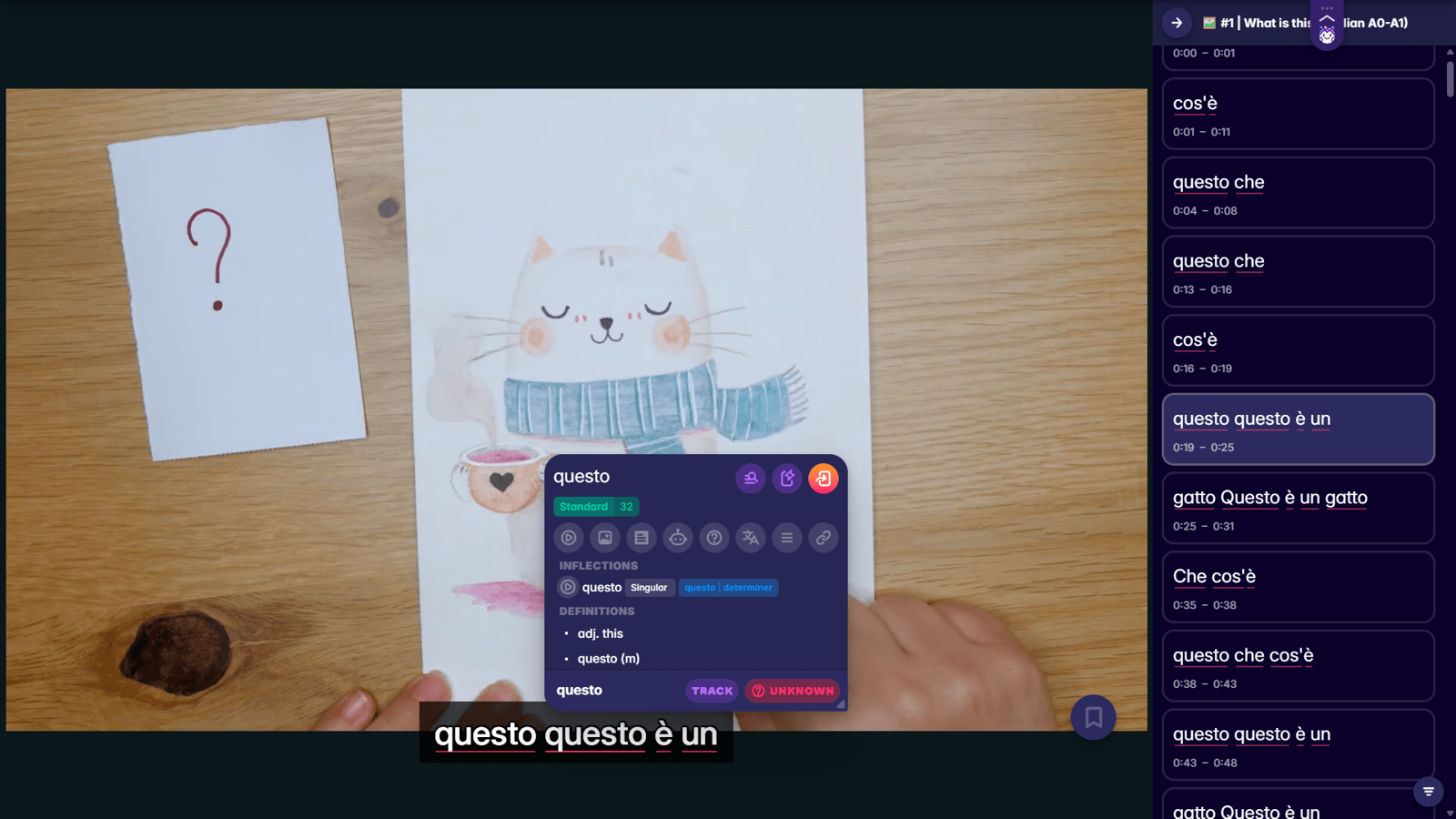
Learning daily Italian words like these can make your life so much easier!
Whether you're opening your first Italian bank account or just trying to understand why your ATM card isn't working, having solid banking vocabulary makes life in Italy significantly easier. It may be difficult to find videos about finance, but you can definitely look through Italian banking websites and news articles to practice these terms.
If you consume media in Italian, and you understand at least some of the messages and sentences within that media, you will make progress. Period.
Learn to navigate life, and not just language lessons!