# Italian Clothing Vocabulary: Essential Shopping Terms
> Complete Italian clothing vocabulary lists for shopping, travel, and conversation. Guide to clothes, shoes, and useful phrases with English translation.
**URL:** https://migaku.com/blog/language-fun/italian-clothing-vocabulary
**Last Updated:** 2026-02-24
**Tags:** vocabulary, phrases
---
So you want to [learn Italian](https://migaku.com/learn-italian) clothing vocabulary? Smart move. Whether you're planning a shopping [trip to Italy](https://migaku.com/blog/language-fun/italian-travel-phrases), trying to describe what someone's wearing, or just building your basic Italian skills, knowing how to talk about clothes is genuinely useful. Italian fashion is world-famous for a reason, and being able to navigate clothing conversations will make your time in Italy way more enjoyable. Plus, this vocabulary shows up constantly in everyday situations, from complimenting someone's outfit to asking a store clerk for help.
---
## Essential clothing terms (abbigliamento)
Let's start with the basics. The general word for clothing in Italian is "**abbigliamento**." You'll see this word on store signs and in formal contexts. For everyday conversation, "**vestiti**" works better (It means clothes or garments).
When you're talking about getting dressed, you'll use "**indossare**" (to wear or put on). "Mi piace indossare vestiti comodi" means "I like to wear comfortable clothes." Pretty straightforward.
Here are the core terms you absolutely need:
| Italian | English | Explanation |
| - | - | - |
| vestito | dress / suit | Can mean dress (for women) or suit (general outfit). Context matters here. "Un bel vestito" could refer to either, depending on who's wearing it. |
| gonna | skirt | |
| pantaloni | pants / trousers | Always plural in Italian, just like English |
| jeans | jeans | Same in both languages, though Italians pronounce it differently |
---
## Upper body garments
Shirts and tops give you lots of vocabulary to work with.
| Italian | English | Explanation |
| - | - | - |
| camicia | button-up shirt | The kind you'd wear to work or a nice dinner. This word is feminine (la camicia), even when talking about men's shirts |
| maglietta | t-shirt | What you'd wear casually |
| canotta | tank top / undershirt | |
| canottiera | undershirt | Specifically the kind worn under other clothes |
| boxer / mutande | boxers / general underwear | "Boxer" works in Italian too; "mutande" is general underwear |
| mutandine | panties | |
| maglione | sweater / jumper | During winter in Italy, you'll hear this word constantly |
| felpa | sweatshirt / hoodie | More casual than a maglione |
| panciotto / gilè | waistcoat | The sleeveless vest worn over a shirt |
| giacca doppiopetto | double-breasted blazer | "Doppiopetto" literally means double-breasted |
| camicetta | blouse | |
| reggiseno | bra | |
| biancheria intima | lingerie | Literally "intimate linens" |
---
## Lower body clothing
| Italian | English | Explanation |
| - | - | - |
| pantaloni | pants / trousers | Most common word for pants |
| pantaloncini | shorts | Literally "little pants" |
| gonna | skirt | |
| jeans | jeans | Huge in Italian fashion; quality of Italian denim is impressive |
| calzoni | trousers (formal) | Older term you might encounter in formal contexts or historical settings |
| mutande | underwear | Works as a general term |
| boxer | boxers | For men's underwear specifically |
| slip | briefs | For men's underwear specifically |
---
## Outerwear and seasonal clothing
Italian weather varies a lot by region and season, so outerwear vocabulary is essential.
| Italian | English | Explanation |
| - | - | - |
| giacca | jacket | General term |
| cappotto | coat | Usually longer and heavier than a giacca |
| giubbotto / giubbino | short jacket | Like a bomber jacket or casual zip-up |
| impermeabile | raincoat | Literally means waterproof |
| piumino | down jacket | Needed in northern Italy where winters get cold |
| giaccone | heavy jacket | Another option for cold weather in northern Italy |
| sciarpa | scarf | Italians wear them a lot, even in mild weather. Partly fashion, partly practical. A nice scarf can completely change an outfit. |
| guanti | gloves | |
| cappello | hat | |
---
## Shoes (scarpe)
Shoes deserve their own section because Italians take footwear seriously. "**Scarpe**" is the general word for shoes. Like pantaloni, it's always plural when you're talking about a pair.
| Italian | English | Explanation |
| - | - | - |
| stivali | boots | Boot quality in Italy is genuinely excellent, especially leather boots |
| stivaletti | ankle boots | Smaller boots, basically |
| sandali | sandals | Seen everywhere in summer, from casual rubber to fancy designer versions |
| scarpe da ginnastica | athletic shoes / trainers | Literally means "gymnastics shoes" |
| sneakers | sneakers | Works the same as English |
| scarpe col tacco | high heels | Literally "shoes with a heel"; "tacco" means heel |
| scarpe basse | flat shoes | |
| mocassini | loafers / moccasins | |
| ciabatte | slippers / flip-flops | |
Italian leather shoes are famous worldwide for good reason. The craftsmanship in cities like Florence and Milan is incredible. If you're shopping for scarpe in Italy, expect quality but also expect to pay for it.
---
## Accessories (accessori)
Accessories in Italian are "**accessori**," easy to remember. But you'll want specific terms for common items.
| Italian | English | Explanation |
| - | - | - |
| cappello | hat | General term |
| berretto | cap / beanie | Closer-fitting hats |
| cappellino | baseball cap | Specifically a baseball cap |
| borsa | bag / purse | General term |
| borsetta | handbag | Smaller handbag |
| zaino | backpack | |
| valigia | suitcase | Useful for travel vocabulary |
| cintura | belt | Leather belts (cinture di pelle) are another Italian specialty |
| pelle | leather | You'll see this describing lots of high-quality Italian goods |
| cravatta | necktie | |
| papillon | bow tie | Borrowed from French |
| foulard | silk scarf | Also from French |
| occhiali | glasses | Always plural |
| occhiali da sole | sunglasses | Literally "sun glasses" |
| orologio | watch | Italian watch design is pretty iconic, think brands from the northern regions |
---
## Useful shopping phrases
Knowing vocabulary lists is one thing, but you need phrases to actually use these words in Italy. Here are some expressions that'll help when you're shopping for clothes.
- "Posso provare questo?" means "Can I try this on?" The verb "provare" means to try. You'll use this constantly in clothing stores.
- "Avete questo in un'altra taglia?" means "Do you have this in another size?" "Taglia" is size. Sizes in Italy run differently than in the US or UK, so trying things on matters.
- "Quanto costa?" means "How much does it cost?" Simple but essential.
- "Mi sta bene?" means "Does this fit me well?" or "Does this look good on me?"
- "È troppo stretto/largo" means "It's too tight/loose." "Stretto" is tight, "largo" is loose or wide.
- "Cercavo qualcosa di più casual/elegante" means "I was looking for something more casual/elegant." Useful for explaining what style you want.
- "Accettate carte di credito?" means "Do you accept credit cards?" though most places in Italy do now in 2026.
- The phrase "mi piace" (I like it) or "non mi piace" (I don't like it) will serve you well when shopping with Italian friends or getting opinions from store staff.
---
## Grammar notes for clothing vocabulary
Quick grammar stuff that'll help you use these words correctly. In Italian, clothing items have gender, and this affects everything around them.
1. Masculine items use "il" (singular) or "i" (plural). Examples: il cappotto (the coat), i pantaloni (the pants).
2. Feminine items use "la" (singular) or "le" (plural). Examples: la gonna (the skirt), le scarpe (the shoes).
3. When you're saying "a shirt" or "some shoes," you need the right indefinite article. "Un" for masculine (un cappello), "una" for feminine (una giacca).
4. Colors need to agree with the gender and number of the item. "Una camicia rossa" (a red shirt, feminine). "Un cappello rosso" (a red hat, masculine). The color changes its ending to match.
5. Possession works differently too. "My jacket" is "la mia giacca" (feminine) or "il mio cappotto" (masculine). The possessive adjective (mia/mio) matches the gender of the thing you own, not your own gender.
---
## Regional and cultural notes about Italian fashion
Italian fashion isn't monolithic. Different regions have different styles and even some different vocabulary.
- In Milan, fashion is more formal and trend-focused. This is the fashion capital of Italy, home to major design houses. People dress up more for everyday activities.
- In Rome, style tends to be classic and elegant but slightly more relaxed than Milan. You'll see a mix of traditional and modern.
- Southern Italy generally dresses more casually, though people still care about appearance. Beach culture in places like Sicily or Puglia means lighter fabrics and more relaxed fits.
The concept of "**bella figura**" (making a good impression through appearance) matters throughout Italy. This isn't about expensive clothes necessarily, but about looking put-together and appropriate for the situation.
Italians tend to invest in fewer, higher-quality pieces rather than buying lots of cheap clothes. This affects shopping culture. You'll find amazing quality in Italian stores, but fast fashion is less dominant than in some other countries.
Seasonal changes matter. Italians switch their wardrobes pretty strictly between seasons. Wearing winter clothes in spring or summer clothes in fall would look odd to locals.
---
## Finding good Italian clothing vocabulary resources
Vocabulary lists are helpful, but you want quality resources. Look for materials that include the gender of each noun (il/la), plural forms, and example sentences.
1. Many Italian [learning apps](https://migaku.com/blog/language-fun/best-italian-learning-apps) now include clothing vocabulary in their beginner courses. The visual element helps, seeing a picture of "stivali" alongside the word makes it stick better.
2. YouTube has tons of Italian fashion and shopping videos where you'll hear this vocabulary in context. Watching Italian fashion hauls or shopping vlogs gives you natural usage.
3. If you want an Italian clothing vocabulary PDF, search for "abbigliamento italiano PDF" or check Italian learning websites. Many offer downloadable lists. Just make sure they include articles and gender markers.
4. The best resource, honestly, is real Italian content. Fashion magazines, shopping websites, Italian Instagram accounts about style, these all use clothing vocabulary naturally and show you current terms.
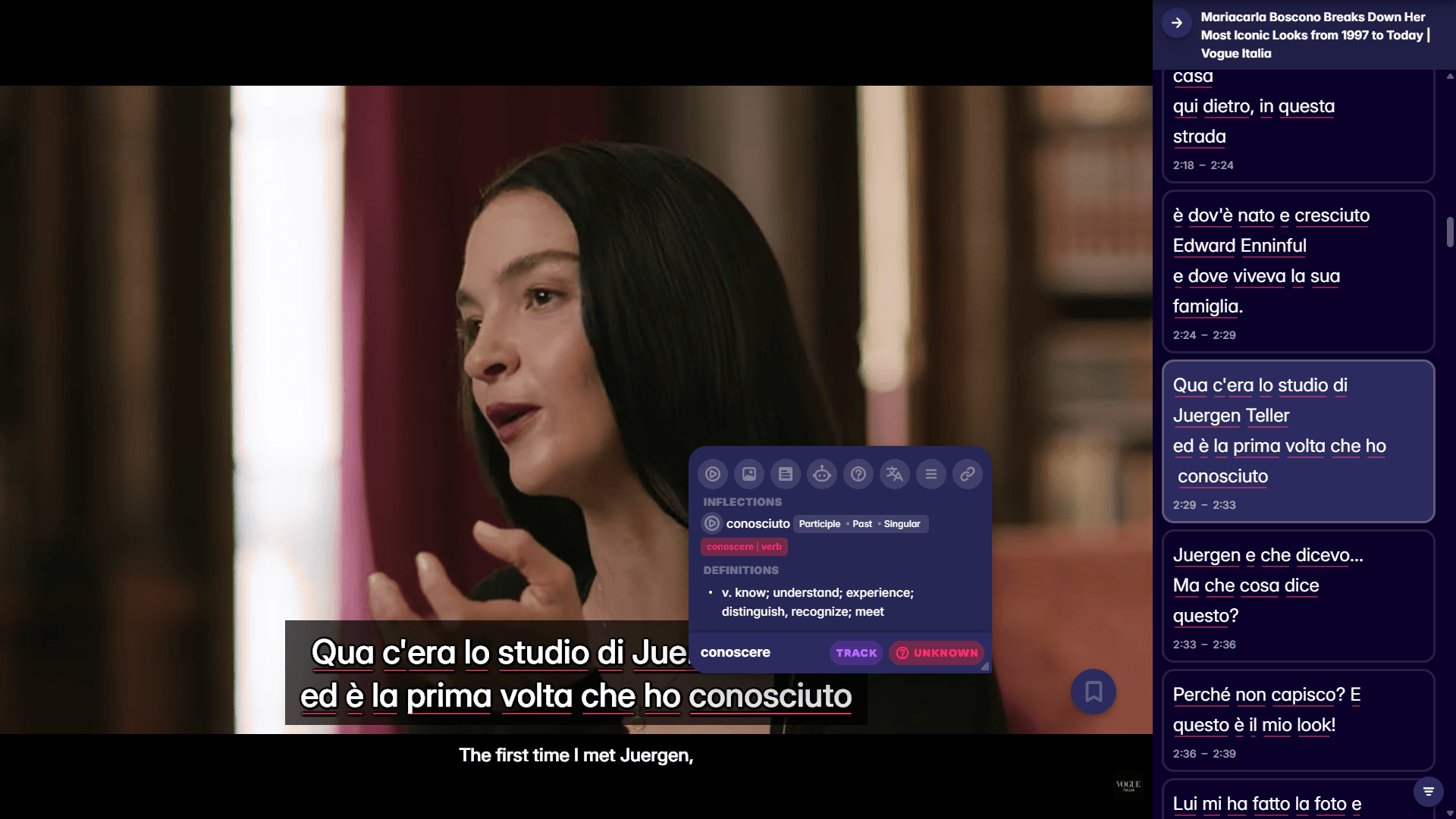
Anyway, if you want to practice this vocabulary with real Italian content, Migaku's browser extension and app let you look up words instantly while watching Italian shows or reading fashion blogs. Makes learning from authentic sources way more practical. There's a 10-day free trial if you want to check it out.
 ---
## It is rewarding to learn Italian vocabulary on fashion!
Learning Italian clothing vocabulary opens up a lot of practical communication. You can shop confidently, describe what people are wearing, pack appropriately for trips, and follow conversations about fashion and style. These clothing words help you understand Italian fashion documentaries, news, and movies faster and easier as well.
> If you consume media in Italian, and you understand at least some of the messages and sentences within that media, you will make progress. _Period_.
Enjoy what you're learning.💖
---
## It is rewarding to learn Italian vocabulary on fashion!
Learning Italian clothing vocabulary opens up a lot of practical communication. You can shop confidently, describe what people are wearing, pack appropriately for trips, and follow conversations about fashion and style. These clothing words help you understand Italian fashion documentaries, news, and movies faster and easier as well.
> If you consume media in Italian, and you understand at least some of the messages and sentences within that media, you will make progress. _Period_.
Enjoy what you're learning.💖