Italian Coffee Culture: Bar Etiquette and Regional Habits
Last updated: May 21, 2026
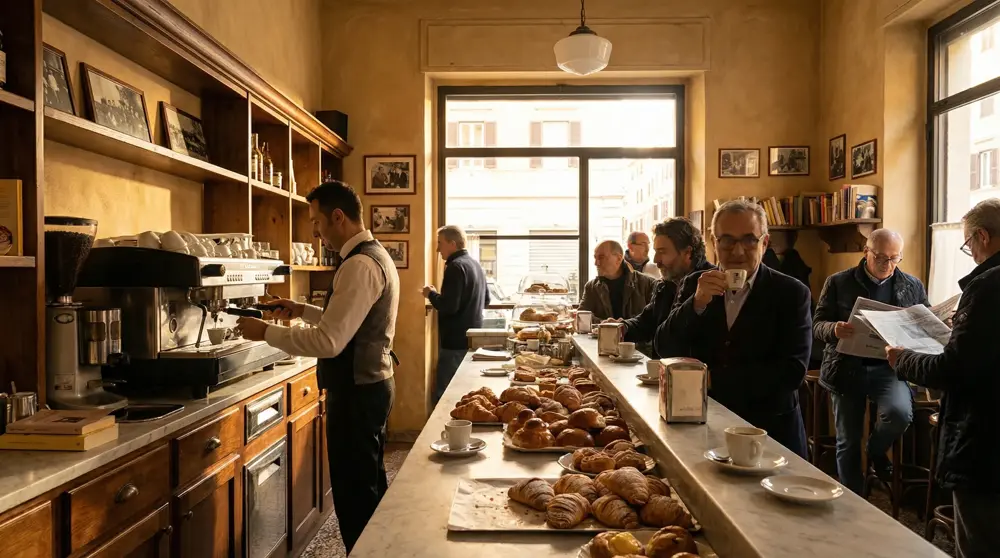
Italian coffee culture runs on a small set of unwritten rules: you stand at the bar, you drink your espresso fast, you pay little, and you don't order milky drinks after a meal. Break those conventions and nothing bad happens, but you'll mark yourself as a visitor and probably pay two to three times more for the same cup.
Last updated: May 21, 2026
The Italian Bar Is Not What You Think It Is
In Italy, a "bar" is not a place for evening drinking. It's the corner café where locals start the day, refuel mid-morning, and finish lunch. Roughly 97% of Italian adults drink coffee daily, and the country has about one coffee bar for every 490 residents. Italians consume around 6 billion cups of coffee in bars every year.
The typical sequence at an Italian bar is fast and choreographed:
- Walk in, look at the price list posted on the wall (this is legally required).
- Pay first at the cashier (la cassa) and get a small receipt (lo scontrino).
- Take the receipt to the counter (il banco), place it down, and tell the barista what you ordered.
- Drink standing up, often in under two minutes.
- Leave.
In smaller towns and in many southern bars, you may order at the counter directly and pay on the way out. In big-city tourist zones (Venice, central Rome, central Florence), the cashier-first system is standard. If in doubt, watch what locals do for thirty seconds before you order.
Al Banco vs. Al Tavolo: Where You Stand Changes the Price
This is the single biggest cost mechanic in Italian coffee, and it is fully legal. Bars charge two different prices depending on whether you drink standing at the counter (al banco) or sitting at a table (al tavolo). Table service typically costs roughly double the counter price, and in tourist squares it can climb to four or five euros for a drink that costs €1.20 at the bar three meters away.
The national average price of a counter espresso reached €1.25 in August 2025, up 20.6% from €1.04 in 2021. As of 2025/2026, a consumer-group estimate from Assoutenti suggested the average is now approaching €1.50, with €2 espressos becoming more common.
Counter prices by selected city (2025 averages):
City | Espresso al banco |
|---|---|
Bolzano | €1.47 |
Ferrara | €1.43 |
Padua | €1.41 |
Belluno | €1.40 |
Naples | €1.21 |
Reggio Calabria | €1.06 |
Messina | €1.06 |
Catanzaro | €1.00 |
Cappuccino prices have crossed €2.50 in many bars, an average 14% increase over three years. At a table in a piazza, expect €4 to €7.
A Florence café was fined €1,000 in 2025 for charging €2 for an espresso, but the fine was for failing to display the price properly, not for the price itself. As long as the price list is posted, the bar can charge what it likes. If you suspect undisclosed fees, the Polizia Municipale and Guardia di Finanza handle consumer-protection complaints.
Why No Cappuccino After Lunch
The rule that fascinates tourists most: Italians do not drink cappuccino after about 11 a.m., and almost never after a meal. There is no law against it. Order one at 3 p.m. and the barista will make it without comment. But it is a cultural marker as reliable as wearing socks with sandals.
The reasoning is digestive and traditional. Italians believe large quantities of milk sit heavily on a full stomach, especially after pasta, meat, or anything with tomato sauce. Cappuccino, caffè latte, and latte macchiato are breakfast drinks, taken with a cornetto (the Italian croissant) or eaten plain. After lunch or dinner, the standard order is a small black coffee, almost always an espresso, sometimes a macchiato (espresso with a dab of foamed milk), occasionally a caffè corretto (espresso "corrected" with grappa or sambuca).
The practical guideline:
- Before 11 a.m.: cappuccino, caffè latte, latte macchiato are all normal.
- 11 a.m. to noon: borderline. Locals are mostly switching to espresso.
- After lunch and after dinner: espresso, macchiato, or corretto only.
If you really want milky coffee in the afternoon, order it. Just know that ordering a cappuccino after a heavy dinner is, in Italian eyes, slightly comical.
The Coffee Menu, Decoded
Italian bars use Italian names, and they don't always match what those names mean abroad. The Italian Espresso National Institute (INEI) defines a certified Italian espresso as 7 to 9 grams of ground coffee producing 13 to 25 ml of liquid, extracted in 20 to 27 seconds, served in a warmed porcelain cup with crema that holds form for at least 120 seconds.
Common orders:
- Caffè: a plain espresso. If you say "un caffè", you'll get an espresso. There is no other default.
- Caffè ristretto: a shorter, more concentrated espresso. Standard in Naples.
- Caffè lungo: a slightly longer espresso. More water, weaker taste.
- Caffè macchiato (caldo or freddo): espresso "stained" with a spot of hot or cold milk.
- Latte macchiato: a glass of hot milk stained with espresso. Mostly milk.
- Cappuccino: roughly one-third espresso, one-third steamed milk, one-third foam.
- Caffè latte: espresso with a lot of steamed milk. Important: never just order "a latte" in Italy. Latte means milk, and you'll get a glass of cold milk.
- Caffè americano: espresso diluted with hot water.
- Caffè corretto: espresso with a shot of grappa, sambuca, or brandy.
- Caffè decaffeinato or caffè deca: decaffeinated espresso.
- Caffè d'orzo: barley-based coffee substitute, caffeine-free.
- Marocchino: espresso with cocoa powder and a small amount of milk foam, often in a glass.
- Caffè shakerato: espresso shaken with ice and sometimes sugar, a summer drink.
Milk is dairy by default. Plant milks (soy, oat, almond) are increasingly available in cities but cost extra and are not universal.
Regional Habits
Italy is not one coffee country. Habits shift sharply between regions, and the same applies to food, as covered in our guide to Italian regional cuisine traditions.
Naples and Campania. The unofficial coffee capital. Espresso is often pulled as a ristretto by default, dark, intense, and served already sweetened in some old-school bars (ask for senza zucchero if you want it plain). Naples is also home to the caffè sospeso, the tradition of paying for two coffees and leaving one prepaid for a stranger who can't afford one. Despite its reputation, Naples is mid-priced: the average espresso reached €1.21 in 2025, having climbed 35% in four years.
Rome and Lazio. Espresso is standard, often with a touch more body than in the north. Rome is also where you will most often see caffè freddo (pre-sweetened cold espresso served from a chilled jug) in summer. Note: the Lazio region has banned line items labeled coperto since a 2006 regional law, so in Rome you'll usually see a bread charge or a service percentage instead.
Northern Italy (Milan, Turin, Bologna, Trieste). Cappuccino culture is strongest here for breakfast. Turin is the historical home of bicerin, a layered drink of espresso, chocolate, and cream served in a small glass. Trieste has its own coffee dialect: ask for a capo in B (a macchiato in a glass) or a nero (an espresso).
Sicily. Home of granita al caffè con panna, a semi-frozen coffee slush topped with whipped cream and eaten with a brioche col tuppo for breakfast in summer. Common in Catania, Messina, and Palermo.
The South generally. Coffee tends to be cheaper. Catanzaro in Calabria is the only large Italian city still selling espresso at exactly €1.00 as of 2025, with Reggio Calabria and Messina close behind at €1.06.
The far north (Alto Adige/South Tyrol). Germanic influences are strong. Bolzano has the most expensive average espresso in Italy at €1.47, and you'll see more filter coffee and Viennese-style preparations than elsewhere.
Tipping, Coperto, and Other Money Questions
Tipping at an Italian bar is essentially not a thing. Servers and baristas are paid a regular wage. If you want to round up by 10 or 20 cents at the counter, no one will refuse, but no one expects it. In a sit-down restaurant, tips of 10 to 15% are reserved for exceptional service in upscale places.
The coperto (cover charge) appears at sit-down meals, not at coffee bars. It typically runs €1 to €3 per person and is legally required to be printed on the menu before you order. Where applied, servizio (service charge) is generally 10 to 20% and must also be disclosed.
At a bar drinking coffee standing up, none of this applies. You pay what's on the price list. That's it.
Common Pitfalls for Foreigners
- Ordering "a latte". You will get a glass of milk. Say caffè latte or latte macchiato.
- Sitting at a table without realizing the price doubles. If a waiter approaches, you're now paying table service. If you wanted the cheap counter price, get up and order at the bar.
- Asking for to-go cups. Takeaway coffee is uncommon and often unavailable at traditional bars. Drink it there.
- Asking for an espresso "with milk on the side". This is a non-order. Pick a drink from the menu.
- Ordering a giant coffee. There is no Italian equivalent of a 16-ounce drink. The largest standard preparation is a caffè latte in a regular glass.
- Tipping like an American. Unnecessary and can be misread.
- Refusing to pay first at the cassa in a tourist-zone bar. The barista will not serve you without a receipt. Just do it.
- Expecting coffee shops to function as workspaces. Italian bars are quick stops. They are not laptop-friendly third places. For café-as-office culture, look for specialty coffee shops in Milan, Turin, Florence, and Rome that have adapted to this format.
- Trying to chat in English in a small-town bar at 7:30 a.m.. The barista is moving fast. Have your order ready and learn the words. Workplace and social rhythms are covered in our piece on Italian work culture and social norms.
FAQ
Is it rude to order a cappuccino after lunch in Italy?
Not rude, just unusual. No one will say anything to you. It is a cultural habit, not a rule. Italians associate large milk drinks with breakfast and consider them heavy on a full stomach.
Why is espresso so cheap in Italy?
A combination of dense competition (Italy has tens of thousands of bars), a historical price-control framework dating back to 1911 when coffee was treated as a basic necessity, and consumer expectation. That said, prices have risen 20.6% since 2021 and a €2 espresso is becoming realistic in some northern cities.
Do I tip the barista?
No, not in any meaningful sense. Rounding up small change is fine but not expected.
Can I sit down with my coffee?
Yes, but you'll pay roughly double the counter price, and a waiter will normally come to take your order. If you sit at a table with a counter-bought coffee, you may be asked to move or to pay the difference.
Is the price list really required by law?
Yes. Bars and restaurants are legally required to display prices. Failure to do so can result in fines, as in the 2025 Florence case where a café was fined €1,000 for not displaying its espresso price.
What's the polite way to ask for the bill at a bar?
You usually don't. You pay at the cashier first. In a sit-down café, say Il conto, per favore.
Are American-style flavored lattes available?
In international chains and some specialty shops in big cities, yes. In a traditional Italian bar, no. Don't ask for a vanilla syrup pump in a small-town café.
Like the bise in France (covered in our piece on European etiquette and greeting customs), Italian coffee etiquette is a small social code that locals run on autopilot. Watch, copy, and within a week you'll be ordering like you've lived there for years.
If you're moving to Italy or spending serious time there, picking up enough Italian to read a menu, order confidently, and chat with the barista changes the experience completely. Try Migaku to learn Italian from real Italian content.