Italian Demonstrative Adjectives: Questo, Quello Guide
Last updated: March 21, 2026

Italian demonstrative adjectives are actually pretty straightforward once you understand the pattern. You use them constantly when speaking Italian because they help you point out specific things, like "this pizza" or "that car over there." The two main words you'll work with are questo (this) and quello (that), and they change forms depending on what you're describing. Let's break down exactly how these work so you can start using them correctly in your Italian conversations.
What are demonstrative adjectives in Italian
A demonstrative adjective points to a specific noun and tells you where it is in relation to the speaker. When you say "this book" in English, you're using a demonstrative adjective to indicate a book that's close to you. Same deal in Italian, except the adjective changes based on the gender and number of the noun you're talking about.
The main difference between Italian and English here is that Italian demonstratives must agree with the noun they modify. If you're pointing at a feminine singular noun, the demonstrative takes a feminine singular form. Masculine plural? The demonstrative becomes masculine plural, too. This agreement rule applies to pretty much everything in Italian grammar, so you'll get used to it.
The questo forms (this/these)
Questo means "this" or "these" and refers to something close to the speaker. The good news is that questo follows a simple pattern that's easier than quello.
Here are all the forms:
- questo (masculine singular): questo libro (this book)
- questa (feminine singular): questa casa (this house)
- questi (masculine plural): questi libri (these books)
- queste (feminine plural): queste case (these houses)
There's also a shortened form quest' that you use before singular nouns starting with a vowel, regardless of gender:
- quest'anno (this year)
- quest'amica (this friend, feminine)
- quest'uomo (this man)
The pattern is consistent and predictable. You just need to know whether your noun is masculine or feminine, singular or plural. Once you know that, picking the right form of questo becomes automatic.
The quello forms (that/those)
Quello means "that" or "those" and refers to something farther from the speaker. Here's where things get a bit more interesting. Quello changes forms based on what comes after it, similar to how the definite article works in Italian.
If you know how to use il, lo, la, i, gli, and le (the definite articles), you'll recognize the pattern:
Form | Gender & Number | Used Before | Example | English |
|---|---|---|---|---|
quel | Masculine singular | Most consonants | quel ragazzo | That boy |
quello | Masculine singular | s + consonant, z, gn, ps, x, y | quello studente quello zaino | That student That backpack |
quell' | Masculine singular | Vowels | quell'amico | That friend |
quella | Feminine singular | Consonants | quella ragazza | That girl |
quell' | Feminine singular | Vowels | quell'amica | That friend (feminine) |
quei | Masculine plural | Most consonants | quei ragazzi | Those boys |
quegli | Masculine plural | Vowels, s + consonant, z, gn, ps, x, y | quegli studenti quegli amici | Those students Those friends |
quelle | Feminine plural | All cases | quelle ragazze quelle amiche | Those girls Those friends |
Yeah, that's a lot of forms. The trick is to think about which definite article you'd use with the noun, then apply the same logic to quello. If you'd say "lo studente," you say "quello studente." If you'd say "il ragazzo," you say "quel ragazzo."
Why quello has so many forms
The reason quello changes so much has to do with Italian pronunciation and flow. Italian speakers really care about how words sound together. When you have certain consonant clusters or vowel combinations, different forms make the sentence easier to say.
Take "quello studente" for example. The noun studente starts with s + t (a consonant cluster). Using "quello" instead of "quel" gives you a smoother sound. Same reason you use "quegli" before "amici" (which starts with a vowel). The gli sound creates a natural bridge between the demonstrative and the noun.
This might seem complicated now, but you'll internalize it through exposure. When you read Italian or listen to native speakers, you'll start to hear which forms sound right in different contexts.
Using demonstratives as pronouns
Both questo and quello can work as pronouns, meaning they replace the noun instead of modifying it. When this happens, they still need to match the gender and number of the noun they're replacing.
As pronouns, the forms are simpler:
- questo, questa, questi, queste (this one, these ones)
- quello, quella, quelli, quelle (that one, those ones)
Notice that as a pronoun, quello only has four forms instead of the eight forms it has as an adjective. You use quello (not quel or quell') when it stands alone.
Examples:
- "Quale libro vuoi?" "Voglio questo."
Which book do you want? I want this one. - "Preferisci questa pizza o quella?"
Do you prefer this pizza or that one? - "Questi sono i miei amici."
These are my friends. - "Quelle sono belle."
Those are beautiful.
The context makes it clear whether you're using a demonstrative adjective or a demonstrative pronoun. If it comes right before a noun, it's an adjective. If it stands alone, it's a pronoun.
Special cases and tricky situations
One cool thing about Italian demonstratives is that you can use questo and quello to mean "the latter" and "the former" in more formal writing or speech.
When you mention two things, questo refers to the latter (the thing mentioned last) and quello refers to the former (the thing mentioned first):
- "Ho parlato con Marco e Luca; questo era felice, quello era triste."
I spoke with Marco and Luca; the latter was happy, the former was sad.
So in this sentence, Luca (mentioned last) was happy, and Marco (mentioned first) was sad.
You can also use questi and quegli as pronouns to mean "this person" and "that person" in literary or formal contexts, but you won't hear this much in everyday conversation.
Distance and proximity matter
The choice between questo and quello isn't random. Questo indicates proximity to the speaker, while quello indicates distance. Think of it like the difference between "this" and "that" in English, but Italian speakers are pretty consistent about using the right one based on physical or metaphorical distance.
- If something is right in front of you or close by, use questo: "Questo caffè è buono." (This coffee is good.) - You're drinking it right now.
- If something is farther away or you're pointing to it across the room, use quello: "Quello studente è molto intelligente." (That student is very intelligent.) - You're pointing at someone across the classroom.
The distance can also be temporal or abstract. When talking about something in the present moment or current situation, questo works better. For something in the past or more removed, quello fits:
- "In questo momento sono occupato."
At this moment I'm busy. - "In quel periodo ero giovane."
In that period I was young.
Common mistakes learners make
- One mistake I see a lot is people using the wrong form of quello because they forget to check what sound comes after it. They'll say "quel studente" instead of "quello studente" because they're thinking of the masculine singular form but forgetting about the s + consonant rule.
- Another common error is forgetting to make the demonstrative agree with the noun in gender and number. Someone might say "questo ragazze" instead of "queste ragazze" because they're thinking in English where "this" and "these" don't change for gender.
- Also, when using demonstratives as pronouns, learners sometimes keep the adjective forms. They might say "quell'amico è simpatico" (correct, adjective) but then try to use "quell'" as a pronoun (incorrect). As a pronoun, it should be "quello è simpatico."
How to learn and practice Italian demonstrative adjectives
The best way to learn Italian demonstratives is through repeated exposure and practice. When you're reading Italian text or watching Italian content, pay attention to how native speakers use questo and quello. Notice the forms they choose and what nouns follow.
Try creating your own example sentences. Pick random objects around you and describe them using demonstratives:
- "Questa penna è rossa."
This pen is red. - "Quel computer è vecchio."
That computer is old. - "Questi libri sono interessanti."
These books are interesting.
The more you practice matching the demonstrative to the noun's gender and number, the more natural it becomes. Eventually, you won't even think about it consciously.
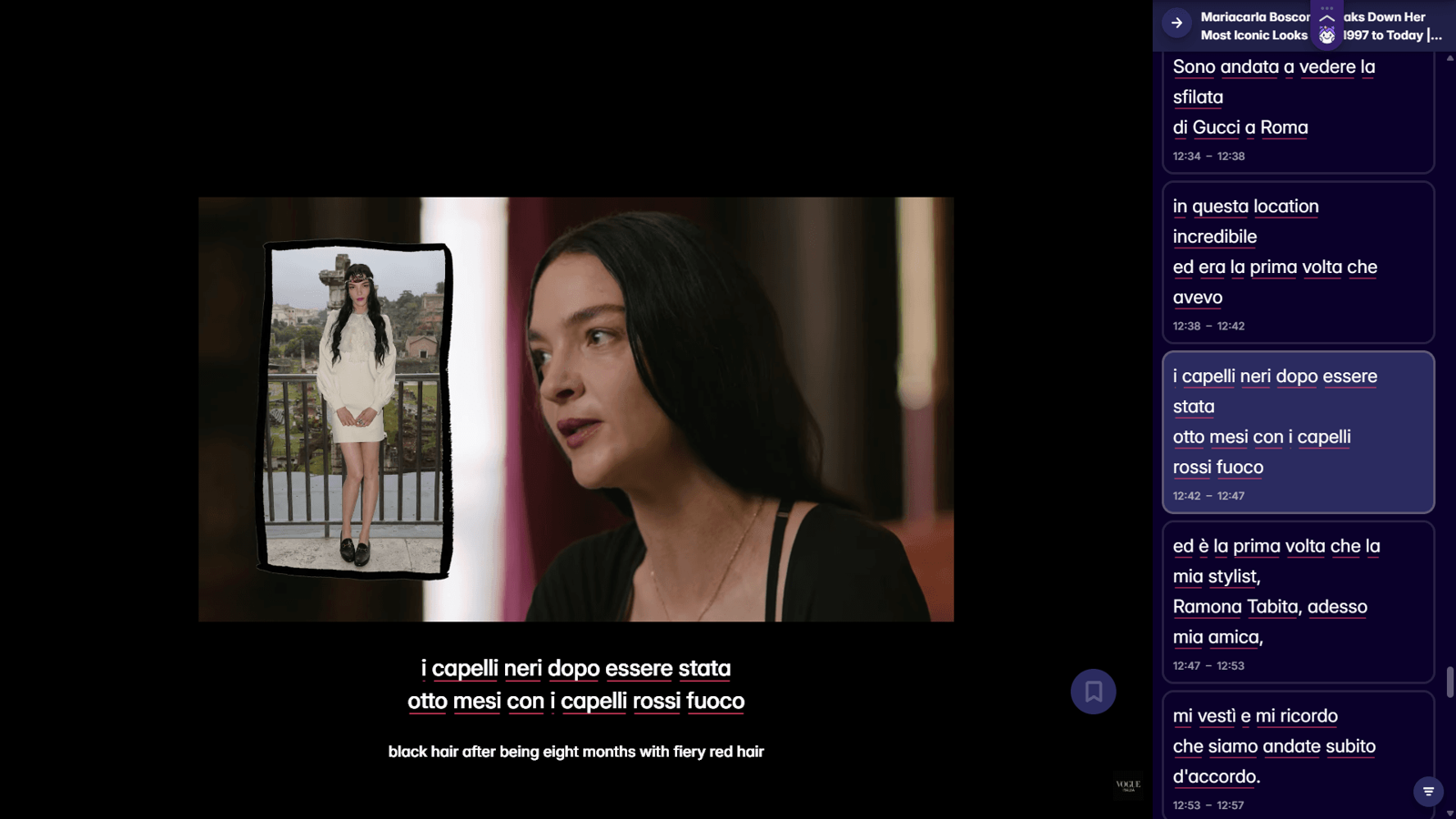
When you learn Italian with real content, you'll encounter these demonstratives constantly, which helps reinforce the patterns naturally. Migaku's browser extension and app let you look up any word instantly while reading Italian articles or watching Italian shows, so you can see how demonstratives work in authentic contexts. Pretty helpful for building that intuitive understanding. There's a 10-day free trial if you want to give it a shot.
Why you should learn this grammar rule early
Italian demonstrative adjectives give you the tools to point out and specify exactly what you're talking about. Questo and its forms handle things close to you, while quello and its many forms handle things farther away. Both come up frequently in daily conversations and Italian media content. If you can understand their meanings and grammar usage, you can greatly improve your reading and listening comprehension.
If you consume media in Italian, and you understand at least some of the messages and sentences within that media, you will make progress. Period.
Focus on understanding the pattern, then build your familiarity through actual use.