# Italian Future Tense: Conjugation and Usage of Futuro Semplice and Futuro Anteriore
> Learn how to form and use the Italian future tense with clear conjugation patterns, irregular verbs, and real-world usage examples for all skill levels.
**URL:** https://migaku.com/blog/language-fun/italian-future-tense
**Last Updated:** 2026-02-24
**Tags:** fundamentals, grammar
---
The Italian future tense gets a bad rap for being complicated, but honestly? Once you understand the basic patterns, it becomes pretty straightforward. Whether you're planning a trip to Italy and want to talk about what you'll do domani (tomorrow), or you're just trying to [master Italian](https://migaku.com/learn-italian) [grammar](https://migaku.com/blog/language-fun/italian-grammar-guide), the future tense is something you'll use constantly. Let's break down exactly how to form and use the futuro semplice, tackle those irregular verbs that always seem to pop up, and cover some real-world usage that goes way beyond just talking about future events.
---
## Is there a future tense in Italian
> 💡 Italian Future Tense 💡
Yes, Italian has a dedicated future tense called the futuro semplice (simple future). Think of it as the equivalent of "I will eat" or "she will go" in English.
But here's where it gets interesting: Italian actually has **two main future tenses**.
1. The futuro semplice handles most future actions.
2. The futuro anteriore (future perfect) expresses actions that will have been completed before another future action happens.
Italian speakers **also use the present tense to talk about future events** pretty often, especially when the context makes it clear you're talking about something that hasn't happened yet. You'll hear "Domani vado al cinema" (Tomorrow I go to the cinema) just as frequently as "Domani andrò al cinema" (Tomorrow I will go to the cinema).
---
## How to form the Italian future tense
The futuro semplice follows a logical pattern once you get the hang of it. Unlike some other Italian tenses that require you to chop off verb endings and add new ones, the future tense keeps most of the infinitive intact and adds specific endings to it.
### Regular verb conjugation patterns
Here's how it works for the three main verb groups. Italian verbs end in -are, -ere, or -ire, and each group has its own set of future tense endings.
1. For **-are** verbs, you change the final -are to -er and then add the future endings. So "parlare" (to speak) becomes "parler-" as your stem.
2. For **-ere** verbs, you simply drop the final -e and add the endings. "Vendere" (to sell) becomes "vender-".
3. For **-ire** verbs, same deal as -ere verbs. Drop the final -e. "Dormire" (to sleep) becomes "dormir-".
The actual endings are the same for all three verb groups, which makes the conjugation easier:
- io: -ò
- tu: -ai
- lui/lei: -à
- noi: -emo
- voi: -ete
- loro: -anno
Let me show you what this looks like with "parlare" (to speak):
| Italian | English |
| - | - |
| io parlerò | I will speak |
| tu parlerai | You will speak |
| lui/lei parlerà | He/she will speak |
| noi parleremo | We will speak |
| voi parlerete | You all will speak |
| loro parleranno | They will speak |
Let's look at "vendere" (to sell) as our -ere example:
- io venderò
- tu venderai
- lui/lei venderà
- noi venderemo
- voi venderete
- loro venderanno
And "dormire" (to sleep) for -ire:
- io dormirò
- tu dormirai
- lui/lei dormirà
- noi dormiremo
- voi dormirete
- loro dormiranno
See the pattern? Once you've got your stem sorted out, the endings stay consistent. This makes learning the Italian future tense way more manageable than some other tenses where every verb group has completely different endings.
---
## Irregular verbs in the future tense
Alright, so regular verbs follow nice patterns. But Italian wouldn't be Italian without some irregular verbs to keep you on your toes. The good news is that even irregular verbs use the same future endings. They just have weird stems in Italian grammar.
The most common irregular verbs you'll encounter include:
| Verb | Future Stem | Conjugation |
| - | - | - |
| Essere (to be) | sar- | sarò, sarai, sarà, saremo, sarete, saranno |
| Avere (to have) | avr- | avrò, avrai, avrà, avremo, avrete, avranno |
| Andare (to go) | andr- | andrò, andrai, andrà, andremo, andrete, andranno |
| Fare (to do/make) | far- | farò, farai, farà, faremo, farete, faranno |
| Vedere (to see) | vedr- | vedrò, vedrai, vedrà, vedremo, vedrete, vedranno |
| Venire (to come) | verr- | verrò, verrai, verrà, verremo, verrete, verranno |
| Volere (to want) | vorr- | vorrò, vorrai, vorrà, vorremo, vorrete, vorranno |
| Potere (to be able to) | potr- | potrò, potrai, potrà, potremo, potrete, potranno |
| Dovere (to have to) | dovr- | dovrò, dovrai, dovrà, dovremo, dovrete, dovremo |
Some verbs drop letters from their stems to make pronunciation smoother. "Cadere" (to fall) becomes "cadrò" instead of "caderò". "Sapere" (to know) becomes "saprò". You'll notice a pattern with verbs that would otherwise have awkward consonant clusters.
The key is memorizing these irregular stems because you'll use these verbs constantly in everyday conversation. Once you know the stem, just slap on those regular future endings and you're good to go.
---
## How to use the Italian future tense
Here's where things get interesting. The futuro semplice does more than just talk about future actions. Italian speakers use it in several specific ways that might surprise you if you're coming from English.
### Talk about the future actions
This is the obvious one. When you want to express something that will happen in the future, you use the future tense.
- Domani andrò al mare.
*Tomorrow I will go to the beach.*
- La prossima settimana studierò per l'esame.
*Next week I will study for the exam.*
- Partiranno fra tre giorni.
*They will leave in three days.*
### Express probability or conjecture
This is where Italian gets cool. You can use the future tense to express what you think is probably true right now. In English, we'd say "He's probably at home" or "She must be tired." In Italian, you can use the future tense to convey this uncertainty.
- Dove sarà Marco?
*Where could Marco be? / I wonder where Marco is.*
- Avrà trent'anni.
*He's probably thirty years old. / He must be thirty.*
- Saranno le otto.
*It must be eight o'clock. / It's probably eight.*
This usage is super common in spoken Italian and gives the language a different flavor than English.
### Making predictions and assumptions
Similar to probability, the future tense works great for predictions about what might happen.
- Pioverà domani.
*It will rain tomorrow.*
- Non ti piacerà quel film.
*You won't like that movie.*
### Giving commands or instructions
Sometimes Italians use the future tense to give firm instructions or commands, especially in formal writing or rules.
- Non ucciderai.
*Thou shalt not kill.*
- Rispetterete le regole.
*You will respect the rules.*
---
## Using the present tense to talk about the future in Italian
Italian speakers regularly use the present tense when talking about future events, especially when the timing is clear from context or when discussing scheduled events. This happens way more in Italian than in English.
- Domani vado a Roma.
*Tomorrow I'm going to Rome.*
- La settimana prossima comincio il nuovo lavoro.
*Next week I start my new job.*
- Ci vediamo stasera?
*Will we see each other tonight?*
The present tense sounds more immediate and definite, while the future tense can sometimes add a layer of uncertainty or formality. You'll hear both constantly, so don't stress too much about which one to use. Context usually makes your meaning crystal clear.
---
## The futuro anteriore (future perfect) in Italian grammar
The futuro anteriore expresses an action that will have been completed before another future action. In English, we use "will have" plus a past participle.
You form it by **using the future tense of "essere" or "avere" plus the past participle of your main verb**. The same rules about which verbs take "essere" versus "avere" apply here as they do in other compound tenses.
- Quando arriverai, avrò già finito.
*When you arrive, I will have already finished.*
- Dopo che sarò partito, potrai usare la mia macchina.
*After I will have left, you can use my car.*
The futuro anteriore shows up mostly in writing or formal speech. In casual conversation, Italians often just use the futuro semplice or even the present perfect instead.
---
## Common mistakes when learning the Italian future tense
1. One mistake I see constantly is people forgetting to change the -are ending to -er before adding future endings. You can't just add -ò to "parlare" and call it a day. It needs to become "parlerò."
2. Another common error is mixing up the accent marks. "Parlerò" (I will speak) has the accent on the final syllable, while "parlerai" (You will speak) doesn't have a written accent. Getting these wrong can make you sound like you're conjugating for the wrong person.
3. People also tend to overuse the future tense when the present tense would sound more natural. If you're talking about scheduled events or things happening soon, the present tense often flows better in Italian.
---
## Tips for mastering Italian verb conjugations
Learning verb conjugations takes repetition and exposure.
1. Reading Italian texts helps you see these verb forms in context, which beats memorizing conjugation tables any day.
2. When you learn a new verb, practice conjugating it in the future tense right away. Don't wait until you've learned 100 verbs and then try to conjugate them all. Do it as you go.
3. Focus on the most common verbs first. You'll use "essere," "avere," "andare," "fare," and "volere" way more than some obscure verb you'll rarely encounter.
4. Pay attention to how native speakers actually use the future tense versus the present tense for future meaning. [Watch Italian shows, read Italian news articles,](https://migaku.com/blog/language-fun/comprehensible-input-method-language-learning) and notice when they choose one over the other.
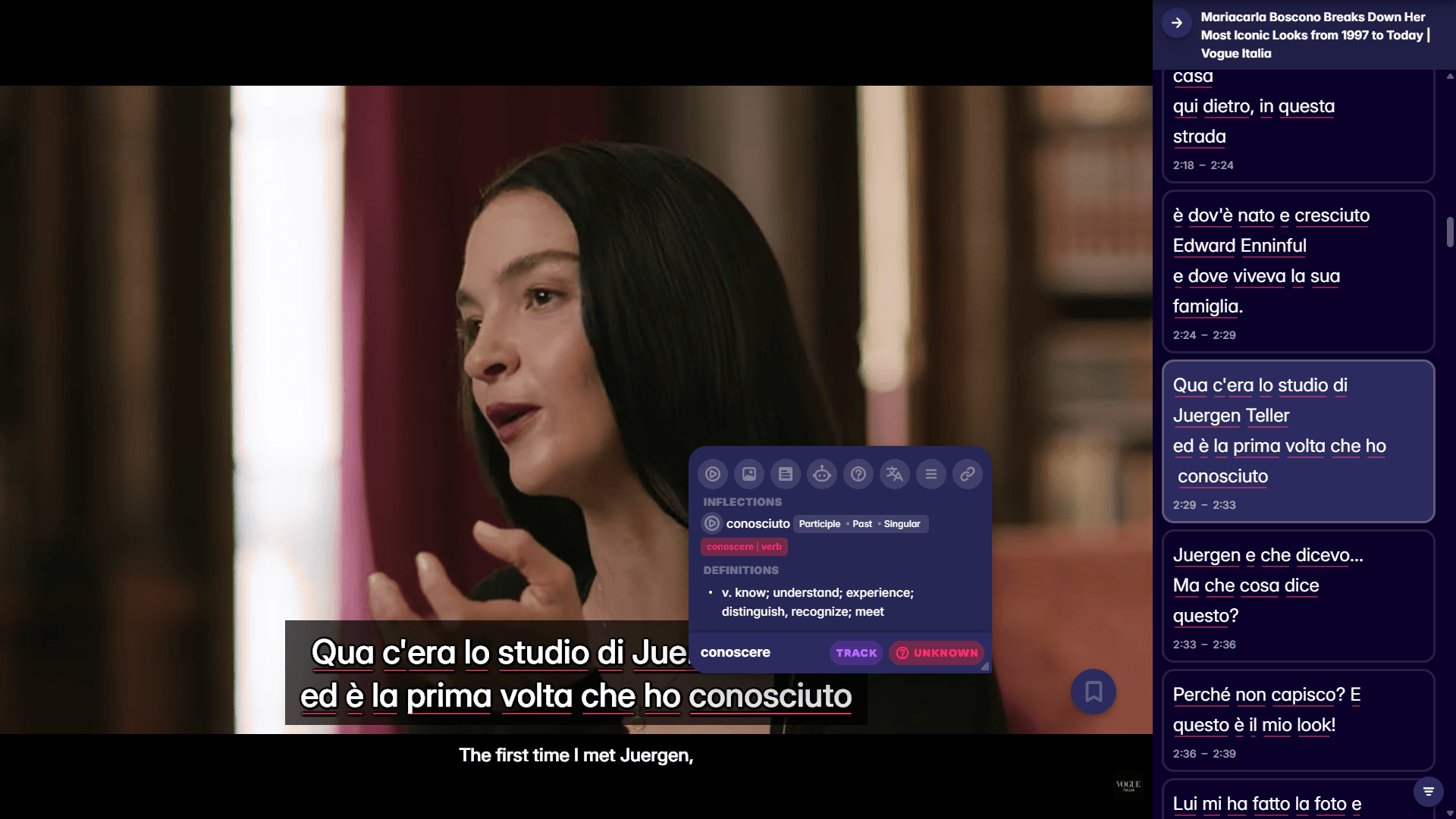
If you want to practice these verb forms while reading actual Italian content, Migaku's browser extension and app let you look up conjugations instantly while reading articles or watching videos. Pretty handy for reinforcing what you've learned here. There's a 10-day free trial if you want to test it out.
 ---
## Stop translating and start to think like a native
A bilingual mindset requires learners to think like a native, instead of translating the grammar and expressions from one language to another. Remember that the futuro semplice does more than just express future actions. It handles probability, conjecture, and predictions too. And don't forget that Italians frequently use the present tense for future events, especially in casual conversation. Start cultivating the Italian language mindset with extensive reading and listening practice. Immerse in an Italian language environment with videos, podcasts, and texts.
> If you consume media in Italian, and you understand at least some of the messages and sentences within that media, you will make progress. _Period_.
Practice the language every day.📆
---
## Stop translating and start to think like a native
A bilingual mindset requires learners to think like a native, instead of translating the grammar and expressions from one language to another. Remember that the futuro semplice does more than just express future actions. It handles probability, conjecture, and predictions too. And don't forget that Italians frequently use the present tense for future events, especially in casual conversation. Start cultivating the Italian language mindset with extensive reading and listening practice. Immerse in an Italian language environment with videos, podcasts, and texts.
> If you consume media in Italian, and you understand at least some of the messages and sentences within that media, you will make progress. _Period_.
Practice the language every day.📆