Italian Office Vocabulary: Learn Italian Workplace Words and Phrases
Last updated: April 4, 2026

Learning Italian for everyday situations is one thing, but stepping into an Italian workplace? That's a whole different ball game. You need specific vocabulary for meetings, emails, office equipment, and professional conversations. Whether you're planning to work in Italy, dealing with Italian business partners, or just want to expand your Italian vocabulary beyond tourist phrases, mastering office terminology will make you sound way more professional and confident in workplace settings.
- Essential Italian words for the workplace
- Italian verbs you'll use daily at work
- Professional phrases and conversation starters
- Adjectives for describing work situations
- Email and written communication in Italian
- Common Italian workplace expressions and idioms
- Cool Italian words and phrases specific to office culture
- Building your Italian business vocabulary list
Essential Italian words for the workplace
Let's start with the basics. These are the Italian words you'll hear constantly in any office environment.
Italian | English |
|---|---|
il posto di lavoro / l'ufficio | Workplace / The office |
i colleghi | Colleagues |
il capo / il direttore | Boss (capo is more general, direttore implies director/manager) |
il dipendente | Employee |
un lavoratore autonomo | Self-employed worker |
il manager | Manager |
il responsabile | Person in charge |
il segretario / la segretaria | Secretary |
il consulente | Consultant |
Here's a quick list of fundamental office nouns:
Italian | English |
|---|---|
la scrivania | Desk |
la sedia | Chair |
il computer | Computer |
la stampante | Printer |
il fax | Fax machine |
la fotocopiatrice | Photocopier |
la riunione | Meeting |
il contratto | Contract |
lo stipendio | Salary |
le ferie | Vacation days |
il permesso | Leave / Permission |
la pausa pranzo | Lunch break |
l'orario di lavoro | Working hours |
Italian verbs you'll use daily at work
Verbs are where the action happens in any language. In an Italian office, you'll need specific verbs to describe what you're doing throughout the day.
For everyday tasks, you'll use:
Italian | English |
|---|---|
lavorare | To work |
assumere | To hire |
licenziare | To fire |
dimettersi | To resign |
inviare | To send |
ricevere | To receive |
stampare | To print |
fotocopiare | To photocopy |
archiviare | To file / archive |
organizzare | To organize |
pianificare | To plan |
programmare | To schedule |
For meetings and communication:
Italian | English |
|---|---|
convocare | To call / convene a meeting |
partecipare | To participate |
presentare | To present |
discutere | To discuss |
decidere | To decide |
approvare | To approve |
rifiutare | To refuse / reject |
rimandare | To postpone |
Grammar tip: many of these verbs are regular, which makes conjugation easier. "Lavorare" follows the standard -are pattern: lavoro, lavori, lavora, lavoriamo, lavorate, lavorano. Pretty straightforward once you know the pattern.
Professional phrases and conversation starters
Knowing individual vocabulary words is useful, but you need complete phrases to actually communicate in Italian workplace settings.
For greetings and basic conversation:
- Buongiorno, come va?
Good morning, how's it going? - Piacere di conoscerla.
Nice to meet you. (formal) - Come posso aiutarla?
How can I help you? - Ha bisogno di qualcosa?
Do you need anything?
For meetings:
- Iniziamo la riunione.
Let's start the meeting. - Passiamo al punto successivo.
Let's move to the next point. - Qualcuno ha domande?
Does anyone have questions? - Posso aggiungere qualcosa?
Can I add something? - Sono d'accordo.
I agree. - Non sono sicuro.
I'm not sure.
These phrases follow Italian workplace formality conventions. Notice the use of "Lei" (formal you) in professional settings rather than "tu" (informal you).
Adjectives for describing work situations
Adjectives help you describe projects, deadlines, and work quality. These are super practical for Italian office environments.
For describing tasks and projects:
Italian | English |
|---|---|
urgente | Urgent |
importante | Important |
facile | Easy |
difficile | Difficult |
complicato | Complicated |
semplice | Simple |
lungo | Long |
breve | Short |
dettagliato | Detailed |
For describing work quality:
Italian | English |
|---|---|
efficiente | Efficient |
produttivo | Productive |
professionale | Professional |
accurato | Accurate |
preciso | Precise |
completo | Complete |
incompleto | Incomplete |
For describing workplace atmosphere:
Italian | English |
|---|---|
collaborativo | Collaborative |
competitivo | Competitive |
stressante | Stressful |
rilassato | Relaxed |
dinamico | Dynamic |
You'll use these adjectives constantly when discussing project status or giving feedback. "Il progetto è urgente e complicato" (The project is urgent and complicated) is something you might say weekly in an Italian office.
Email and written communication in Italian
Italian business emails follow specific conventions that differ from English. The formality level is generally higher, and there are standard phrases you should memorize.
Opening an email:
- Egregio Dott. Rossi.
Dear Dr. Rossi. (very formal) - Gentile Signora Bianchi.
Dear Mrs. Bianchi. (formal) - Buongiorno.
Good morning. (less formal but still professional)
Stating your purpose:
- Le scrivo per informarla che...
I'm writing to inform you that... - Vorrei chiederle informazioni su...
I would like to ask for information about... - Mi permetto di contattarla per...
I'm taking the liberty of contacting you to...
Closing phrases:
- RingraziandoLa anticipatamente.
Thanking you in advance. - In attesa di una Sua cortese risposta.
Awaiting your kind reply. - Distinti saluti.
Yours sincerely. (very formal) - Cordiali saluti.
Kind regards. (standard professional)
One thing that confuses English speakers: Italian business emails use capitalized pronouns when referring to the recipient (Lei, La, Sua) to show respect. This is standard practice in professional writing.
Common Italian workplace expressions and idioms
Every language has workplace expressions that don't translate literally. Italian is full of these.
- "Mettersi al lavoro" literally means "to put oneself to work" but it just means to get started on something. "Abbiamo molto da fare, mettiamoci al lavoro!" (We have a lot to do, let's get to work!)
- "Fare gli straordinari" means to work overtime. "Devo fare gli straordinari questa settimana" (I have to work overtime this week).
- "Prendere un giorno di ferie" means to take a vacation day. Different from "andare in ferie" which means going on vacation for an extended period.
- "Essere sotto scadenza" means to be under deadline, similar to how we'd say "up against a deadline" in English.
- "Fare carriera" means to advance in your career, to climb the corporate ladder.
- "Avere le mani in pasta" literally translates to "having your hands in the dough" but means being involved in something, usually in a position of influence or control.
Cool Italian words and phrases specific to office culture
Some Italian workplace vocabulary doesn't have direct English equivalents, which makes them pretty interesting.
- "Tutto pepe" literally means "all pepper" and describes someone who's lively, energetic, and full of spirit. You might hear "È una persona tutto pepe" about an enthusiastic colleague.
- "Furbetto" is a diminutive of "furbo" (clever/cunning) and refers to someone who bends rules or finds loopholes, often in a slightly negative way. In workplace contexts, it might describe someone who always finds ways to avoid difficult tasks.
- "Raccomandato" technically means "recommended" but in Italian workplace culture, it refers to someone who got their job through connections or nepotism rather than merit. This is a sensitive topic in Italian professional environments.
- "Trasferta" means a business trip, but it carries specific connotations about being sent somewhere by your company for work purposes.
Building your Italian business vocabulary list
Creating your own vocabulary list helps with learning and retention. Here's how to organize it effectively.
Start with categories:
- Office equipment and supplies
- Job titles and positions
- Meeting vocabulary
- Email phrases
- Time management terms
- Project management vocabulary
- Human resources terminology
- Financial and business terms
For each word or phrase, include:
- The Italian term
- English translation
- Example sentence in Italian
- Context notes (formal/informal, common/rare)
Don't just memorize isolated words. Learn them in context through example sentences. "La riunione è stata rimandata" (The meeting was postponed) teaches you both the word "riunione" and the verb "rimandare" in a realistic context.
Use spaced repetition to review your vocabulary regularly. This is way more effective than cramming everything at once.
Listen to Italian business podcasts or watch Italian workplace content. Shows set in offices or business environments give you exposure to natural workplace conversation and vocabulary in context.
Practice both formal and informal registers. You'll use different languages with your boss versus your work friends during lunch break. Italian has clear distinctions between these registers, and using them appropriately matters.
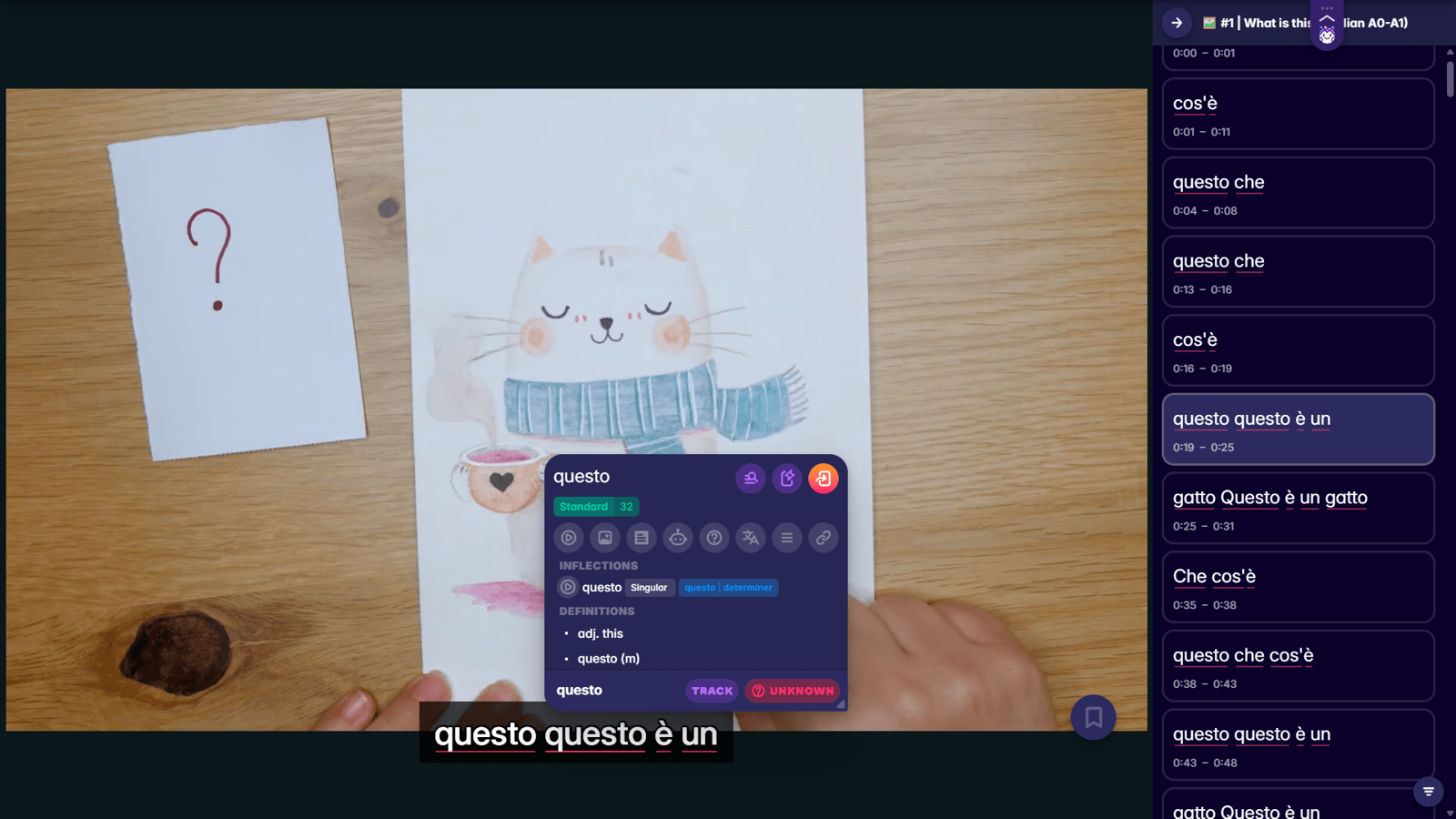
Anyway, if you want to use these strategies with real Italian content, Migaku's browser extension and app let you look up words instantly while watching Italian shows or reading Italian articles. Makes learning workplace vocabulary from authentic sources way more practical. There's a 10-day free trial if you want to check it out.
Italian vocabulary for the office represents just one slice of the language
Yet, it's a crucial one if you're using Italian professionally. From basic nouns like "scrivania" to complex phrases for business emails, this vocabulary opens doors to professional opportunities in Italian-speaking environments. The key is consistent practice with real materials. Read Italian business articles, watch Italian workplace content, and practice writing professional emails. The more you expose yourself to authentic Italian workplace language, the more natural it becomes.
If you consume media in Italian, and you understand at least some of the messages and sentences within that media, you will make progress. Period.
Keep working toward professional fluency.💪