Italian Passive Voice: How to Form and Use It Correctly in Italian Grammar
Last updated: March 20, 2026

Learning Italian grammar can feel overwhelming at first, especially when you get to the passive voice. But here's the thing: the Italian passive voice follows pretty logical rules once you understand the basic structure. You'll use essere plus a past participle, make sure everything agrees in gender and number, and boom, you've got yourself a passive sentence. This guide breaks down exactly how to form the passive voice in Italian, which tenses to use, and when you'd want to use it instead of the active voice.
- What is the passive voice in Italian
- How to form the passive voice with essere
- Conjugating passive constructions
- Using passive voice across different tenses in Italian grammar
- The preposition da and the agent
- Learn Italian alternatives to the standard passive construction
- Agreement rules for the past participle
- When to use the passive voice
- Transitive verbs and passive voice
What is the passive voice in Italian
The passive voice in Italian works similarly to English in terms of function. When you use the passive construction, the subject of the sentence receives the action instead of performing it. The person or thing doing the action either gets mentioned with a preposition or disappears entirely from the sentence.
In the active voice, you'd say "Marco mangia la pizza" (Marco eats the pizza). Marco performs the action. In the passive voice, you'd say "La pizza è mangiata da Marco" (The pizza is eaten by Marco). Now the pizza becomes the subject, even though it's receiving the action.
The passive voice in Italian gets used less frequently than in English, honestly. Italian speakers tend to prefer active constructions or use alternatives like the si passivante, which we'll get into later. But you'll still encounter passive sentences all the time in formal writing, news articles, and official documents.
How to form the passive voice with essere
The most common way to form the passive in Italian uses the auxiliary verb essere combined with the past participle of the main verb. This construction works across pretty much every tense you'll need.
💡Here's the basic formula: essere (conjugated in whatever tense you need) + past participle (agreeing in gender and number with the subject).
Let's look at a simple example in the present tense. Take the verb "invitare" (to invite). The active sentence "Giovanni invita Maria" (Giovanni invites Maria) becomes "Maria è invitata da Giovanni" (Maria is invited by Giovanni) in the passive.
Notice how "invitata" ends with an "a" because Maria is feminine singular. If you were talking about multiple women, you'd say "Le ragazze sono invitate" (The girls are invited), with "invitate" taking the feminine plural ending.
The past participle always agrees with the subject in passive constructions. This trips up a lot of learners at first, but you get used to it pretty quickly with practice.
Conjugating passive constructions
To conjugate a verb in the passive voice, you need to know two things: how to conjugate essere in your target tense, and the past participle of your main verb.
Let's take "amare" (to love) through several tenses in the passive, using a masculine singular subject.
- Present: è amato (is loved)
- Imperfect: era amato (was loved)
- Passato prossimo: è stato amato (was loved / has been loved)
- Future: sarà amato (will be loved)
- Conditional: sarebbe amato (would be loved)
For a feminine plural subject with the same verb:
- Present: sono amate (are loved)
- Imperfect: erano amate (were loved)
- Passato prossimo: sono state amate (were loved / have been loved)
- Future: saranno amate (will be loved)
- Conditional: sarebbero amate (would be loved)
The pattern stays consistent. You're really just conjugating essere and making sure the past participle agrees. Once you've got those two skills down, forming passive sentences becomes pretty straightforward.
Using passive voice across different tenses in Italian grammar
You can form passive sentences in basically any tense by conjugating essere appropriately and keeping that past participle agreeing with the subject.
- In the passato prossimo, you'll use the present tense of essere plus the past participle. "Il libro è stato letto" means "The book was read" or "The book has been read." The verb essere gets conjugated as "è stato" (has been), and then "letto" is the past participle of "leggere" (to read).
- For the imperfect tense, you'd say "Il libro era letto ogni sera" (The book was read every evening). Here essere is conjugated in the imperfect as "era."
- The future tense follows the same pattern. "Il libro sarà letto domani" means "The book will be read tomorrow." Essere becomes "sarà" in the future tense.
- Even the conditional works this way. "Il libro sarebbe letto se avessi tempo" translates to "The book would be read if I had time."
The passato prossimo is probably the trickiest because you're essentially using a compound tense with essere twice. "Le lettere sono state scritte ieri" (The letters were written yesterday) uses "sono state" (the passato prossimo of essere) plus "scritte" (past participle of scrivere, feminine plural to agree with "lettere").
The preposition da and the agent
When you want to mention who's performing the action in a passive sentence, you use the preposition "da" (by). This introduces what grammar nerds call the agent of the action.
"La casa è stata costruita da mio nonno" means "The house was built by my grandfather." The preposition da connects "costruita" to "mio nonno," showing who did the building.
You don't always need to include the agent, though. Lots of passive sentences in Italian just leave it out entirely. "Molti dizionari italiani sono venduti qui" (Many Italian dictionaries are sold here) doesn't specify who's selling them, and that's totally fine.
Actually, one of the main reasons to use the passive is when the agent doesn't matter or is already obvious from context. News articles love this construction: "Il ladro è stato arrestato" (The thief was arrested). We can assume the police did it without needing to spell it out.
Learn Italian alternatives to the standard passive construction
Italian has some other ways to express passive meaning without using the essere plus past participle formula. These alternatives often sound more natural in everyday conversation.
The si passivante
The si passivante (passive si) is super common in Italian. You form it by putting "si" before the third person form of a verb. "Si parla italiano qui" literally means "Italian is spoken here" or "One speaks Italian here."
This construction works great for general statements. "Si vendono molti libri in questa libreria" translates to "Many books are sold in this bookstore." The verb "vendono" agrees in number with "libri" (plural), which is a quirk of this construction.
You'll see the si passivante everywhere in Italian, from restaurant menus ("Si accettano carte di credito" = Credit cards are accepted) to street signs ("Si affittano camere" = Rooms for rent).
The verb venire
The verb venire can replace essere in passive constructions, but only in simple tenses (present, imperfect, future). You can't use venire in compound tenses like the passato prossimo. "La pizza viene mangiata" means the same thing as "La pizza è mangiata" (The pizza is eaten).
Using venire instead of essere can emphasize the action itself rather than the resulting state. The difference is pretty subtle, though, and both versions are grammatically correct.
The verb andare
The verb andare works in passive constructions too, but it carries a sense of necessity or obligation. "Questo lavoro va fatto subito" means "This work must be done immediately." The passive with andare implies something should or must happen.
Agreement rules for the past participle
Getting the past participle to agree correctly is crucial for forming proper passive sentences in Italian. The past participle acts like an adjective, changing its ending based on the gender and number of the subject.
- For a masculine singular subject, the past participle ends in "o": "Il libro è letto" (The book is read).
- For a feminine singular subject, it ends in "a": "La lettera è letta" (The letter is read).
- For a masculine plural subject, it ends in "i": "I libri sono letti" (The books are read).
- For a feminine plural subject, it ends in "e": "Le lettere sono lette" (The letters are read).
This agreement happens automatically in passive constructions because the past participle directly modifies the subject. You can't skip this step, or the sentence will sound wrong to native speakers.
Some irregular past participles follow their own patterns. "Scrivere" becomes "scritto," "fare" becomes "fatto," "dire" becomes "detto." But even these irregular forms still take the standard agreement endings: "scritto/scritta/scritti/scritte."
When to use the passive voice
Italian speakers generally prefer active constructions over passive ones in everyday conversation. The passive voice shows up more in formal writing, academic texts, news reports, and official communications.
- You'd use the passive when the action matters more than who's doing it. "La cattedrale fu costruita nel 1200" (The cathedral was built in 1200) focuses on the building's construction date rather than the specific builders.
- The passive also works well when you don't know who performed the action. "La mia macchina è stata rubata" (My car was stolen) doesn't require you to identify the thief.
- Sometimes the passive just sounds more polite or diplomatic. "È stato fatto un errore" (A mistake was made) sounds less accusatory than "Tu hai fatto un errore" (You made a mistake).
- In scientific or technical writing, the passive voice appears constantly. "L'esperimento è stato condotto in laboratorio" (The experiment was conducted in the laboratory) maintains an objective, impersonal tone.
Transitive verbs and passive voice
Only transitive verbs (verbs that take a direct object) can form passive constructions in Italian. This makes sense because you need a direct object to become the subject of the passive sentence.
- "Mangiare" (to eat) is transitive. You can say "Marco mangia la mela" (Marco eats the apple), so you can also say "La mela è mangiata da Marco" (The apple is eaten by Marco).
- "Dormire" (to sleep) is intransitive. You can't say "Marco sleeps the bed" in any language, so you can't form a passive construction with dormire. There's no direct object to become the subject.
Some verbs can be both transitive and intransitive depending on how you use them. "Correre" (to run) is usually intransitive, but in "correre un rischio" (to run a risk), it's transitive. You could theoretically say "Il rischio è corso" (The risk is run), though that sounds pretty weird.
This is where Italian grammar gets fun. You start noticing which verbs naturally take objects and which don't, and it helps you understand sentence structure better overall.
Anyway, if you're working on your Italian grammar and want to see these constructions in real content, Migaku's browser extension and app let you look up words and phrases instantly while reading Italian articles or watching videos. Makes learning from authentic material way easier. There's a 10-day free trial if you want to check it out.
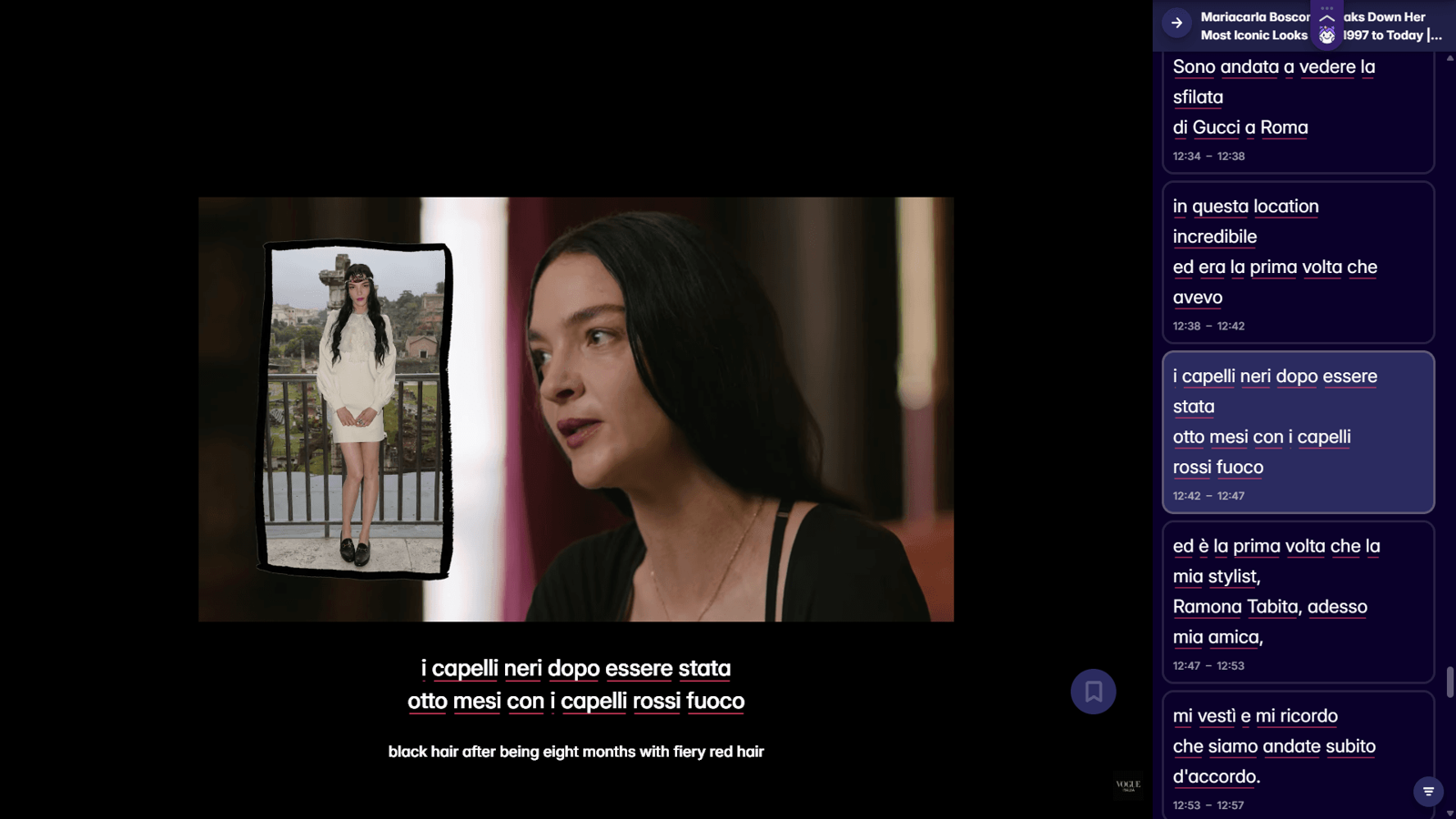
Learning the passive voice in Italian is totally useful
As mentioned previously, the passive voice can be used to convey more nuanced meanings, such as reducing the accusatory tones, laying emphasis on the actions or objects, and, in general, adding more color to your Italian expressions. To understand these subtleties, you need media consumption. Media content, like articles, news, dramas, and so on, can teach you not just the grammar in context, but also the settings and situations that require this type of grammar usage.
If you consume media in Italian, and you understand at least some of the messages and sentences within that media, you will make progress. Period.
Level up your grammar knowledge with more than one resource!📚👩🏫