Italian Vocabulary for Phone Conversations: Talk Confidently on Calls
Last updated: March 29, 2026

Calling someone in Italian can feel intimidating, especially when you're still learning the language. The phone takes away all the visual cues you'd normally rely on during conversation, like gestures and facial expressions. But here's the good news: Italian phone conversations follow pretty predictable patterns, and once you know the essential phrases, you'll handle calls with way more confidence. This guide covers everything from answering the phone to dealing with bad connections, plus full conversation examples you can use.
- What Italians say when they answer the phone
- Basic Italian phrases for starting a conversation
- Useful Italian phrases for asking someone to wait
- Italian telephone phrases for connection problems
- Handling wrong numbers and unavailable people
- Basic Italian phrases for ending phone calls
- When to use formal versus informal phone phrases
- Regional variations when making Italian phone conversations
- Making your first call in Italian
What Italians say when they answer the phone
Unlike English speakers who typically say "hello" when answering, Italians have their own standard greeting: "Pronto?" This literally translates to "ready?" but functions as the universal way to answer a phone call in Italy. You'll hear this phrase whether someone's answering a formal business call or chatting with their best friend.
The question mark matters here. Italians say "Pronto?" with a rising intonation, like they're asking "ready to talk?" It's become so automatic that most Italians don't even think about the literal meaning anymore.
When you're the one calling, you typically respond with a greeting like "Ciao" (for informal situations) or "Buongiorno" (good morning) or "Buonasera" (good evening) for more formal contexts.
Then you'd identify yourself: "Sono (your name)" (It's (your name)) or "Sono io, (name)" (It's me, (name)).
Here's a quick example:
- Person answering: "Pronto?"
- Person calling: "Ciao, sono Marco. C'è Lisa?" (Hi, it's Marco. Is Lisa there?)
Some older Italians or people in more formal settings might answer with just "Sì?" (Yes?) or even state their name directly, but "Pronto?" remains the most common greeting you'll encounter.
Basic Italian phrases for starting a conversation
After the initial greeting, you need to establish who you are and why you're calling. These basic Italian phrases will get you through the opening moments of any call.
To identify yourself:
- Sono (name).
I am (name). - Sono io.
It's me. (used when the person should recognize your voice) - Parla (name).
This is (name) speaking. (more formal)
To ask for someone:
- C'è (name)?
Is (name) there? (informal) - Potrei parlare con (name)?
Could I speak with (name)? (polite) - Vorrei parlare con (name), per favore.
I would like to speak with (name), please. (formal)
To explain why you're calling:
- Ti chiamo per...
I'm calling you to... (informal) - La chiamo per...
I'm calling you to... (formal) - Volevo chiedere...
I wanted to ask...
The distinction between informal and formal matters way more on the phone than you might expect. Since you can't see the person's reaction, using the wrong register can create awkward moments. When in doubt, start formal with "Lei" forms and wait for the other person to suggest switching to the informal "tu."
Useful Italian phrases for asking someone to wait
Phone conversations often involve waiting while someone gets the person you need or checks information. These phrase options keep things polite while you're on hold.
"Un momento, per favore" (One moment, please) is the most common and versatile. You'll hear this constantly in Italian phone conversations, whether you're calling a restaurant or a friend's house.
Other useful variations:
- Attenda un attimo.
Wait a moment. (formal) - Aspetti un secondo.
Wait a second. (formal) - Resta in linea.
Stay on the line. - Non riattaccare.
Don't hang up. - Le passo (name).
I'll pass you to (name). (formal) - Ti passo (name).
I'll pass you to (name). (informal)
When you're the one who needs to wait:
- Certo, aspetto.
Sure, I'll wait. - Nessun problema.
No problem. - Grazie.
Thank you.
If someone asks you to hold but you're in a hurry, you can say "Quanto tempo ci vorrà?" (How long will it take?) or "Posso richiamare più tardi?" (Can I call back later?).
Italian telephone phrases for connection problems
Phone calls in Italy can be just as frustrating as anywhere else when the connection acts up. These Italian phrases help you communicate technical issues without getting flustered.
"Non ti sento" (I can't hear you, informal) or "Non la sento" (I can't hear you, formal) solves most audio problems. The verb "sentire" means both "to hear" and "to feel," so this phrase literally says "I don't hear you."
More specific connection issues:
- La linea è disturbata.
The line is disturbed / has interference. - C'è un'eco.
There's an echo. - Senti male?
Can you hear me badly? (informal) - Mi sente?
Can you hear me? (formal) - Parla più forte, per favore.
Speak louder, please. - Stai andando e venendo.
You're cutting in and out. (informal) - È caduta la linea.
The line dropped.
If the connection is too bad to continue:
- Ti richiamo.
I'll call you back. (informal) - La richiamo tra poco.
I'll call you back shortly. (formal) - Provo a richiamare.
I'll try calling back.
Cell phone specific issues:
- Non c'è campo.
There's no signal. (literally "no field") - La batteria sta per scaricarsi.
The battery is about to die. - Sto perdendo il segnale.
I'm losing the signal.
Handling wrong numbers and unavailable people
Wrong numbers happen, and knowing how to handle them politely saves everyone from awkwardness. When you realize you've dialed incorrectly, say "Scusi, ho sbagliato numero" (Sorry, I got the wrong number, formal) or "Scusa, numero sbagliato" (Sorry, wrong number, informal).
If someone calls looking for a person who doesn't live there or isn't available:
- Ha sbagliato numero.
You have the wrong number. (formal) - Non c'è nessuno con questo nome qui.
There's no one with that name here. - Non è in casa.
He/She isn't home. - Non c'è al momento.
He/She isn't here at the moment. - È fuori.
He/She is out. - È occupato / occupata.
He/She is busy. - È in riunione.
He/She is in a meeting.
Taking messages:
- Vuole lasciare un messaggio?
Would you like to leave a message? (formal) - Posso prendere un messaggio?
Can I take a message? - Gli/Le dico di richiamarla?
Should I tell him/her to call you back? (formal) - Vuole che gli/le dica qualcosa?
Do you want me to tell him/her something?
Leaving messages:
- Può dirgli/dirle che ho chiamato?
Can you tell him/her I called? - Gli/Le dica di richiamarmi, per favore.
Tell him/her to call me back, please. - Lascio il mio numero.
I'll leave my number.
Basic Italian phrases for ending phone calls
Knowing how to wrap up a conversation smoothly matters just as much as starting one. The standard goodbye on the phone is "Arrivederci" (literally "until we see each other again"), which works in both formal and informal contexts.
Common ending phrases:
- Ciao.
Bye. (informal only) - A presto.
See you soon. - Ci sentiamo.
We'll talk. (literally "we'll hear each other") - Ti richiamo.
I'll call you back. (informal) - La richiamo.
I'll call you back. (formal) - Buona giornata.
Have a good day. - Buona serata.
Have a good evening. - Buon fine settimana.
Have a good weekend.
Before the final goodbye, you might add:
- Grazie per la chiamata.
Thanks for the call. - Grazie mille.
Thanks a lot. - È stato un piacere.
It was a pleasure. - Salutami (name).
Say hi to (name) for me.
In professional contexts, you might hear:
- Resto in attesa.
I'll wait to hear from you. - La terrò informato / informata.
I'll keep you informed. - La contatto presto.
I'll contact you soon.
The phrase "Ci sentiamo" deserves special attention because it's super common among friends and family. It acknowledges that you'll likely talk again soon, even if you don't have specific plans.
When to use formal versus informal phone phrases
The formal/informal distinction in Italian can trip up English speakers who aren't used to this level of formality marking. On the phone, this choice matters even more because you can't rely on context clues like the setting or the person's age and appearance.
Use formal phrases (Lei form) when calling:
- Businesses (restaurants, hotels, shops, offices)
- Government offices or official institutions
- Medical offices or hospitals
- People significantly older than you
- Professional contacts you don't know well
- Anyone you'd address as "Signore" or "Signora"
Use informal phrases (tu form) when calling:
- Friends and close acquaintances
- Family members
- Children and teenagers
- Peers in casual settings
- People who've explicitly told you to use "tu"
The tricky middle ground happens with colleagues, distant relatives, or acquaintances. When uncertain, start formal. Italians will often say "Dammi del tu" (Use tu with me) if they want to switch to informal. Making this switch too early can seem presumptuous, but staying formal when someone expects informal can create distance.
Regional variations when making Italian phone conversations
Italian phone conversation phrases stay pretty consistent across regions, but you'll notice some variations. The basic structure (answering with "Pronto?") remains standard from Milan to Sicily, but certain expressions and pronunciation patterns differ.
In some parts of southern Italy, you might hear "Dimmi" (Tell me) instead of or after "Pronto?" This literally means "tell me" and functions as "what can I do for you?" It's more common in informal contexts.
The Veneto region sometimes uses "Diga" (formal) or "Dime" (informal), which are Venetian dialect versions of "tell me." Older speakers, especially, might mix these into Italian phone conversations.
Pronunciation matters more on the phone than in person since you lose visual cues. Northern Italian speakers tend to pronounce consonants more crisply, while southern speakers might soften certain sounds. The word "pronto" might sound like "prohn-toh" in Rome but "pron-to" with a harder T in Milan.
Ending phrases show regional personality too. "Ci sentiamo" is universal, but you might hear "Ci si sente" in Tuscany or "Ci si vede" (We'll see each other) in some areas, even though technically you're not planning to see each other, just talk again.
Business phone etiquette stays more standardized across regions since companies want to present a professional image. Regional variations appear most in casual conversations between friends and family.
Making your first call in Italian
Your first real phone conversation in Italian will probably feel nerve-wracking, and that's completely normal. The phone removes safety nets, like pointing at things or using gestures to communicate. Here's how to set yourself up for success.
- Start with low-stakes calls where mistakes don't matter much. Calling a restaurant to ask about hours or making a simple reservation gives you practice without high pressure. These businesses expect calls from tourists and non-native speakers, so they'll be patient.
- Write out your key phrases before calling. Having a script in front of you isn't cheating, it's smart preparation.
- Practice saying everything out loud before dialing. Your mouth needs to get comfortable with the sounds, and you want to catch any pronunciation issues before you're on the actual call.
- Call during less busy times. Restaurants are more patient at 3pm than during dinner rush. Offices are calmer mid-morning than right at opening.
- After your call, write down any phrases you heard but didn't know. These real-world phrases are gold for your learning because they're actually useful, not just textbook examples.
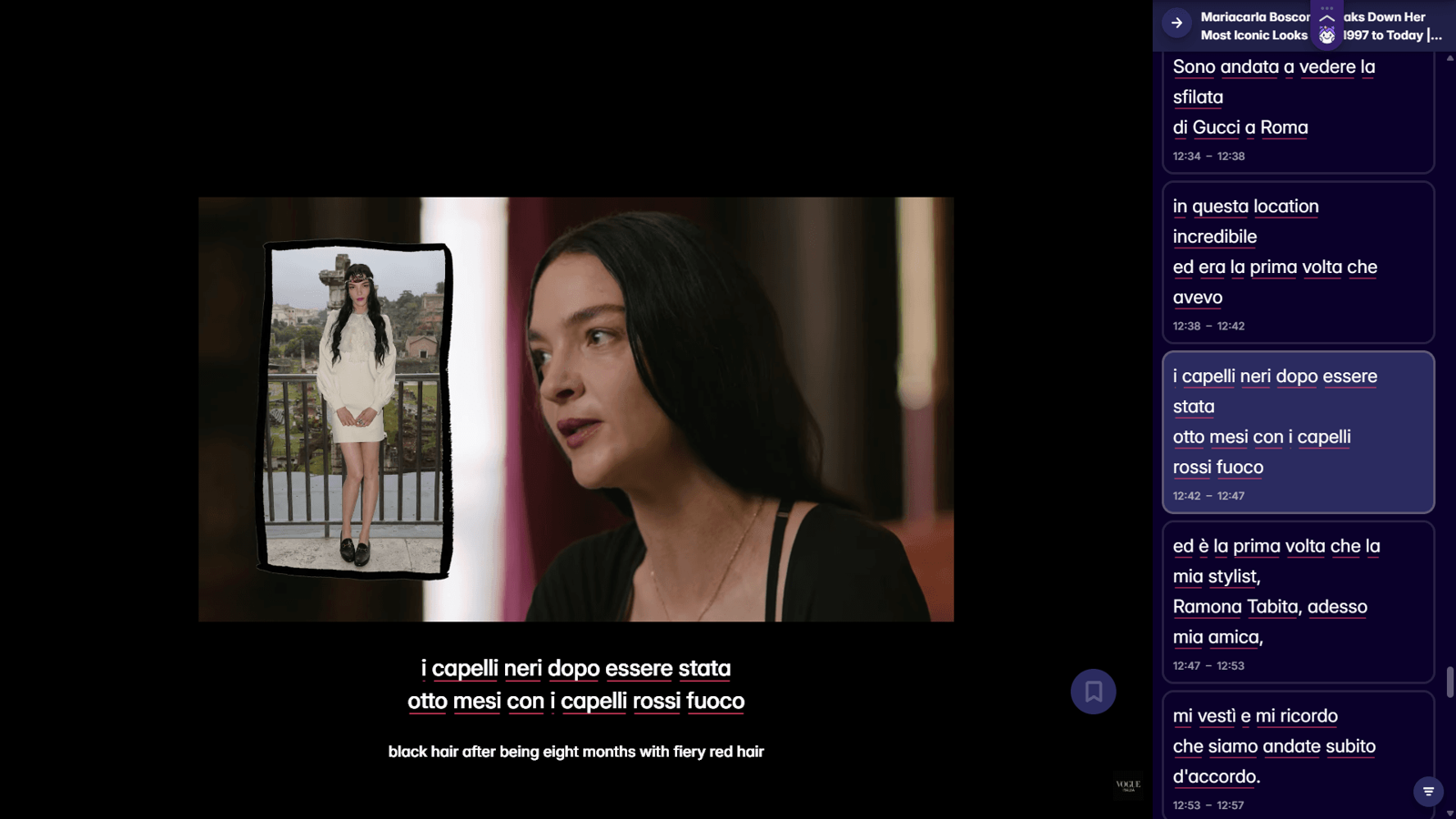
Want to accelerate your Italian learning beyond phone conversations? Migaku's browser extension and app let you learn from real Italian content like shows, movies, and articles by looking up words instantly as you watch or read. You can save phrases you encounter into personalized flashcards and actually remember them. There's a 10-day free trial if you want to see how immersion learning works in practice.
Keep practicing Italian vocabulary with real conversations
The beautiful thing about phone phrases is that they're highly predictable. Once you've handled a few calls, you'll notice the same patterns repeating. Most conversations follow the same basic structure: greeting, identification, purpose, discussion, closing. The middle part changes, but the framework stays consistent. If you're learning Italian seriously, another trick is to watch videos and listen to podcasts without any subtitles or transcripts. This way, you can adapt to the mode of relying on listening only, just like when making phone calls.
If you consume media in Italian, and you understand at least some of the messages and sentences within that media, you will make progress. Period.
Nervousness fades. Confidence grows.💪