Italian Restaurant Phrases: Order Food in Italian Confidently
Last updated: April 2, 2026

You're sitting in a charming trattoria in Rome, the waiter approaches with a warm smile, and suddenly your mind goes blank. You know you want the pasta, but how do you actually say that in Italian? Learning a handful of essential Italian phrases before you travel can transform your dining experience from stressful pointing and gesturing into genuine cultural connection. This guide walks you through every step of ordering food at an Italian restaurant, from making a reservation to paying the bill, with the exact phrases you'll need.
- Basic greetings and politeness phrases
- Making a reservation and arriving at the restaurant
- Understanding the Italian menu structure
- Italian phrases for ordering drinks: vino, water, and coffee
- Phrases for ordering food at any restaurant in Italy
- Handling dietary restrictions and preferences
- During the meal: Common requests and questions
- Asking for the bill and understanding payment customs
- Italian food sayings and restaurant slogans
Basic greetings and politeness phrases
Before you even think about food, you need the foundational phrases that show respect and politeness. Italians value courtesy, especially in service settings.
Start with "Buongiorno" (good morning/good day) if you're arriving for lunch, or "Buonasera" (good evening) for dinner. The switch typically happens around 4 PM.
When you need to get the waiter's attention, say "Mi scusi" (excuse me) rather than snapping your fingers or waving frantically.
The magic word "per favore" should become your best friend. Add it to virtually any request to sound polite. "Un tavolo per due, per favore" (A table for two, please) sounds infinitely better than just demanding a table.
Other essential politeness phrases include:
Italian | English |
|---|---|
Grazie | Thank you |
Prego | You're welcome / Please, go ahead |
Salve | Hello (slightly less formal than buongiorno) |
Arrivederci | Goodbye |
Making a reservation and arriving at the restaurant
If you're planning ahead, calling to make a reservation shows you're serious about dining there. The phrase you need is: "Vorrei prenotare un tavolo per (number) persone per (day) alle (time)." That's "I would like to reserve a table for (number) people for (day) at (time)."
For example: "Vorrei prenotare un tavolo per quattro persone per sabato alle venti" means you want a table for four people on Saturday at 8 PM. Italians use the 24-hour clock, so 8 PM is "venti" (20:00).
When you arrive at the Italian restaurant, approach the host and say: "Ho una prenotazione a nome (your name)" (I have a reservation under (name)). If you're walking in without a reservation, try: "Avete un tavolo per due?" (Do you have a table for two?).
The waiter or host might ask you preference questions:
- Preferite dentro o fuori?
Do you prefer inside or outside? - Va bene questo tavolo?
Is this table okay?
Just answer with "Sì, va bene" (Yes, that's fine) or "Preferirei..." (I would prefer...) followed by your choice.
Understanding the Italian menu structure
Italian meals follow a specific structure that might surprise you if you're used to American or British dining. Understanding this helps you order appropriately and avoid accidentally ordering way too much food.
The traditional Italian meal progresses through these courses:
- Antipasto: The appetizer course. Think bruschetta, cured meats, or marinated vegetables.
- Primo: The first course, usually pasta, risotto, or soup. This is often what foreigners think of as the "main dish," but Italians consider it just the beginning.
- Secondo: The second course, featuring meat or fish. This typically comes without sides.
- Contorno: Side dishes, ordered separately. Vegetables, salad, or potatoes.
- Dolce: Dessert. Tiramisu, panna cotta, gelato, or whatever the restaurant specializes in.
You don't have to order every course. Many Italians today just order a primo and maybe share an antipasto, especially at lunch. But knowing the structure prevents confusion when you see the menu.
Italian phrases for ordering drinks: vino, water, and coffee
Drinks come first in Italian dining. The waiter will typically ask "Da bere?" (To drink?) or "Volete qualcosa da bere?" (Would you like something to drink?).
For water, you'll need to specify: "Acqua naturale" (still water) or "Acqua frizzante" (sparkling water). They'll usually bring bottled water, which you pay for. If you want tap water, you can ask "Posso avere acqua del rubinetto?" though some restaurants might give you a look.
For vino (wine), you have options. You can order by the bottle: "Una bottiglia di vino rosso/bianco, per favore" (A bottle of red/white wine, please). Or by the glass: "Un bicchiere di vino rosso" (A glass of red wine).
If you want a recommendation, ask: "Quale vino consiglia?" (Which wine do you recommend?) or "Avete un vino della casa?" (Do you have a house wine?).
Coffee culture in Italy has strict unwritten rules. Cappuccino is a breakfast drink, period. Ordering a cappuccino after lunch or dinner marks you as a tourist immediately. After meals, Italians drink caffè (espresso). Just say "Un caffè, per favore" and you'll get a perfect shot of espresso.
Other coffee options:
- Caffè macchiato: Espresso with a splash of milk
- Caffè americano: Espresso with hot water (closer to American coffee)
- Caffè corretto: Espresso "corrected" with a shot of liquor
Phrases for ordering food at any restaurant in Italy
When you're ready to order, the waiter will ask "Siete pronti per ordinare?" (Are you ready to order?) or simply "Prego?" (a versatile word meaning "please go ahead" in this context).
Here are the core ordering phrases you'll use constantly:
- "Vorrei..." (I would like...) is your go-to phrase. "Vorrei la carbonara, per favore" (I would like the carbonara, please).
- "Prendo..." (I'll take...) is slightly more casual. "Prendo il secondo piatto" (I'll take the second dish).
- If you're still deciding, say "Un momento, per favore" (One moment, please) or "Ancora un minuto" (One more minute).
- To ask what the waiter recommends: "Cosa consiglia?" (What do you recommend?) or "Qual è la specialità della casa?" (What's the house specialty?).
- When you want to know what's in a dish: "Cosa c'è nel (dish name)?" (What's in the (dish)?) or "Come è preparato?" (How is it prepared?).
Handling dietary restrictions and preferences
If you have allergies or dietary restrictions, you need to communicate them clearly. Italian cuisine relies heavily on certain ingredients, so speaking up matters.
For allergies, say: "Sono allergico/allergica a..." (I'm allergic to...) followed by the ingredient. Common allergens:
Italian | English |
|---|---|
Noci | Nuts |
Arachidi | Peanuts |
Glutine | Gluten |
Lattosio | Lactose |
Frutti di mare | Shellfish |
For vegetarians:
- Sono vegetariano / vegetariana. Avete piatti senza carne?
I'm vegetarian. Do you have dishes without meat?
For vegans:
- Sono vegano / vegana. Questo piatto contiene latticini o uova?
I'm vegan. Does this dish contain dairy or eggs?
To ask for modifications: "Posso avere questo senza (ingredient)?" (Can I have this without (ingredient)?). For example, "Posso avere la pasta senza aglio?" (Can I have the pasta without garlic?).
During the meal: Common requests and questions
Once your food arrives, you might need to ask for additional items or handle issues. Here are the phrases that cover most situations:
"Posso avere..." (Can I have...) works for requesting anything:
- Posso avere un altro bicchiere?
Can I have another glass? - Posso avere più pane?
Can I have more bread? - Posso avere sale e pepe?
Can I have salt and pepper?
If something's wrong with your order: "Mi scusi, ma ho ordinato..." (Excuse me, but I ordered...) or "Questo non è quello che ho ordinato" (This isn't what I ordered).
If the food is too cold or overcooked: "Mi dispiace, ma questo è troppo freddo/cotto" (I'm sorry, but this is too cold/overcooked).
To compliment the food (always appreciated): "È delizioso!" (It's delicious!) or "Complimenti allo chef!" (Compliments to the chef!).
Asking for the bill and understanding payment customs
When you're ready to leave, you need to ask for il conto (the bill). In Italy, the waiter won't bring the bill until you request it. They consider it rude to rush diners.
Say: "Il conto, per favore" (The bill, please) or "Possiamo avere il conto?" (Can we have the bill?).
When the bill arrives, you'll likely see "coperto" listed. This is a cover charge, typically 1-3 euros per person, that covers bread and table service. It's standard practice, not a scam.
Tipping culture in Italy differs dramatically from America. Service is usually included in the bill. Leaving a few euros (maybe 5-10% for exceptional service) is appreciated but not expected like the mandatory 15-20% in the US.
You can pay by saying: "Posso pagare con carta?" (Can I pay by card?) or "Accettate carte di credito?" (Do you accept credit cards?). Many smaller restaurants still prefer cash, so always ask.
If you're splitting the bill: "Possiamo dividere il conto?" (Can we split the bill?). Though be aware that some restaurants prefer not to split bills among many people.
Italian food sayings and restaurant slogans
Beyond practical phrases, Italian culture is rich with food-related expressions that reveal how central dining is to Italian life.
- "A tavola non si invecchia" (At the table, one does not grow old) captures the Italian belief that shared meals are timeless moments.
- "Buono come il pane" (Good as bread) is used to describe someone with a kind, simple nature.
- "Essere in un brodo di giuggiole" (To be in a jujube broth) means to be extremely happy, the equivalent of "on cloud nine."
For restaurant slogans, you'll see variations on classics:
- "Dove mangiare è un'arte" (Where eating is an art)
- "Sapori di casa" (Flavors of home)
- "La tradizione nel piatto" (Tradition on the plate)
These sayings reflect the Italian philosophy that food transcends mere sustenance. It's about family, tradition, and joy.
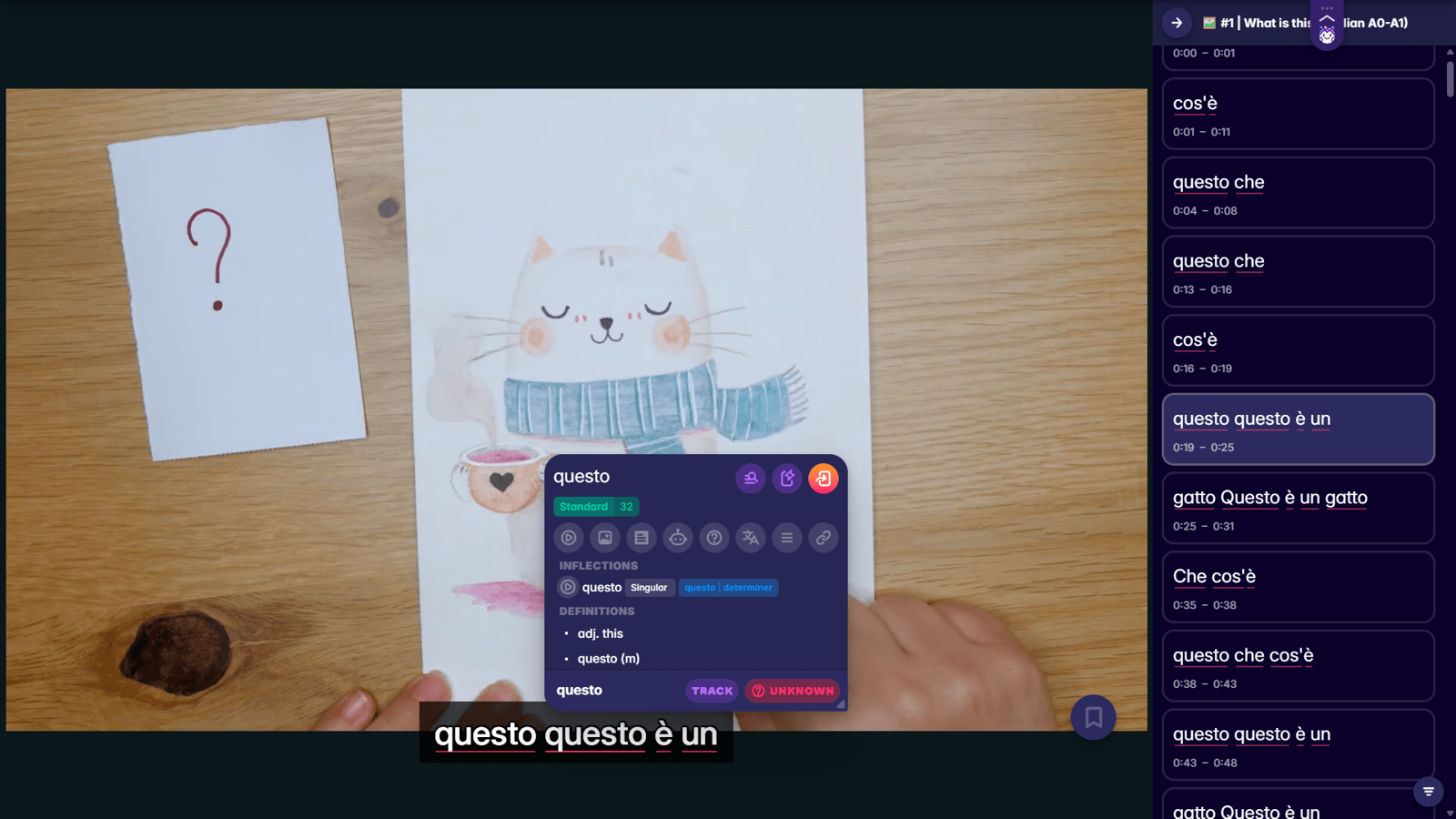
If you want to level up beyond restaurant phrases and actually understand Italian movies, shows, or YouTube videos, Migaku's browser extension and app let you look up words instantly while watching. You can save the phrases you hear into flashcards and build your vocabulary from real content. There's a 10-day free trial if you want to check it out.
Your next meal in Italian restaurants starts with these phrases
Whether you end up in a family-run trattoria in Tuscany or a seafood restaurant on the Amalfi Coast, these Italian restaurant phrases give you the foundation to order confidently and connect with Italian culture through its most important ritual: the shared meal. Once you can order food comfortably, you'll find yourself wanting to learn more. You'll catch new words from menus, Italian food vlogs, restaurant blogs, and more.
If you consume media in Italian, and you understand at least some of the messages and sentences within that media, you will make progress. Period.
Pointing works. But speaking feels better.😋