Italian Time Expressions: Tell Time in Italian Like a Native Speaker
Last updated: April 5, 2026
Learning Italian time expressions is one of those essential skills that comes up constantly in real conversations. Whether you're catching a train in Rome, meeting friends for an aperitivo, or just talking about your daily schedule, you'll need these expressions. The good news? Italian time expressions follow pretty logical patterns once you understand the basics. In this lesson, we'll cover everything from asking what time it is to talking about parts of the day, plus some useful phrases that'll make you sound more natural when discussing time in Italian.
- Asking what time it is in Italian
- How to tell time in Italian using hours and minutes
- The 24-hour clock in Italian
- Time expressions in Italian for parts of the day
- Common Italian phrases about time
- Grammar rules for telling time in Italian
- Advanced time expressions and idioms
- Practice strategies for mastering Italian time expressions
Asking what time it is in Italian
The most common way to ask for the time in Italian is "Che ore sono?" This literally translates to "What hours are they?" and it's the phrase you'll use in most situations. You might also hear "Che ora è?" which means "What hour is it?" Both work fine, but "Che ore sono?" is more common in everyday conversation.
When someone asks you the time, you'll answer using "Sono le" (it's) followed by the hour. For example, "Sono le tre" means "It's three o'clock." The word "ore" appears in the question but usually gets dropped in the answer unless you're being very formal or specific.
Here's something that trips up a lot of learners: one o'clock and noon use different grammar. Instead of "Sono le," you say "È l'una" (it's one) and "È mezzogiorno" (it's noon). This is because these are singular, while other hours are plural. Midnight works the same way: "È mezzanotte."
How to tell time in Italian using hours and minutes
💡Once you get past the hour, you need to add minutes. The structure is pretty straightforward: state the hour, then add "e" (and) followed by the minutes.
So "Sono le quattro e dieci" means "It's 4:10." You're literally saying "It's four and ten."
💡For quarter past, Italians use "e un quarto" (and a quarter).
"Sono le cinque e un quarto" is 5:15. Half past uses "e mezza" (and half), so "Sono le sei e mezza" is 6:30. These expressions are super common and you'll hear them way more often than someone saying "e trenta" for thirty minutes.
💡When you get past the half hour, Italian does something interesting. Instead of saying "six and forty," you can say "sette meno venti" (seven minus twenty) for 6:40. This "meno" (minus) construction is common for times approaching the next hour.
Quarter to uses "meno un quarto," so "Sono le otto meno un quarto" is 7:45.
You'll need to know your Italian numbers to tell time effectively. The numbers from one to twelve are: uno, due, tre, quattro, cinque, sei, sette, otto, nove, dieci, undici, dodici. For minutes, you might need higher numbers, but these basics will get you through most time expressions.
The 24-hour clock in Italian
Italy uses the 24-hour clock system way more than English-speaking countries do. Train schedules, TV programming, business hours, and official appointments almost always use this format. When you see "le 15:00" on a train ticket, that's 3 PM. "Le 20:30" is 8:30 PM.
In conversation, people mix both systems. You might hear someone say "alle otto di sera" (at eight in the evening) or just "alle venti" (at twenty hours). The 24-hour format is especially common when there could be confusion between morning and evening times.
When speaking formally or reading schedules, you'd say "Sono le quattordici" for 2 PM, "Sono le diciotto" for 6 PM, and so on. But in casual chat, most Italians stick to the 12-hour system and add context about morning or evening.
Time expressions in Italian for parts of the day
Italian has specific words for different parts of the day, and using them correctly makes your Italian sound much more natural.
- "Mattina" means morning
- "Pomeriggio" is afternoon
- "Sera" is evening
- "Notte" is night.
You use these with "di" to specify which part of the day you're talking about.
So "alle tre di mattina" is "at three in the morning," while "alle tre di pomeriggio" is "at three in the afternoon." This distinction becomes important when you're not using the 24-hour clock. "Alle otto di sera" (at eight in the evening) is clearly different from "alle otto di mattina" (at eight in the morning).
Some other useful time expressions include "stamattina" (this morning), "stasera" (this evening), "stanotte" (tonight/last night), and "oggi pomeriggio" (this afternoon). These compound words are super common in everyday Italian and you'll use them constantly when making plans or describing your day.
Common Italian phrases about time
Beyond just telling the clock time, Italian has tons of expressions related to time that come up in conversation.
- "In punto" means exactly or on the dot. "Sono le cinque in punto" is "It's exactly five o'clock." Italians are pretty relaxed about punctuality in social situations, but this phrase shows up when precision matters.
- "Che ora è?" can also be answered with approximate times. "Verso le tre" means "around three," and "circa le quattro" means "about four." These are way more common in casual conversation than giving exact times down to the minute.
- When talking about duration, you'll use "per" (for) plus a time period. "Ho studiato per due ore" means "I studied for two hours."
- For talking about when something happens, "fra" or "tra" both mean "in" for future time. "Ci vediamo fra dieci minuti" is "See you in ten minutes."
- "Fa" works for past time. "Due giorni fa" means "two days ago." "Un'ora fa" is "an hour ago." This little word is super useful for talking about recent events.
Grammar rules for telling time in Italian
💡The verb "essere" (to be) is what you use when telling time.
Remember that it conjugates as "è" for singular times (one o'clock, noon, midnight) and "sono" for plural times (everything else). This is a basic Italian grammar point that applies specifically to time expressions.
The definite article changes too. You use "l'" before "una" (one), giving you "è l'una." For all other hours, you use "le" because "ore" is feminine plural. "Sono le due," "Sono le tre," and so on. This article usage is consistent and you'll pick it up quickly with practice.
💡When you're saying "at" a certain time, you use "a" or "alle" depending on the hour.
"All'una" (at one), but "alle due" (at two), "alle tre" (at three), etc. The preposition combines with the article, which is standard in Italian but takes some getting used to if you're new to the language.
Adjectives describing time periods follow normal Italian agreement rules. "Mezz'ora" (half an hour) uses the feminine form because "ora" is feminine. "Mezzo giorno" (noon) uses masculine because "giorno" is masculine. These little details matter for sounding natural.
Advanced time expressions and idioms
Once you've got the basics down, there are some more advanced Italian expressions related to time that'll make you sound more fluent.
- "Di tanto in tanto" means "from time to time" or "every now and then."
- "Prima o poi" is "sooner or later." These idiomatic phrases don't translate word for word, but they're super common.
- "In orario" means on time, while "in ritardo" means late. "Il treno è in orario" (The train is on time) versus "Il treno è in ritardo" (The train is late). Given how often Italian trains actually run late, you'll probably use the second one more often.
- "Fare tardi" is a useful phrase meaning to be late or to stay up late, depending on context. "Ho fatto tardi ieri sera" could mean "I stayed up late last night" or "I was late last night." The meaning usually comes clear from context.
- "Il tempo è denaro" (Time is money) exists in Italian just like English.
- "Meglio tardi che mai" means "better late than never." These don't directly relate to telling clock time, but they show how deeply time concepts are embedded in the language.
Practice strategies for mastering Italian time expressions
The best way to get comfortable with time in Italian is to actually use it.
- Try setting your phone or computer to Italian and pay attention to how times are displayed. When you check the time, practice saying it out loud in Italian. This tiny daily habit builds real fluency.
- Create flashcards specifically for time expressions if you're using spaced repetition. Include both the question forms and various answer patterns. Mix in the special cases like noon, midnight, and one o'clock so you don't forget those irregular forms.
- Listen to Italian radio or podcasts where time gets mentioned frequently. News broadcasts are great for this because they constantly reference times for events, weather forecasts, and programming schedules. You'll hear the 24-hour format used naturally and pick up the rhythm of how native speakers handle time expressions.
- When you're planning your day, try thinking through your schedule in Italian. "Mi sveglio alle sette" (I wake up at seven), "Pranzo all'una" (I have lunch at one), "Vado a letto alle undici" (I go to bed at eleven). This mental practice reinforces the patterns without requiring a conversation partner.
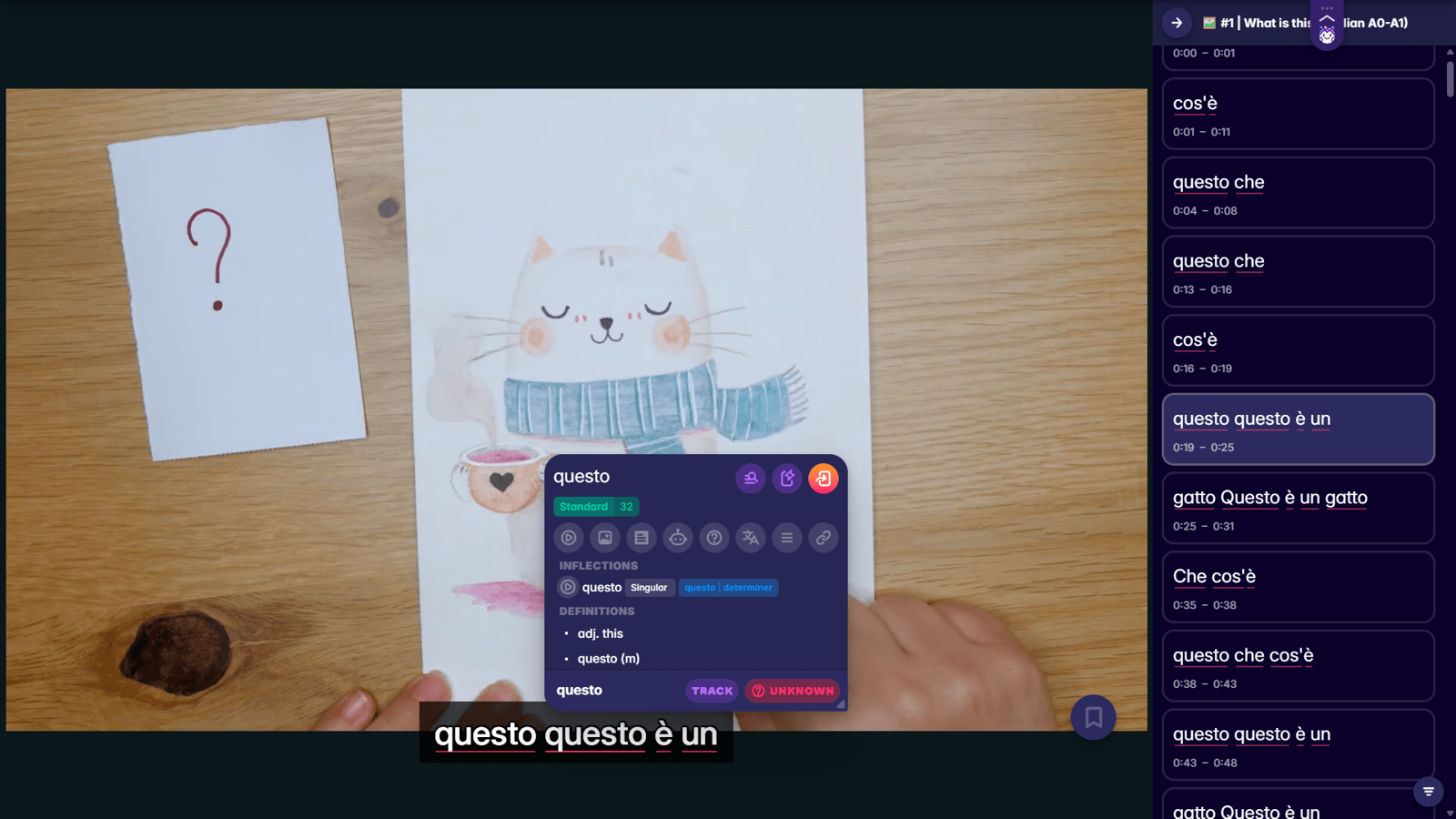
Speaking of consuming Italian media, if you're serious about picking up natural time expressions and everything else, Migaku's browser extension and app make it super easy to learn from actual Italian content. You can watch shows, read articles, and look up words instantly without breaking your flow. There's a 10-day free trial if you want to see how much faster you learn when you're working with real Italian instead of textbook examples.
Time expressions are fundamental to communicating in Italian language
Honestly, they're not that complicated once you understand the basic patterns. The key is consistent practice. Every Italian conversation about schedules or plans gives you a chance to use what you've learned. Every time you check the clock or hear the words on the media, you've got an opportunity to reinforce these patterns.
If you consume media in Italian, and you understand at least some of the messages and sentences within that media, you will make progress. Period.
The payoff is huge for learning the time words early!