Italian Transport Vocabulary: Essential Words for Travelling in Italy
Last updated: March 20, 2026

Planning a trip to Italy or just learning the language? You'll definitely need to know how to get around. Italian transport vocabulary covers everything from trains and buses to boats and taxis, plus all those practical phrases you'll use at ticket counters and stations. Getting comfortable with these words makes traveling through Italy way less stressful, whether you're hopping on a regional train in Tuscany or catching a vaporetto in Venice.
- Basic Italian transport vocabulary
- Italian train vocabulary and phrases
- Bus and public transit words and phrases
- Learn Italian taxi and car vocabulary
- Italian vocabulary for airport and airplane
- Water transport vocabulary
- Tickets and payment vocabulary
- Directions and navigation vocabulary
- Signs and written vocabulary
- Specialized and construction vehicles
- Common mistakes when using Italian public transportation phrases
Basic Italian transport vocabulary
Let's start with the fundamental transport words you'll hear everywhere in Italy. The Italian word for transport itself is "trasporto" or "trasporti" (plural). When talking about a vehicle in general, you'd say "veicolo."
Here are the most common modes of transport you'll encounter:
Italian | English |
|---|---|
Treno | Train |
Autobus / bus | Bus |
Automobile / macchina | Car |
Aereo | Airplane |
Bicicletta / bici | Bicycle |
Motocicletta / moto | Motorcycle |
Taxi | Taxi |
Metropolitana / metro | Subway / Metro |
Tram | Tram |
Nave | Ship |
Traghetto | Ferry |
Vaporetto | Water bus (especially in Venice) |
The word "treno" shows up constantly in Italian vocabulary lists because trains are absolutely important in Italy. The rail network connects pretty much every major city, and Italians use trains way more than Americans do for everyday travel.
Italian train vocabulary and phrases
Trains deserve their own section because you'll probably use them more than any other transport in Italy. The Italian rail system includes everything from high-speed trains to regional connections.
Types of trains you'll encounter:
Italian | English |
|---|---|
Treno ad alta velocità | High-speed train |
Treno regionale | Regional train |
Treno intercity | Intercity train |
Frecciarossa | Red Arrow (fastest high-speed train) |
Frecciargento | Silver Arrow |
Frecciabianca | White Arrow |
At the train station ("stazione ferroviaria" or just "stazione"), you'll need these words:
Italian | English |
|---|---|
Binario | Platform / Track |
Biglietto | Ticket |
Biglietteria | Ticket office |
Orario | Schedule / Timetable |
Partenza | Departure |
Arrivo | Arrival |
Ritardo | Delay |
Carrozza | Train car |
Posto | Seat |
Prima classe | First class |
Seconda classe | Second class |
Essential train phrases:
- "Questo treno va a...?" (Does this train go to...?) is probably the most useful phrase when you're standing on a platform looking confused. Italian train stations can be chaotic, and double-checking never hurts.
- "Dove posso comprare i biglietti?" (Where can I buy tickets?) helps when you can't find the ticket machines or counter. Sometimes they're tucked away in weird corners of the station.
- "A che ora parte il prossimo treno per...?" (What time does the next train to... leave?) is essential for planning.
- "Devo cambiare treno?" (Do I need to change trains?) saves you from accidentally ending up in the wrong city.
- "Questo posto è occupato?" (Is this seat taken?) is polite before you sit down.
Bus and public transit words and phrases
Buses connect smaller towns that trains don't reach, and every Italian city has its own bus network. The vocabulary here overlaps with trains but has some unique terms.
Bus-related words:
Italian | English |
|---|---|
Autobus | Bus (formal) |
Pullman | Coach / Long-distance bus |
Fermata | Bus stop |
Autostazione | Bus station |
Linea | Line / Route |
Conducente / autista | Driver |
Capolinea | Terminus / Last stop |
Public transit phrases:
- "Dove posso prendere l'autobus per...?" (Where can I catch the bus to...?) is super useful in unfamiliar cities.
- "Quanto costa il biglietto?" (How much does the ticket cost?) because bus fares vary between cities.
- "Devo timbrare il biglietto?" (Do I need to validate the ticket?) This one's important because Italy uses an honor system where you buy tickets separately and validate them on board. Forget to validate, and you risk a hefty fine.
- "Mi può dire quando scendere?" (Can you tell me when to get off?) is helpful if you're unsure about stops.
Learn Italian taxi and car vocabulary
Taxis in Italy work differently from those in some countries. You usually can't just hail them on the street in most cities. You need to go to a taxi stand ("posteggio taxi") or call one.
Taxi phrases:
- "Posso avere un taxi?" (Can I have a taxi?) works when calling or asking at a hotel desk.
- "Quanto costa andare a...?" (How much does it cost to go to...?) helps avoid surprises, though Italian taxis use meters.
- "Mi può portare a questo indirizzo?" (Can you take me to this address?) is straightforward and useful.
Car vocabulary becomes important if you're renting:
Italian | English |
|---|---|
Macchina a noleggio | Rental car |
Patente | Driver's license |
Benzina | Gasoline |
Diesel | Diesel |
Parcheggio | Parking |
Autostrada | Highway / Motorway |
Strada | Road |
Incrocio | Intersection |
Semaforo | Traffic light |
Rotatoria | Roundabout |
Italian vocabulary for airport and airplane
Flying into Italy? You'll need airport vocabulary from the moment you land.
Airport terms:
Italian | English |
|---|---|
Aeroporto | Airport |
Terminal | Terminal |
Gate | Gate |
Imbarco | Boarding |
Bagaglio | Luggage |
Valigia | Suitcase |
Controllo passaporti | Passport control |
Dogana | Customs |
Arrivi | Arrivals |
Partenze | Departures |
Volo | Flight |
Useful airport phrases:
- "Dov'è il gate...?" (Where is gate...?) because Italian airports can be confusing.
- "Ho perso il mio bagaglio" (I lost my luggage) is unfortunate, but necessary to know.
- "C'è un autobus per il centro?" (Is there a bus to the city center?) helps you figure out ground transport after landing.
Water transport vocabulary
Italian transportation system has tons of water transport, especially in Venice, along the coasts, and between islands. This vocabulary is pretty specialized but super useful in certain regions.
Water transport terms:
Italian | English |
|---|---|
Barca | Boat (general term) |
Nave | Ship |
Traghetto | Ferry |
Vaporetto | Water bus (in Venice) |
Gondola | Gondola |
Motoscafo | Motorboat |
Porto | Port / Harbor |
Molo | Pier / Dock |
Imbarco | Boarding point |
In Venice specifically, you'll constantly hear "vaporetto" because that's how most people get around. The vaporetto system works just like a bus network, with numbered lines and stops along the canals. "Quale vaporetto va a...?" (Which vaporetto goes to...?) is essential in Venice.
Tickets and payment vocabulary
Buying tickets in Italy involves its own set of vocabulary that applies across different transport types.
Ticket-related words:
Italian | English |
|---|---|
Biglietto | Ticket |
Biglietto di andata | One-way ticket |
Biglietto di andata e ritorno | Round-trip ticket |
Abbonamento | Pass / Subscription |
Tariffa | Fare / Rate |
Ridotto | Reduced price |
Intero | Full price |
Convalida | Validation |
Multa | Fine |
Payment phrases:
- "Vorrei un biglietto per..." (I'd like a ticket to...) is your basic ticket-buying phrase.
- "Accettate carte di credito?" (Do you accept credit cards?) because some smaller stations or buses are cash-only.
- "Dove si convalida il biglietto?" (Where do you validate the ticket?) saves you from fines.
Directions and navigation vocabulary
Getting around requires understanding directions and signs.
Direction words:
Italian | English |
|---|---|
Destra | Right |
Sinistra | Left |
Dritto | Straight |
Avanti | Forward |
Indietro | Back |
Nord | North |
Sud | South |
Est | East |
Ovest | West |
Vicino | Near |
Lontano | Far |
Navigation phrases:
- "Come arrivo a...?" (How do I get to...?) is probably the most common question tourists ask.
- "È lontano?" (Is it far?) helps you decide between walking and taking transport.
- "Posso andare a piedi?" (Can I go on foot?) is useful for short distances.
Signs and written vocabulary
Italian transport signs use specific vocabulary you'll see everywhere.
Common signs:
Italian | English |
|---|---|
Entrata | Entrance |
Uscita | Exit |
Vietato | Forbidden / Prohibited |
Occupato | Occupied |
Libero | Free / Available |
In servizio | In service |
Fuori servizio | Out of service |
Informazioni | Information |
Soccorso | Emergency / Help |
Deposito bagagli | Luggage storage |
Understanding these signs makes navigating stations and vehicles way easier. "Fuori servizio" on a bathroom door or ticket machine means you need to find another one.
Specialized and construction vehicles
While less common for travelers, these words round out your transport vocabulary.
Specialized vehicles:
Italian | English |
|---|---|
Camion | Truck |
Furgone | Van |
Ambulanza | Ambulance |
Autopompa | Fire truck |
Scuolabus | School bus |
Tir | Semi-truck / Lorry |
Scooter | Scooter |
Monopattino | Scooter / Kick scooter |
Monopattino elettrico | Electric scooter |
Construction and work vehicles:
Italian | English |
|---|---|
Gru | Crane |
Escavatore | Excavator |
Bulldozer | Bulldozer |
Betoniera | Cement mixer |
You probably won't need these daily, but they show up in Italian vocabulary lists and you'll definitely see them around Italian cities.
Common mistakes when using Italian public transportation phrases
- People learning Italian transport vocabulary often confuse "fermata" (stop) with "stazione" (station). A fermata is a simple stop, like a bus stop. A stazione is a full station building with facilities.
- Another common mix-up: "macchina" versus "automobile." Both mean car, but "macchina" is way more common in everyday speech. Saying "automobile" sounds formal and a bit old-fashioned.
- The word "treno" is masculine, so you'd say "il treno" (the train), not "la treno." This matters when forming phrases like "il prossimo treno" (the next train).
- Don't confuse "biglietto" (ticket) with "biglietteria" (ticket office). They're related but mean different things. "Vorrei un biglietto" (I'd like a ticket) versus "Dov'è la biglietteria?" (Where's the ticket office?).
Anyway, if you want to practice Italian transport vocabulary with content, Migaku's browser extension and app let you look up words instantly while watching Italian travel vlogs or reading transit websites. You can build custom flashcard decks from real Italian content about transportation. There's a 10-day free trial if you want to check it out.
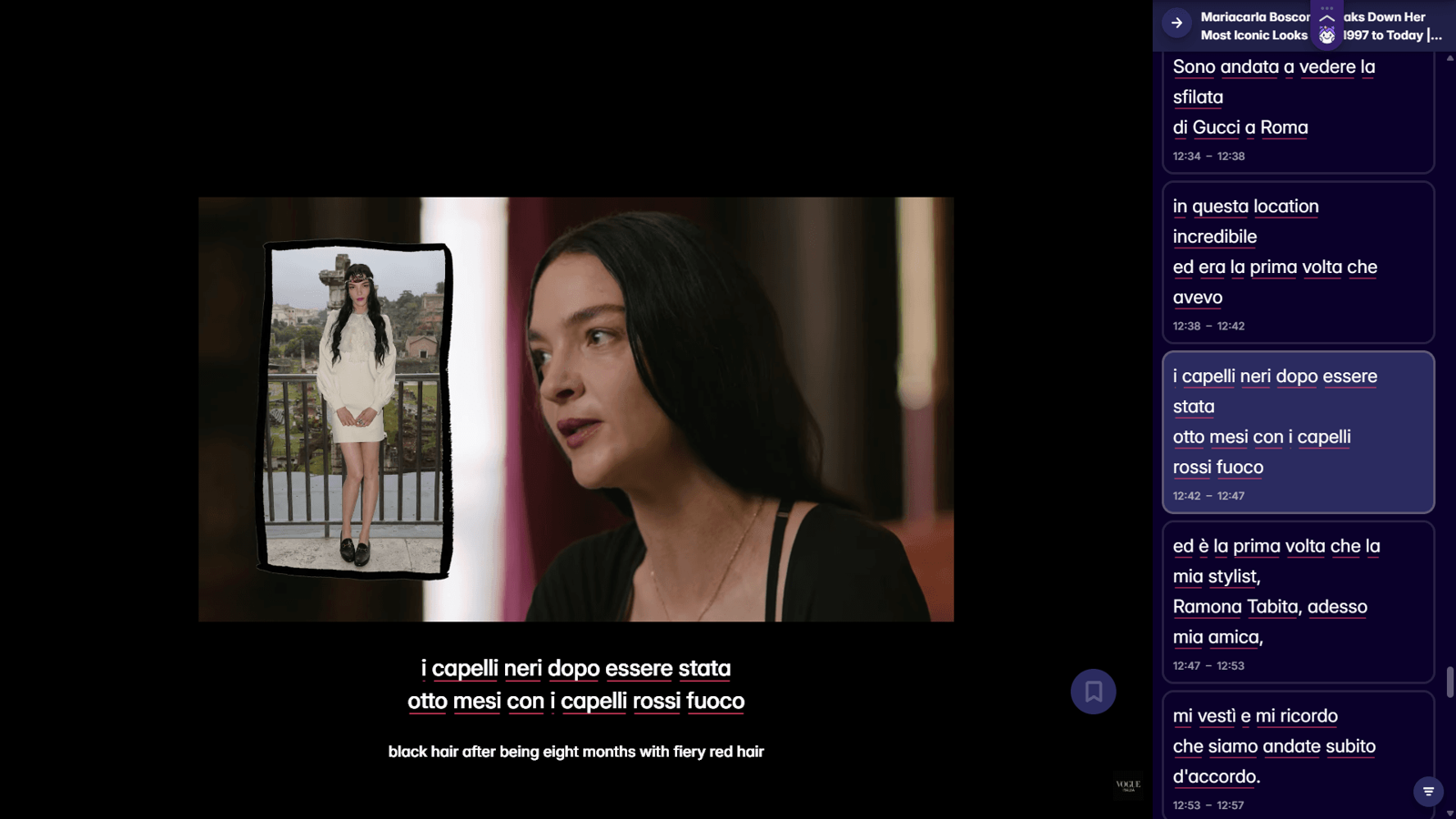
Learn the transportation vocabulary list fast with flashcards and context
Learning Italian transport vocabulary works best when you practice it in context. Reading train schedules online, watching Italian travel videos, or even going through Google Maps in Italian helps cement these words. You can also mine the sentences and expressions that you are not familiar with to your flashcards, and review them later to reinforce your memory.
If you consume media in Italian, and you understand at least some of the messages and sentences within that media, you will make progress. Period.
When you get to Italy, you will definitely have the chance to use these words!🚋🛤️