# Language Learning Journal: Acquire Your Second Language Faster
> Keeping a language learning journal accelerates fluency through active practice, progress tracking, and personalized learning. Here's how to start today.
**URL:** https://migaku.com/blog/language-fun/language-learning-journal-guide
**Last Updated:** 2026-03-06
**Tags:** resources, discussion, deepdive
---
You know what's funny? People spend hundreds of hours consuming [language learning](https://migaku.com/blog/language-fun/3-things-to-learn-a-language) content, downloading apps, and buying textbooks, but most never think to just write about what they're learning. Keeping a [language learning](https://migaku.com/) journal is probably one of the most underrated tools for getting fluent faster. It forces you to use the language instead of just passively absorbing it, and it creates this permanent record of your progress that keeps you motivated when things get tough. Let me show you exactly how journaling accelerates your language acquisition and how to do it right.
---
## What a language learning journal is
> A language learning journal is basically a personal notebook where you write regularly **in your target language**.
Pretty straightforward concept, but here's the thing: you're not writing about your language studies in English. You're writing IN the foreign language you're trying to learn.
This could be a physical notebook, a digital document, or even a private blog. The format doesn't matter as much as the habit of sitting down and producing language on a regular basis. Some learners write daily entries about their day, others focus on specific vocabulary they learned, and some use prompts to practice particular grammar structures.
The whole point is active production. When you're watching shows or reading articles, you're in input mode. Journaling flips that switch and forces your brain to recall words, construct sentences, and use what you've been learning. That's where the real magic happens.
---
## Why journaling accelerates language learning faster than most methods
Passive learning only gets you so far. You can watch a thousand hours of content in your target language and still freeze up when someone asks you a simple question. Journaling fixes this problem by making you an active participant in your learning process.
When you write in your journal, you're engaging multiple cognitive processes simultaneously. You're recalling vocabulary from memory, applying grammar rules in context, making decisions about word choice, and creating original content. This is way more demanding than recognizing words when you see them, which is what happens during passive reading or listening.
Research in second language acquisition shows that [output practice](https://migaku.com/blog/language-fun/output-hypothesis-language-learning), what you do when you write or speak, creates stronger neural pathways than input alone. Your brain has to work harder to retrieve and produce language compared to just understanding it. That extra effort translates to better retention and faster fluency gains.
Plus, journaling gives you immediate feedback on your skill level. When you try to write about something and realize you don't know the words you need, that's valuable information. You've just identified a gap in your knowledge that you can fill. This kind of self-assessment is harder to get from passive study.
---
## Progress tracking and milestones through journal entries
### Why journaling is good for tracking
One of the most motivating aspects of keeping a language learning journal is watching your progress over time. When you're in the middle of learning a language, it often feels like you're not improving at all. You still make mistakes, you still don't understand everything, and fluency seems impossibly far away.
But flip back through your journal entries from three months ago and you'll have insights into your improvement. The sentences that felt challenging back then now look simple. The vocabulary you struggled to remember is now automatic. You can express more complex ideas with greater accuracy.
This visible summary of your progress is incredibly powerful for motivation. Language learning takes years, and it's easy to get discouraged during the intermediate [plateau](https://migaku.com/blog/language-fun/break-through-language-learning-plateau) when gains feel slow. Your journal becomes this archive of evidence that you're actually getting better in your second language learning, even when it doesn't feel like it day to day.
### How to track the progress
I recommend dating every entry and occasionally reviewing old ones. You'll spot patterns in your errors that you've since corrected, notice how your writing style has evolved, and see vocabulary becoming more sophisticated. These milestones matter because they prove the process is working.
Some learners like to set specific goals and track them in their journals. Maybe you want to write 100 words per entry by the end of the month, or use ten new vocabulary words each week. Writing these targets down and checking your progress creates accountability that's hard to get from other study methods.
---
## Grammar and vocabulary practice that sticks
Here's something most textbooks don't tell you: you need to encounter a new word multiple times in different contexts before it really sticks in your memory. Journaling creates those repeated exposures naturally because you're writing about your life and interests.
1. When you learn a new word, try to use it in your journal entry that same day. Write a sentence that relates to your personal experience. This creates a memory association that's way stronger than just seeing the word in a vocabulary list or example sentence from a textbook.
2. For vocabulary practice specifically, try themed journal entries. Spend one day writing about food and cooking, another about your work or studies, another about hobbies. This naturally exposes you to different vocabulary domains and helps you build practical, usable language skills across multiple contexts.
Grammar works the same way. You can study conjugation tables all day, but until you actually use those verb forms to express your own thoughts, they won't become automatic. Journaling forces you to make those grammar decisions in real time. Should this be past or present tense? Which particle fits here? Does this adjective need to agree with the noun?
---
## Reflection and self-assessment for personalized learning
Every learner has different strengths and weaknesses. Maybe you're great at reading comprehension but struggle with producing natural-sounding sentences. Or maybe you know tons of vocabulary but constantly mess up basic grammar. Your journal helps you identify these personal patterns.
When you review your entries, pay attention to the mistakes you make repeatedly. Are you always forgetting the same grammar rule? Do certain types of words give you trouble? This self-assessment tells you exactly where to focus your study time instead of following some generic curriculum that might not match your needs.
---
## How to start your language learning journal today
You don't need anything fancy to get started.
1. A cheap notebook and a pen work perfectly fine. If you prefer digital, a simple document on your computer or phone works just as well. Some people use apps like Notion or Evernote, others just use Google Docs. The tool matters way less than actually doing it.
2. Start small. Don't try to write a full page on day one if you're a beginner. Even three sentences about your day count as a valid journal entry. The goal is to build the habit first, then gradually increase the length and complexity as your skills improve.
3. Keep a dictionary or translation tool handy while you write. When you don't know a word, look it up and use it. This is active vocabulary acquisition because you're learning words you need to express your thoughts, which means they're more likely to stick in your memory.
4. For beginners, mixing in some English is okay at first. Maybe write a sentence in your target language, then add notes in English about grammar or vocabulary. As you progress, gradually reduce the English until you're writing entirely in your target language.
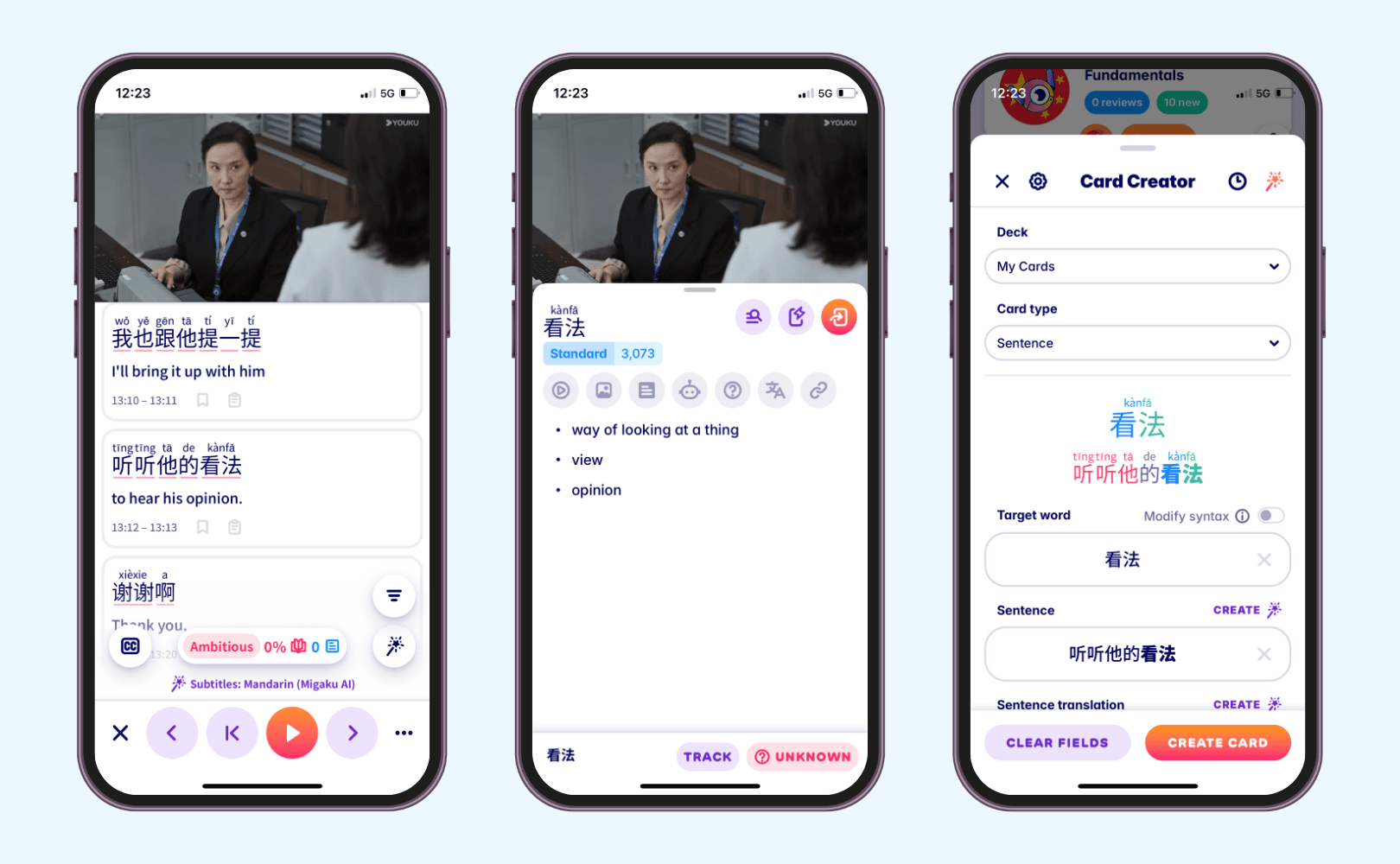
Anyway, if you want to combine journaling with immersive content consumption, Migaku's browser extension and app let you look up words instantly while reading articles or watching videos in your target language. You can save interesting sentences or vocabulary directly to your study materials, which gives you authentic content to reference when writing your journal entries. There's a 10-day free trial if you want to check it out.
 ---
## FAQs
Yeah, they're genuinely effective if you use them consistently. The research supports journaling as a tool for developing writing skills, building vocabulary, and increasing learner autonomy. The key is regular practice over time, not occasional bursts of activity.
This refers to communication, cultures, connections, comparisons, and communities. These standards from language education policy emphasize using language in real contexts, understanding cultural perspectives, connecting to other knowledge areas, comparing languages, and participating in multilingual communities. Journaling touches on several of these, especially communication and comparisons.
Absolutely. If you're learning multiple languages, keeping separate journals for each one helps prevent mixing and reinforces the distinct patterns of each language. The practice of regular writing in different languages builds the cognitive flexibility that characterizes successful multilingual learners.
---
## Improve your proficiency by combining journaling with other modern tools
You don't have to choose between traditional journaling and technology. Lots of learners use hybrid approaches that combine the benefits of both. You might watch videos for immersion practice today, and keep a simple journal of the new expressions you have learned. Different study methods can reinforce your memory in different ways, and it is definitely worth trying out journaling with other language learning practices!
> If you consume media in the language you want to learn, and you understand at least some of the messages and sentences within that media, you will make progress. _Period_.
Nothing explored, nothing learned.
---
## FAQs
Yeah, they're genuinely effective if you use them consistently. The research supports journaling as a tool for developing writing skills, building vocabulary, and increasing learner autonomy. The key is regular practice over time, not occasional bursts of activity.
This refers to communication, cultures, connections, comparisons, and communities. These standards from language education policy emphasize using language in real contexts, understanding cultural perspectives, connecting to other knowledge areas, comparing languages, and participating in multilingual communities. Journaling touches on several of these, especially communication and comparisons.
Absolutely. If you're learning multiple languages, keeping separate journals for each one helps prevent mixing and reinforces the distinct patterns of each language. The practice of regular writing in different languages builds the cognitive flexibility that characterizes successful multilingual learners.
---
## Improve your proficiency by combining journaling with other modern tools
You don't have to choose between traditional journaling and technology. Lots of learners use hybrid approaches that combine the benefits of both. You might watch videos for immersion practice today, and keep a simple journal of the new expressions you have learned. Different study methods can reinforce your memory in different ways, and it is definitely worth trying out journaling with other language learning practices!
> If you consume media in the language you want to learn, and you understand at least some of the messages and sentences within that media, you will make progress. _Period_.
Nothing explored, nothing learned.