# Language Learning With AI Tools: Can AI Language Learning Apps Replace Human Tutors in 2026?
> Discover the best AI tools for language learning in 2026. Compare pricing, features, and effectiveness of apps like ELSA, Talkio, and Speak for faster fluency.
**URL:** https://migaku.com/blog/language-fun/language-learning-with-ai-tools
**Last Updated:** 2026-03-11
**Tags:** resources, discussion, deepdive
---
AI tools have completely changed [how we learn languages in 2026](https://migaku.com/). You can now have unlimited conversations with an AI tutor at 3am in your pajamas, get instant pronunciation feedback, and practice speaking without worrying about embarrassing yourself in front of a real person. The question isn't whether AI can help you learn anymore. The real questions are: which tools actually work, are they worth paying for, and how do you use them to actually get fluent faster?
---
## Why AI language learning tools actually work
Here's the thing about traditional language learning. You either pay $30-60 per hour for a human tutor, or you use apps like Duolingo that focus mostly on reading and multiple-choice exercises. Neither option gives you unlimited speaking practice at an affordable price.
AI changes this completely. You can now practice speaking for hours every day without spending hundreds of dollars on tutors. The AI doesn't get tired, doesn't judge your mistakes, and costs maybe $10-15 per month for unlimited access.
The technology got really good around 2024-2025. Modern AI language apps use voices cloned from native speakers, so they sound natural instead of robotic. They can understand your speech even with a terrible accent, give you specific feedback on pronunciation errors, and adapt conversations to your level.
I was skeptical at first. But after testing these tools for several months, I can say they genuinely help you improve faster than traditional methods for speaking skills specifically.
---
## The best AI tools for speaking practice in 2026
Let me break down the top AI language learning apps that actually deliver results. I've tested all of these personally, so these aren't just specs copied from their websites.
### Talkio AI
This one focuses purely on conversational practice. You get AI tutors that can discuss basically any topic, from ordering coffee to debating philosophy. The AI adapts to your level automatically, which is pretty cool.
What makes Talkio stand out is the pronunciation feedback. After each conversation, you get a detailed breakdown of which sounds you messed up and how to fix them. It supports over 130 languages and multiple dialects for each.
Pricing sits around $11 per month for unlimited conversations. They offer a free trial so you can test it before committing.
### ELSA Speak
ELSA specializes in pronunciation training, particularly for English learners. The AI analyzes your speech at the sound level and shows you exactly which phonemes you're pronouncing wrong.
The app uses color-coded feedback. Green means you nailed it, yellow means close enough, red means work on this. It sounds simple but it's incredibly effective for fixing accent issues.
ELSA costs about $13 per month depending on your subscription length. Definitely the most affordable option for serious pronunciation work.
### Speak
Speak combines conversational AI with structured lessons. You get role-play scenarios like job interviews, restaurant conversations, or casual chats with friends. The AI responds naturally to whatever you say instead of forcing you down a scripted path.
What I like about Speak is that it feels more like a game than studying. You unlock new scenarios as you progress, and the AI remembers previous conversations so there's actual continuity.
Pricing runs around $57-71 per month. A bit pricier than other options, but the production quality is noticeably higher.
### TalkPal
TalkPal offers a good middle ground between structured lessons and free conversation. You can choose specific topics to practice or just chat about whatever interests you.
The AI tutor provides real-time corrections during conversations, which some people love and others find distracting. You can toggle this feature on or off based on your preference.
Monthly subscription costs about $6-15.
### Langua
This app focuses on [vocabulary](https://migaku.com/blog/language-fun/3-things-to-learn-a-language) building through conversations. The AI intentionally uses new words in context, then reviews them with you after each session.
Langua tracks which words you struggle with and brings them up repeatedly in future conversations until you master them. This integration of vocabulary and speaking practice is something most other apps miss.
Pricing is around $8-10 per month. Good value if vocabulary expansion is your main goal.
---
## AI-powered pronunciation and feedback features
Getting pronunciation feedback from AI has become incredibly accurate. These tools can now identify specific issues like:
- Your tongue placement for certain sounds, whether you're stressing the right syllables in words, if you're using the correct intonation patterns for questions versus statements, and which sounds you're substituting from your native language.
- The feedback happens instantly too. You say a sentence, the AI analyzes it in 2-3 seconds, and you can immediately try again with corrections. This rapid feedback loop is way more effective than waiting a week between tutor sessions to fix bad habits.
ELSA shows you detailed descriptions on how to pronounce and gives you exercises targeting your specific problem sounds. After a few weeks of daily practice, you'll notice real improvement in how native speakers understand you.
For other languages, Talkio and Speak both offer solid pronunciation analysis. They might not be as detailed as ELSA, but they'll catch major errors and help you sound more natural.
---
## Good AI apps for language and dialect coverage
Most AI language learning apps now support 20-40+ languages. The big ones covered by basically every app include Spanish, French, German, Italian, Portuguese, Japanese, Korean, Chinese (Mandarin), and Arabic.
Dialect support matters more than people realize. Mexican Spanish sounds different from Spanish from Spain. Brazilian Portuguese differs significantly from European Portuguese. A good AI tool lets you choose which dialect you want to learn.
Talkio handles dialects best. You can select specific regional variations and the AI tutor will use vocabulary and pronunciation from that region. Pretty helpful if you're learning Spanish for a move to Mexico versus Spain.
For less common languages, your options narrow down quickly. If you're learning something like Finnish, Thai, or Hebrew, check which apps support your target language before subscribing.
---
## Comparing AI tutors with human language teachers
Let me be honest about this. AI tutors excel at certain things and completely fail at others compared to humans.
🤖✅**What AI does better**: unlimited availability, zero judgment about mistakes, infinite patience with repetition, consistent pricing, instant feedback on pronunciation, and willingness to practice the same scenario 50 times if needed.
👩🏫✅**What human tutors do better**: explaining complex grammar concepts, understanding cultural context, adapting to your specific learning style, catching subtle errors AI might miss, providing motivation and accountability, and having actual life experiences to share.
The best approach in 2026 combines both. Use AI tools for daily speaking practice and pronunciation drills. Then meet with a human tutor once or twice weekly to work on grammar, get cultural insights, and practice more complex conversations.
This hybrid method costs way less than doing all human tutoring while giving you way more practice than human lessons alone. I've seen learners using this approach reach conversational fluency in 6-8 months versus 12-18 months with traditional methods.
---
## How to use AI to accelerate your new language learning
Having access to these AI tools means nothing if you don't use them effectively. Here's what actually works based on my experience and talking to other successful language learners:
1. Practice daily for at least 15-20 minutes. Consistency beats intensity when learning a language. Twenty minutes every single day will get you further than two-hour weekend sessions.
2. Focus on speaking from day one. Don't wait until you "know enough grammar" to start conversations. Use the AI tutor to practice speaking even as a complete beginner. You'll make tons of mistakes and that's exactly the point.
3. Review your pronunciation feedback seriously. When the AI tells you a sound is wrong, don't just move on. Repeat that word or sentence until you get it right. This is where the real improvement happens.
4. Combine multiple AI tools for different purposes. Use ELSA for pronunciation drills, Talkio for conversations, and maybe a [vocabulary app](https://migaku.com/blog/language-fun/anki-settings-for-language-learning) for learning new words. Each tool does specific things well.
5. Set specific goals for each practice session. Instead of just "practice Spanish," try "order food at a restaurant" or "describe my day using past tense." This focused practice is way more effective.
6. Record yourself speaking and compare to native speakers. Many AI apps let you hear the correct pronunciation alongside your attempt. This comparison helps you hear the differences you need to fix.
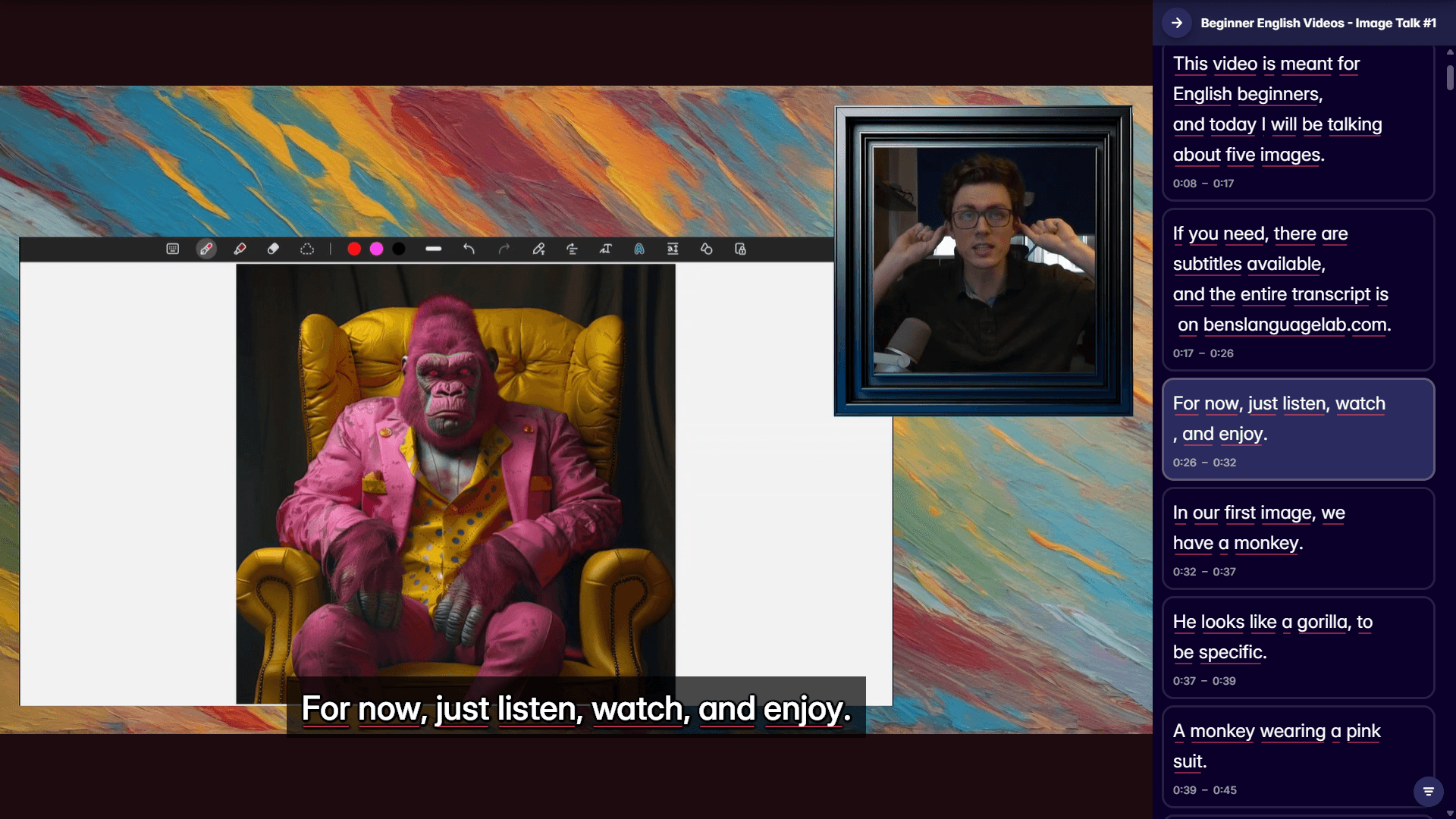
Anyway, if you want to practice reading and listening with real content, Migaku's browser extension and app let you look up words instantly while watching shows or reading articles in your target language. Makes immersion learning way more practical. There's a 10-day free trial if you want to check it out.
 ---
## FAQs on using AI for language fluency
Yeah, there are some genuinely useful free options. They have limitations compared to paid apps, but they can still help you improve. ChatGPT is probably the most versatile free AI tool for language learning. You can have text conversations in your target language, ask it to explain grammar, request vocabulary lists, or have it correct your writing. The free version works fine for this stuff. Some AI apps offer free trials that are legitimately useful. ELSA's free trial gives you full access for 7 days. You can make serious progress on pronunciation in a week if you practice daily.
I've been using AI language learning apps for about 18 months now across three different languages. Here's what I've noticed. For speaking skills and pronunciation, AI tools absolutely work. My accent in Spanish improved dramatically after three months of daily ELSA practice. I can now have fluent conversations in Japanese thanks to regular sessions with Talkio's AI tutor. For reading and writing, AI tools work differently. ChatGPT is excellent for getting writing corrections and explanations. But you still need to read real content written by humans to develop natural comprehension.
---
## AI-powered language learning tools can help learners with more than just speaking skills
Nowadays, many apps integrate AI for spaced repetition, subtitles generation, instant translations, and others. But even the best AI tools make mistakes, and you need media content to learn how languages work in real life. The learners I know who progressed fastest all combined AI tools with real content [immersion](https://migaku.com/blog/language-fun/comprehensible-input-method-language-learning) and occasional human tutoring. None of these elements alone gets you fluent, but together they create a powerful learning system.
> If you consume media in the language you want to learn, and you understand at least some of the messages and sentences within that media, you will make progress. _Period_.
Stay resourceful!
---
## FAQs on using AI for language fluency
Yeah, there are some genuinely useful free options. They have limitations compared to paid apps, but they can still help you improve. ChatGPT is probably the most versatile free AI tool for language learning. You can have text conversations in your target language, ask it to explain grammar, request vocabulary lists, or have it correct your writing. The free version works fine for this stuff. Some AI apps offer free trials that are legitimately useful. ELSA's free trial gives you full access for 7 days. You can make serious progress on pronunciation in a week if you practice daily.
I've been using AI language learning apps for about 18 months now across three different languages. Here's what I've noticed. For speaking skills and pronunciation, AI tools absolutely work. My accent in Spanish improved dramatically after three months of daily ELSA practice. I can now have fluent conversations in Japanese thanks to regular sessions with Talkio's AI tutor. For reading and writing, AI tools work differently. ChatGPT is excellent for getting writing corrections and explanations. But you still need to read real content written by humans to develop natural comprehension.
---
## AI-powered language learning tools can help learners with more than just speaking skills
Nowadays, many apps integrate AI for spaced repetition, subtitles generation, instant translations, and others. But even the best AI tools make mistakes, and you need media content to learn how languages work in real life. The learners I know who progressed fastest all combined AI tools with real content [immersion](https://migaku.com/blog/language-fun/comprehensible-input-method-language-learning) and occasional human tutoring. None of these elements alone gets you fluent, but together they create a powerful learning system.
> If you consume media in the language you want to learn, and you understand at least some of the messages and sentences within that media, you will make progress. _Period_.
Stay resourceful!