# Learn Portuguese with Netflix: Shows & Strategies for Portuguese Learners
> Discover the best Netflix shows and proven subtitle strategies to learn Portuguese effectively. Get specific recommendations and techniques.
**URL:** https://migaku.com/blog/language-fun/learn-portuguese-with-netflix
**Last Updated:** 2026-03-13
**Tags:** resources, discussion, deepdive
---
If you've been searching for ways to [learn Portuguese](https://migaku.com/learn-portuguese) without feeling like you're grinding through textbooks, Netflix is probably the most entertaining option you've got. The platform has a solid lineup of Portuguese-language shows, especially from Brazil, and you can use them to improve your listening skills, pick up vocabulary, and get used to how people actually talk. Here's how to make it work for real learning, not just passive entertainment.
----
## Why Netflix actually works for learning Portuguese
Here's the thing: watching shows in Portuguese gives you something textbooks can't deliver.
- You hear real dialogue, natural speech patterns, slang, and the rhythm of conversation.
- You also get cultural context, which matters way more than most courses admit.
The biggest advantage? Netflix has a huge catalog of content from Brazil, which means you're getting authentic Brazilian Portuguese from native speakers. You're not listening to some language teacher speaking slowly and clearly. You're hearing how people actually communicate when they're arguing, joking around, or just having normal conversations.
Plus, you can control the subtitles. This is massive. You can start with English subtitles to follow the plot, switch to Portuguese subtitles to connect spoken words with written text, or go subtitle-free when you're feeling confident. That flexibility lets you adjust based on your current level.
----
## Best Netflix shows for learning Portuguese
Let me give you specific recommendations because not all shows work equally well for language learning.
### 3%
This dystopian thriller follows people competing to join the elite 3% who get to leave poverty behind. The dialogue is clear enough for intermediate learners, and the plot keeps you hooked. You'll hear modern Brazilian Portuguese with a good mix of formal and casual speech. The show ran for four seasons, so you've got plenty of content to work through.
### The Mechanism (O Mecanismo)
Based on Brazil's real corruption scandal, this political thriller has more formal Portuguese than other shows. Great if you want to learn vocabulary related to politics, business, and law. The pacing is slower than action shows, which actually helps when you're trying to catch every word.
### Samantha!
A comedy about a former child star trying to make a comeback. The language is conversational and filled with everyday expressions. Comedy can be tough because jokes depend on cultural knowledge, but that's exactly why it's useful. You'll learn how Brazilians use humor, sarcasm, and wordplay.
### Invisible City (Cidade Invisível)
This fantasy series mixes modern Rio de Janeiro with Brazilian folklore. You get contemporary urban Portuguese plus mythology references. The visual storytelling helps you understand context even when you miss some words.
### Sintonia
Follows three friends from São Paulo's favelas pursuing music, religion, and crime. The Portuguese here is raw and authentic, with plenty of slang and regional expressions. Probably better for intermediate to advanced learners because the dialogue moves fast and uses a lot of colloquial language.
----
## How to practice Portuguese with drama series (not just watch)
Watching shows passively won't teach you much. You need a strategy.
### Start with English subtitles
Yeah, I know everyone says to jump straight into Portuguese subtitles. But if you're a beginner, you'll spend the whole time confused and frustrated. Start with English subtitles so you understand the plot and context. This builds your [listening comprehension](https://migaku.com/blog/language-fun/active-vs-passive-listening-language-learning) because you're connecting the Portuguese audio with the English meaning.
Watch a full episode or two this way. Get familiar with the characters, the setting, and the story.
### Switch to Portuguese subtitles
Now rewatch the same episodes with Portuguese subtitles. This is where real learning happens. You're seeing exactly what words match the sounds you're hearing. You'll notice how Portuguese spelling connects to pronunciation, which is super helpful because Portuguese has sounds that don't exist in English.
Pause when you see new vocabulary. Write it down. Look up words you keep hearing repeatedly because those are probably common expressions worth memorizing.
### Active watching techniques
Pick short scenes (2-3 minutes) and study them in detail. Watch the scene multiple times. First with Portuguese subtitles, then without any subtitles. Try to repeat what characters say, mimicking their pronunciation and intonation.
This feels tedious, but it works. You're training your ear to recognize individual words instead of just hearing a blur of sounds. You're also practicing pronunciation by copying native speakers.
### Use the subtitle as a transcript
Take a screenshot of interesting subtitle lines. Later, you can review these as vocabulary lists. This is especially useful for phrases and expressions that don't translate literally. For example, "Tá ligado?" literally means "Are you connected?" but actually means "You know what I mean?"
----
## Brazilian Portuguese vs European Portuguese on Netflix
Most Netflix Portuguese content is Brazilian Portuguese. That's just the reality. Brazil has a bigger entertainment industry, and Netflix has invested heavily in Brazilian originals.
The differences matter. [Brazilian Portuguese and European Portuguese](https://migaku.com/blog/language-fun/brazilian-vs-european-portuguese) have different pronunciation, vocabulary, and even some grammar. Brazilians tend to pronounce vowels more openly and clearly. European Portuguese swallows a lot of vowel sounds, making it harder to understand for beginners.
If you specifically want European Portuguese, your Netflix options are limited. You might find some Portuguese films or documentaries, but the TV show selection is thin. For European Portuguese, you'd probably need to supplement with other platforms or content sources.
For most learners, Brazilian Portuguese makes more sense anyway. Brazil has over 200 million speakers compared to Portugal's 10 million. If you're learning Portuguese for travel, business, or general communication, Brazilian Portuguese gives you more opportunities.
----
## Tools and apps that enhance Netflix learning
### Language Learning with Netflix (LLN) extension
This browser extension is pretty awesome. It shows two subtitle languages simultaneously, so you can see Portuguese and English at the same time. You can click words for instant translations, and it lets you slow down playback without making everyone sound weird.
The extension also has a popup dictionary and saves vocabulary automatically. Way more efficient than pausing, screenshotting, and looking up words manually.
### Lingopie
This is a separate streaming platform focused on language learning, not part of Netflix. People sometimes ask "Is Lingopie free on Netflix?" and the answer is no. They're different services. Lingopie has its own content library with interactive subtitles and built-in learning tools. It costs extra but offers features specifically designed for language learners.
### [Anki](https://migaku.com/blog/language-fun/anki-settings-for-language-learning) for vocabulary review
After watching, take the vocabulary you collected and put it into [Anki flashcards](https://migaku.com/blog/language-fun/anki-settings-for-language-learning). Spaced repetition ensures you actually remember words instead of forgetting them three days later. Include the full sentence from the show as context, not just isolated words.
----
## Choosing genres strategically when watching Portuguese TV shows
Different genres expose you to different vocabulary and speaking styles.
| Genre | Characteristics | Learning Benefit |
| - | - | - |
| **Dramas and thrillers** | Clear dialogue and serious topics | Learn vocabulary for emotions, relationships, conflict, and everyday situations. Pacing allows you to catch what people are saying. |
| **Comedies** | Harder because humor relies on cultural knowledge and wordplay | Teaches informal language, slang, and how people joke around. This is the Portuguese you'll actually use with friends. |
| **Documentaries** | Narration is usually slower and clearer than dramatic dialogue | Great for specific vocabulary fields. A nature documentary teaches environmental terms. A cooking show teaches food vocabulary. |
| **Reality shows** | Most natural, unscripted language. People interrupt each other, use filler words, and speak quickly. | Challenging but incredibly useful for understanding real conversations. |
----
## Making consistent progress
The key is consistency over intensity.
1. Watching one episode every day beats binge-watching an entire season once a month. Your brain needs regular exposure to build pattern recognition.
2. Set a realistic schedule. Maybe 30 minutes daily. Pick a show you genuinely enjoy because you'll stick with it longer. If you hate political dramas, don't force yourself to watch *The Mechanism* just because it's "good for learning."
3. Track your progress somehow. Notice when you start understanding more without subtitles. Celebrate when you catch a joke or understand a full conversation without pausing. These small wins keep you motivated.
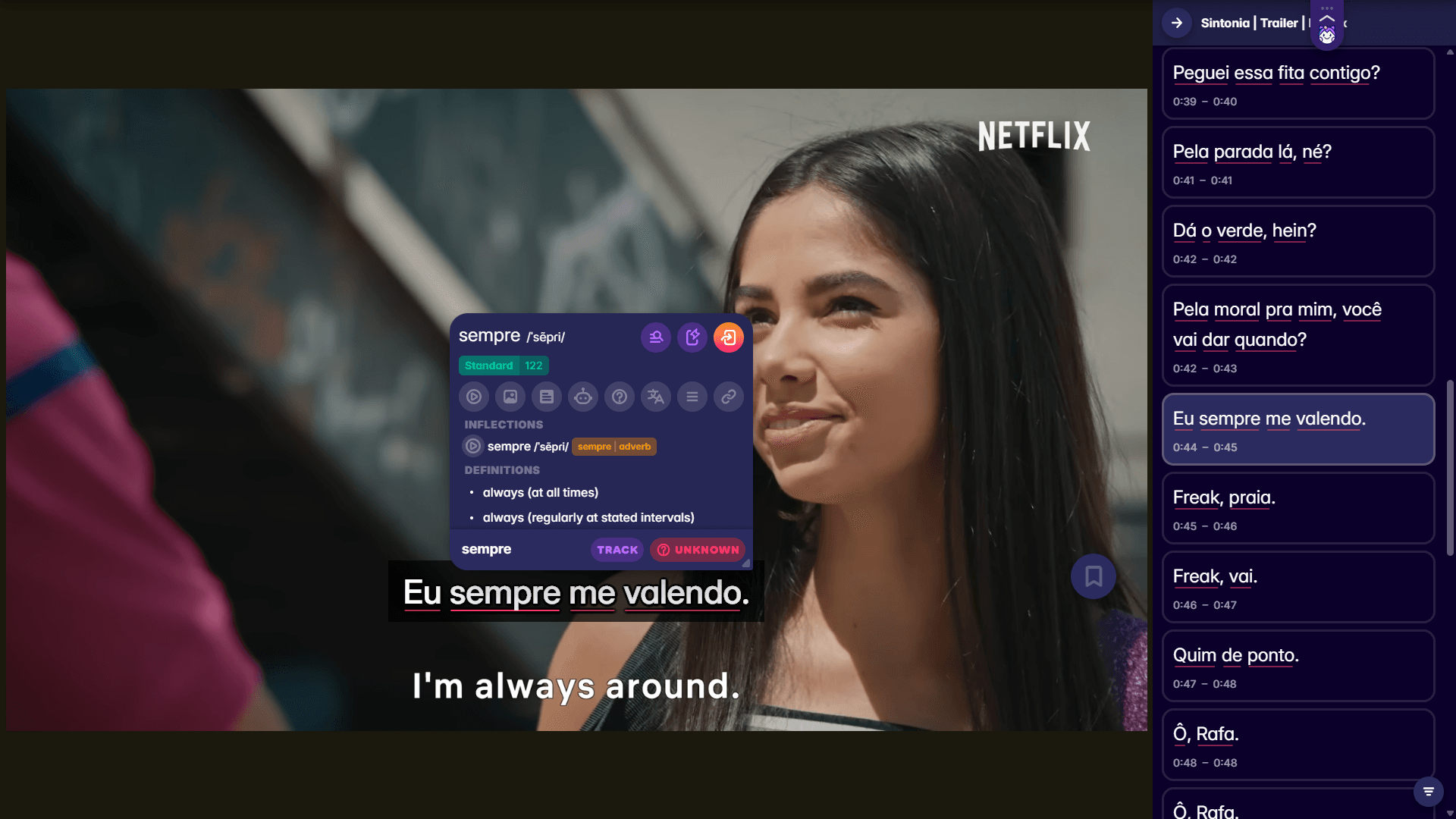
Anyway, if you want to take this further, Migaku's browser extension and app work with Netflix and other streaming platforms to give you instant word lookups, automatic flashcard creation, and better subtitle controls. Makes the whole immersion learning process way smoother. There's a 10-day free trial if you want to check it out.
 ----
## FAQs
You'll definitely improve your listening comprehension and pick up vocabulary. But watching alone won't make you fluent. You need to practice speaking, writing, and actually using the language. Netflix works best as part of a bigger learning strategy that includes conversation practice and active study.
----
## Mixing Netflix with other methods to learn Portuguese
Netflix shouldn't be your only Portuguese resource. Use it for listening and cultural exposure, but supplement with other activities. Practice speaking, even if you're just talking to yourself or repeating show dialogue. Find a language exchange partner or tutor for real conversations. Read Portuguese articles, books, or social media to improve reading skills. [Study grammar when you notice](https://migaku.com/blog/language-fun/best-portuguese-grammar-guide) patterns you don't understand. The combination works better than any single method. Netflix makes learning enjoyable and exposes you to real language.
> If you consume media in Portuguese, and you understand at least some of the messages and sentences within that media, you will make progress. _Period_.
Study and practice actively!📚🏋️♂️
----
## FAQs
You'll definitely improve your listening comprehension and pick up vocabulary. But watching alone won't make you fluent. You need to practice speaking, writing, and actually using the language. Netflix works best as part of a bigger learning strategy that includes conversation practice and active study.
----
## Mixing Netflix with other methods to learn Portuguese
Netflix shouldn't be your only Portuguese resource. Use it for listening and cultural exposure, but supplement with other activities. Practice speaking, even if you're just talking to yourself or repeating show dialogue. Find a language exchange partner or tutor for real conversations. Read Portuguese articles, books, or social media to improve reading skills. [Study grammar when you notice](https://migaku.com/blog/language-fun/best-portuguese-grammar-guide) patterns you don't understand. The combination works better than any single method. Netflix makes learning enjoyable and exposes you to real language.
> If you consume media in Portuguese, and you understand at least some of the messages and sentences within that media, you will make progress. _Period_.
Study and practice actively!📚🏋️♂️