How to Say Nice to Meet You in Portuguese (Brazil & Portugal)
Last updated: March 19, 2026

Learning how to greet people properly is one of the first things you'll want to nail down when picking up Portuguese. Whether you're planning a trip to Brazil, connecting with Portuguese-speaking friends, or just expanding your language skills, knowing how to say "nice to meet you" in Portuguese will make those first impressions way smoother. The good news? There are several ways to express this depending on where you are and who you're talking to. Let's break down all the variations you'll use in real conversations.
- The standard way to say nice to meet you in Portuguese
- Brazilian Portuguese vs. European Portuguese differences
- Formal vs. informal greetings
- Full introduction dialogues you can use
- Other essential Portuguese greetings
- Cultural tips for Portuguese introductions
- Learning Portuguese greetings effectively
- Common mistakes to avoid
The standard way to say nice to meet you in Portuguese
The most common phrase you'll hear is "Prazer em conhecê-lo" (formal) or "Prazer em conhecê-la" (formal, to a woman).
If you want to keep things simple and universal, just saying "Prazer!" works perfectly fine in most situations. This shortened version is super popular in Brazil and Portugal, and honestly, it's what most people actually say in casual introductions.
Here's how the full phrases break down:
- Prazer em conhecê-lo.
Nice to meet you. (formal, to a man) - Prazer em conhecê-la.
Nice to meet you. (formal, to a woman) - Prazer em conhecer você.
Nice to meet you. (neutral) - Prazer!
Nice to meet you. (casual shortcut)
The word "prazer" literally means "pleasure," so you're essentially saying "pleasure in meeting you." Pretty straightforward once you know what's going on.
Brazilian Portuguese vs. European Portuguese differences
This is where things get interesting. Brazilian and European Portuguese handle greetings a bit differently, and you'll want to adjust based on where you're actually speaking the language.
- In Brazil, people tend to use "Prazer em conhecê-lo/la" or just "Prazer!" most of the time. Brazilians are generally more informal in their daily interactions, so the shortened "Prazer!" fits right into their communication style. You might also hear "Muito prazer" (Very nice to meet you), which adds a little extra warmth to the greeting.
- European Portuguese speakers use "Prazer em conhecer-te" for informal situations and "Prazer em conhecê-lo/la" for formal ones. The "te" versus "lo/la" distinction matters more in Portugal than in Brazil. Europeans also tend to be slightly more formal overall, so you'll hear the full phrases more often than the shortened version.
The pronunciation differs too. Brazilian Portuguese has softer sounds and more open vowels, while European Portuguese tends to swallow some vowel sounds and speak a bit faster. If you're watching a video tutorial, make sure you know which variant they're teaching.
Formal vs. informal greetings
Knowing when to be formal or casual can save you from awkward moments. Here's the practical breakdown.
Use formal greetings when you're meeting:
- Business contacts or colleagues
- Elderly people
- Authority figures (professors, bosses, officials)
- Anyone in a professional setting
- People you're meeting for the first time in formal contexts
Stick with informal greetings when you're meeting:
- Friends
- People around your age in casual settings
- At parties or social gatherings
- In relaxed environments like cafes or beaches
The informal version "Prazer em conhecer você" or just "Prazer!" works great for most everyday situations. You really can't go wrong with "Prazer!" as a beginner. It's friendly, appropriate, and widely understood.
Full introduction dialogues you can use
Let's get practical with some complete conversations you can actually use. These examples cover different scenarios you'll run into.
Casual introduction at a party:
- You: Oi! Eu sou (your name). E você?
Hi! I'm (your name). And you? - Them: Sou Pedro. Prazer!
I'm Pedro. Nice to meet you! - You: Prazer! Você é amigo da Ana?
Nice to meet you! Are you Ana's friend?
Professional introduction:
- You: Bom dia. Meu nome é (your name).
Good morning. My name is (your name). - Them: Bom dia. Prazer em conhecê-lo. Sou Carla Santos.
Good morning. Nice to meet you. I'm Carla Santos. - You: Muito prazer, Carla.
Very nice to meet you, Carla.
First day at language class:
- Teacher: Olá! Bem-vindo! Como você se chama?
Hello! Welcome! What's your name? - You: Olá! Eu me chamo (your name). Prazer em conhecê-la!
Hello! My name is (your name). Nice to meet you!
These dialogues show you how "nice to meet you" fits naturally into real exchanges. Practice these patterns, and you'll be ready for actual conversations.
Other essential Portuguese greetings
While we're talking about greetings, let me throw in some other phrases you'll use constantly. These work alongside "nice to meet you" in various situations.
Five greetings in Portuguese translation:
- Olá (Hello) - Universal and always safe
- Oi (Hi) - Super casual, very Brazilian
- Bom dia (Good morning) - Used until around noon
- Boa tarde (Good afternoon) - From noon until evening
- Boa noite (Good evening/night) - After dark
And yes, "Tudo bem?" is definitely a greeting. It literally means "everything well?" but functions as "how are you?" or even just "hey" in casual contexts. Brazilians say this constantly. The typical response is also "Tudo bem!" or "Tudo bom!" which creates this nice back-and-forth rhythm.
You'll also hear "E aí?" in Brazil, which is super informal and means something like "what's up?" Use this with friends, not in professional settings.
Cultural tips for Portuguese introductions
Understanding the language is one thing, but knowing the cultural expectations makes a huge difference. Here's what happens when Portuguese speakers meet.
In Brazil, expect physical contact. Brazilians typically greet with a kiss on each cheek (sometimes just one, depending on the region). Women kiss women, women kiss men, and men shake hands with each other. If you're a guy meeting another guy, a firm handshake is standard. Eye contact is important and shows you're engaged and friendly.
Portugal tends to be slightly more reserved. Handshakes are more common than kisses for first meetings, though friends will kiss on both cheeks. Maintain good eye contact here too, as it signals respect and honesty.
Some practical tips:
- Smile when you greet people (sounds obvious, but it matters)
- Use the person's name after they introduce themselves
- Don't rush away immediately after saying "Prazer"
- In professional settings, wait for the other person to initiate physical contact
- If someone goes in for a kiss greeting, just go with it
The formality level shifts based on age differences too. If someone is significantly older than you, lean toward the formal greetings even if the setting is casual.
Learning Portuguese greetings effectively
Here's how to learn these greetings:
- Watch videos of native speakers using these phrases in context. YouTube has tons of Brazilian and Portuguese content showing real introductions. Pay attention to the rhythm and intonation, not just the individual words.
- Practice with language exchange partners. Apps like HelloTalk or Tandem let you chat with native Portuguese speakers who want to learn English. You can practice introductions in a low-pressure environment.
- Shadow native speakers by repeating what they say immediately after hearing it. This helps you match their pronunciation and flow. Find a video of someone introducing themselves and pause after each phrase to repeat it.
- Record yourself saying these phrases and compare to native audio. You'll catch pronunciation issues you might not notice otherwise.
- Use spaced repetition to remember the different variations. Create flashcards for formal vs. informal, Brazilian vs. European, and review them regularly.
Common mistakes to avoid
Let me save you from some awkward moments by pointing out what beginners usually mess up.
- Don't say "Bom conhecer você" trying to directly translate "good to meet you." That's not how Portuguese works. Stick with "Prazer" or the full "Prazer em conhecer você."
- Don't forget the gender agreement if you're using the full formal phrase. "Prazer em conhecê-lo" for men, "Prazer em conhecê-la" for women. If you're unsure, just use "Prazer!" or "Prazer em conhecer você" which works for everyone.
If you want to learn Portuguese through real content instead of just memorizing phrases, Migaku's browser extension and app let you look up words instantly while watching Brazilian shows or reading Portuguese articles. Makes the whole immersion process way more practical. There's a 10-day free trial if you want to check it out.
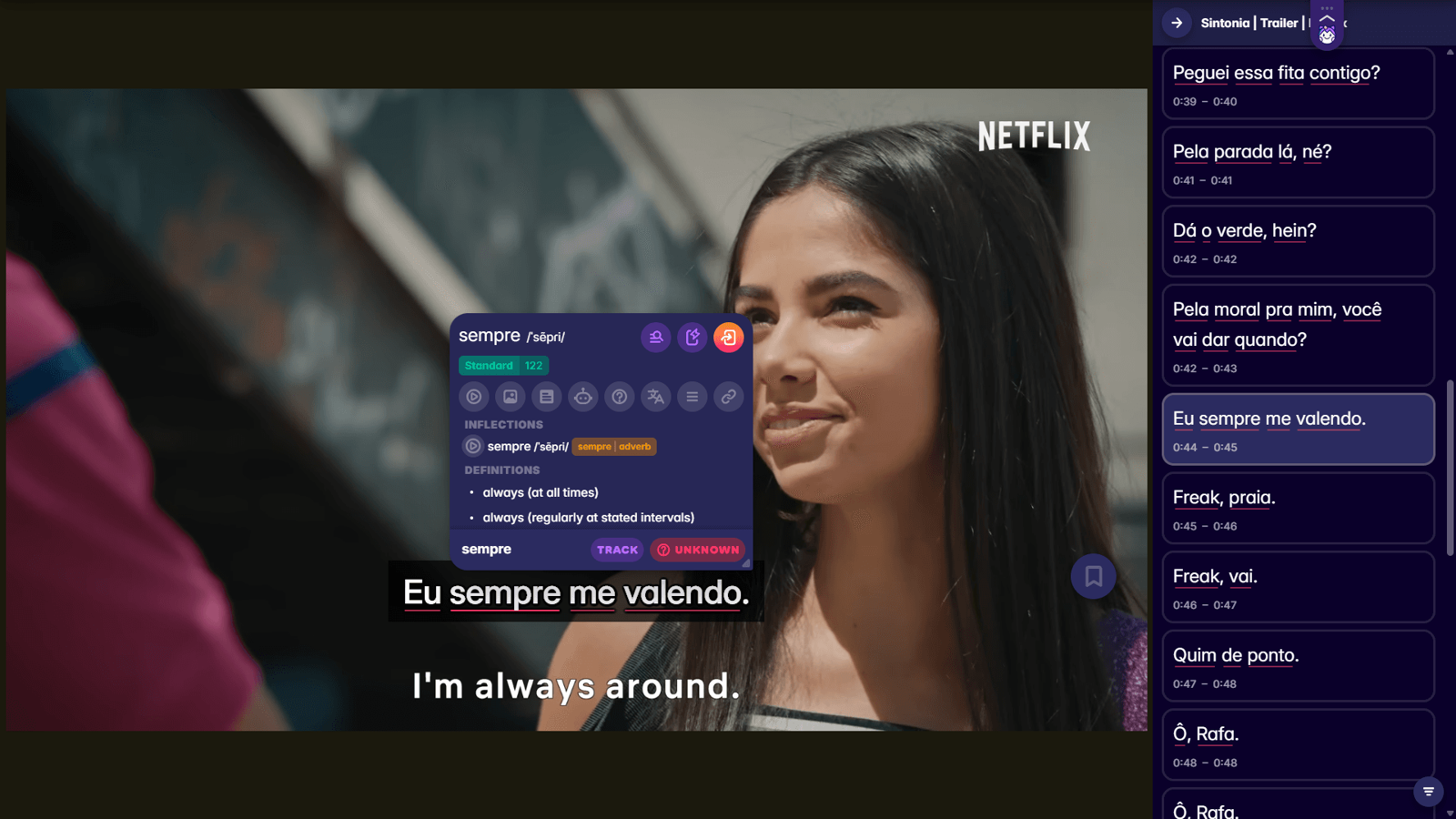
Watching videos is the best way to learn the context
Language learning happens through exposure and practice, so start watching videos about Portuguese greetings or watching dramas, movies, or reality shows extensively to get used to phrases for different situations. The more you see how people greet, the faster you can put textbook phrases into practice.
If you consume media in Portuguese, and you understand at least some of the messages and sentences within that media, you will make progress. Period.
Politeness isn't complex — it starts with "nice to meet you!"