How to Say Please in Portuguese: Politeness Expressions in Brazilian & European Portuguese
Last updated: April 2, 2026

Learning Portuguese "please" is one of those essential first steps that makes you sound polite instead of accidentally rude. The good news? Portuguese has a straightforward way to say please, but there are some regional differences and variations you'll want to know about. Whether you're planning a trip to Brazil, Portugal, or just want to have a polite conversation with Portuguese speakers, understanding when and how to use "por favor" and its variations will make your interactions way smoother.
How to say please in Portuguese
The most common way to say please in Portuguese is "por favor." You'll hear this phrase across all Portuguese-speaking countries, from Brazil to Portugal to Mozambique. The pronunciation is pretty straightforward: "poor fah-VOR" with the stress on the last syllable.
Here's the thing, "por favor" literally translates to "as a favor" or "for a favor," which actually makes sense when you think about polite requests. You're basically asking someone to do something as a favor to you.
In European Portuguese, especially in Portugal, you'll also hear "se faz favor" (pronounced "seh fahz fah-VOR") and its shortened form "faz favor." These mean essentially the same thing as por favor but are more commonly used in Portugal than in Brazil. The literal translation is "if you do the favor" or "if you please."
Some quick examples:
- Água, por favor.
Water, please. - Pode me ajudar, por favor?
Can you help me, please? - Faz favor?
Please? / Can I help you?
The pronunciation isn't too tricky for English speakers, but remember that Portuguese has nasal vowels that might take some practice. The "or" in "favor" sounds a bit different than in English, with a slightly rolled R at the end.
What is please in informal Portuguese
In Brazilian Portuguese, "por favor" works fine in informal contexts. You don't really need a separate informal version because por favor itself isn't overly formal. You'll hear friends use it with each other all the time: "Me passa o sal, por favor?" (Pass me the salt, please?)
Some Brazilians might drop the "por favor" entirely in very casual situations and rely on tone of voice and other softeners instead. You might hear "poderia" (could you), "dá pra" (is it possible to), or "teria como" (would there be a way to) to make requests sound less direct.
In Portugal, the informal scene is slightly different. "Faz favor" is common in everyday situations, and you'll hear it constantly in shops, cafes, and casual interactions. It's not really more or less formal than por favor, just a regional preference.
One thing to note: Portuguese speakers generally add "please" at the end of requests rather than at the beginning. "Por favor, água" sounds a bit awkward compared to "Água, por favor."
Common conversation phrases and example sentences
Let's look at some practical situations where you'll use please in Portuguese. These example sentences will help you understand the natural flow of polite requests.
At a restaurant:
- A conta, por favor.
The bill, please. - Mais água, por favor.
More water, please. - Poderia trazer o menu, por favor?
Could you bring the menu, please? - Onde fica o banheiro, por favor?
Where is the bathroom, please?
Asking for help:
- Pode me ajudar, por favor?
Can you help me, please? - Poderia repetir, por favor?
Could you repeat that, please? - Fala mais devagar, por favor?
Can you speak more slowly, please? - Me desculpe, poderia me indicar o caminho, por favor?
Excuse me, could you show me the way, please?
Shopping:
- Quanto custa, por favor?
How much does it cost, please? - Tem em outro tamanho, por favor?
Do you have it in another size, please? - Posso experimentar, por favor?
Can I try it on, please?
In Portugal specifically:
- Faz favor?
Can I help you? / What would you like? - Um café, se faz favor.
A coffee, please. - A senha, faz favor.
The ticket/number, please.
Transportation:
- Para aqui, por favor.
Stop here, please. / To here, please. - Uma passagem para Lisboa, por favor.
A ticket to Lisbon, please. - Poderia abrir a janela, por favor?
Could you open the window, please?
Notice how por favor usually comes at the end of the phrase? That's the natural position in Portuguese. You can put it at the beginning for emphasis, but it sounds more natural at the end.
Should please in Portuguese be capitalized
Nope, "por favor" doesn't get capitalized unless it's at the beginning of a sentence. It's not a proper noun, just a regular phrase.
You'll see it written as "Por favor" when it starts a sentence, but otherwise it stays lowercase: "Água, por favor."
Same goes for "se faz favor" and "faz favor." These are common phrases that follow normal capitalization rules.
This is different from some languages where polite forms get special capitalization treatment, but Portuguese keeps it simple. The only time you'd capitalize these phrases is in titles or at the start of sentences.
Making polite requests beyond "please"
Portuguese has other strategies for sounding polite that go beyond just adding por favor to everything. Learning these will make you sound more natural.
The conditional tense is your friend. "Poderia" (could you) and "gostaria" (I would like) automatically soften requests:
- Poderia me passar o sal?
Could you pass me the salt? - Gostaria de um café.
I would like a coffee.
Using "você" (you) or "o senhor/a senhora" (sir/madam) also affects politeness levels. In Brazil, "você" is standard, but "o senhor/a senhora" shows extra respect for older people or formal situations.
Questions naturally sound more polite than commands. "Pode fechar a porta?" (Can you close the door?) sounds way better than "Feche a porta" (Close the door), even without adding por favor.
Adding "se possível" (if possible) or "se não for incômodo" (if it's not too much trouble) makes requests even gentler:
- Poderia me ligar amanhã, se possível?
Could you call me tomorrow, if possible?
The phrase "teria como" (would there be a way to) is super common in Brazilian Portuguese for polite requests:
- Teria como me emprestar uma caneta?
Would there be a way you could lend me a pen?
Learning Portuguese through immersion
Here's where things get practical. You can memorize "por favor" and a bunch of polite phrases, but you'll really internalize them when you hear them in context.
- Watching Portuguese shows, movies, or YouTube videos gives you a sense of when and how native speakers actually use these phrases. You'll notice that the frequency and placement of "por favor" varies depending on the situation, the relationship between speakers, and regional preferences.
- Brazilian telenovelas are great for this because they feature tons of everyday conversations. You'll hear characters making requests, ordering at restaurants, and interacting politely (or impolitely) in ways that show you the natural flow of the language.
- Portuguese podcasts and video content from Portugal will expose you to "faz favor" and "se faz favor" in their natural habitat. You'll start picking up on the subtle differences in usage that are hard to explain in a textbook but obvious when you hear them.
If you want to learn Portuguese through actual content you enjoy, Migaku's browser extension and app let you look up words and save phrases while watching shows or reading articles. Makes the whole immersion thing way more practical. There's a 10-day free trial if you want to check it out.
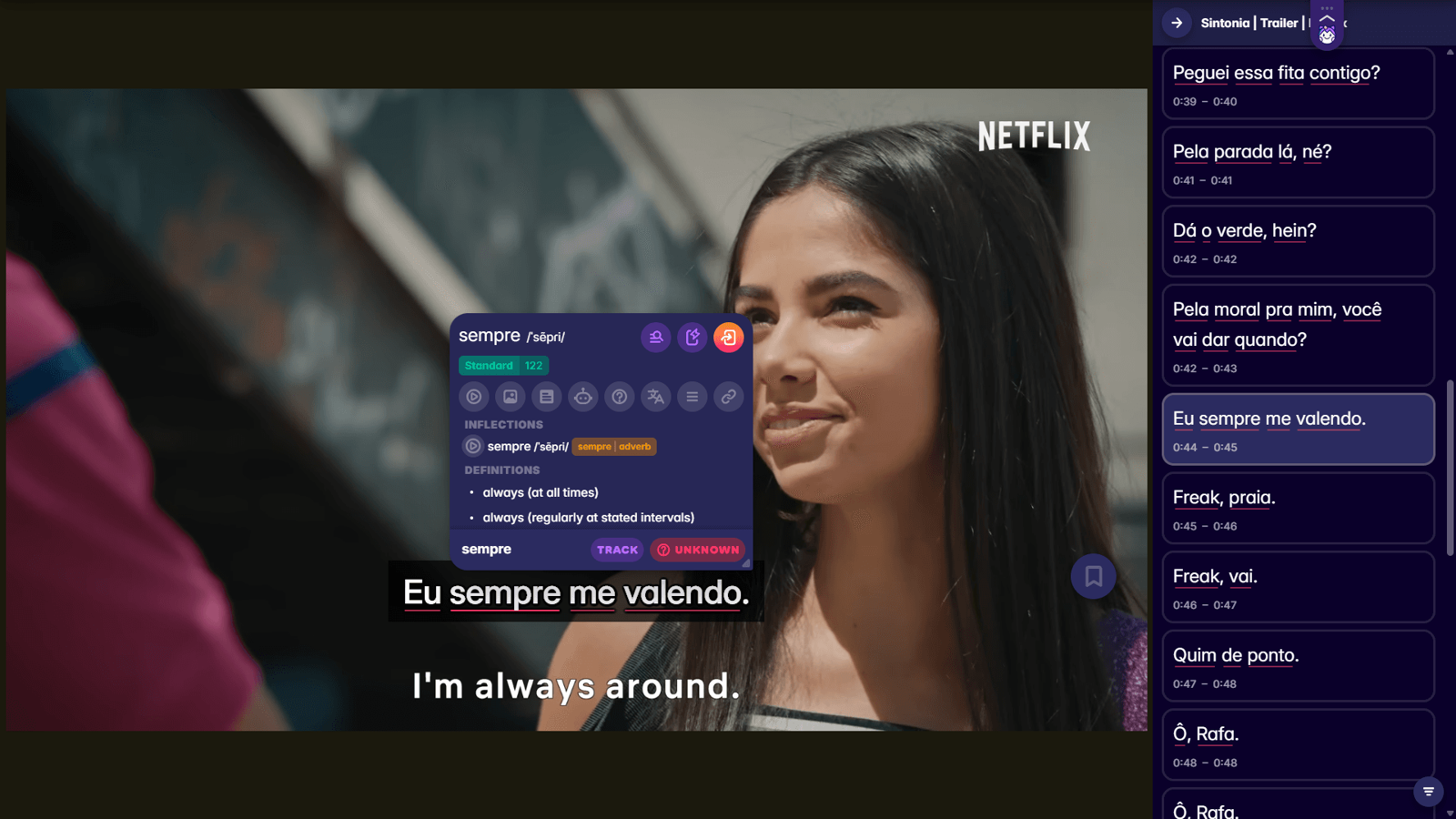
Native speakers will appreciate the effort you're making to be polite!
Combine the basic phrases with other courteous expressions like obrigado/obrigada, com licença, and desculpe, and you've got a solid foundation for polite interactions in Portuguese. The real learning happens when you start using these phrases in actual conversations or when you're consuming Portuguese media and hearing how native speakers deploy them naturally. Context teaches you way more than memorization ever could.
If you consume media in Portuguese, and you understand at least some of the messages and sentences within that media, you will make progress. Period.
Politeness invites politeness in return.🧡