Portuguese Directional Words: Handy Portuguese Phrases to Make Your Travel Easier
Last updated: March 14, 2026

Getting lost in Lisbon or São Paulo is pretty much a rite of passage for Portuguese learners, but you know what makes it way less stressful? Actually understanding when someone tells you to "virar à esquerda" or points you toward "a próxima rua." Learning directional vocabulary in Portuguese isn't just about memorizing a few words. You're building the practical language skills that'll help you navigate real streets, ask locals for help, and actually get where you're trying to go without pulling out Google Maps every thirty seconds.
Basic directional vocabulary
Let me start with the essentials. These are the words you'll hear constantly when asking for or receiving directions in Portuguese.
The most fundamental directional words are "esquerda" (left) and "direita" (right). You'll hear these paired with the verb "virar" (to turn) constantly. "Vire à esquerda" means "turn left," while "vire à direita" means "turn right."
"Em frente" or "reto" both mean straight ahead. In Portugal, you'll hear "sempre em frente" (Keep going straight) pretty often, while Brazilians might say "segue reto" more frequently. Both work fine, and locals will understand you either way.
Here's the thing about position words. "Perto" means near or close, while "longe" means far. You'll use these all the time: "É perto?" (Is it close?) or "Fica longe daqui?" (Is it far from here?). "Aqui" means here, "ali" means there (nearby), and "lá" means over there (farther away).
The word "em frente de" means in front of, which is different from just "em frente" (straight ahead). Yeah, it's a little confusing at first. "Ao lado de" means next to or beside, "atrás de" means behind, and "entre" means between.
Cardinal directions in Portuguese
The cardinal directions in Portuguese follow a pretty straightforward pattern.
Portuguese | English |
|---|---|
norte | North |
sul | South |
leste | East |
oeste | West |
When you're navigating in cities, you might hear "para o norte" (toward the north) or "na zona sul" (in the southern area). In Brazil especially, neighborhoods and districts often get described by their cardinal position: "Zona Norte de São Paulo" or "Zona Sul do Rio."
The intermediate directions work just like English.
Portuguese | English |
|---|---|
nordeste | Northeast |
noroeste | Northwest |
sudeste | Southeast |
sudoeste | Southwest |
Portugal's geography gets described this way constantly. The Algarve is in the south, Porto is in the north, and so on.
Imperative commands for giving directions
This is where things get practical. When someone gives you directions in Portuguese, they'll use imperative verb forms. These are commands, basically, but they're not rude at all. They're just the standard way to give directions.
- "Vire" (turn) is probably the most common. "Vire à esquerda na próxima esquina" means "turn left at the next corner."
- "Siga" means follow or continue: "Siga em frente" (continue straight ahead) or "Siga esta rua" (follow this street).
- "Continue" works similarly: "Continue até o semáforo" (continue until the traffic light).
- "Atravesse" means cross: "Atravesse a rua" (cross the street) or "Atravesse a ponte" (cross the bridge).
- "Pegue" (take) shows up constantly too. "Pegue a primeira à direita" means "take the first right." In Portugal, you might hear "apanhe" instead of "pegue" for the same meaning, though both work.
- "Desça" (go down) and "suba" (go up) refer to both literal elevation and street direction. "Desça a rua" means go down the street, while "suba até a praça" means go up to the square.
Learn Portuguese distance and position phrases
Describing distance in Portuguese uses some specific vocabulary that's worth learning.
- "Fica" is the verb you'll hear for location. "Fica perto do metro" (It's near the metro) or "Fica ao lado do banco" (It's next to the bank). This verb comes from "ficar," which has about a million meanings in Portuguese, but for directions it means "is located."
- "Depois de" means after: "Depois do supermercado, vire à direita" (after the supermarket, turn right).
- "Antes de" means before: "Antes da igreja, há uma farmácia" (before the church, there's a pharmacy).
- The phrase "no final da rua" means at the end of the street, while "no início" means at the beginning.
- "Na esquina" means at the corner, and you'll hear this constantly: "Vire na esquina" (turn at the corner).
Asking for directions like a local
When you need to ask for directions in Portuguese, there are a few standard phrases that work everywhere.
- "Com licença, onde fica...?" (Excuse me, where is...?) is probably the most common and polite way to start.
- "Como eu chego ao...?" means "How do I get to...?" and works perfectly for asking about specific locations. In Brazil, you might also hear "Como eu faço para chegar ao...?" which means the same thing but is a bit more colloquial.
- "Estou perdido" (I'm lost) if you're male, or "Estou perdida" if you're female. Adding this before asking for help makes people way more willing to give you detailed directions. Portuguese speakers are generally pretty helpful when you're clearly struggling.
- "Pode me mostrar no mapa?" means "Can you show me on the map?" This phrase has saved me countless times. Sometimes it's just easier to point at a map than to follow complex verbal directions.
- Here's a useful one: "Fica longe para ir a pé?" (Is it far to go on foot?). This helps you figure out whether you should walk or grab transportation.
Common landmarks and reference points
Portuguese directions rely heavily on landmarks rather than street names sometimes.
Transportation landmarks are super common.
Portuguese | English |
|---|---|
metro | Subway |
paragem de autocarro (Portugal) / ponto de ônibus (Brazil) | Bus stop |
estação de comboios (Portugal) / estação de trem (Brazil) | Train station |
Buildings you'll reference constantly:
Portuguese | English |
|---|---|
banco | Bank |
farmácia | Pharmacy |
supermercado | Supermarket |
igreja | Church |
praça | Square / Plaza |
jardim / parque | Park / Garden |
Street features matter too.
Portuguese | English |
|---|---|
semáforo | Traffic light |
rotunda (Portugal) / rotatória (Brazil) | Roundabout |
passadeira (Portugal) / faixa de pedestres (Brazil) | Crosswalk |
Practice to understand directions in Portuguese
You can't just memorize these words and phrases. You need to actually practice using them. Here are some methods that actually work.
- Try describing your daily route in Portuguese. How do you get from your home to work or school? Walk through it mentally using Portuguese directional vocabulary. "Saio de casa, viro à direita, sigo em frente até o semáforo..." and so on.
- Watch Portuguese YouTube videos of people walking through cities. Turn off subtitles and try to follow along with the directions they give. Lisbon and Rio walking tours work great for this. You'll hear natural speech patterns and real-world vocabulary.
- Use Google Street View to practice. Pick a starting point in a Portuguese-speaking city, then write out directions to a landmark. Check if your directions would actually get someone there. It sounds nerdy, but it works.
- Create flashcards specifically for directional phrases, not just individual words. "Vire à esquerda na próxima esquina" as a complete phrase is more useful than just memorizing "esquerda" by itself.
- Find a language exchange partner and practice giving each other directions to places in your respective cities. This combines speaking practice with practical vocabulary use.
Anyway, if you want to practice Portuguese words with real content, Migaku's browser extension and app let you look up words instantly while watching shows or reading articles from Portugal or Brazil. Makes language learning in context way more natural than just drilling flashcards. There's a 10-day free trial if you want to check it out.
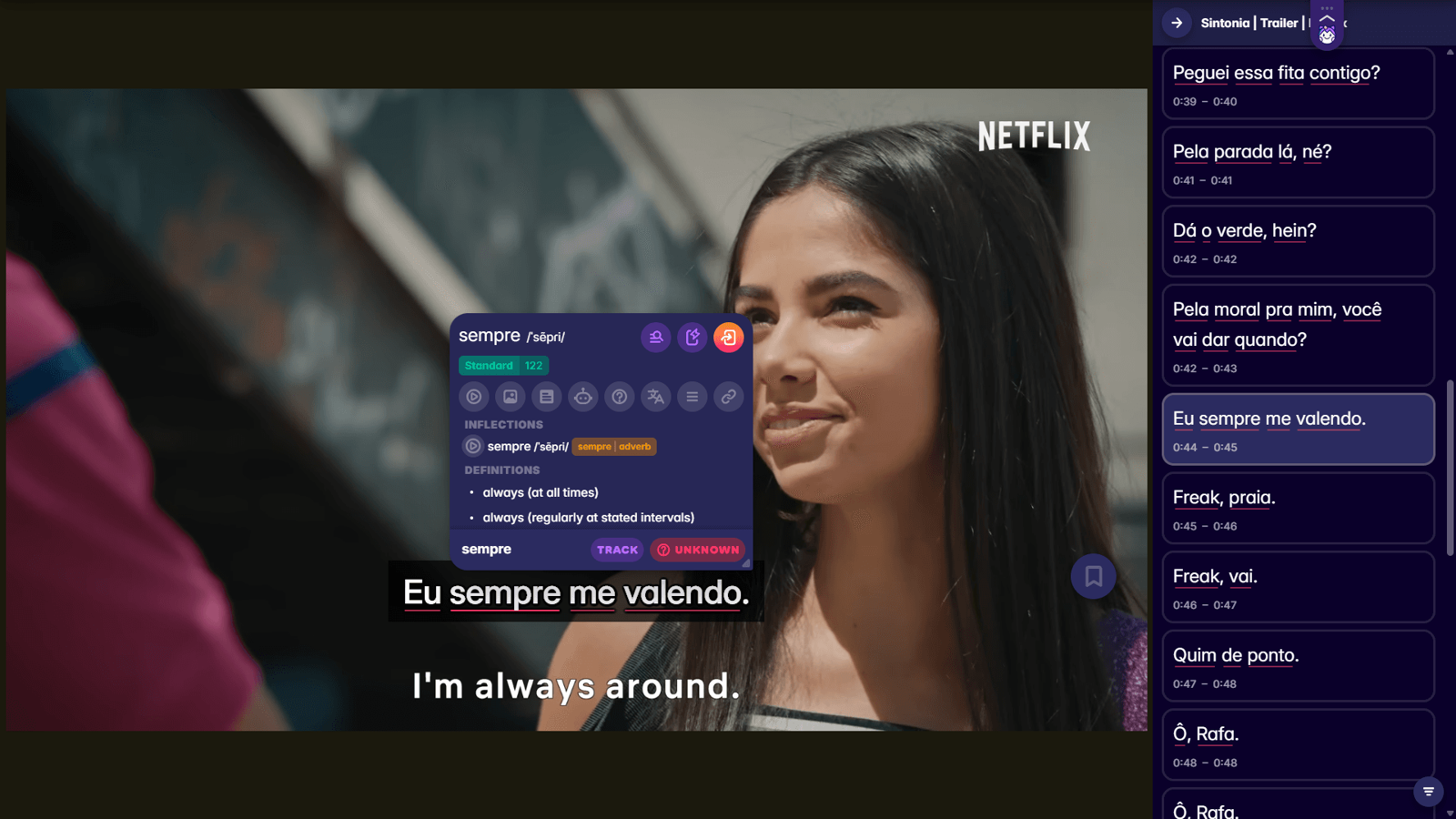
Learn vocabulary for directions immersively
The difference between memorizing a list and actually being able to navigate is practice with real scenarios. Watch videos, do the exercises I mentioned, and don't be afraid to make mistakes when you actually try speaking. Explore ten videos or listen to podcasts about the essential phrases for directions in Portuguese language before your travel. As you spend more time consuming Portuguese media content, you will get more and more used to the vocabulary for directions.
If you consume media in Portuguese, and you understand at least some of the messages and sentences within that media, you will make progress. Period.
Practice diligently, and speak confidently!