# Portuguese Future Tense: Talk About the Future in Portuguese With This Guide
> Form and use the Portuguese future tense, from simple future conjugation to informal ir + infinitive. Get practical examples for natural speech.
**URL:** https://migaku.com/blog/language-fun/portuguese-future-tense
**Last Updated:** 2026-02-26
**Tags:** fundamentals, conjugation, grammar, verbs
---
Learning how to talk about the future [in Portuguese](https://migaku.com/learn-portuguese) can feel a bit overwhelming at first. You've got the simple future tense, the informal "ir + infinitive" construction, and even the present tense doing double duty. Here's the thing though: once you understand how each method works and when Portuguese speakers actually use them, it all clicks into place. This guide breaks down everything you need to know about forming and using the Portuguese future tense, with plenty of examples to help you sound natural in conversation.
---
## Why Portuguese has multiple ways to express the future
Portuguese gives you several options for talking about future events, and each one carries a different vibe.
1. **The simple future tense** exists and works perfectly fine, but in everyday conversation, especially in Brazil, you'll hear people using other methods way more often. Think of it like how English speakers say "I'm gonna go" instead of "I shall go." Both are correct, but one sounds way more natural in casual settings. The formal simple future tense appears more in writing, news broadcasts, and formal speeches.
2. Meanwhile, the **"ir + infinitive"** construction dominates spoken Portuguese.
3. You'll also find Portuguese speakers **using the present tense with time markers** to talk about near-future events. Each method has its place, and knowing when to use which one makes you sound like a real speaker instead of a [textbook](https://migaku.com/blog/language-fun/best-portuguese-textbooks).
---
## The simple future tense in Portuguese
The simple future tense (futuro do presente) follows a pretty straightforward pattern.
> 💡 The Simple Future Tense 💡
You take the infinitive form of the verb and add specific endings. This works for all three verb groups: -ar, -er, and -ir verbs.
Here are the endings you'll add to the infinitive:
- eu: -ei
- tu: -ás
- ele/ela/você: -á
- nós: -emos
- vós: -eis
- eles/elas/vocês: -ão
Let's see how this works with the verb "falar" (to speak):
- eu falarei (I will speak)
- tu falarás (You will speak)
- ele/ela/você falará (He/She/You will speak)
- nós falaremos (We will speak)
- vós falareis (You all will speak)
- eles/elas/vocês falarão (They/You all will speak)
The same pattern applies to -er and -ir verbs. Take "comer" (to eat):
- eu comerei
- tu comerás
- ele/ela/você comerá
- nós comeremos
- vós comereis
- eles/elas/vocês comerão
And "partir" (to leave):
- eu partirei
- tu partirás
- ele/ela/você partirá
- nós partiremos
- vós partireis
- eles/elas/vocês partirão
Pretty cool how consistent it is, right? The endings stay the same across all conjugation groups.
### Irregular verbs in the simple future
Most verbs follow the regular pattern, but you've got three main irregular verbs to watch out for: "**fazer**" (to do/make), "**dizer**" (to say), and "**trazer**" (to bring).
For "fazer," the stem becomes "far-":
- eu farei
- tu farás
- ele/ela/você fará
- nós faremos
- vós fareis
- eles/elas/vocês farão
Notice how it drops the "ze" from the infinitive? The verb "dizer" does something similar, becoming "dir-":
- eu direi
- tu dirás
- ele/ela/você dirá
- nós diremos
- vós direis
- eles/elas/vocês dirão
And "trazer" becomes "trar-":
- eu trarei
- tu trarás
- ele/ela/você trará
- nós traremos
- vós trareis
- eles/elas/vocês trarão
These are the main irregular verbs you'll encounter in the simple future tense. Everything else follows the regular pattern, which makes life easier.
---
## The informal future: ir + infinitive
Here's where things get real.
> 💡 The Informal Future 💡
In everyday conversation, especially in Brazil, Portuguese speakers overwhelmingly prefer using the verb "ir" (to go) in the present tense plus the infinitive form of the main verb. This construction works exactly like "going to" in English.
First, you need to know how to conjugate "ir" in the present tense:
- eu vou
- tu vais
- ele/ela/você vai
- nós vamos
- vós ides
- eles/elas/vocês vão
Then you just add the infinitive of whatever action you're talking about:
- Eu vou falar com ela amanhã.
*I'm going to talk to her tomorrow.*
- Você vai comer agora?
*Are you going to eat now?*
- Nós vamos partir cedo.
*We're going to leave early.*
- Eles vão fazer o trabalho.
*They're going to do the work.*
This construction feels way more natural in conversation. If you walk around São Paulo or Lisbon and listen to people chatting, you'll hear "vou fazer" a million times before you hear "farei." The simple future tense sounds formal and stiff in casual settings.
The "ir + infinitive" method also works great for expressing immediate intentions or plans. When someone asks what you're doing tonight, you'd say "Vou assistir um filme" (I'm going to watch a movie), not "Assistirei um filme" (which sounds like you're making a solemn declaration).
---
## Using the present tense for future events
Portuguese speakers also use the present tense (presente) to talk about future events, especially when the context makes the timing clear. This happens a lot with scheduled events or when you mention a specific time marker.
- Amanhã eu viajo para o Brasil.
*Tomorrow I travel to Brazil.*
- A reunião começa às três.
*The meeting starts at three.*
- Na próxima semana, nós voltamos.
*Next week, we return.*
This usage mirrors how English speakers say things like "The train leaves at 5pm" or "I fly out tomorrow." The present tense works because the time reference makes it obvious you're talking about the future.
You'll hear this construction all the time in casual conversation. It's quick, efficient, and sounds completely natural. The key is including some kind of time marker (amanhã, na próxima semana, daqui a pouco) so your listener knows you're not talking about right now.
---
## Compound future constructions
Beyond the main methods, Portuguese has several compound constructions that express future actions with different nuances. These add flavor and specificity to your speech.
### Ter de + infinitive
This construction expresses obligation or necessity about future actions:
- Eu tenho de estudar amanhã.
*I have to study tomorrow.*
- Você tem de estar lá às oito.
*You have to be there at eight.*
### Haver de + infinitive
This older, more formal construction expresses determination or strong intention:
- Hei de conseguir!
*I shall succeed!*
- Havemos de vencer.
*We shall overcome.*
You won't hear this much in everyday [Brazilian](https://migaku.com/blog/language-fun/brazilian-vs-european-portuguese) Portuguese, but it pops up in European Portuguese and literary contexts.
### Estar para + infinitive
This indicates something about to happen or on the verge of occurring:
- O filme está para começar.
*The movie is about to start.*
- Ela está para chegar.
*She's about to arrive.*
These compound forms give you more tools to express exactly what kind of future action you're talking about.
---
## Formal vs informal usage across Portuguese-speaking regions
The choice between different future tenses depends heavily on formality and regional preferences.
- In Brazil, the informal "ir + infinitive" dominates everyday speech. You'll hear "vou fazer" way more than "farei" in casual conversations, TV shows, and even some news contexts.
- The simple future tense appears more in formal writing, legal documents, news articles, and formal speeches. When a Brazilian politician makes an official statement, they might say "O governo implementará novas políticas" (The government will implement new policies), but in a casual interview, the same person would probably say "O governo vai implementar novas políticas."
- European Portuguese shows a bit more variation. While "ir + infinitive" is still common in conversation, you'll hear the simple future tense more frequently than in Brazil, even in casual settings. The regional differences matter when you're trying to match the speaking style of the Portuguese variant you're learning.
---
## What are the different future tenses in Portuguese
Portuguese actually has several future tenses beyond what we've covered so far.
1. The **futuro do presente** (simple future) is what most learners think of first.
2. Then you've got the **futuro do pretérito** (conditional), which technically expresses hypothetical future actions from a past perspective.
3. There's also the **futuro do subjuntivo** (future subjunctive), which triggers after certain conjunctions and expressions of uncertainty. This tense appears in sentences like "Quando você chegar, me ligue" (When you arrive, call me). The future subjunctive sounds intimidating, but you'll pick it up naturally through exposure.
4. The **futuro perfeito** (future perfect) describes actions that will be completed before a certain future point: "Eu terei terminado o trabalho até amanhã" (I will have finished the work by tomorrow). This tense shows up less frequently in conversation but appears regularly in writing.
So depending on how you count, Portuguese has four to five distinct future tenses, plus the informal constructions we covered earlier. Each one serves a specific purpose in expressing different types of future events.
---
## Common mistakes to avoid
1. Learners often overcomplicate things by trying to use the simple future tense in casual conversation. Save it for formal contexts and stick with "ir + infinitive" when chatting with friends or speaking informally.
2. Another mistake is forgetting to conjugate "ir" properly before adding the infinitive. Make sure you're using the right form (vou, vai, vamos, etc.) to match your subject.
3. Some learners also mix up the future subjunctive with the simple future. Remember that the future subjunctive appears in dependent clauses after specific conjunctions, while the simple future stands alone in independent clauses.
4. Watch out for irregular verbs like "fazer," "dizer," and "trazer" in the simple future tense. These don't follow the standard pattern, so you need to memorize their specific forms.
5. Finally, don't forget time markers when using the present tense for future events. Without context clues like "amanhã" or "na próxima semana," your listener might think you're talking about the present moment.
---
## Practical tips for mastering the Portuguese future tense
1. Start by getting comfortable with "ir + infinitive" since you'll use it constantly in conversation. Practice conjugating "ir" until it becomes automatic, then add infinitives to express different actions. This construction will carry you through most casual situations.
2. Learn the simple future tense conjugation pattern next. Even though you won't use it as much in speech, you'll encounter it in reading, and knowing it makes you sound more sophisticated when the situation calls for formality.
3. Pay attention to context when consuming Portuguese content. Notice when speakers choose the simple future versus "ir + infinitive" versus the present tense. This awareness helps you develop an intuitive sense for which method fits different situations.
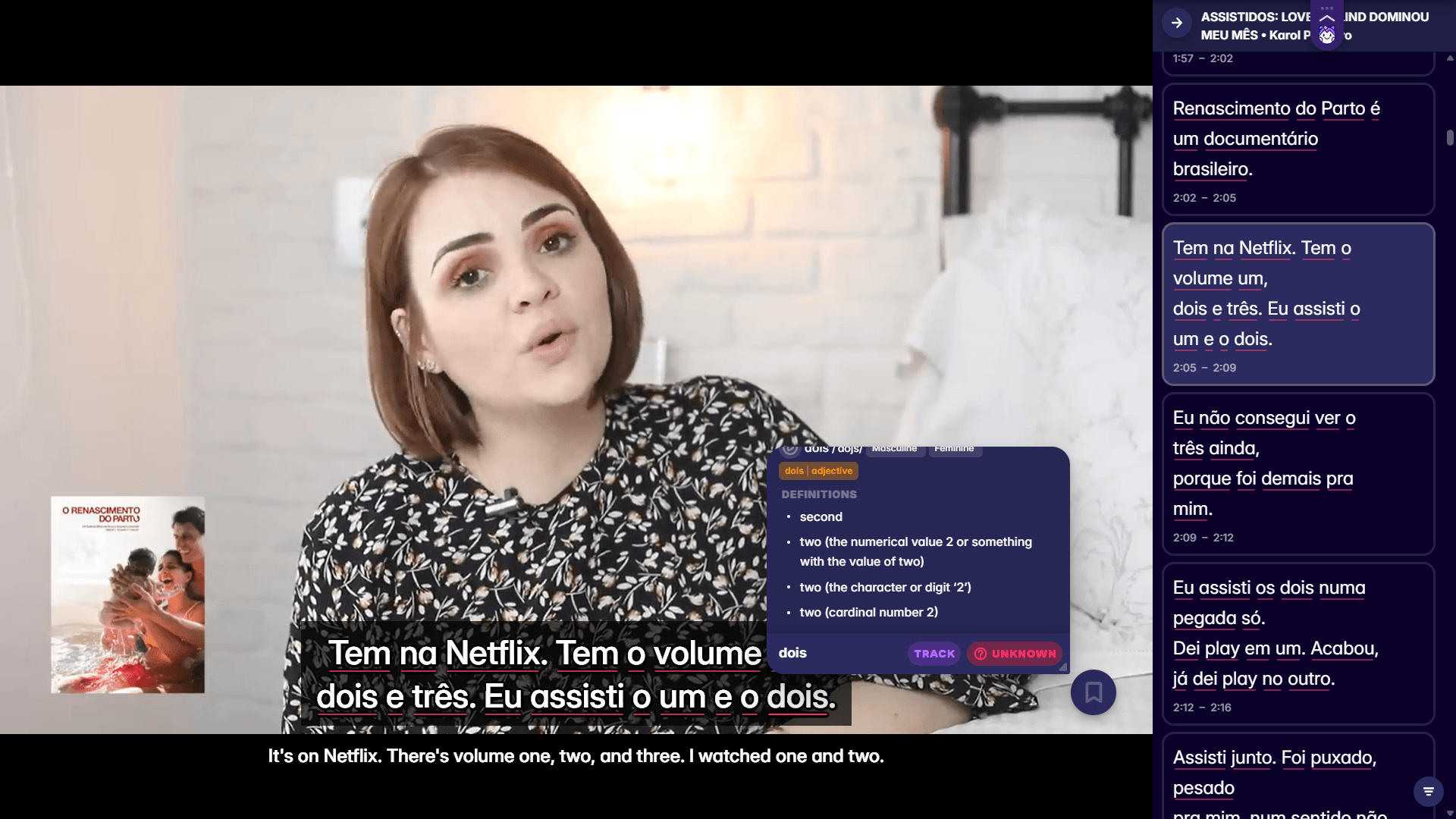
If you want to practice these tenses with real Portuguese content, Migaku's browser extension and app let you look up verb conjugations instantly while watching shows or reading articles. You can see these future constructions in context and build your understanding naturally. There's a 10-day free trial if you want to check it out.
 ---
## Start now. Perfection can come later!
Portuguese speakers will understand you regardless of which future form you choose. The important thing is communicating your meaning clearly. Practice with real examples from content you enjoy. When you hear a future tense in a song, podcast, or show, pause and think about why the speaker chose that particular construction. This active engagement speeds up your learning way more than drilling conjugation tables.
> If you consume media in Portuguese, and you understand at least some of the messages and sentences within that media, you will make progress. _Period_.
Practice first, perfection follows.💯
---
## Start now. Perfection can come later!
Portuguese speakers will understand you regardless of which future form you choose. The important thing is communicating your meaning clearly. Practice with real examples from content you enjoy. When you hear a future tense in a song, podcast, or show, pause and think about why the speaker chose that particular construction. This active engagement speeds up your learning way more than drilling conjugation tables.
> If you consume media in Portuguese, and you understand at least some of the messages and sentences within that media, you will make progress. _Period_.
Practice first, perfection follows.💯