Portuguese Passive Voice: Formation and Usage Guide
Last updated: March 30, 2026

If you're learning Portuguese and want to sound more formal or sophisticated, understanding the passive voice is pretty essential. The passive voice in Portuguese works differently from English, and honestly, it's used way more often in written Portuguese than in everyday conversation. But here's the thing: once you understand the basic formula and get comfortable with the conjugations, forming passive sentences becomes second nature. Let's break down exactly how to form and use the passive voice in Portuguese, with real examples you can use.
- Understanding what the passive voice does
- How to form the standard passive voice in Portuguese
- Working with irregular past participles
- Using the preposition "por" to introduce the agent
- Conjugating "ser" across different tenses
- Alternatives to "ser" in passive constructions
- The impersonal passive construction with "se"
- Active voice versus passive voice in Portuguese
- Common mistakes when forming passive sentences
Understanding what the passive voice does
The passive voice flips the typical sentence structure around. Instead of focusing on who performs an action, you emphasize what receives the action. In Portuguese, just like in English, this construction appears frequently in news articles, academic writing, and formal contexts.
Take this active voice sentence: "O chef preparou a comida" (The chef prepared the food). Here, the chef is the subject performing the action. In the passive voice, this becomes: "A comida foi preparada pelo chef" (The food was prepared by the chef). Now the food becomes the subject of the sentence, and the chef gets demoted to an optional agent introduced by "pelo" (by the).
Portuguese gives you two main ways to form passive constructions:
- The standard passive with ser plus the past participle
- The impersonal passive using "se"
Both are super common, but they work in different contexts.
How to form the standard passive voice in Portuguese
💡The most straightforward way to create passive voice in Portuguese follows this formula: subject + ser (conjugated) + past participle of the main verb + por + agent.
The auxiliary verb "ser" carries all the tense information. You conjugate ser in whatever tense you need, then add the past participle of your main verb. The past participle has to agree in gender and number with the subject, which is different from English where participles stay the same.
Here's how this works across different tenses:
- Present tense: "O livro é lido pelos estudantes" (The book is read by the students). The verb ser appears as "é" in the present tense, and "lido" agrees with the masculine singular noun "livro".
- Preterite tense: "A casa foi construída em 1920" (The house was built in 1920). Here, "foi" is the preterite form of ser, and "construída" takes the feminine singular ending to match "casa".
- Imperfect tense: "As cartas eram escritas à mão" (The letters were written by hand). The verb "eram" shows the imperfect tense, and "escritas" agrees with the feminine plural "cartas".
- Future tense: "O projeto será finalizado amanhã" (The project will be finished tomorrow). Using "será" for the future, with "finalizado" matching the masculine singular "projeto".
The past participle agreement is crucial. For regular verbs, you form the past participle by replacing the infinitive ending: -ar verbs become -ado, -er verbs become -ido, and -ir verbs also become -ido. Then you adjust for gender and number: preparado/preparada/preparados/preparadas.
Working with irregular past participles
Portuguese has quite a few irregular past participles that you'll need to memorize. These don't follow the standard -ado/-ido pattern, and they show up constantly in passive constructions.
Common irregular participles include:
Infinitive | Past Participle | English |
|---|---|---|
abrir | aberto | Opened |
escrever | escrito | Written |
fazer | feito | Done / Made |
ver | visto | Seen |
pôr | posto | Put |
dizer | dito | Said |
vir | vindo | Come |
Some verbs actually have two past participles: a regular one and an irregular one. Generally, you use the irregular form with ser and estar, and the regular form with ter and haver. For example, "aceitar" has both "aceito" and "aceitado". You'd say "O convite foi aceito" (The invitation was accepted) using the irregular form.
These irregular participles still need to agree with the subject in gender and number. So "aberto" becomes "aberta/abertos/abertas" depending on what you're describing.
Using the preposition "por" to introduce the agent
💡When you want to mention who performs the action in a passive sentence, you introduce them with the preposition "por" (by). This combines with the definite articles to form contractions: por + o = pelo, por + a = pela, por + os = pelos, por + as = pelas.
Examples:
- O romance foi escrito pela autora famosa.
The novel was written by the famous author. - Os documentos foram assinados pelo diretor.
The documents were signed by the director.
Here's something interesting: you don't always need to include the agent. In fact, passive sentences often omit the agent entirely when it's unknown, unimportant, or obvious from context. "A janela foi quebrada" (The window was broken) works perfectly fine without saying who broke it.
This actually makes the passive voice super useful for situations where you want to avoid assigning blame or simply don't know who did something. News reports use this constantly.
Conjugating "ser" across different tenses
Since ser carries all the tense information in passive constructions, you need to get comfortable conjugating it. Here are the key tenses you'll use most often:
- Present: sou, és, é, somos, sois, são
- Preterite: fui, foste, foi, fomos, fostes, foram
- Imperfect: era, eras, era, éramos, éreis, eram
- Future: serei, serás, será, seremos, sereis, serão
- Conditional: seria, serias, seria, seríamos, seríeis, seriam
The preterite forms "foi" and "foram" appear constantly in passive sentences describing completed past actions. "O prédio foi demolido" (The building was demolished). "As regras foram mudadas" (The rules were changed).
For ongoing past actions, you'd use the imperfect: "A cidade era governada por um prefeito corrupto" (The city was governed by a corrupt mayor).
The subjunctive mood also shows up in passive constructions when expressing doubt, wishes, or hypotheticals: "Espero que o problema seja resolvido" (I hope the problem is solved). The present subjunctive of ser includes: seja, sejas, seja, sejamos, sejais, sejam.
Alternatives to "ser" in passive constructions
While ser is the standard auxiliary verb for passive voice, Portuguese sometimes uses "estar" or "ficar" instead, creating slightly different meanings.
- Using "estar" plus the past participle emphasizes a resulting state rather than the action itself. "A porta está fechada" (The door is closed) focuses on the current state, while "A porta foi fechada" (The door was closed) emphasizes the action of closing.
- The verb "ficar" can replace ser to suggest the result of a process or transformation. "O homem ficou ferido no acidente" (The man was injured in the accident). This feels more dynamic than using ser, implying a change of state.
These alternatives don't technically form the passive voice in the grammatical sense, but they serve similar communicative functions and you'll encounter them frequently when learning Portuguese.
The impersonal passive construction with "se"
Portuguese has this really elegant way to form passive-like sentences using the pronoun "se". This construction is way more common in everyday speech than the formal passive with ser. Brazilians especially love this structure.
💡The formula is: se + verb (third person) + subject. The verb agrees with the subject in number, which technically makes this a reflexive construction, but it functions exactly like the passive voice.
Examples:
- Vendem-se casas.
Houses are sold / Houses for sale. - Fala-se português aqui.
Portuguese is spoken here. - Consertam-se computadores.
Computers are repaired.
Notice how the verb changes based on whether the subject is singular or plural. "Vende-se casa" (singular) versus "Vendem-se casas" (plural). The verb always comes in third person, either singular or third person plural.
This construction feels more natural and less formal than using ser plus the past participle. You'll see it everywhere on signs, advertisements, and casual writing. It's particularly common when the agent is people in general or completely unspecified.
One limitation: the "se" construction works best with transitive verbs and typically appears in present or imperfect tenses. For other tenses or with intransitive verbs, you'll want to use the standard passive with ser.
Active voice versus passive voice in Portuguese
Understanding when to use passive versus active voice helps you sound more natural.
Active voice puts the focus on the doer: "Maria escreveu o relatório" (Maria wrote the report). Passive voice shifts attention to the action or recipient: "O relatório foi escrito por Maria" (The report was written by Maria).
Portuguese speakers generally prefer active voice in conversation because it sounds more direct and personal. Passive voice appears more in written Portuguese, especially in journalism, academic papers, legal documents, and formal reports.
There's this general rule that works pretty well: if the doer matters more than the action, use active voice. If the action or the thing affected matters more, use passive voice. News headlines love passive constructions because they can omit agents and sound objective.
Brazilian Portuguese tends to favor the "se" construction over the formal passive with ser in everyday speech. European Portuguese uses both more freely, though the "se" construction remains extremely common.
Common mistakes when forming passive sentences
- One frequent error is forgetting to make the past participle agree with the subject. English speakers especially struggle with this because English participles don't change.
- Another mistake is using the wrong auxiliary verb. Some learners try to use "ter" or "haver" to form the passive voice like in compound tenses, but these don't work for passive constructions. You need ser (or occasionally estar/ficar).
- With the "se" construction, people sometimes forget to make the verb agree with the subject. "Vende-se carros" is wrong; it should be "Vendem-se carros" because "carros" is plural.
- Also, don't overuse the passive voice. Portuguese speakers use it less frequently than English speakers, especially in conversation. If you find yourself writing multiple passive sentences in a row, consider switching some to active voice for better flow.
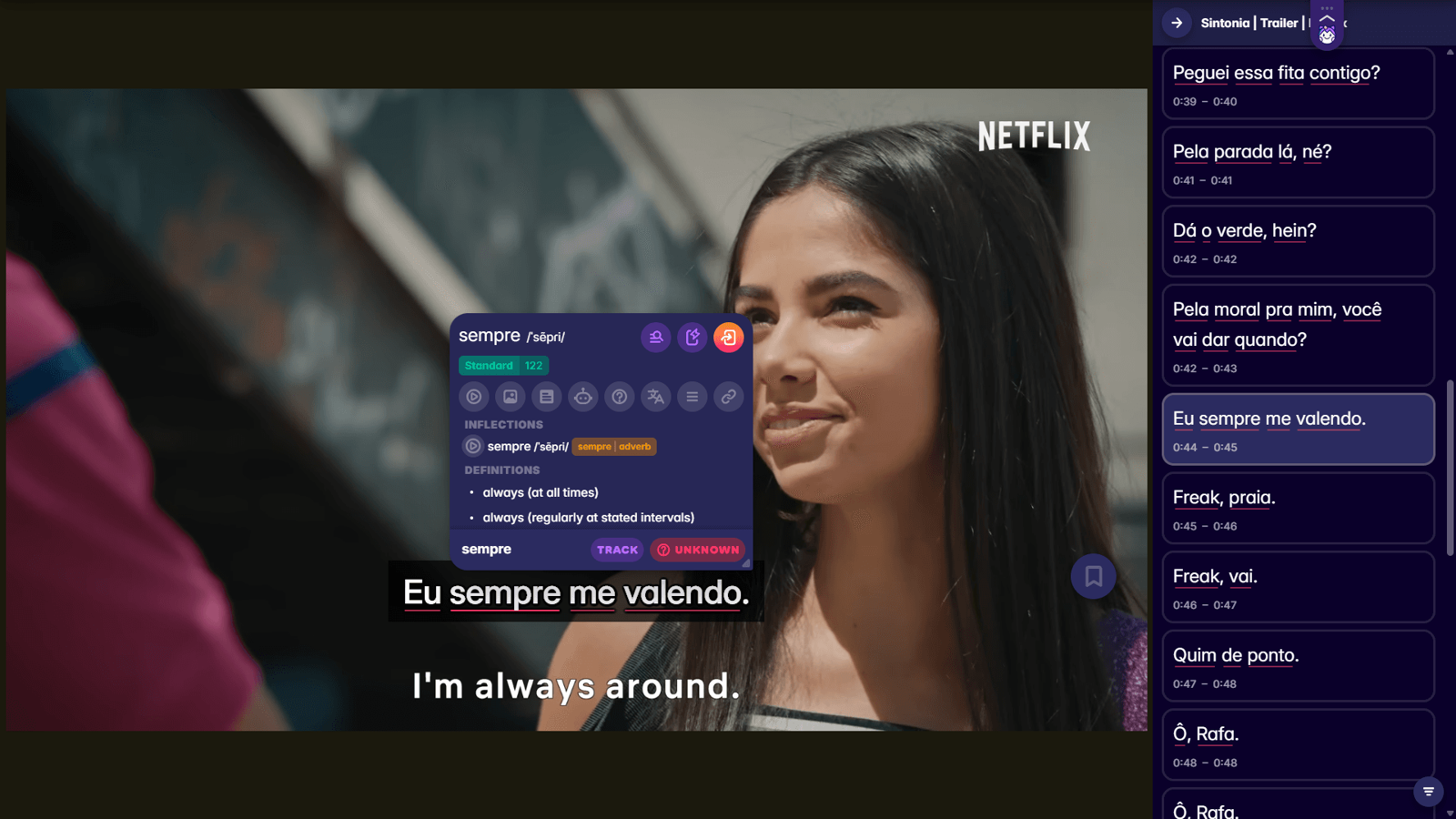
If you want to learn Portuguese through actual content instead of just textbook exercises, Migaku's browser extension and app let you look up words and save sentences instantly while watching shows or reading articles. Makes the whole immersion process way more practical. There's a 10-day free trial if you want to check it out.
Why immersion helps you learn Portuguese faster
You can memorize all the rules about forming passive voice, practice exercises until you're blue in the face, and still struggle to use it naturally. The real breakthrough comes when you start seeing these constructions in context, in actual Portuguese content that interests you. Reading news articles, watching shows, listening to podcasts, whatever Portuguese media you enjoy, that's where you'll internalize how native speakers use passive voice. You'll notice that some contexts call for it while others don't. You'll pick up the rhythm and feel of when a passive sentence sounds right.
If you consume media in Portuguese, and you understand at least some of the messages and sentences within that media, you will make progress. Period.
Interest accelerates learning.