# Portuguese Professions Vocabulary: Learn Words and Phrases to Talk About Jobs
> Talk about your job with Portuguese professions vocabulary. Covers masculine/feminine forms, example sentences, and conversational phrases.
**URL:** https://migaku.com/blog/language-fun/portuguese-professions-vocabulary
**Last Updated:** 2026-03-20
**Tags:** vocabulary, phrases
---
[Learning Portuguese](https://migaku.com/learn-portuguese) professions vocabulary is one of those topics that sounds boring until you realize how often jobs come up in everyday conversation. Whether you're introducing yourself, making small talk, or trying to understand what someone does for a living, knowing profession words in Portuguese makes a huge difference. Let's break down the most common professions, how to use them in sentences, and the conversational phrases you'll need.
----
## Masculine and feminine forms of professions
Portuguese nouns have gender, and professions follow this rule too. When talking about a male doctor, you'd say "médico." For a female doctor, it's "médica." The word changes based on who you're talking about.
1. Most professions follow predictable patterns. Words ending in **-o for masculine** typically change to **-a for feminine**. So "professor" (male teacher) becomes "professora" (female teacher). "Enfermeiro" (male nurse) becomes "enfermeira" (female nurse). Pretty straightforward once you see the pattern.
2. Some professions ending in **-or add an -a to make the feminine form**. "Vendedor" (male salesperson) becomes "vendedora." "Escritor" (male writer) becomes "escritora." You'll see this pattern with a bunch of common jobs.
3. Then there are professions that use the **same word for both genders**. "Dentista" works for both male and female dentists. Same with "jornalista" (journalist), "artista" (artist), and "estudante" (student). The article or context tells you the gender: "o dentista" (the male dentist) versus "a dentista" (the female dentist).
4. **A few professions only have one commonly used form.** "Médico" is used way more often than "médica" in some regions, though this is changing. Language evolves, and younger Portuguese speakers in Brazil especially tend to use both forms equally now.
----
## Common professions list
Let's get into the practical stuff. Here's a list of professions you'll hear constantly in Portuguese conversations, organized by how frequently they pop up:
**Professional and office jobs:**
| Portuguese | English |
| - | - |
| Médico / Médica | Doctor |
| Enfermeiro / Enfermeira | Nurse |
| Professor / Professora | Teacher |
| Advogado / Advogada | Lawyer |
| Engenheiro / Engenheira | Engineer |
| Contador / Contadora | Accountant |
| Dentista | Dentist |
| Arquiteto / Arquiteta | Architect |
| Programador / Programadora | Programmer |
| Gerente | Manager |
**Service and trade jobs:**
| Portuguese | English |
| - | - |
| Garçom / Garçonete | Waiter / Waitress |
| Cozinheiro / Cozinheira | Cook / Chef |
| Motorista | Driver |
| Vendedor / Vendedora | Salesperson |
| Cabeleireiro / Cabeleireira | Hairdresser |
| Mecânico / Mecânica | Mechanic |
| Eletricista | Electrician |
| Encanador / Encanadora | Plumber |
| Pedreiro | Construction worker |
| Pintor / Pintora | Painter |
**Creative and media professions:**
| Portuguese | English |
| - | - |
| Jornalista | Journalist |
| Fotógrafo / Fotógrafa | Photographer |
| Designer | Designer |
| Músico / Música | Musician |
| Ator / Atriz | Actor / Actress |
| Escritor / Escritora | Writer |
| Artista | Artist |
**Business and administration:**
| Portuguese | English |
| - | - |
| Empresário / Empresária | Business owner |
| Secretário / Secretária | Secretary |
| Recepcionista | Receptionist |
| Diretor / Diretora | Director |
| Administrador / Administradora | Administrator |
This list covers maybe 70% of the professions you'll encounter in normal Portuguese conversation. Sure, there are hundreds more, but these are the ones that come up again and again.
----
## How to say company, job, and employee in Portuguese vocabulary
Beyond specific profession names, you need some general work-related vocabulary. These words form the foundation of any conversation about employment.
- **"Empresa" ** means company. You'll use this constantly: "Eu trabalho em uma empresa de tecnologia" (I work at a technology company). In Brazil, you might also hear **"firma" ** for company, though it sounds a bit old-fashioned.
- **"Trabalho" ** is the word for work or job. It works as both a noun and a verb form. "Meu trabalho é interessante" (My job is interesting). You can also use **"emprego" ** specifically for job in the sense of employment: "Consegui um novo emprego" (I got a new job).
- **"Funcionário" ** (masculine) or **"funcionária" ** (feminine) means employee. "Ela é funcionária do banco" (She's a bank employee). **"Empregado" ** and **"empregada" ** also mean employee, but sound more formal.
- **"Chefe" ** means boss and works for both genders, though you might hear **"chefa" ** for a female boss in Brazil.
- **"Colega" ** means colleague or coworker and doesn't change based on gender.
- **"Salário" ** is salary. **"Escritório" ** is office. **"Reunião" ** is meeting. These words show up in any workplace conversation, so they're worth memorizing alongside the profession vocabulary.
----
## Example sentences using profession vocabulary
Seeing words in context helps them stick way better than just memorizing lists. Here are example sentences you'd actually hear or use:
- Meu pai é médico e minha mãe é professora.
*My father is a doctor and my mother is a teacher.*
- Ela trabalha como engenheira em uma empresa grande.
*She works as an engineer at a large company.*
- Você conhece algum bom advogado?
*Do you know any good lawyers?*
- O garçom trouxe a conta.
*The waiter brought the check.*
- Minha irmã é jornalista e mora em São Paulo.
*My sister is a journalist and lives in São Paulo.*
- Preciso marcar uma consulta com o dentista.
*I need to schedule an appointment with the dentist.*
- Ele é programador e trabalha de casa.
*He's a programmer and works from home.*
- A cozinheira deste restaurante é excelente.
*The chef at this restaurant is excellent.*
- Meu colega é fotógrafo profissional.
*My colleague is a professional photographer.*
- Estou procurando emprego como vendedor.
*I'm looking for work as a salesperson.*
These sentences show how profession words fit into everyday Portuguese. Notice how the verb "ser" (to be) is used with professions: "sou médico" (I am a doctor), "ele é professor" (he is a teacher).
----
## Conversational phrases about jobs and professions
When you're talking to someone in Portuguese, you need more than just vocabulary. You need the phrases that make conversations flow naturally.
**To ask what someone does:**
- O que você faz?
*What do you do?* (Most common in Brazil)
- Qual é a sua profissão?
*What's your profession?* (More formal)
- Em que você trabalha?
*What do you work in?*
- Onde você trabalha?
*Where do you work?*
**To answer about your profession:**
- Sou professor / professora.
*I'm a teacher.*
- Trabalho como enfermeiro / enfermeira.
*I work as a nurse.*
- Sou estudante de medicina.
*I'm a medical student.*
- Trabalho em uma empresa de marketing.
*I work at a marketing company.*
- Estou desempregado / desempregada.
*I'm unemployed.*
- Sou autônomo / autônoma.
*I'm self-employed.*
**To discuss work in general:**
- Gosto do meu trabalho.
*I like my job.*
- O trabalho está difícil ultimamente.
*Work has been difficult lately.*
- Vou mudar de emprego.
*I'm going to change jobs.*
- Recebi uma promoção.
*I got a promotion.*
These phrases come up in basically every conversation where you're getting to know someone. Master these, and you can handle the job talk portion of small talk without breaking a sweat.
----
## Should Portuguese professions vocabulary be capitalized
Quick grammar note because this trips people up: profession names in Portuguese are **NOT capitalized unless they start a sentence**. In English, we might write "She is a Doctor" in some formal contexts, but in Portuguese, it's always "Ela é médica" with a lowercase m.
This applies to all professions. "O professor chegou" (The teacher arrived), "Minha amiga é advogada" (My friend is a lawyer), "Conheci um engenheiro ontem" (I met an engineer yesterday). All lowercase.
The only exception is when the profession word starts a sentence: "Médicos recomendam exercício regular" (Doctors recommend regular exercise). Otherwise, keep them lowercase.
This is different from how Portuguese handles some other categories of words, so it's worth remembering as a specific rule for professions.
----
## Brazilian vs European Portuguese differences in profession vocabulary
Most profession vocabulary works the same in Brazil and Portugal, but there are some differences worth knowing about. The core words like médico, professor, and engenheiro are universal, but some professions have regional variations.
1. In Brazil, you'll hear "garçom" and "garçonete" for waiter and waitress. In Portugal, they often use "empregado de mesa" or just "empregado."
2. A lawyer is "advogado" in both places, but you might hear "causídico" in very formal Portuguese contexts in Portugal.
3. "Motorista" (driver) works everywhere, but in Portugal, you might hear "condutor" more often.
4. A salesperson is "vendedor" universally, but Portugal sometimes uses "comerciante" for shopkeeper or merchant.
----
## Building your profession vocabulary effectively
Learning all these profession words at once is overwhelming and unnecessary.
1. Focus on the professions that matter to your life first. Learn how to say your own job, your family members' jobs, and your friends' professions. These are the ones you'll actually use.
2. Create example sentences using professions in contexts that matter to you. Personal connections make vocabulary stick way better than abstract memorization.
3. Group professions by category in your mind. Medical professions together, creative professions together, trade professions together. This creates mental associations that help with recall.
4. Practice the conversational phrases as complete units. Don't just memorize "médico" as an isolated word. Practice the whole phrase "Sou médico" or "Minha mãe é médica." This prepares you for conversations instead of vocabulary quizzes.
5. Pay attention to professions when you're [consuming Portuguese content](https://migaku.com/blog/language-fun/comprehensible-input-method-language-learning). When you're watching a Brazilian show and a character mentions their job, notice the word they use. When you're reading a Portuguese news article about someone, check how they describe the person's profession. Real-world exposure beats flashcards every time.
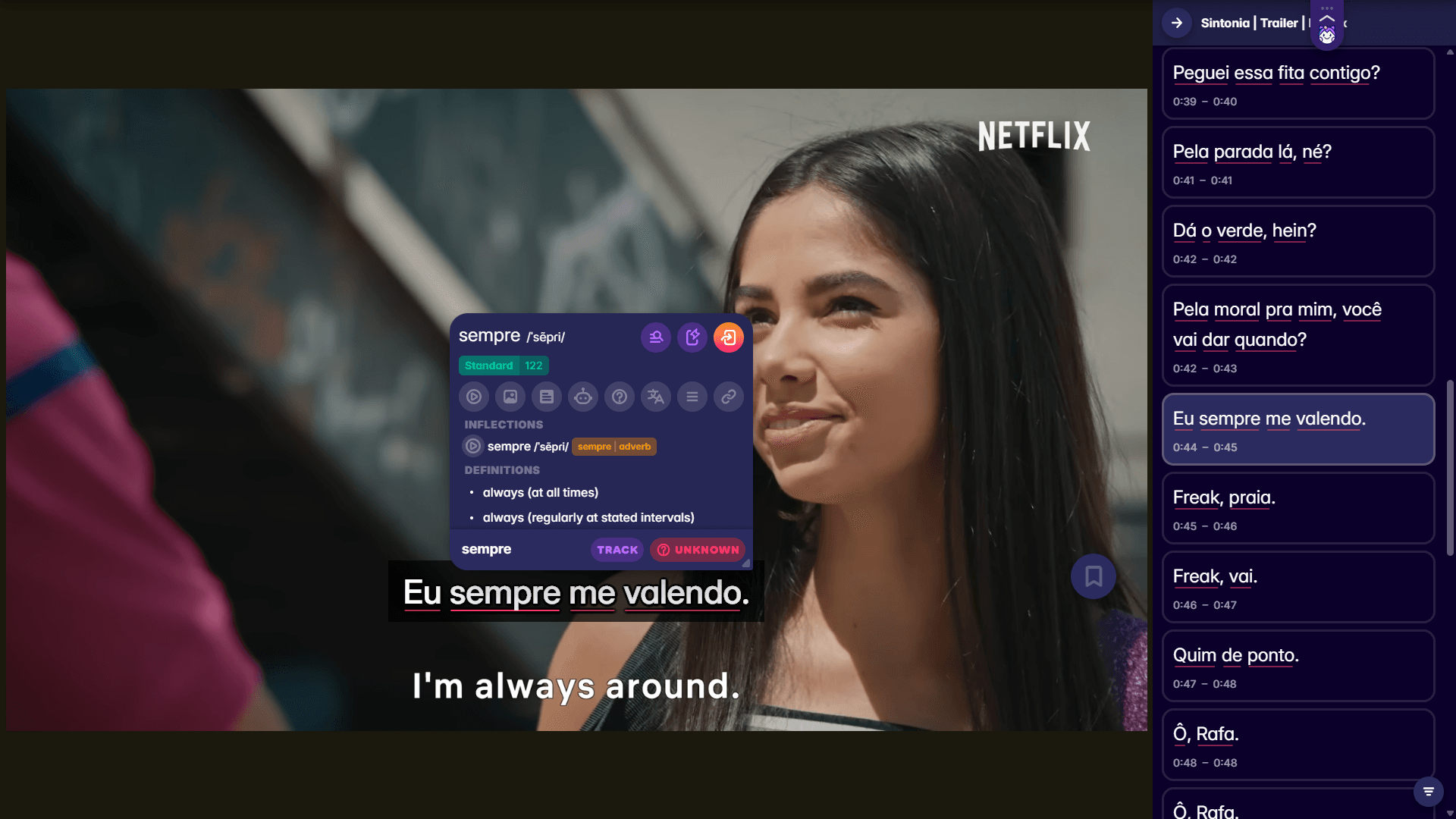
Anyway, if you want to practice this vocabulary with real Portuguese content, Migaku's browser extension and app let you look up profession words and any other vocabulary instantly while watching shows or reading articles. Makes learning from actual Portuguese way more practical. There's a 10-day free trial if you want to check it out.
 ----
## Why profession vocabulary matters in Portuguese
Beyond introductions, profession words show up in news articles, job postings, casual chats about friends and family, and even in [Portuguese TV shows](https://migaku.com/blog/language-fun/best-portuguese-shows-language-learners) when characters talk about their work lives. You can't really get around learning these words if you want to have normal conversations or improve your listening comprehension.
> If you consume media in Portuguese, and you understand at least some of the messages and sentences within that media, you will make progress. _Period_.
The vocabulary itself isn't super hard. Embrace the challenge!
----
## Why profession vocabulary matters in Portuguese
Beyond introductions, profession words show up in news articles, job postings, casual chats about friends and family, and even in [Portuguese TV shows](https://migaku.com/blog/language-fun/best-portuguese-shows-language-learners) when characters talk about their work lives. You can't really get around learning these words if you want to have normal conversations or improve your listening comprehension.
> If you consume media in Portuguese, and you understand at least some of the messages and sentences within that media, you will make progress. _Period_.
The vocabulary itself isn't super hard. Embrace the challenge!