# Portuguese Relative Pronouns: Comprehensive Guide to Relative Pronoun Que and Others
> Master Portuguese relative pronouns que, quem, and onde to build natural, complex sentences. Clear explanations, examples, and tips for learners.
**URL:** https://migaku.com/blog/language-fun/portuguese-relative-pronouns
**Last Updated:** 2026-04-01
**Tags:** fundamentals, grammar
---
Portuguese relative pronouns might sound like a grammar nightmare as you start to [learn Portuguese](https://migaku.com/learn-portuguese), but they're actually the secret sauce that makes your sentences flow naturally. If you've been stringing together short, choppy sentences because you're not sure how to connect ideas smoothly, understanding que, quem, and onde will level up your Portuguese fast. These little words let you build complex thoughts just like native speakers do, and honestly, they're way simpler than you might think.
----
## What are relative pronouns in Portuguese
> 💡 Definition 💡
Relative pronouns **connect two clauses together, letting you add extra information about a noun** without starting a whole new sentence. In English, we use words like "who," "which," "that," and "where" all the time. Portuguese does the same thing, just with its own set of pronouns.
Here's the thing: Portuguese relative pronouns help you avoid repetition and make your speech sound way more natural. Instead of saying "I have a friend. The friend lives in Brazil," you can say "I have a friend who lives in Brazil." That second version flows better, right? Portuguese works exactly the same way.
The main relative pronouns in Portuguese are que, quem, onde, o qual (and its variations), and cujo. Each one has specific uses, and while some overlap with English patterns, others work a bit differently. Getting comfortable with these will seriously improve how natural you sound when speaking Portuguese.
----
## The versatile workhorse: que
**Que ** is by far the most common relative pronoun you'll encounter. It works for **both people and things**, and it doesn't change based on gender or number. This makes it super convenient because you don't need to worry about matching it to what comes before.
- You can use que to refer to **people**: "A mulher que trabalha aqui é minha irmã" (The woman who works here is my sister).
- You can also use it for **things**: "O livro que comprei é interessante" (The book that I bought is interesting). See how flexible it is?
Que functions as **both a subject and a direct object** in relative clauses.
- When it's the subject, it's doing the action: "O homem que mora ao lado é professor" (The man who lives next door is a teacher).
- When it's the object, something is being done to it: "O filme que assistimos foi ótimo" (The movie that we watched was great).
Pretty much every Portuguese learner starts with que because it covers so many situations. If you're ever unsure which relative pronoun to use, que is often a safe bet. Just remember that when you need a preposition before the pronoun, things get a bit more specific.
### When que needs help from prepositions
Sometimes you'll see que paired with prepositions like **em, de, or com**. This happens when the verb in the relative clause requires that preposition. For example: "A casa em que moro é pequena" (The house in which I live is small). The verb "morar" needs the preposition "em," so it comes before que.
Another example: "O assunto de que falamos é importante" (The subject about which we talked is important). The verb "falar" uses "de" when talking about a topic, so you get "de que."
In casual Brazilian Portuguese, people often drop the preposition entirely and just use que. You might hear "A casa que moro" instead of "A casa em que moro." This is super common in spoken language, though more formal writing keeps the preposition.
----
## Using quem for people with prepositions
**Quem ** **specifically refers to people**, and you'll mostly see it after prepositions. While que can technically work after prepositions too, quem is the go-to choice when you're talking about humans.
Here's a typical example: "A pessoa com quem falei foi muito simpática" (The person with whom I spoke was very friendly). You need "com" because of how "falar com" works, and since we're talking about a person, quem fits perfectly.
More examples:
- O amigo para quem dei o presente ficou feliz.
*The friend to whom I gave the gift was happy.*
- As pessoas de quem gosto moram longe.
*The people whom I like live far away.*
Without a preposition, you'd just use que instead: "A pessoa que me ajudou foi gentil" (The person who helped me was kind). Quem works specifically in those prepositional situations, making it a bit more specialized than que.
----
## Onde and aonde for locations
**Onde ** means "where" and refers to **places**. It's invariable, meaning it doesn't change form regardless of what you're describing. You'll use it when talking about locations:
- A cidade onde nasci é pequena.
*The city where I was born is small.*
Portuguese grammar actually distinguishes between onde (static location) and aonde (movement toward a place). **Aonde ** combines "a" (to) with "onde," so it indicates **direction**:
- O lugar aonde vamos é lindo.
*The place where we're going is beautiful.* (The verb "ir" (to go) implies movement, so technically aonde is correct here)
In practice, especially in Brazilian Portuguese, most people just use onde for everything. You'll hear "O lugar onde vamos" way more often than "O lugar aonde vamos." [European Portuguese tends to maintain](https://migaku.com/blog/language-fun/brazilian-vs-european-portuguese) the distinction more strictly, but even there, onde dominates in casual speech.
You can also use onde with prepositions: "A escola de onde vim fica longe" (The school from where I came is far away). This adds another layer of specificity about the relationship between the clauses.
----
## The formal alternative: o qual and variations
**O qual ** is a more **formal relative pronoun that changes based on gender and number**. You get:
- o qual (masculine singular)
- a qual (feminine singular)
- os quais (masculine plural)
- as quais (feminine plural)
These forms agree in gender and number with the noun they refer to.
This pronoun shows up mostly in written Portuguese or very formal speech. For example:
- O documento o qual assinei está aqui.
*The document which I signed is here.* (You could easily replace "o qual" with "que" and sound more natural: "O documento que assinei está aqui")
The real advantage of o qual comes when you need clarity. If you have a complex sentence with multiple nouns, o qual makes it crystal clear which noun you're referring to because it matches in gender and number.
- A filha do professor, a qual mora em Lisboa, é médica.
*The professor's daughter, who lives in Lisbon, is a doctor.* (The feminine "a qual" clearly refers to "a filha," not "o professor")
With prepositions, o qual contracts just like articles do. You get do qual, da qual, no qual, na qual, and so on.
- A empresa para a qual trabalho é grande.
*The company for which I work is large.* (This sounds pretty formal compared to just saying "A empresa para que trabalho" or even dropping the preposition in casual speech)
----
## The possessive cujo and its forms
**Cujo ** is the **possessive relative pronoun, meaning "whose" in English**. It also changes based on gender and number: cujo, cuja, cujos, cujas. Here's the tricky part: cujo agrees with the thing being possessed, not the possessor.
Check out this example:
- O homem cujo carro quebrou está aqui.
*The man whose car broke down is here.* (Carro is masculine singular, so you use "cujo," even though you're talking about a man)
- A mulher cuja casa é bonita.
*The woman whose house is beautiful.* (You'd use "cuja" because "casa" is feminine)
Cujo connects two nouns with a possessive relationship. You'll see it in formal writing and legal documents more than everyday conversation. Most Portuguese speakers would rephrase to avoid it in casual speech. Instead of "O autor cujo livro li," they might say "O autor do livro que li" (The author of the book that I read).
The plural forms work the same way:
- Os alunos cujos trabalhos foram aprovados passaram.
*The students whose papers were approved passed.* ("Cujos" matches with "trabalhos" (masculine plural), not "alunos")
----
## Portuguese pronouns beyond relatives
While we're focused on relative pronouns, it helps to understand where they fit in the bigger picture of pronouns in Portuguese.
1. **Personal pronouns** like eu, você, ele, and ela handle subjects and objects. Demonstrative pronouns like este, esse, and aquele point to specific things.
2. **Possessive pronouns** like meu, seu, and nosso show ownership.
3. **Relative pronouns** connect ideas and build complexity. They work alongside these other pronoun types to create the full range of Portuguese expression.
When you're [learning Portuguese grammar](https://migaku.com/blog/language-fun/best-portuguese-grammar-guide), understanding how all these pieces fit together makes each individual part easier to grasp.
The conjugation of verbs also plays into how you use relative pronouns. Since Portuguese verbs change endings based on the subject, you need to pay attention to agreement. "As pessoas que falam português" uses the third person plural "falam" to match "pessoas."
----
## Common mistakes learners make
1. One huge mistake is forgetting that que is invariable. English speakers sometimes try to change it based on the noun, but que stays the same whether you're talking about one thing or many things, masculine or feminine. "O livro que li" and "Os livros que li" both use the exact same "que."
2. Another error is mixing up que and quem after prepositions. Remember, when you have a preposition and you're talking about people, quem usually sounds better. "A pessoa com que falei" works grammatically, but "A pessoa com quem falei" sounds more natural.
3. People also struggle with cujo because it's so formal and the agreement pattern feels backward. If you're not sure, just rephrase the sentence. There's almost always a simpler way to say the same thing using que or another structure.
4. Dropping necessary prepositions is common in speech, but can confuse meaning. While "O lugar que vou" might fly in casual Brazilian Portuguese, "O lugar para onde vou" or "O lugar aonde vou" is clearer and more correct.
----
## Tips for mastering relative pronouns in Portuguese
1. Start by focusing on que since it covers the most ground. Get comfortable using it in simple sentences before moving to the more specialized pronouns. Practice building relative clauses by combining two short sentences into one longer, more sophisticated one.
2. Listen to how native speakers actually use these pronouns. You'll notice that spoken Portuguese often simplifies what you see in grammar books. Brazilian Portuguese especially tends toward simpler structures in casual conversation.
3. Pay attention to which verbs require which prepositions. This knowledge directly affects how you'll use relative pronouns. If you know "falar de" means "to talk about," you'll know to use "de que" or "de quem" in relative clauses.
4. Read Portuguese texts at different formality levels. News articles, blog posts, and literature all use relative pronouns differently. Seeing the range helps you understand when to use formal options like o qual or cujo versus sticking with simple que.
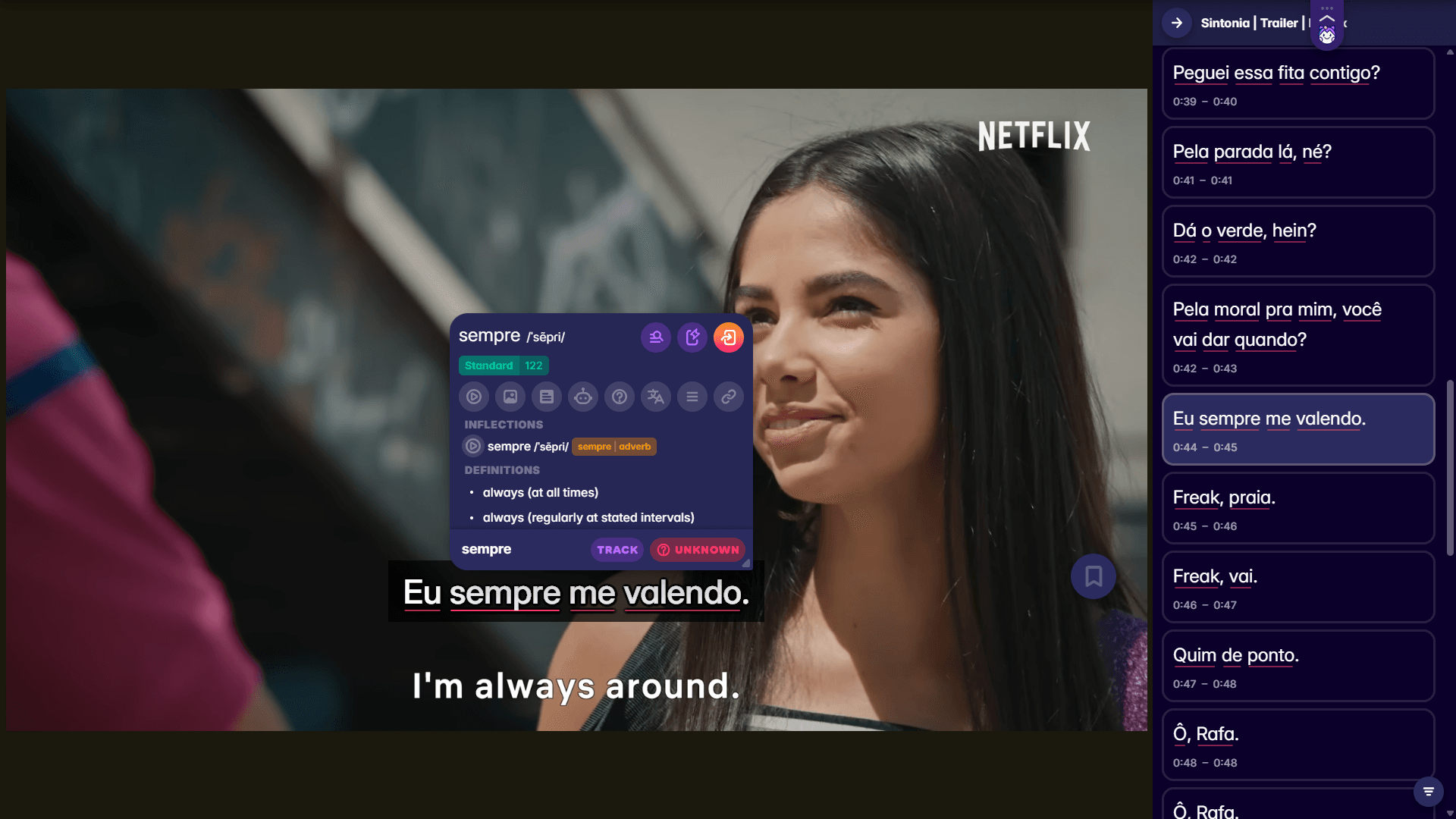
Anyway, if you want to practice with real Portuguese content, Migaku's browser extension and app let you look up words and save example sentences while watching shows or reading online. Makes learning these grammar patterns way more natural than just memorizing rules. There's a 10-day free trial if you want to check it out.
 ----
## Relative clauses transform your Portuguese from basic to sophisticated
Once you get comfortable with que for everyday use, sprinkle in quem after prepositions when talking about people, and use onde for places, you'll sound way more fluent. The best way to internalize these patterns? Immersion. When you're [watching Portuguese shows](https://migaku.com/blog/language-fun/best-portuguese-shows-language-learners) or reading articles, notice how native speakers connect their ideas. Save those example sentences, review them, and gradually the patterns will become automatic.
> If you consume media in Portuguese, and you understand at least some of the messages and sentences within that media, you will make progress. *Period*.
As the challenges grow, so will your abilities.💪
----
## Relative clauses transform your Portuguese from basic to sophisticated
Once you get comfortable with que for everyday use, sprinkle in quem after prepositions when talking about people, and use onde for places, you'll sound way more fluent. The best way to internalize these patterns? Immersion. When you're [watching Portuguese shows](https://migaku.com/blog/language-fun/best-portuguese-shows-language-learners) or reading articles, notice how native speakers connect their ideas. Save those example sentences, review them, and gradually the patterns will become automatic.
> If you consume media in Portuguese, and you understand at least some of the messages and sentences within that media, you will make progress. *Period*.
As the challenges grow, so will your abilities.💪