# Portuguese School Vocabulary: Classroom Vocabulary, School Supplies, and Other Common Portuguese Words
> Phrases perfect for beginners building practical language skills. Learn Portuguese school vocabulary, including classroom objects and more.
**URL:** https://migaku.com/blog/language-fun/portuguese-school-vocabulary
**Last Updated:** 2026-03-31
**Tags:** vocabulary, phrases
---
[Learning Portuguese](https://migaku.com/learn-portuguese) school vocabulary is one of those practical starting points that actually makes sense. Whether you're planning to study in Brazil or Portugal, helping your kids with homework, or just want to understand conversations about education, knowing these words gives you a solid foundation. Plus, school vocabulary shows up everywhere: in movies, books, TV shows, and everyday conversations. You'll hear people talking about their university days, complaining about tests, or discussing what their kids are learning. Let's get into the essential words and phrases you need to know.
----
## Essential classroom vocabulary in Portuguese
The classroom is where most of your school vocabulary comes to life. These are the words you'll use constantly if you're studying Portuguese in an academic setting or watching content that takes place in schools.
Starting with the basics, "classroom" in Portuguese is **"sala de aula." ** The word "aula" itself means "lesson" or "class," and you'll hear it all the time. "I have a Portuguese lesson today" would be "Tenho uma aula de português hoje."
Here are the core classroom items you should learn first:
| Portuguese | English |
| - | - |
| cadeira | Chair |
| mesa | Desk or table |
| quadro | Board (blackboard or whiteboard) |
| giz | Chalk |
| apagador | Eraser (for the board) |
| janela | Window |
| porta | Door |
| mochila | Backpack |
The teacher's desk is usually called "mesa do professor" or "secretária" in European Portuguese. Students sit at their "carteira" (student desk) in many traditional classrooms, though "mesa" works too.
Pretty cool how some of these words are completely different from what you might expect if you know Spanish. "Giz" for chalk is one of those uniquely Portuguese words that doesn't share the Spanish root.
----
## School supplies you need to know
School supplies vocabulary is super practical because you'll need these words when shopping, organizing, or just describing what you're doing. These are the items students carry in their backpacks every day.
| Portuguese | English |
| - | - |
| caneta | Pen |
| lápis | Pencil |
| borracha | Eraser (the small kind for pencils) |
| apontador | Pencil sharpener |
| régua | Ruler |
| tesoura | Scissors |
| cola | Glue |
| caderno | Notebook |
| livro | Book |
| folha | Sheet of paper |
| bloco de notas | Notepad |
| estojo | Pencil case |
| pasta | Folder or binder |
| marcador | Marker or highlighter |
| calculadora | Calculator |
The word "borracha" is interesting because in Brazilian Portuguese it specifically means eraser, while in some other Portuguese-speaking contexts it can mean rubber. Context makes it clear what you're talking about.
----
## Portuguese words for educational roles and people at school
Knowing who's who in a school setting helps you understand conversations and navigate educational environments.
| Portuguese | English |
| - | - |
| professor / professora | Teacher (male/female) |
| aluno / aluna | Student (male/female) |
| diretor / diretora | Principal or director |
| secretário / secretária | School secretary |
| bibliotecário / bibliotecária | Librarian |
| enfermeiro / enfermeira | Nurse |
| médico / médica | Doctor |
| psicólogo / psicóloga | Psychologist |
| coordenador / coordenadora | Coordinator |
In Portuguese, job titles change based on gender, which you've probably noticed. The "-o" ending is masculine and "-a" is feminine. This applies to almost all professional roles. When you're talking about your teacher, you'd say "meu professor" (my teacher, if male) or "minha professora" (my teacher, if female). The possessive adjective also changes to match the gender of the noun.
----
## Types of schools and educational institutions
Understanding the different school types helps you talk about education systems and your own academic background. Portuguese-speaking countries have their own educational structures, but the vocabulary is pretty straightforward.
School levels:
| Portuguese | English |
| - | - |
| jardim de infância | Kindergarten |
| escola primária | Elementary / Primary school |
| escola secundária | Secondary school / High school |
| universidade | University |
| faculdade | College or faculty within a university |
In Brazil, the system uses "ensino fundamental" (fundamental education, roughly grades 1-9) and "ensino médio" (middle education, roughly grades 10-12). Portugal has a slightly different structure but uses similar vocabulary.
Types of institutions:
| Portuguese | English |
| - | - |
| escola pública | Public school |
| escola privada | Private school |
| colégio | Private school or school in general |
| instituto | Institute (often for specialized education) |
The word "colégio" is interesting because it's used differently across Portuguese-speaking regions. In Brazil, it often refers to private schools, while in Portugal, it can mean any secondary school.
----
## Words you need to know for academic activities and subjects
These are the action words and subject areas that describe what actually happens in school. You need these to talk about your schedule, homework, or what you're studying.
Core subjects:
| Portuguese | English |
| - | - |
| Matemática | Mathematics |
| Português | Portuguese language |
| História | History |
| Geografia | Geography |
| Ciências | Sciences |
| Física | Physics |
| Química | Chemistry |
| Biologia | Biology |
| Inglês | English |
| Educação física | Physical education |
Activities and assessments:
| Portuguese | English |
| - | - |
| trabalho de casa | Homework |
| teste | Test or quiz |
| exame | Exam (usually more formal) |
| prova | Test or exam |
| nota | Grade |
| projeto | Project |
| apresentação | Presentation |
The difference between "teste," "prova," and "exame" can be subtle. Generally, "teste" is a smaller quiz, "prova" is a regular test, and "exame" is a major exam like a final or standardized test. But people use these somewhat interchangeably depending on the region.
Common phrases:
- Fazer um teste.
*To take a test.*
- Estudar para a prova.
*To study for the exam.*
- Entregar o trabalho.
*To hand in the assignment.*
- Tirar boas notas.
*To get good grades.*
----
## School locations and facilities
Knowing the different areas of a school helps you navigate conversations about where things happen and understand directions.
| Portuguese | English |
| - | - |
| biblioteca | Library |
| cantina | Cafeteria |
| refeitório | Dining hall (more formal than cantina) |
| ginásio | Gymnasium |
| pátio | Courtyard or playground |
| laboratório | Laboratory |
| auditório | Auditorium |
| secretaria | Main office |
| corredor | Hallway |
| escada | Stairs |
| elevador | Elevator |
| banheiro (Brazil) / casa de banho (Portugal) | Bathroom |
The "pátio" is where students hang out during breaks. In Brazil, you'll often hear "recreio" for recess or break time, while in Portugal, "intervalo" is more common.
Here's the thing about bathroom vocabulary: this is one of the most obvious differences between [Brazilian and European Portuguese](https://migaku.com/blog/language-fun/brazilian-vs-european-portuguese). Brazilians say "banheiro" while Portuguese people say "casa de banho" or "WC." Both groups will understand you either way, but it's good to know both terms.
----
## Verbs and phrases for school activities
Beyond nouns, you need action words to talk about what you're doing in school. These verbs combine with the vocabulary you've learned to form complete thoughts.
Essential school verbs:
| Portuguese | English |
| - | - |
| estudar | To study |
| aprender | To learn |
| ensinar | To teach |
| ler | To read |
| escrever | To write |
| fazer | To do / To make |
| responder | To answer |
| perguntar | To ask |
Conjugating these in the present tense for "I":
- Eu estudo (I study)
- Eu aprendo (I learn)
- Eu leio (I read)
- Eu escrevo (I write)
Common phrases you'll use:
- Tenho aula às nove.
*I have class at nine.*
- Preciso estudar para o teste.
*I need to study for the test.*
- Vou fazer o trabalho de casa.
*I'm going to do the homework.*
- Estou aprendendo português.
*I'm learning Portuguese.*
The verb "aprender" (to learn) is super useful. You'll say "aprender português" (learn Portuguese) constantly as a language student. Combine it with school subjects: "aprender matemática," "aprender história," and so on.
----
## Building your Portuguese school vocabulary effectively
Learning vocabulary works best when you encounter words in context, not just by memorizing lists. Here's how to actually retain this school vocabulary.
1. Use real content. [Watch Portuguese shows or movies](https://migaku.com/blog/language-fun/best-portuguese-shows-language-learners) that take place in schools. Teen dramas, coming-of-age films, and educational content all feature school vocabulary naturally. When you hear "caderno" in a scene where someone's writing in a notebook, your brain makes the connection way better than just seeing the word on a list.
2. Create context sentences. Don't just learn "caneta" means pen. Learn the sentence "Preciso de uma caneta azul" (I need a blue pen). This gives you the word in a usable context with grammar you can actually apply.
3. Group vocabulary by theme. Your brain remembers related words together. Study all the school supplies at once, then all the school locations, then all the subjects. This creates mental categories that make recall easier.
4. Practice with real scenarios. Imagine yourself in a Portuguese classroom. What would you need to say? "Posso ir ao banheiro?" (Can I go to the bathroom?), "Não entendi a pergunta" (I didn't understand the question), "Qual é o trabalho de casa?" (What's the homework?). These practical phrases stick because they're useful.
5. Review consistently. [Spaced repetition works](https://migaku.com/blog/language-fun/anki-settings-for-language-learning). See a word today, review it tomorrow, then in three days, then in a week. This pattern builds long-term retention way better than cramming everything at once.
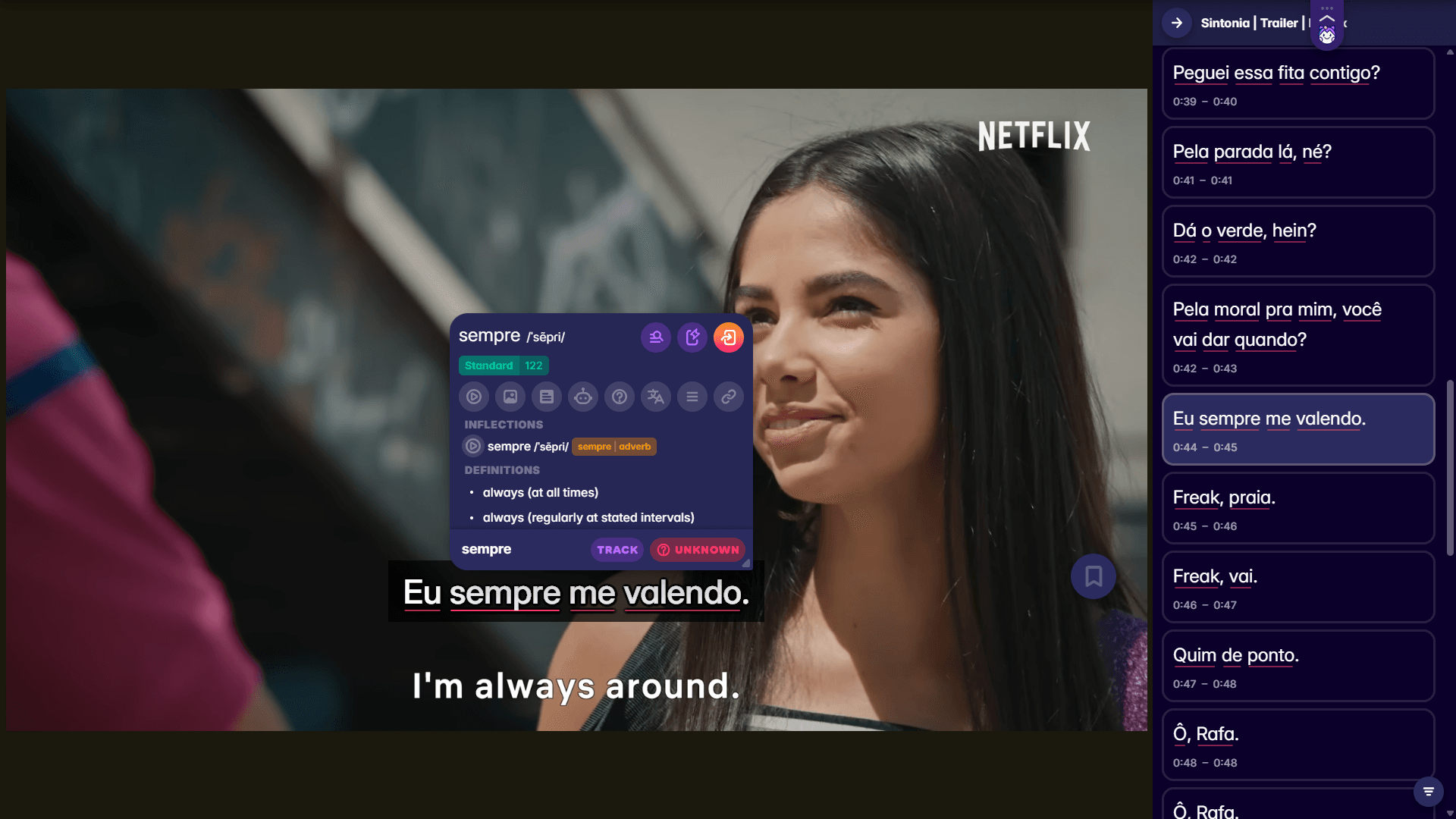
Speaking of immersion, if you want to learn Portuguese vocabulary from actual content you're watching, Migaku's browser extension and app let you look up words instantly while streaming shows or reading articles. Makes the whole process way more practical than switching between tabs. There's a 10-day free trial if you want to check it out.
 ----
## This Portuguese vocabulary will show up constantly in your language learning journey
Whether you're watching Brazilian teen dramas, reading Portuguese news about education, or planning to study abroad, school vocabulary gives you a practical entry point into Portuguese that you can actually use. The best way to make this vocabulary stick? Immersion. Find content you enjoy that happens to include school settings, and you'll pick up these words naturally while having fun. Save the sentences you encounter to flashcards, review them regularly, and you'll own this vocabulary for life.
> If you consume media in Portuguese, and you understand at least some of the messages and sentences within that media, you will make progress. *Period*.
Build your confidence in academic settings!
----
## This Portuguese vocabulary will show up constantly in your language learning journey
Whether you're watching Brazilian teen dramas, reading Portuguese news about education, or planning to study abroad, school vocabulary gives you a practical entry point into Portuguese that you can actually use. The best way to make this vocabulary stick? Immersion. Find content you enjoy that happens to include school settings, and you'll pick up these words naturally while having fun. Save the sentences you encounter to flashcards, review them regularly, and you'll own this vocabulary for life.
> If you consume media in Portuguese, and you understand at least some of the messages and sentences within that media, you will make progress. *Period*.
Build your confidence in academic settings!