# Portuguese Sports Vocabulary: Learn Sports in Portuguese With Cultural Tips
> Learn Portuguese sports vocabulary with practical examples, from basic sport names to action verbs and game terminology. Includes pronunciation tips.
**URL:** https://migaku.com/blog/language-fun/portuguese-sports-vocabulary
**Last Updated:** 2026-03-22
**Tags:** vocabulary, phrases
---
[Learning Portuguese](https://migaku.com/learn-portuguese) sports vocabulary opens up a whole world of conversations, whether you're watching a game at a bar in Lisbon, playing pickup soccer in São Paulo, or just trying to understand what your Portuguese-speaking friends are yelling at the TV. Knowing the right words makes everything more fun. This guide covers the essential vocabulary you need, from basic sport names to action verbs and game-specific terminology.
----
## Basic sports names in Portuguese
Here are the essential sport names you'll hear most often.
| Portuguese | English |
| - | - |
| futebol | Soccer / Football |
| basquetebol | Basketball |
| voleibol | Volleyball |
| ténis / tênis | Tennis |
| natação | Swimming |
| atletismo | Athletics / Track and field |
| ciclismo | Cycling |
| ginástica | Gymnastics |
| boxe | Boxing |
| golfe | Golf |
| surf | Surfing |
| vela | Sailing |
| remo | Rowing |
| esqui | Skiing |
| patinagem no gelo | Ice skating |
----
## Athletic terminology and Olympic sports in Portuguese
Olympic sports vocabulary expanded significantly as Portugal and Brazil increased their Olympic participation. **"Jogos Olímpicos" ** means Olympic Games, and **"atleta" ** means athlete in Portuguese.
**"Medalha de ouro" ** (gold medal), **"medalha de prata" ** (silver medal), and **"medalha de bronze" ** (bronze medal) are straightforward. **"Pódio" ** means podium, where athletes stand during medal ceremonies.
**Track and field events:**
| Portuguese | English |
| - | - |
| corrida | Race / Running |
| salto em altura | High jump (literally "jump in height") |
| salto em comprimento | Long jump (literally "jump in length") |
| lançamento de peso | Shot put (literally "weight throw") |
| maratona | Marathon |
| revezamento (Brazil) / estafeta (Portugal) | Relay race |
**Swimming events:**
| Portuguese | English |
| - | - |
| estilo livre | Freestyle |
| costas | Backstroke |
| peito | Breaststroke |
| borboleta | Butterfly |
| mergulho | Diving |
----
## Action verbs for sports activities
You can't talk about sports without action verbs.
| Portuguese | English |
| - | - |
| jogar | To play — your go-to verb for playing most sports |
| praticar | To practice / To do — works for individual sports and activities |
| correr | To run |
| nadar | To swim |
| pular / saltar | To jump — both mean to jump, with regional preferences between Brazil and Portugal |
| arremessar | To throw — crucial for discussing basketball, baseball, or throwing events |
| chutar | To kick — used constantly when talking about futebol |
| marcar um gol | To score a goal — used in soccer/football |
| fazer um ponto | To score a point — used in other sports |
| treinar | To train — "Eu treino todos os dias" means "I train every day" |
| competir | To compete |
| ganhar | To win |
| perder | To lose |
| defender | To defend |
| atacar | To attack |
| passar | To pass — to pass the ball |
| driblar | To dribble / To fake out — to dribble or fake out an opponent |
----
## Learn Portuguese soccer vocabulary and expressions
Soccer deserves its own section because it's such a crucial part of Portuguese-speaking culture.
| Portuguese | English |
| - | - |
| campo de futebol | Soccer field |
| bola | Ball |
| gol | Goal (both the structure and the score) |
| goleiro (Brazil) / guarda-redes (Portugal) | Goalkeeper |
| zagueiro / defesa | Defender |
| meio-campista / médio | Midfielder |
| atacante / avançado | Forward / Striker |
| árbitro | Referee |
| cartão amarelo | Yellow card |
| cartão vermelho | Red card |
| falta | Foul |
| pênalti (Brazil) / penálti (Portugal) | Penalty kick |
| escanteio (Brazil) / canto (Portugal) | Corner kick |
| impedimento | Offside |
| tempo | Half (first half / second half) |
| torcida (Brazil) / adeptos (Portugal) | Fans / Supporters |
| estádio | Stadium |
| campeonato | Championship / League |
Common expressions include "fazer um golaço" (to score an amazing goal) and "dar um chapéu" (to chip the ball over someone's head, literally "to give a hat"). "Bicicleta" (bicycle kick) is that spectacular overhead kick move.
----
## Sport-specific equipment and positions
Each sport has its specialized vocabulary.
| Sport | Portuguese | English |
| - | - | - |
| **Basketball** | cesta | Basket |
| | quadra (Brazil) / campo (Portugal) | Court |
| | armador | Point guard |
| | ala | Wing / Forward |
| | pivô | Center |
| **Tennis** | raquete | Racket |
| | rede | Net |
| | saque | Serve |
| | vantagem | Advantage |
| | iguais / deuce | Deuce |
| **Volleyball** | saque | Serve |
| | levantador | Setter |
| | bloqueio | Block |
| | manchete | Forearm pass |
| | toque | Set / Overhead pass |
| **Swimming** | touca | Swim cap |
| | óculos de natação | Goggles |
| | maiô / fato de banho | Swimsuit |
| | piscina | Pool |
| | raia | Lane |
| **Cycling** | bicicleta / bike | Bicycle |
| | capacete | Helmet |
| | guidão | Handlebars |
| | pedal | Pedal |
| | corrida de bicicleta | Bicycle race |
----
## Traditional Portuguese sports
Portugal has some sports that don't get much attention elsewhere.
- **"Hóquei em patins" ** (roller hockey) is absolutely massive in Portugal. The Portuguese national team has won numerous world championships, and local clubs have passionate followings.
- **"Andebol" ** (handball) is another sport where Portugal competes at high levels internationally. The vocabulary is specific: "baliza" means goal, "guarda-redes" means goalkeeper (same as soccer in Portugal), and "remate" means shot.
- **"Futsal" ** deserves mention as an indoor variant of soccer played on a hard court. Brazil and Portugal both excel at futsal. The game is faster-paced than regular soccer, with different tactical vocabulary. "Pivô" in futsal means the player who stays near the opponent's goal.
- **"Pelota" ** or **"pelota basca" ** refers to Basque pelota, played in some regions.
- **"Corrida de touros" ** (bullfighting) is controversial but historically significant in Portuguese culture, though it's more associated with Spain.
- Traditional Portuguese games include **"jogo do pau" ** (stick fighting/fencing) and various folk sports that appear at festivals. These aren't mainstream sports, but they're part of the cultural vocabulary.
----
## Common mistakes learners make
1. Many learners confuse "jogar" and "brincar." "Brincar" means to play in the sense of children playing or playing around. "Jogar" means to play a sport or game. Don't say "brincar futebol."
2. Another mistake is using "fazer" (to do/make) for all sports. While "fazer exercício" (to do exercise) works, you should use "jogar" or "praticar" for specific sports. "Fazer futebol" sounds wrong. Say "jogar futebol."
3. Gender agreement trips people up. "O futebol" is masculine, so you say "o futebol brasileiro" (Brazilian soccer). "A natação" is feminine, so "a natação olímpica" (Olympic swimming). Articles and adjectives must match.
4. Pronunciation of borrowed English words causes issues. Portuguese adapted these words to their phonetic system. "Surf" in Portuguese doesn't sound exactly like English. Listen to native speakers and imitate their pronunciation rather than using English pronunciation.
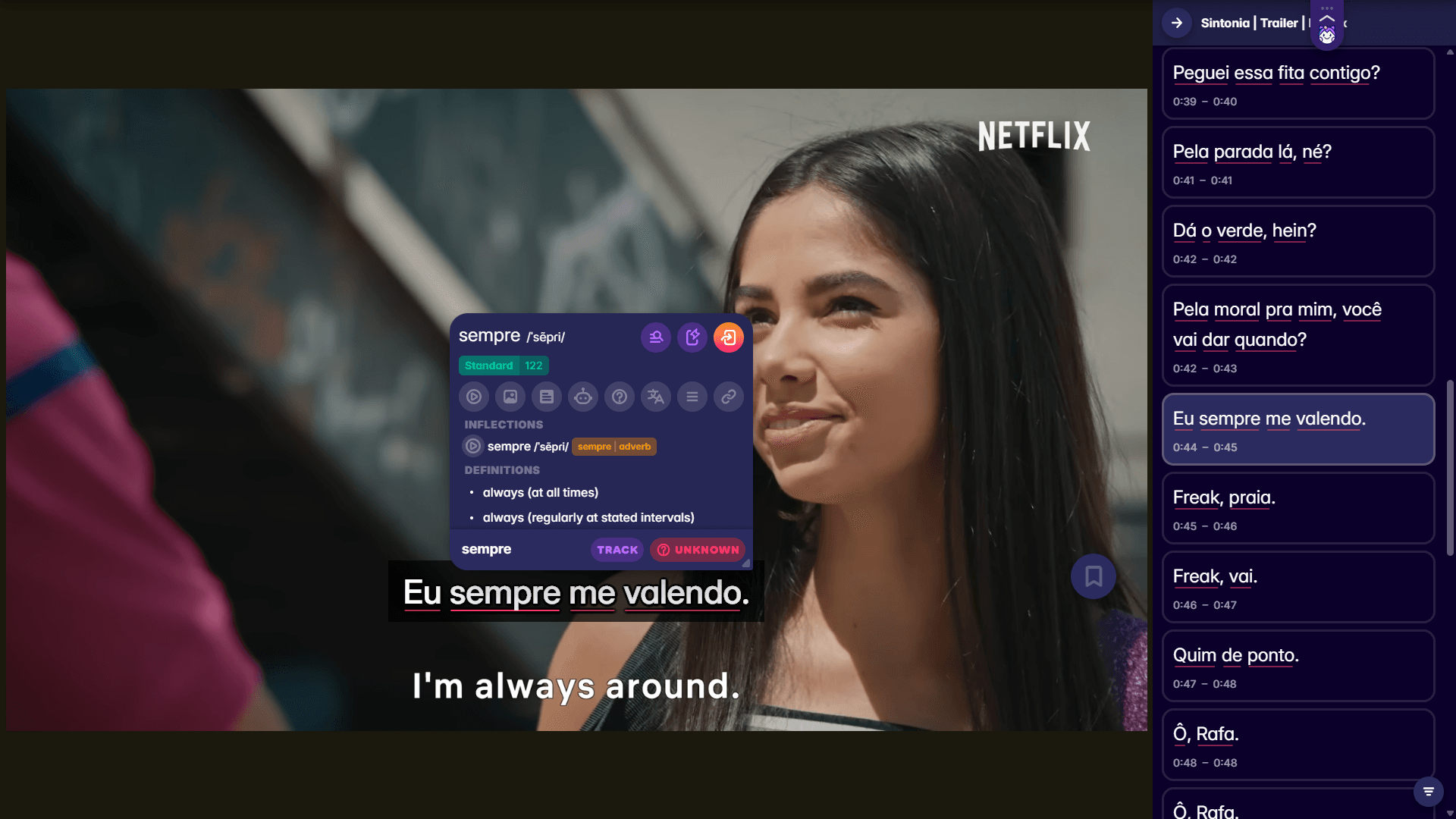
Anyway, if you're serious about learning Portuguese through content you actually enjoy, Migaku's browser extension and app let you look up sports vocabulary instantly while watching Brazilian soccer matches or Portuguese sports documentaries. Makes learning from real content way more practical. There's a 10-day free trial if you want to check it out.
 ----
## Understanding how to use Portuguese vocabulary for sports naturally takes practice
Sports commentary has its own style. Commentators use the present tense for live action: "Ele chuta, ele marca!" (He shoots, he scores!) The excitement comes through verb choice and intonation. Newspaper sports sections use specific terminology. Social media posts about sports use lots of abbreviations and slang. As a Portuguese learner, you need to consume all sorts of media and get used to different language use.
> If you consume media in Portuguese, and you understand at least some of the messages and sentences within that media, you will make progress. _Period_.
Language learning is not easy, but you will get there!
----
## Understanding how to use Portuguese vocabulary for sports naturally takes practice
Sports commentary has its own style. Commentators use the present tense for live action: "Ele chuta, ele marca!" (He shoots, he scores!) The excitement comes through verb choice and intonation. Newspaper sports sections use specific terminology. Social media posts about sports use lots of abbreviations and slang. As a Portuguese learner, you need to consume all sorts of media and get used to different language use.
> If you consume media in Portuguese, and you understand at least some of the messages and sentences within that media, you will make progress. _Period_.
Language learning is not easy, but you will get there!