# Portuguese Time Expressions: How to Tell Time in Portuguese
> Understand how to tell time with é vs são, minutes past with e, para expressions, and essential phrases in Brazilian and European Portuguese.
**URL:** https://migaku.com/blog/language-fun/portuguese-time-expressions
**Last Updated:** 2026-03-24
**Tags:** fundamentals, vocabulary, phrases
---
The time structure is pretty straightforward once you get the hang of it, but there are some quirks that trip people up, especially if you're used to how English handles time expressions. This guide will walk you through everything you need to know as a [Portuguese learner](https://migaku.com/learn-portuguese), from the basic "é uma hora" versus "são duas horas" distinction to more advanced expressions you'll hear in everyday conversation. Whether you're planning to travel to Brazil or Portugal, or just want to understand Portuguese better, getting comfortable with these time expressions will make your life way easier.
----
## The basic structure: é vs são
Here's the thing about telling time in Portuguese. You use **"é" ** for one o'clock and **"são" ** for everything else. This trips up a lot of beginners because English just uses "it's" for everything.
- When it's one o'clock, you say **"é uma hora" ** (It is one hour). The singular form makes sense here because you're talking about one single hour.
- For any other time, you use **"são" with the plural "horas"**. So two o'clock is "são duas horas" , three o'clock is "são três horas" , and so on up to twelve. The verb changes to match the plural noun, which is pretty logical once you think about it.
This é/são distinction is super important because you'll use it constantly. Native speakers notice immediately when learners mess this up, so it's worth drilling until it becomes automatic.
----
## Adding minutes with "e"
Once you've got the basic hours down, you need to know how to add minutes. Portuguese uses **"e" ** (and) to connect the hour with the minutes past.
If it's 3:15, you say "são três horas e quinze minutos" or just "são três e quinze" in casual speech. The word "minutos" is often dropped in everyday conversation because it's obvious you're talking about minutes.
For quarter past, you can say **"e quinze" ** or use **"e um quarto" ** (and a quarter). Both work fine, though "e quinze" is probably more common in Brazilian Portuguese.
Some examples to make this clearer:
| Time | Portuguese |
| - | - |
| 2:10 | são duas e dez |
| 4:20 | são quatro e vinte |
| 7:25 | são sete e vinte e cinco |
| 9:05 | são nove e cinco |
----
## Half past with "meia" in Portuguese time
When you hit the 30-minute mark, Portuguese has a special expression. Instead of saying "trinta minutos", you use **"meia" ** (half).
So 6:30 becomes "são seis e meia". The word "meia" literally means half, referring to half an hour. You'll hear this a lot because it's much more natural than saying "e trinta".
One thing that confuses people is that "meia" is feminine (It's short for "meia hora"), so you don't change it to match anything else in the sentence. It's always **"e meia"** regardless of what hour you're talking about.
Examples:
| Time | Portuguese |
| - | - |
| 1:30 | é uma e meia |
| 8:30 | são oito e meia |
| 11:30 | são onze e meia |
----
## Minutes to the hour with "para"
When you're getting close to the next hour, Portuguese switches things up. Instead of saying how many minutes past the hour it is, you say how many minutes are left until the next hour using **"para" ** (to/until).
If it's 4:50, you'd say "são dez para as cinco" (It's ten to five). You're literally saying "ten for the five", meaning ten minutes until five o'clock.
The **"as" ** before the next hour is important. You're saying "para as cinco" (to the five), using the article because you're referring to five o'clock as a specific time.
More examples:
| Time | Portuguese |
| - | - |
| 2:45 | são quinze para as três |
| 7:55 | são cinco para as oito |
| 11:40 | são vinte para as doze |
For quarter to the hour, you can say "quinze para" or "um quarto para". Both work fine.
----
## Parts of the day in Portuguese vocabulary
Portuguese doesn't use AM and PM the same way English does. Instead, you add phrases that indicate which part of the day you're talking about.
- **"Da manhã" ** means "of the morning" and covers roughly from sunrise until noon.
- **"Da tarde" ** is "of the afternoon/evening" and goes from noon until it gets dark, usually around 6 or 7 PM.
- **"Da noite" ** means "of the night" and covers the evening and nighttime hours.
- You'll also hear **"da madrugada" ** for the early morning hours after midnight, like 2 AM or 3 AM. It refers to that late-night/very-early-morning period.
So if you want to say 8 AM, you'd say "são oito horas da manhã" or just "oito da manhã". For 8 PM, it's "são oito horas da noite" or "oito da noite".
The boundaries between these periods are a bit flexible and can vary by region. In Brazil, "da tarde" might extend later into the evening than in Portugal.
Examples:
| Time | Portuguese |
| - | - |
| 6:00 AM | são seis da manhã |
| 3:00 PM | são três da tarde |
| 9:00 PM | são nove da noite |
| 11:00 PM | são onze da noite |
----
## Noon and midnight: meio-dia and meia-noite
Noon and midnight have their own special terms in Portuguese. Noon is **"meio-dia" ** (literally "half-day") and midnight is **"meia-noite" ** (literally "half-night").
For noon, you say "é meio-dia" using the singular "é" because you're treating it as a single point in time. Same goes for midnight: "é meia-noite".
When you add minutes to these, the structure changes slightly. For 12:15 PM, you'd say "é meio-dia e quinze". For 12:30 PM, it's "é meio-dia e meia". Notice you're still using "é" because you're building off of "meio-dia" as your reference point.
This is different from other hours where you'd use "são". It's one of those quirks you just have to memorize.
----
## Tell time in Portuguese with 12-hour vs 24-hour clock
Portuguese speakers use both the 12-hour and 24-hour clock systems, depending on the context. The 12-hour clock is more common in everyday conversation, while the 24-hour clock shows up in formal contexts like schedules, timetables, and official documents.
In Brazil, casual conversation almost always uses the 12-hour format with "da manhã", "da tarde", and "da noite" to clarify. But if you're looking at a bus schedule or train timetable, you'll see times written as 14:00, 18:30, etc.
The 24-hour clock is pretty straightforward. You just read the numbers as they are. So 14:00 is "catorze horas" (or "quatorze horas" depending on spelling preference), 18:30 is "dezoito e trinta", and 23:45 is "vinte e três e quarenta e cinco".
In Portugal, the 24-hour clock is used more frequently in everyday situations than in Brazil. You'll hear it on the news, in announcements, and even in some casual contexts.
----
## Asking what time it is: que horas são
To ask what time it is in Portuguese, the standard phrase is **"que horas são?" ** This literally translates to "what hours are they?" which sounds weird in English but makes perfect sense in Portuguese.
You might also hear **"tem horas?" ** (Do you have the time?) in Brazil, which is a more casual way to ask someone for the time.
The response follows the same structure we've covered. If it's 3:30, you'd answer "são três e meia". If it's 1:00, you'd say "é uma hora".
----
## Using "às" and "à" for scheduled times
When you're talking about when something happens, you need the preposition "a" combined with the article. This gives you **"às" ** for most hours and **"à" ** for one o'clock.
If a meeting is at 9 AM, you say "a reunião é às nove da manhã". The "às" means "at the" and agrees with the plural "nove horas".
For one o'clock, you use the singular form: "o almoço é à uma da tarde" (Lunch is at one in the afternoon).
This distinction between "às" and "à" follows the same logic as "são" versus "é". You're matching the article to whether you're talking about one hour or multiple hours.
Examples:
- A aula é às dez da manhã.
*The class is at 10 AM.*
- A loja abre às oito da manhã.
*The store opens at 8 AM.*
- O jantar é às sete da noite.
*Dinner is at 7 PM.*
- A consulta é à uma da tarde.
*The appointment is at 1 PM.*
----
## Additional expressions related to time
Beyond just telling the time, there are some useful Portuguese time expressions that come up constantly.
- **"Em ponto" ** means "on the dot" or "sharp". If something starts at exactly 3:00, you might say "às três em ponto". It emphasizes punctuality.
- **"Ainda" ** means "still" or "yet" and shows up in time-related contexts. "Ainda são três horas" could mean "it's still three o'clock" if you're surprised time hasn't moved forward.
- **"Já" ** means "already" and pairs well with time. "Já são cinco horas?" (Is it already five o'clock?) expresses surprise at how quickly time passed.
- **"Daqui a" ** means "in" when talking about future time. "Daqui a uma hora" means "in one hour" or "an hour from now".
- **"Há" ** means "ago" for past time. "Há duas horas" means "two hours ago".
These little expressions make your Portuguese sound way more natural than just stating times mechanically.
----
## Common mistakes to avoid
1. One big mistake is mixing up "é" and "são". Remember, "é" is only for one o'clock. Everything else uses "são".
2. Another issue is forgetting the articles with "às" and "à". You can't just say "a reunião é três horas". You need "às três horas" with the article.
3. Mixing up "para" (to/until) and "e" (and/past) is another common error. If it's 3:45, you should say "quinze para as quatro", not "três e quarenta e cinco" (though technically that's not wrong, it just sounds unnatural).
4. Don't forget that "horas" is plural. You say "duas horas", not "duas hora".
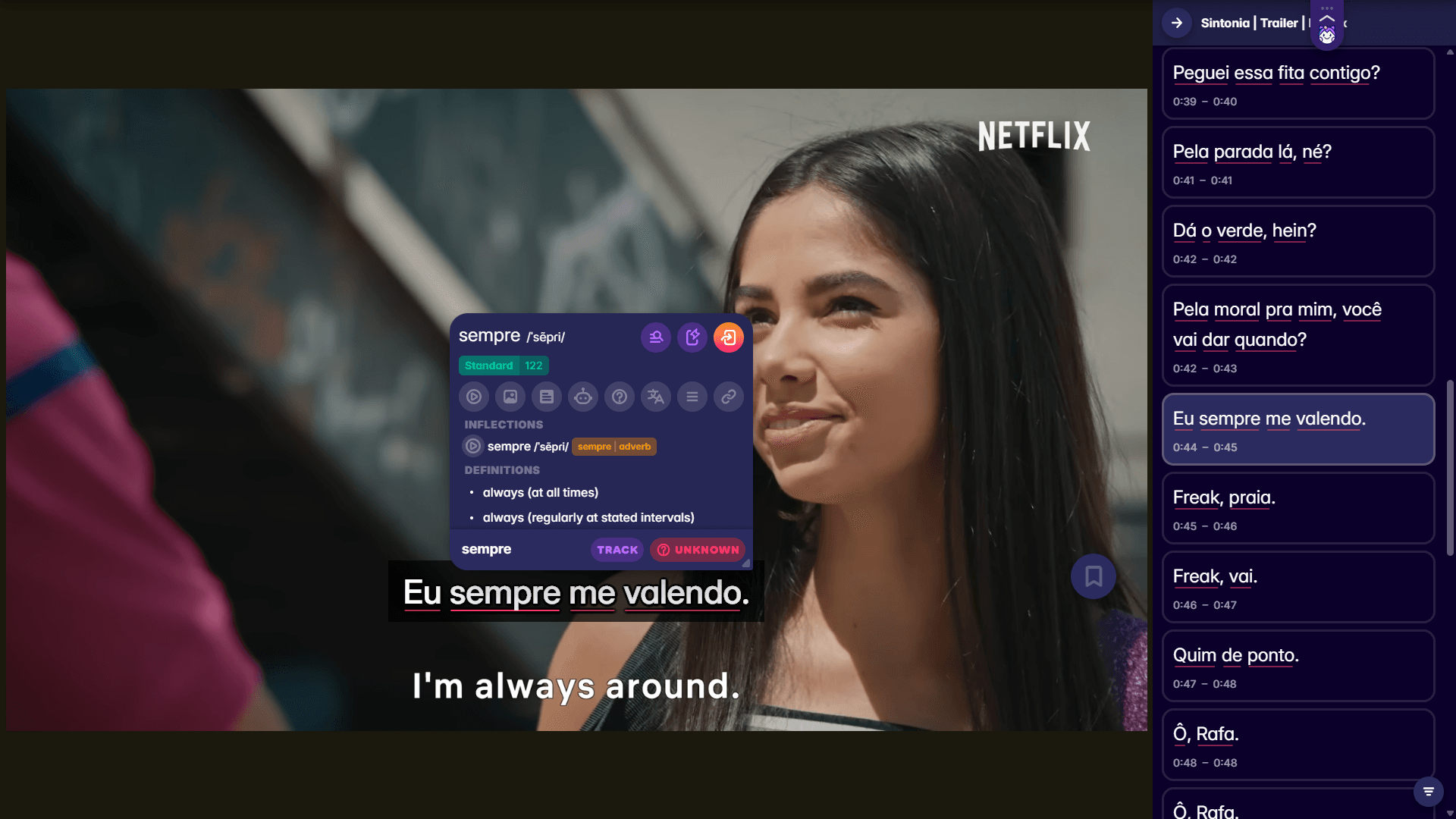
Anyway, if you're serious about learning Portuguese through real content, Migaku's browser extension and app let you look up words and phrases instantly while watching Brazilian or Portuguese shows. You can save time expressions you encounter and review them later with [spaced repetition](https://migaku.com/blog/language-fun/spaced-repetition-vs-cramming). There's a 10-day free trial if you want to see how it works with actual Portuguese content.
 ----
## Practice makes automatic!
The only way to get comfortable with Portuguese time expressions is to practice them until they become automatic. Listen to how native speakers use these expressions in context. [Watch Portuguese shows](https://migaku.com/blog/language-fun/best-portuguese-shows-language-learners) or [listen to podcasts](https://migaku.com/blog/language-fun/best-portuguese-podcasts) and pay attention when people mention times. You'll start noticing patterns and natural usage that textbooks don't always capture.
> If you consume media in Portuguese, and you understand at least some of the messages and sentences within that media, you will make progress. _Period_.
The grammar rules matter, but fluency comes from repetition and exposure.🎧👂
----
## Practice makes automatic!
The only way to get comfortable with Portuguese time expressions is to practice them until they become automatic. Listen to how native speakers use these expressions in context. [Watch Portuguese shows](https://migaku.com/blog/language-fun/best-portuguese-shows-language-learners) or [listen to podcasts](https://migaku.com/blog/language-fun/best-portuguese-podcasts) and pay attention when people mention times. You'll start noticing patterns and natural usage that textbooks don't always capture.
> If you consume media in Portuguese, and you understand at least some of the messages and sentences within that media, you will make progress. _Period_.
The grammar rules matter, but fluency comes from repetition and exposure.🎧👂