# How to Say Sorry in Portuguese: Explore Different Ways to Apologize
> Learn how to say sorry in Portuguese with desculpa, desculpe, sinto muito, and more. Master formal and informal apologies.
**URL:** https://migaku.com/blog/language-fun/sorry-in-portuguese
**Last Updated:** 2026-03-19
**Tags:** vocabulary, phrases
---
[Learning Portuguese](https://migaku.com/learn-portuguese) apologies is one of those essential skills that'll save you in countless situations, whether you accidentally bump into someone in Lisbon, need to excuse yourself in a São Paulo business meeting, or just want to smooth things over with a Brazilian friend. The good news? Portuguese has plenty of ways to express regret and say sorry, from quick casual phrases to deeply sincere apologies. This lesson will walk you through everything you need to know about apologizing like a native speaker.
----
## How do you say sorry in Portuguese
The most common way to say sorry in Portuguese is **"desculpa" ** (informal) or **"desculpe" ** (formal). These are your go-to apology expressions that work in most everyday situations. Think of "desculpa" as what you'd say to friends, family, or people your age, while "desculpe" is better for strangers, older people, or professional settings.
Here's the thing about these two words: they come from the verb "desculpar," which means "to excuse" or "to forgive." When you say "desculpa" or "desculpe," you're literally asking someone to excuse you. Pretty straightforward.
The pronunciation is fairly simple once you get the hang of it. "Desculpa" sounds like "desh-KOOL-pah" with the stress on the middle syllable. "Desculpe" is "desh-KOOL-peh." The "s" at the beginning has a "sh" sound in Brazilian Portuguese, though in European Portuguese it sounds more like a regular "s."
For a more serious apology, you can use **"sinto muito," ** which translates to "I'm very sorry" or literally "I feel a lot." This phrase carries more emotional weight and shows genuine regret. Use it when you've really messed up or when expressing condolences.
----
## Everyday casual apologies in Brazilian Portuguese
Brazilian Portuguese has some relaxed ways to apologize that you'll hear constantly in daily conversation.
"**Foi mal" ** is super common among younger people and in informal settings. It literally means "it was bad," but functions like "my bad" in English. You'll hear this all the time in casual conversations.
Another informal expression is **"me desculpa," ** which adds a personal pronoun to make it "forgive me" or "excuse me." It sits somewhere between completely casual and moderately polite. You can use this with coworkers you're friendly with or people you know reasonably well.
**"Perdão" ** is another option that means "pardon" or "forgiveness." While it can sound a bit dramatic in some contexts, Brazilians use it naturally when they need to interrupt someone or get past them in a crowded space. Think of it like "pardon me" when squeezing through a busy market.
For really minor things like accidentally stepping on someone's toe or bumping into them lightly, a quick "opa, desculpa!" works perfectly. The "opa" is just an interjection showing surprise, kind of like "oops" in English.
----
## Formal apologies and professional settings
When you need to apologize in a business context or formal situation, "desculpe" becomes your baseline. But you can take it further with **"peço desculpas," ** which means "I ask for forgiveness" or more naturally "I apologize." This phrase sounds professional and sincere without being overly dramatic.
In written communication like emails, you might see **"lamento" ** (I regret) or **"lamento informar" ** (I regret to inform). These expressions work well in customer service situations or when delivering bad news professionally.
**"Sinto muito" ** also works in formal contexts, especially when expressing sympathy or serious regret. If you need to decline a business opportunity or inform someone about a significant problem, "sinto muito, mas..." (I'm very sorry, but...) shows appropriate gravity.
For very formal or legal contexts, **"peço perdão" ** (I ask for forgiveness) exists, though you won't use this in everyday professional life. It's more for serious situations requiring deep contrasts.
----
## Situational apologies and specific contexts
Different situations call for different levels of apology.
- If you accidentally bump into someone on the street, a quick "desculpa" or "perdão" does the job. No need to make it more complicated than that.
- In restaurants or shops, "com licença" (Excuse me) often works better than "desculpa" when you need to get someone's attention or pass by. Save "desculpa" for when you've actually done something wrong, like spilling a drink or arriving late.
- When expressing condolences, "sinto muito" or "meus sentimentos" (My sympathies) are appropriate. You wouldn't use casual phrases like "foi mal" in these situations. The gravity of the situation demands more formal language.
- For business mistakes or professional errors, combining phrases works well: "Peço desculpas pelo inconveniente" (I apologize for the inconvenience) or "Sinto muito pelo atraso" (I'm very sorry for the delay). These show professionalism and accountability.
- In romantic relationships or close friendships, you can be more creative and personal. "Me perdoa?" (Will you forgive me?) as a question shows vulnerability. "Desculpa mesmo" (Really sorry) adds emphasis through "mesmo" (really/truly).
----
## Brazilian vs European Portuguese apologies
The way Brazilians and Portuguese people apologize has some interesting variations.
- In Portugal, you'll hear "peço desculpa" (singular) much more often than in Brazil, where "peço desculpas" (plural) is standard. Both mean the same thing, but the singular form is distinctly European.
- European Portuguese speakers tend to use "desculpe" more frequently across the board, even in somewhat casual situations where Brazilians might use "desculpa." The formality threshold sits at a different place between the two dialects. Pronunciation differences matter too. In European Portuguese, the unstressed vowels get reduced more heavily, so "desculpe" sounds clipped and quick. Brazilian Portuguese pronounces all the vowels more clearly, making it easier for learners to understand initially.
- The phrase "foi mal" is very Brazilian. You won't hear it much in Portugal, where people stick more closely to "desculpa" or "perdão" for casual apologies.
- Regional expressions exist within Brazil too. In some areas, you might hear "me perdoa" (Forgive me) more often than in others. Brazilian Portuguese varies quite a bit from region to region, though these apology phrases stay fairly consistent nationwide.
----
## Responding to apologies in Portuguese
Knowing how to accept an apology is just as important as knowing how to give one.
- The most common response is **"tudo bem," ** which means "it's all good" or "no worries." You'll hear this constantly in Brazil.
- **"Sem problemas" ** (No problem) works perfectly too, especially in slightly more formal situations. It's polite and friendly without being too casual.
- **"Não foi nada" ** translates to "it was nothing" and works well for minor apologies. If someone says "desculpa" for something small, responding with "não foi nada" shows you're not bothered at all.
- **"De nada" ** (You're welcome) can work in some contexts, though it's more commonly used to respond to "obrigado" (Thank you). Some Brazilians do use it after apologies though, particularly older generations.
- For more serious apologies, you might say **"está tudo bem" ** (Everything is fine) or **"não se preocupe" ** (Don't worry). These responses acknowledge that the apology was needed but show you're willing to move past it.
----
## Learning Portuguese apologies through context
1. Pay attention to tone and body language, too. A casual "desculpa" said with a smile while squeezing past someone on a bus feels completely different from a serious "sinto muito" said with eye contact and a concerned expression.
2. Practice doesn't just mean memorizing phrases. Try to think about situations where you'd apologize in your native language, then consider which Portuguese expression fits best. Would you use informal or formal language? Is this a minor oops or a serious mistake?
3. Regional variations matter, so if you're learning Brazilian Portuguese specifically, focus on how Brazilians actually speak. European Portuguese has its own patterns, and mixing them can sound odd to native speakers.
4. The cultural aspect of apologizing differs, too. Brazilians tend to be warm and forgiving, so apologies are often accepted quickly and graciously. Understanding this cultural context helps you gauge appropriate response levels.
Remember that language learning involves making mistakes. You'll probably apologize incorrectly at some point, and that's completely fine. Most people appreciate the effort and will help you learn the right way to say things.
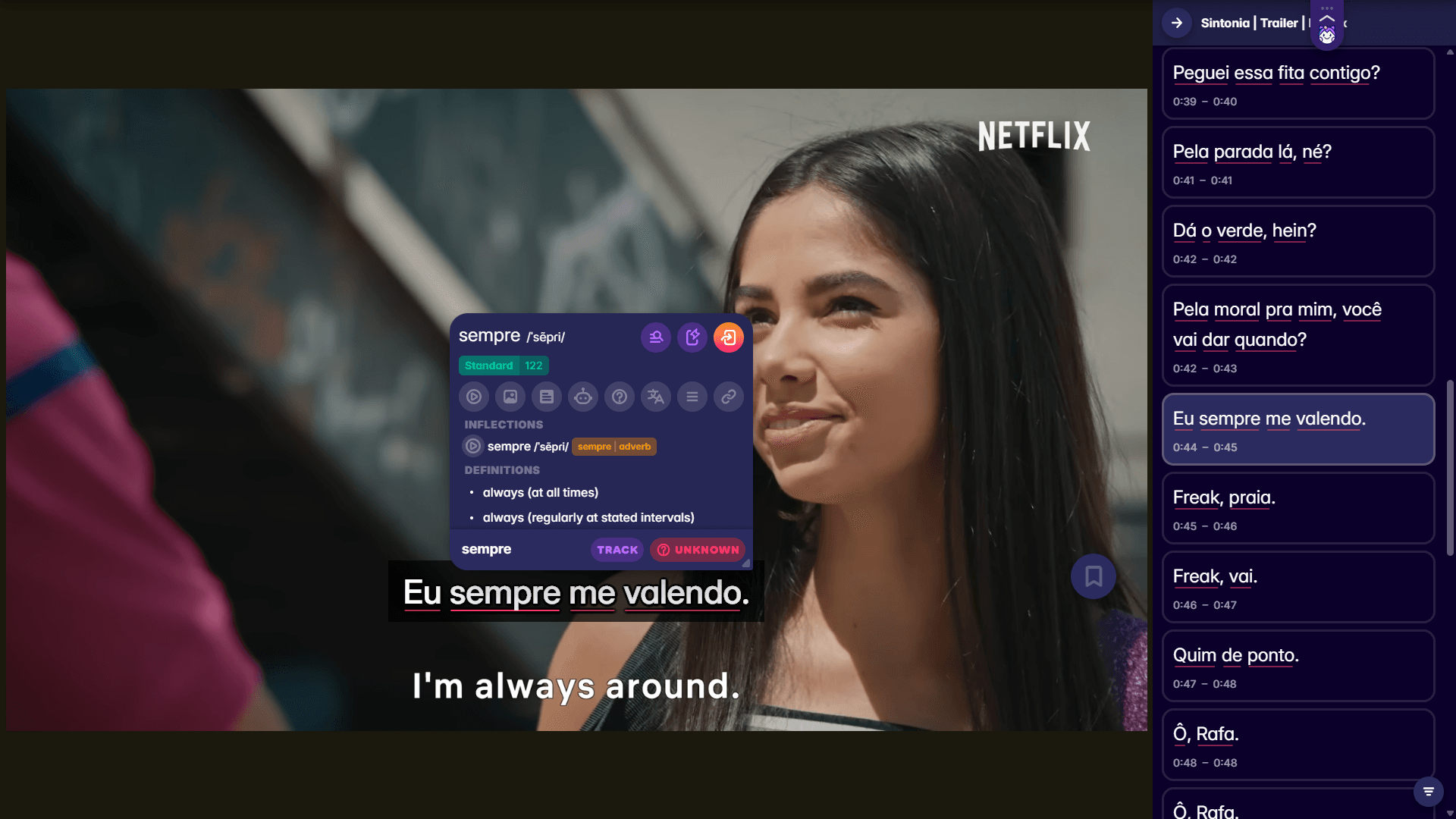
If you want to practice these apology phrases in context with real Portuguese content, Migaku's browser extension and app let you look up words and phrases instantly while watching Brazilian shows or reading Portuguese articles. Makes learning from actual native content way more practical. There's a 10-day free trial if you want to check it out.
 ----
## Learn to speak Portuguese with immersion!
The best way to really understand when and how to use these expressions is through exposure to real Portuguese. Watching Brazilian shows or Portuguese films gives you context that textbook lessons can't provide. You'll see how people apologize in different situations and pick up on the subtle differences.
> If you consume media in Portuguese, and you understand at least some of the messages and sentences within that media, you will make progress. _Period_.
Try out different learning methods!
----
## Learn to speak Portuguese with immersion!
The best way to really understand when and how to use these expressions is through exposure to real Portuguese. Watching Brazilian shows or Portuguese films gives you context that textbook lessons can't provide. You'll see how people apologize in different situations and pick up on the subtle differences.
> If you consume media in Portuguese, and you understand at least some of the messages and sentences within that media, you will make progress. _Period_.
Try out different learning methods!