JavaScript is required

Ver Imperfect Tense: Complete Spanish Conjugation Guide

Last updated: April 29, 2026

Understanding ver imperfect tense with examples - Banner

Understanding the Ver Imperfect Tense in Spanish

So you're learning Spanish and you've stumbled onto the verb ver (to see, to watch) in the imperfect tense. Good news: this verb is actually one of the easier irregular verbs to master once you understand how it works. The imperfect tense in Spanish gets used all the time when talking about what you used to do, what you were seeing, or actions that happened repeatedly in the past.

Here's the thing about ver in the imperfect. While most Spanish learners panic when they hear "irregular verb," ver follows a pretty straightforward pattern once you memorize it. I'm going to walk you through everything you need to know about conjugating ver in the imperfect tense, with plenty of examples so you can actually use it in conversation.

What Makes Ver Special in Spanish

The verb ver means "to see" or "to watch" in English. You'll use it constantly when talking about movies you watched, things you saw, or describing past experiences. In the present tense, ver already has some irregularities (like "yo veo"), so finding out it has quirks in other tenses shouldn't shock you too much.

When we talk about the imperfect tense (pretérito imperfecto), we're discussing actions that were ongoing, habitual, or repeated in the past. Think of phrases like "I used to see," "I was watching," or "I would watch every day." That's imperfect territory.

Ver belongs to a small group of irregular verbs in the imperfect tense. Actually, Spanish only has three truly irregular verbs in the imperfect: ser (to be), ir (to go), and ver (to see/watch). Pretty manageable compared to other tenses, right?

The Complete Conjugation Table for Ver in Imperfect Tense

Let me give you the full conjugation breakdown. Memorize this table and you're golden:

Yo veía (I used to see / I was seeing)
Tú veías (You used to see / You were seeing)
Él/Ella/Usted veía (He/She/You formal used to see)
Nosotros/Nosotras veíamos (We used to see)
Vosotros/Vosotras veíais (You all used to see - used in Spain)
Ellos/Ellas/Ustedes veían (They/You all used to see)

Notice the accent marks on the í in every single form. Those aren't optional. The accent mark keeps the i and a as separate syllables instead of blending into a diphthong. Without it, you'd be mispronouncing the verb completely.

The endings here (ía, ías, ía, íamos, íais, ían) actually look similar to regular -er and -ir verb endings in the imperfect, except for that crucial accent mark. Regular -er verbs would use "ía" too, but ver's stem is just "v," which makes it look different from the infinitive form.

Why Ver Is Considered Irregular

Okay, so what makes ver irregular in the imperfect tense? When you conjugate regular -er verbs like comer (to eat) in the imperfect, you take the infinitive, drop the -er ending, and add the imperfect endings: comía, comías, comía, comíamos, comíais, comían.

For ver, you'd expect to drop the -er and get "v" as your stem, then add those same endings. And actually, that's basically what happens! The irregularity comes from the fact that the stem is just a single letter (v), which looks weird and requires those accent marks to maintain proper pronunciation.

Some Spanish teachers and textbooks list ver as irregular because it doesn't follow the typical pattern visually. Others argue it's technically regular since it follows the standard -er imperfect endings. For practical purposes, just remember that ver conjugates with "veía" forms and you'll be fine.

The other two irregular imperfect verbs look completely different. Ser becomes "era, eras, era, éramos, erais, eran" and ir becomes "iba, ibas, iba, íbamos, ibais, iban." Those are truly irregular because they don't resemble their infinitive forms at all.

When to Use the Imperfect Tense with Ver

The imperfect tense serves specific purposes in Spanish. You'll use veía and its conjugations when describing:

Habitual or repeated actions in the past: Things you used to see regularly or would watch often.

Example: "Cuando era niño, veía esa película cada semana" (When I was a kid, I used to watch that movie every week).

Ongoing actions without a defined endpoint: Situations where you were watching something, but the focus is on the action itself rather than when it started or finished.

Example: "Mientras veíamos la televisión, sonó el teléfono" (While we were watching television, the phone rang).

Background descriptions or settings: When you're setting the scene and describing what people were seeing.

Example: "Desde mi ventana, veía las montañas cada mañana" (From my window, I would see the mountains every morning).

Age, time, or mental/emotional states in the past: Though this applies more to other verbs, ver can describe what you were perceiving during these states.

Example: "No veía bien sin mis gafas" (I couldn't see well without my glasses).

The key difference between the imperfect and the preterite tense is completion. If you watched something once and finished it, you'd use the preterite: "vi la película" (I watched the movie). If you were watching it, used to watch it, or watched it habitually, you'd use the imperfect: "veía la película" (I was watching the movie / I used to watch the movie).

Real Example Sentences Using Ver in Imperfect

Let me give you some practical examples you might actually use in conversation:

¿Veías ese programa cuando eras joven? (Did you used to watch that program when you were young?)

This question asks about habitual viewing in the past. The answer might be: "Sí, lo veía todos los sábados" (Yes, I used to watch it every Saturday).

Mis abuelos veían las noticias cada noche. (My grandparents would watch the news every night.)

This describes a repeated action that happened regularly in the past.

Yo veía a mi vecino en el parque frecuentemente. (I used to see my neighbor in the park frequently.)

Here, ver means "to see" rather than "to watch," describing regular encounters.

¿Qué veías desde tu habitación? (What could you see from your room?)

This asks about what was visible from a specific location in the past.

Cuando vivíamos en la costa, veíamos el océano desde la terraza. (When we lived on the coast, we would see the ocean from the terrace.)

This combines the imperfect of vivir and ver to describe an ongoing past situation.

No veíamos televisión en mi casa porque no teníamos una. (We didn't watch television in my house because we didn't have one.)

A description of past circumstances and habits.

Los niños veían dibujos animados mientras sus padres preparaban la cena. (The kids were watching cartoons while their parents prepared dinner.)

This shows simultaneous ongoing actions in the past.

Comparing Ver Across Different Spanish Tenses

Understanding the imperfect makes more sense when you compare it to other tenses. Let me show you how ver changes:

Present tense: veo, ves, ve, vemos, veis, ven (I see, you see, etc.)

Preterite tense: vi, viste, vio, vimos, visteis, vieron (I saw, you saw, etc.)

Imperfect tense: veía, veías, veía, veíamos, veíais, veían (I used to see, I was seeing, etc.)

Future tense (futuro simple): veré, verás, verá, veremos, veréis, verán (I will see, you will see, etc.)

The future tense is actually pretty straightforward. You take the infinitive ver and add the future endings: é, ás, á, emos, éis, án. So "I will see" becomes "veré" and "we will see" becomes "veremos."

How do you conjugate ver in the future tense? Just remember that ver keeps its full infinitive form and adds those future endings directly. "Mañana veremos la película" (Tomorrow we will see the movie).

The preterite and imperfect often confuse Spanish learners. Quick distinction: preterite focuses on completed actions ("I saw the movie last night" = "Vi la película anoche"), while imperfect focuses on ongoing or habitual actions ("I was watching the movie when you called" = "Veía la película cuando llamaste").

Common Mistakes and Tips for Using Veía

After teaching Spanish for a while, I've noticed students make the same mistakes repeatedly with ver in the imperfect. Here are the big ones:

Forgetting the accent marks. Writing "veia" instead of "veía" is wrong. That accent mark matters for pronunciation and spelling. Every single conjugation of ver in the imperfect needs that accent on the í.

Confusing imperfect with preterite. Students often say "vi" when they mean "veía." If you're describing something you used to do regularly or were doing, you need the imperfect. "Cuando era niño, vi mucha televisión" is wrong. It should be "veía mucha televisión."

Mixing up ver with other verbs. Sometimes learners confuse ver (to see) with leer (to read) or mirar (to look at/watch). While mirar and ver both can mean "to watch," ver emphasizes the act of seeing or perceiving, while mirar emphasizes directing your gaze toward something.

Using the wrong tense after time expressions. Phrases like "siempre" (always), "todos los días" (every day), "a menudo" (often), and "frecuentemente" (frequently) typically signal imperfect tense usage. "Siempre vi ese programa" sounds weird. Better: "Siempre veía ese programa."

Forgetting vosotros forms. If you're learning Spanish from Spain or studying formal Spanish, you need to know "veíais." Latin American Spanish typically uses "ustedes" instead, but you should recognize the vosotros conjugation when you see it.

A good memory trick: associate the "ía" ending with habitual past actions. When you see or need to use those "ía" endings, think "used to" or "was doing."

Practice Makes Perfect with Ver Imperfect

The best way to master ver in the imperfect tense is through consistent practice. Try creating your own sentences about your childhood or past routines. Start simple:

"Cuando era estudiante, veía..." (When I was a student, I used to watch...)

"Cada verano, mis hermanos y yo veíamos..." (Every summer, my siblings and I would watch...)

"Antes, no veía..." (Before, I didn't watch...)

Read Spanish books, articles, or stories written in the past tense. You'll encounter veía and other imperfect forms constantly in narrative writing. Pay attention to when authors choose imperfect over preterite. That contextual learning helps way more than memorizing rules.

Listen to native Spanish speakers tell stories about their past. Notice how naturally they slip between preterite and imperfect. The preterite moves the story forward with completed actions, while the imperfect fills in background details and describes ongoing situations.

Write a short paragraph about your childhood viewing habits. Force yourself to use veía multiple times with different subjects. Something like: "Cuando tenía diez años, veía muchas películas de Disney. Mi hermana y yo veíamos la televisión después de la escuela. Mis padres no veían programas en inglés porque no entendían el idioma."

Ver in Context: A Lesson in Natural Usage

Let me give you a longer example that shows how ver in the imperfect works within a natural paragraph:

"Mis abuelos vivían en una casa antigua en el campo. Desde la cocina, veían el jardín donde mi abuela cultivaba tomates y flores. Cada tarde, mi abuelo veía las noticias mientras mi abuela preparaba la cena. Los fines de semana, cuando los visitábamos, todos veíamos películas viejas en blanco y negro. Yo no entendía por qué les gustaban tanto esas películas, pero ahora veo que eran parte de sus recuerdos felices."

Notice how the imperfect creates that nostalgic, descriptive atmosphere. The verbs "vivían," "veían," "cultivaba," "preparaba," "visitábamos," and "entendía" all work together to paint a picture of how things were, not just what happened once.

The final "veo" switches to present tense because the narrator is commenting on their current understanding. That's another common pattern in Spanish storytelling: using present tense to reflect on past events described in imperfect or preterite.

Answering Common Questions About Ver Imperfect Tense

What is ver in imperfect tense? Ver in the imperfect tense refers to the conjugation of the Spanish verb "to see" or "to watch" used for habitual, repeated, or ongoing actions in the past. The forms are: veía, veías, veía, veíamos, veíais, veían.

Which ver imperfect tense in Spanish? Spanish has one imperfect tense (pretérito imperfecto), and ver conjugates as veía for most subjects. The specific form depends on the subject pronoun you're using.

Do ver imperfect tenses exist in other languages? Yes, many Romance languages have imperfect tenses. French has "je voyais" (I was seeing), Italian has "vedevo," and Portuguese has "via." Each language handles the imperfect slightly differently, but the concept of describing ongoing or habitual past actions exists across these languages.

How do you conjugate ver in the imperfect? Take the stem "ve" and add the imperfect endings with accent marks: ía, ías, ía, íamos, íais, ían. Remember those accent marks on every conjugation.

The imperfect tense in Spanish takes some getting used to, especially if your native language doesn't distinguish between completed and ongoing past actions the same way. English speakers often struggle because we use "used to" or "would" to express habitual past actions, or we use past progressive ("was watching") for ongoing actions. Spanish combines these concepts into the imperfect tense.

Building Your Spanish Verb Confidence

Mastering ver in the imperfect tense gives you a solid foundation for understanding how Spanish handles past descriptions. Since ver is one of only three irregular imperfect verbs, learning it means you've tackled a significant chunk of imperfect irregularity.

The imperfect tense appears constantly in Spanish conversation, literature, and media. You can't tell stories about your past, describe childhood memories, or explain how things used to be without it. Ver specifically comes up whenever you're discussing movies you watched, shows you followed, or things you witnessed regularly.

Once you've got veía down, the other imperfect forms become easier. Regular -ar verbs follow the "aba" pattern (hablaba, caminaba, estudiaba), while regular -er and -ir verbs follow the "ía" pattern similar to ver (comía, vivía, escribía). You'll start recognizing these patterns in reading and hearing them in speech.

The relationship between preterite and imperfect takes time to internalize. Don't stress if you mix them up sometimes. Even advanced learners occasionally pause to think about which tense fits better. The more you read and listen to Spanish, the more natural the distinction becomes.

Spanish verb conjugation can feel overwhelming with all the tenses, moods, and irregular forms. But here's something encouraging: you don't need to master everything at once. Focus on the most common verbs in the most common tenses first. Ver in the imperfect definitely qualifies as essential, so you're studying the right stuff.

Moving Forward with Ver and Beyond

Now that you understand how ver works in the imperfect tense, you can start using it actively in your Spanish practice. Try incorporating it into your speaking and writing exercises. When you're doing language exchange or talking with native speakers, look for opportunities to discuss past habits and routines.

Combine ver with other imperfect verbs to create richer descriptions. "Cuando vivía en México, veía muchas películas en español y comía tacos auténticos cada semana" (When I lived in Mexico, I would watch many movies in Spanish and eat authentic tacos every week).

The beauty of the imperfect tense is how it lets you paint detailed pictures of the past. You're describing the backdrop of your life, the recurring patterns, the way things were. Ver plays a crucial role in those descriptions because so much of how we remember the past involves what we saw and watched.

Keep practicing with different subjects and contexts. Write about what your family members used to watch, what you could see from different places you lived, what programs were popular when you were younger. The more personal and specific your practice sentences, the better they'll stick in your memory.

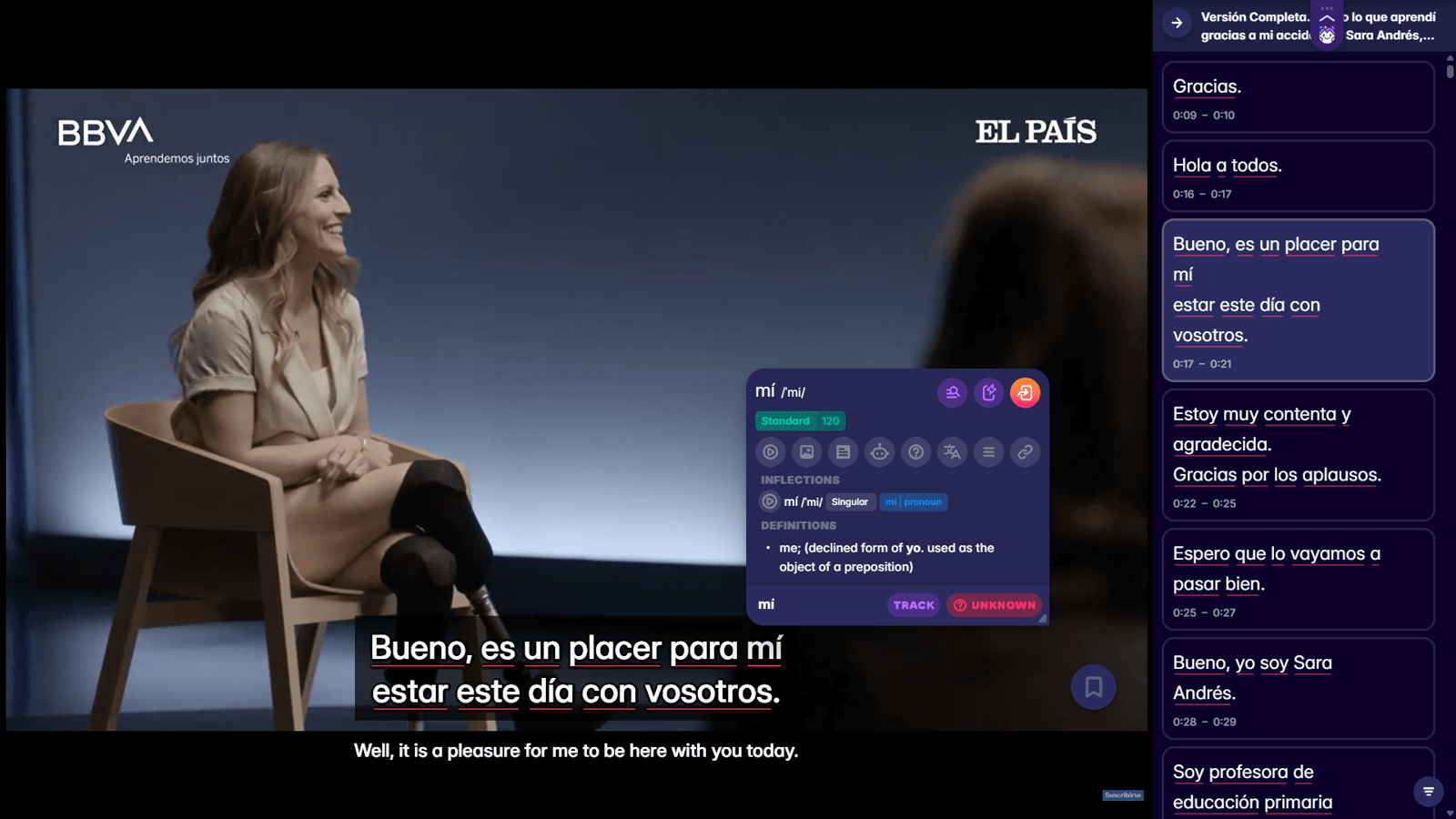
Anyway, if you're serious about improving your Spanish and want to learn from actual content that native speakers watch and read, Migaku's browser extension lets you look up words and save vocabulary while streaming shows or browsing Spanish websites. You can see words like "veía" in real context and build your understanding naturally. There's a 10-day free trial if you want to check it out.
Learn Languages with Migaku