# Vietnamese Restaurant Phrases: Order Food and Drinks Like a Local
> Learn how to order food, ask questions, and pay the bill with this Vietnamese food and drinks vocabulary list. Practical guide with audio.
**URL:** https://migaku.com/blog/language-fun/vietnamese-restaurant-phrases-order-food
**Last Updated:** 2026-03-21
**Tags:** vocabulary, phrases
---
Walking into a Vietnamese restaurant for the first time can feel a bit intimidating if you don't speak the language. You're hungry, you want to order something delicious, but you're not sure how to ask for it. The good news? You don't need to [be fluent in Vietnamese](https://migaku.com/learn-vietnamese) to enjoy an amazing meal. Learning just a handful of essential Vietnamese restaurant phrases will make your dining experience way more enjoyable and help you connect with locals who'll appreciate your effort to speak their language.
----
## Essential greetings and getting attention
Before you order anything, you'll want to greet your server properly. The most common greeting is **"chào," ** which works for any time of day. Vietnamese uses different pronouns depending on who you're talking to, but as a foreigner, people will be forgiving if you don't get it exactly right. When addressing someone who looks around your age or younger, you can say "Chào anh" (to a man) or "Chào chị" (to a woman). For older servers, "Chào cô" (to a woman) or "Chào chú" (to a man) shows more respect. If you're unsure, "chào" by itself works fine.
To get your server's attention politely, you can say **"Em ơi" ** (if they're younger) or **"Chị ơi" ** (if they're older and female) or **"Anh ơi" ** (if they're older and male). The word "ơi" is basically a polite way to call someone over.
----
## Asking for a table and the menu in Vietnamese language
When you first arrive at a restaurant, you might need to ask for a table.
**"Cho tôi một bàn" ** means "Give me a table" or more naturally "A table, please." The word "một" means "one," and "bàn" means "table." If you're dining with others, you can say **"Cho tôi một bàn cho hai người" ** (a table for two people). The word "hai" means "two."
Once you're seated, you'll want to see the menu. The phrase **"Cho tôi xem thực đơn" ** means "Please show me the menu." The word "tôi" is the pronoun for "I" or "me," which is pretty neutral and safe to use in most situations. "Thực đơn" means "menu."
Many Vietnamese restaurants, especially smaller local spots, might not have printed menus. In these cases, the server will tell you what's available, or you can ask **"Em có thể giới thiệu món nào ngon được không?" ** which translates to "Can you recommend any delicious dishes?" This question appears frequently in Vietnamese dining conversations because locals love sharing their favorite menu items.
----
## Common Vietnamese words for ordering food and drinks
The most useful phrase for ordering is **"Cho tôi" ** followed by what you want. This literally means "Give me" but functions as "I'd like" or "Can I have." For example, "Cho tôi một phở bò" means "I'd like one beef pho." Pho is probably the most famous Vietnamese dish, and knowing how to order it properly is essential.
If you want to order multiple items, you can list them: "Cho tôi một phở gà và một cà phê sữa đá" (I'd like one chicken pho and one iced milk coffee). The word **"và" ** means "and."
When ordering drinks, "nước" means "water," so "Cho tôi một nước suối" is "I'd like one bottled water." For Vietnamese iced tea, which is often free at restaurants, you can say "Cho tôi trà đá."
If you're not sure about portion sizes or want to order more later, you can say **"Cho tôi một phần" ** (Give me one portion) and add more dishes as you go. Vietnamese dining culture often involves ordering several dishes to share, so don't feel pressured to order everything at once.
----
## Vietnamese phrases for making customizations and special requests
Vietnamese cuisine can be quite spicy for some people, so knowing how to request modifications is helpful. The word **"không" ** is super useful because it means "no" or "not," and you'll use it frequently when making requests. "Không cay" means "not spicy" or "no spice."
If you want extra of something, **"thêm" ** means "more" or "add." So "Cho tôi thêm rau" means "Give me more vegetables."
If you're vegetarian, **"Tôi ăn chay" ** means "I eat vegetarian" or "I'm vegetarian." You can also ask "Món này có thịt không?" (Does this dish have meat?). The "không?" at the end turns a statement into a yes/no question.
If you have allergies, **"Tôi bị dị ứng với..." ** means "I'm allergic to..." followed by the ingredient. Some common allergens: "đậu phộng" (peanuts), "hải sản" (seafood), "tôm" (shrimp).
For other dietary preferences, here are some useful phrases:
- "Không hành" means "no onions"
- "Không rau mùi" means "no cilantro"
- "Ít đường" means "less sugar"
- "Không đá" means "no ice"
----
## Understanding what your server asks you
Your server might ask you some questions, too.
- **"Anh chị thấy đồ ăn hôm nay thế nào?" ** translates to "How did you find the food today?" This question comes up when servers want feedback about your meal. You can respond with "Ngon lắm" (very delicious) or "Rất ngon" (very good).
- Another common question is **"Anh chị thanh toán bằng thẻ hay bằng tiền mặt?" ** which means "Will you pay by card or cash?" Many smaller Vietnamese restaurants still operate on a cash-only basis, so it's good to be prepared. "Tiền mặt" means "cash" and "thẻ" means "card."
- If the server asks **"Anh chị muốn gọi thêm gì không?" ** they're asking "Would you like to order anything else?" You can say "Không, cảm ơn" (No, thank you) or "Vâng, cho tôi thêm..." (Yes, give me more...).
----
## Basic phrases for handling the bill and payment
When you're ready to leave, you'll need to ask for the bill.
- The most common phrase is **"Tính tiền" ** which literally means "calculate money" but functions as "Check, please." You can also say "Cho tôi tính tiền" to be more polite.
- Another option is **"Cho tôi hóa đơn" ** (Give me the receipt/bill). Both phrases work perfectly fine in Vietnamese restaurants.
- If you're paying as a group and need to split the bill, you can say **"Chia đều" ** which means "split evenly" or **"Tính riêng" ** which means "separate bills."
- Tipping isn't traditionally expected in Vietnam, though it's becoming more common in tourist areas and upscale restaurants. If you want to leave a tip, you can simply leave the money on the table or say **"Thôi, giữ lại" ** (Keep it) when paying.
----
## Expressing gratitude and saying goodbye
After your meal, showing appreciation goes a long way.
- **"Cảm ơn" ** means "thank you" and works in any situation.
- To be more emphatic, **"Cảm ơn nhiều" ** means "thank you very much."
- When leaving, you can say **"Tạm biệt" ** (goodbye) or the more casual "Chào" again.
- If the meal was particularly good, **"Đồ ăn rất ngon" ** (The food was very delicious) will make your server's day.
----
## How to practice and improve
Learning Vietnamese restaurant phrases from a list helps, but you can memorize them better if you order food in real life.
1. If you have Vietnamese restaurants in your area, order food and drinks in Vietnamese there. Most Vietnamese restaurant owners abroad are thrilled when customers attempt Vietnamese.
2. You can also [practice key phrases with language exchange partners](https://migaku.com/blog/language-fun/best-vietnamese-learning-apps) or use apps that focus on practical conversation. The key is repetition and real-world usage.
3. The basic Vietnamese phrases covered here will handle 90% of restaurant situations you'll encounter. As you get comfortable with these, you'll naturally pick up more vocabulary and start understanding responses better.
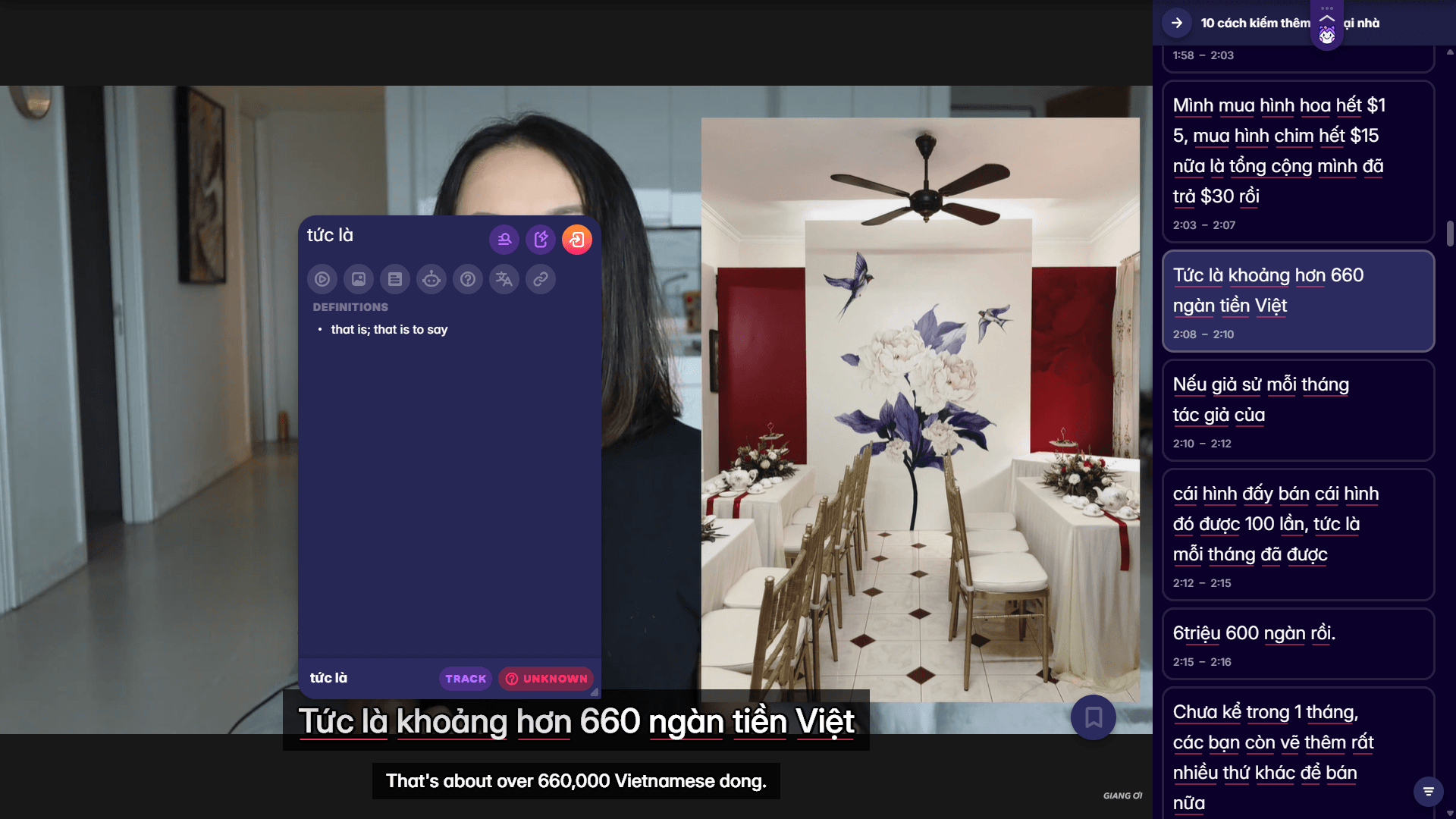
Anyway, if you want to take your Vietnamese learning beyond restaurant phrases, Migaku's browser extension and app let you look up words instantly while [watching Vietnamese shows](https://migaku.com/blog/language-fun/best-vietnamese-podcasts-for-language-learners) or reading Vietnamese content online. Makes [immersion learning](https://migaku.com/blog/language-fun/comprehensible-input-method-language-learning) way more practical. There's a 10-day free trial if you want to check it out.
 ----
## Why you should learn how to order food in Vietnamese restaurants
Vietnamese people genuinely appreciate it when foreigners try to speak their language, even if your pronunciation isn't perfect. Using basic Vietnamese phrases at restaurants shows respect for the culture and often leads to better service, friendlier interactions, and sometimes even recommendations for dishes that aren't on the menu. To practice ordering Vietnamese food, the fastest way is to read through several Vietnamese menus, watch Vietnamese food-hunt vlogs, and relevant documentaries.
> If you consume media in Vietnamese, and you understand at least some of the messages and sentences within that media, you will make progress. _Period_.
The effort pays off when you see the smile on your server's face.👍😊
----
## Why you should learn how to order food in Vietnamese restaurants
Vietnamese people genuinely appreciate it when foreigners try to speak their language, even if your pronunciation isn't perfect. Using basic Vietnamese phrases at restaurants shows respect for the culture and often leads to better service, friendlier interactions, and sometimes even recommendations for dishes that aren't on the menu. To practice ordering Vietnamese food, the fastest way is to read through several Vietnamese menus, watch Vietnamese food-hunt vlogs, and relevant documentaries.
> If you consume media in Vietnamese, and you understand at least some of the messages and sentences within that media, you will make progress. _Period_.
The effort pays off when you see the smile on your server's face.👍😊