# What Is Your Name in Portuguese: Phrases to Ask and Respond
> Learn how to ask "What is your name in Portuguese?" and respond naturally. Covers pronunciation, European vs Brazilian differences, and examples.
**URL:** https://migaku.com/blog/language-fun/what-is-your-name-in-portuguese
**Last Updated:** 2026-03-19
**Tags:** vocabulary, phrases
---
Learning how to introduce yourself is literally the first thing you need when picking up a new language. [If you're diving into Portuguese](https://migaku.com/learn-portuguese), you'll want to know how to ask someone's name and how to give yours back. The good news? The phrases are super straightforward, and once you get the hang of the pronunciation, you'll sound pretty natural. This guide covers everything from the basic "what is your name in Portuguese" to the little differences between Brazilian and European Portuguese that actually matter in real conversations.
----
## How do you say "what is your name" in Portuguese
The most common way to ask someone's name in Portuguese is **"Como se chama?" ** This literally translates to "How do you call yourself?" but it means "What is your name?" in everyday conversation.
Here's the breakdown: "como" means "how," "se" is a reflexive pronoun, and "chama" comes from the verb "chamar" (to call). The reflexive verb "chamar-se" is the standard way Portuguese speakers talk about names.
You might also hear **"Qual é o seu nome?" ** which is more direct and translates literally to "What is your name?" This version is perfectly fine and maybe a bit easier for beginners to remember since it follows English structure more closely. Both phrases work in Brazilian and European Portuguese, though you'll hear "Como se chama?" more frequently in Portugal.
For informal situations, especially with people your age or younger, you can say **"Como você se chama?" ** in Brazil or **"Como te chamas?" ** in Portugal. The difference here is the pronoun, "você" is the standard informal "you" in Brazilian Portuguese, while "te" is used in European Portuguese informal speech.
----
## Ways to say "my name is" in Portuguese
Once someone asks your name, you need to know how to respond. There are a few options here, and they're all pretty common.
1. The most standard response is **"O meu nome é (your name)" ** which directly translates to "My name is (your name)." Simple and works everywhere. In Brazil, you might hear people drop the "o" and just say "Meu nome é João" or whatever their name happens to be.
2. Another super common way is using that same reflexive verb from the question: **"Chamo-me (name)" ** in European Portuguese or **"Me chamo (name)" ** in Brazilian Portuguese. This literally means "I call myself (name)." The difference is just word order, Portugal puts the pronoun after the verb in statements, while Brazil puts it before.
3. You can also say **"Eu sou (name)" ** which means "I am (name)." This is the most casual and works great in informal settings. You'll hear this one a lot in everyday Brazilian Portuguese especially.
Here's a quick reference:
- O meu nome é Maria.
*My name is Maria.*
- Chamo-me Pedro.
*I call myself Pedro.* (European style)
- Me chamo Ana.
*I call myself Ana.* (Brazilian style)
- Eu sou Carlos.
*I am Carlos.*
----
## Full self-introduction examples in Portuguese
Knowing just the name exchange isn't enough for a real conversation. Here's how you'd actually introduce yourself in a natural way.
**Basic introduction in Brazilian Portuguese:**
- Oi! Meu nome é Lucas. Prazer em conhecer você.
*Hi! My name is Lucas. Nice to meet you.*
**Basic introduction in European Portuguese:**
- Olá! Chamo-me Sofia. Muito prazer.
*Hello! My name is Sofia. Very pleased to meet you.*
**A slightly longer introduction might go:**
- Bom dia! Meu nome é Rafael, mas pode me chamar de Rafa. Sou do Brasil, de São Paulo. E você, como se chama?
*Good morning! My name is Rafael, but you can call me Rafa. I'm from Brazil, from São Paulo. And you, what's your name?*
**In Portugal, you might hear:**
- Boa tarde! Chamo-me Catarina. Sou de Lisboa. Muito gosto.
*Good afternoon! My name is Catarina. I'm from Lisbon. Very pleased.*
The phrase "prazer em conhecer" or just "prazer" means ["pleasure to meet you"](https://migaku.com/blog/language-fun/nice-to-meet-you-in-portuguese) and is super common in introductions. In European Portuguese, "muito gosto" (literally "much pleasure") is another polite way to say nice to meet you.
----
## European vs Brazilian Portuguese differences for introductions
The language variations between Portugal and Brazil matter more than you might think when you're learning basic phrases.
1. **Pronoun usage is probably the biggest difference.** In Brazil, "você" is the standard way to say "you" in almost all situations. In Portugal, they use "tu" for informal and "você" for formal contexts, but "você" is actually less common there overall. This affects how you ask names: "Como você se chama?" in Brazil versus "Como te chamas?" in Portugal for informal situations.
2. **The placement of pronouns changes too.** Brazilians say "Me chamo" while Portuguese say "Chamo-me." This applies to other reflexive and object pronouns across the board. Brazilian Portuguese puts them before the verb, European Portuguese typically puts them after (in statements, not questions).
3. **Vocabulary sometimes differs for greetings.** "Oi" is the casual "hi" in Brazil, while Portugal uses "Olá" more often. Both understand both versions, but you'll sound more local if you match the regional preference.
4. **The pronunciation gap is real.** European Portuguese sounds more closed and clipped, with unstressed vowels getting reduced or dropped. Brazilian Portuguese has clearer, more open vowels and a more melodic rhythm. When someone from Portugal says "Como se chama?" it might sound almost like two syllables got compressed into one in the middle.
For learners, Brazilian Portuguese is generally considered easier to understand because of those clearer vowel sounds. But if you're planning to live or travel in Portugal specifically, you should familiarize yourself with how they speak there.
----
## Name pronunciation adaptations in Portuguese
When you introduce yourself in Portuguese with a non-Portuguese name, there are some interesting things that happen with pronunciation.
Portuguese doesn't have all the same sounds as English.
- The "th" sound doesn't exist, so names like "Matthew" become "Mateus" (which is actually the Portuguese version of Matthew anyway).
- If your name is "Sarah," Portuguese speakers might pronounce it "SAH-rah" with a rolled or tapped R sound.
- Names with "J" sounds get adapted too. In Portuguese, "J" sounds like the "s" in "measure" or "vision." So "John" becomes "João" (the Portuguese equivalent), but if you insist on your English name, they might say it like "ZHON."
- The letter "H" is silent in Portuguese, which means names like "Henry" might get pronounced "EN-ree" unless the speaker is familiar with English pronunciation. Some Portuguese speakers will make an effort to pronounce foreign names correctly, but others will naturally adapt them to Portuguese phonetics.
If your name has sounds that don't exist in Portuguese, you have a few options. You can teach people the correct pronunciation and accept that it might sound a bit different with their accent. You can adopt the Portuguese version of your name if one exists (Michael becomes Miguel, Peter becomes Pedro, etc.). Or you can just roll with however they naturally say it.
In my experience watching language learners interact, most Portuguese speakers are pretty accommodating and will try to say your name the way you prefer. But in casual conversation, expect some phonetic adaptation to happen naturally.
----
## Common mistakes when asking names in Portuguese
Learners make some predictable errors with these basic phrases, and knowing them helps you avoid sounding awkward.
1. One big mistake is saying "Que es tu nombre?" because people assume Spanish and Portuguese are basically the same. That's actually Spanish, and while Portuguese speakers might understand you, it's not correct Portuguese at all. The Portuguese version uses "qual" or "como," never "que es."
2. Another error is mixing up "nome" and "name" pronunciation. "Nome" is two syllables (NO-mee), and English speakers often want to make it one syllable like "nome" rhyming with "home." That sounds really foreign.
3. Forgetting the reflexive pronoun is common too. You can't just say "Como chama?" because the verb "chamar" needs that "se" to mean asking about someone's name. Without it, you're asking "how does (something else) call?" which doesn't make sense in this context.
4. Some learners use overly formal language in casual situations. If you're meeting someone your age at a party and you bust out "Qual é o seu nome?" with perfect formal pronunciation, it might sound stiff. "E você, como se chama?" or even "Qual seu nome?" sounds more natural in Brazilian Portuguese for casual contexts.
5. Word order trips people up with the response. In European Portuguese, saying "Me chamo João" instead of "Chamo-me João" marks you as Brazilian or as someone who learned Brazilian Portuguese. Neither is wrong, but they signal different regional varieties.
----
## Video and audio resources for learning name phrases
Since pronunciation is so important for these basic phrases, using video and audio content makes a huge difference in how quickly you pick them up.
1. **YouTube** has tons of Portuguese lesson channels that cover introductions. Channels focused on Brazilian Portuguese will give you that variant, while channels specifically for European Portuguese will show you those differences. Look for videos that show native speakers actually saying the phrases in context, the ones where they're just on screen talking to the camera or having real conversations.
2. **Language learning apps** like Duolingo often have audio for basic phrases. The advantage here is that you can replay the same phrase over and over until you get it. Some apps let you record yourself and compare your pronunciation to that of a native speaker, which is pretty helpful for catching where you're off.
3. **Podcasts** such as PortuguesePod101 for Portuguese learners usually start with introduction phrases in their early episodes. The nice thing about podcasts is you can listen while doing other stuff, and the repetition helps cement the phrases in your memory.
4. **Movies and TV shows** in Portuguese are gold for hearing how people introduce themselves in natural contexts. You'll hear the casual versions, the formal versions, and everything in between. Brazilian telenovelas are great for this because there are always new characters meeting each other and introducing themselves.
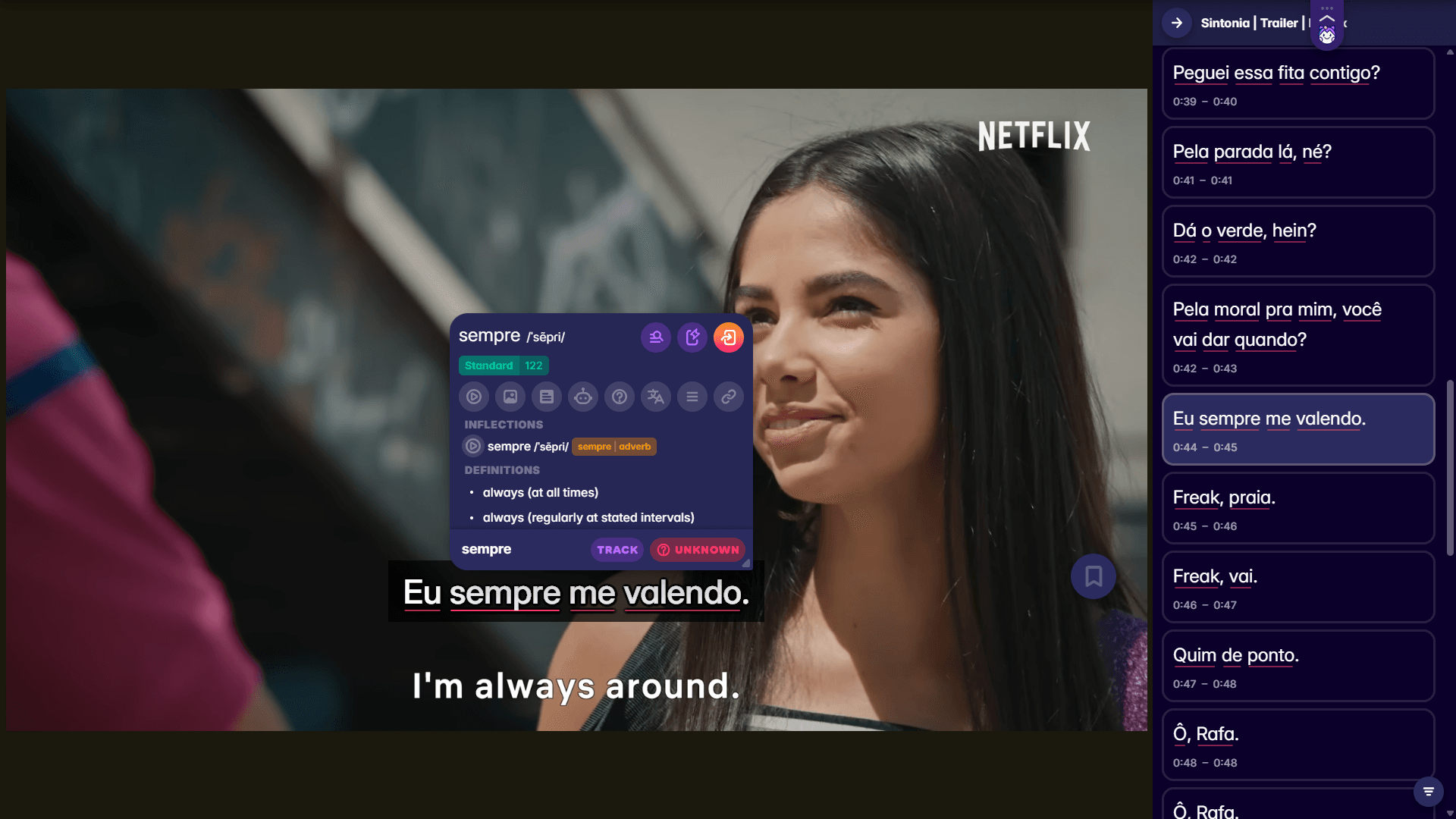
Anyway, if you want to practice these phrases with real Portuguese content, Migaku's browser extension and app let you look up words and save phrases while watching Brazilian or Portuguese shows. You can build your own deck of introduction phrases and practice them with spaced repetition. There's a 10-day free trial if you want to check it out and see how immersion learning speeds up your progress.
 ----
## Don't overlook the basics in language learning!
These introduction phrases might seem super basic, but they're the foundation for everything else you'll learn in Portuguese. First off, they teach you essential grammar structures. The reflexive verb "chamar-se" appears in tons of other contexts. The phrases also introduce you to Portuguese pronunciation in a low-stakes way. You're going to hear and use these phrases over and over, which means you can get tons of practice no matter whether you are consuming Portuguese media or living in Portuguese-speaking countries.
> If you consume media in Portuguese, and you understand at least some of the messages and sentences within that media, you will make progress. _Period_.
Get comfortable with these phrases, and stop stressing about the introduction.💡🤝
----
## Don't overlook the basics in language learning!
These introduction phrases might seem super basic, but they're the foundation for everything else you'll learn in Portuguese. First off, they teach you essential grammar structures. The reflexive verb "chamar-se" appears in tons of other contexts. The phrases also introduce you to Portuguese pronunciation in a low-stakes way. You're going to hear and use these phrases over and over, which means you can get tons of practice no matter whether you are consuming Portuguese media or living in Portuguese-speaking countries.
> If you consume media in Portuguese, and you understand at least some of the messages and sentences within that media, you will make progress. _Period_.
Get comfortable with these phrases, and stop stressing about the introduction.💡🤝