Best Way to Learn Spanish in 2026: Tested Ways to Learn Spanish as an Adult
Last updated: April 14, 2026
Maybe you're planning a trip to Barcelona, trying to connect with your partner's family, or just tired of being the only person at the office who can't understand the break room conversations. Whatever your reason, you're probably wondering what actually works for Spanish learning in 2026. I'm going to walk you through how to get conversational in Spanish, based on what's available right now in 2026. No fluff, just practical strategies you can start using today.
- Why most people fail to learn Spanish
- Focus on pronunciation early
- Start with high-frequency vocabulary
- Get a Spanish tutor for speaking practice
- Use apps strategically (Not as your only method)
- Immersion techniques for language learning
- Consume Spanish media actively, not passively
- Common mistakes to avoid
- The best way to learn Spanish language for beginners
Why most people fail to learn Spanish
Before we dive into the good stuff, let's talk about why so many people give up. The typical beginner downloads Duolingo, does lessons for three weeks, gets bored with the repetitive exercises, and quits. Or they buy a $300 course, watch a few videos, and never practice speaking because they're too nervous.
The problem isn't motivation. Most people genuinely want to learn a new language. The issue is using methods that don't match how adults actually acquire languages. You need comprehensible input, active practice, and consistent exposure. Passive studying alone won't cut it.
Focus on pronunciation early
A lot of Spanish courses ignore pronunciation until you're already intermediate, which is backwards. If you develop bad pronunciation habits early, they're hard to fix later. Plus, good pronunciation makes you way more confident when speaking.
The good news is Spanish pronunciation is pretty straightforward compared to English or French. The vowels are consistent, and most letters sound the same every time. The tricky parts for English speakers are usually the rolled R sound, the J sound (like a hard H), and distinguishing between B and V (which sound almost identical in Spanish).
YouTube has tons of free pronunciation tutorials now. Watch a few, practice the sounds that feel weird, and then record yourself speaking. Listen back and compare it to native speakers. Yeah, it feels cringy, but it works.
Better yet, have your tutor focus on pronunciation in your first few sessions. They can hear exactly what you're doing wrong and give you specific tips. Getting this feedback early prevents you from reinforcing bad habits.
Start with high-frequency vocabulary
One of the smartest ways to learn Spanish quickly is focusing on the words you'll often use. This is where the 80/20 rule comes in handy. Basically, about 20% of Spanish vocabulary makes up 80% of everyday conversations. If you learn the right 1,000 words first, you can understand a huge chunk of real Spanish.
Instead of memorizing random vocabulary lists from a textbook, focus on high-frequency words. Things like "tener" (to have), "hacer" (to do/make), "ir" (to go), "poder" (can/to be able to), and "querer" (to want). These verbs show up constantly in conversations.
Apps like Anki are perfect for this. You can find pre-made Spanish vocabulary decks organized by frequency, so you're always learning the most useful words first. Spend 15-20 minutes daily reviewing these cards, and you'll build a solid foundation way faster than traditional methods.
Get a Spanish tutor for speaking practice
The best investment you can make as a Spanish learner is regular conversation practice with a tutor. Platforms like italki and Preply have completely changed the game here. You can book one-on-one lessons with native Spanish speakers for $8-15 per hour. That's cheaper than a decent lunch.
I recommend starting with at least two 30-minute sessions per week. Your tutor can correct your pronunciation in real-time, explain confusing grammar points, and help you practice the specific scenarios you care about (ordering food, job interviews, whatever). This personalized feedback accelerates your progress way more than any app can.
When choosing a tutor, look for someone who specializes in conversational practice rather than academic Spanish. You want someone who'll get you talking from day one, even if you only know 50 words. The confidence you build from actual conversations is huge.
Use apps strategically (Not as your only method)
Let's talk about Duolingo since everyone asks about it. Is Duolingo good for learning Spanish? Yeah, it's decent for building basic vocabulary and getting familiar with sentence patterns. The 2026 version has improved AI that adapts to your mistakes, which is pretty cool.
But here's the reality: Duolingo alone won't make you fluent. It's great for beginners who need structure and gamification to stay motivated. Use it for your first 2-3 months to build foundational vocabulary and get comfortable with basic grammar. After that, you need more challenging input.
Some people ask whether Babbel or Duolingo is better for Spanish. Honestly, they're pretty similar. Babbel has slightly more grammar explanations and feels more "serious," while Duolingo is more game-like. Pick whichever interface you'll actually use daily. Consistency matters more than which app you choose.
For intermediate learners, apps like LingQ or Readlang are more useful. They let you read authentic Spanish content (news articles, stories, blogs) with instant dictionary lookups. This is where you really start expanding your vocabulary beyond beginner basics.
Immersion techniques for language learning
You've probably heard that immersion is the best way to learn Spanish. True, but most people misunderstand what this means. You don't need to move to Madrid for six months (though that'd be nice). You can create a Spanish immersion environment wherever you live.
Daily immersion in 2026 looks like this:
- Change your phone's language to Spanish.
- Watch Spanish shows with Spanish subtitles.
- Listen to Spanish podcasts during your commute.
- Follow Spanish speakers on social media.
The goal is surrounding yourself with the language so your brain starts recognizing patterns naturally.
For watching content, start with shows you've already seen in English. If you know the plot of Breaking Bad, watching it in Spanish becomes way more comprehensible. You can focus on the language instead of trying to follow the story. Netflix has tons of Spanish-language content now, and the subtitle options in 2026 are accurate.
Podcasts are perfect for learners because you can replay confusing sections and practice while doing other stuff. "Notes in Spanish" and "Coffee Break Spanish" are solid for beginners. Once you're intermediate, switch to podcasts made for native speakers about topics you genuinely care about.
Consume Spanish media actively, not passively
Here's a mistake I see constantly: people spend hours watching Spanish videos or listening to podcasts but never actually produce the language themselves. They're consuming passively instead of engaging actively.
Active learning means you're doing something with the language.
- Repeating sentences out loud, writing summaries of what you read.
- Explaining concepts to yourself in Spanish, or having conversations.
This forces your brain to retrieve and use what you've learned, which is how information moves from short-term to long-term memory.
Try this: after watching a Spanish YouTube video, pause and summarize what you just learned in Spanish. Speak it out loud. It'll feel awkward at first, but this active recall is incredibly powerful. You're training your brain to use Spanish, not just recognize it.
Same thing with reading. Don't just passively read Spanish articles. After each paragraph, close your eyes and try to recall the main points in Spanish. Look up key vocabulary and create example sentences using those words. This takes more effort than passive reading, but you'll remember way more.
Common mistakes to avoid
After seeing hundreds of learners struggle, here are the mistakes that kill progress:
- Perfectionism: Waiting until you "know enough" to start speaking. You'll never feel ready. Start having conversations after your first month, even if you only know 100 words.
- Translating everything: Trying to translate every word directly from English creates awkward Spanish. Learn phrases and expressions as complete units.
- Ignoring listening practice: Reading is comfortable, but if you can't understand spoken Spanish, you can't have real conversations. Balance your skills.
- Giving up too early: Everyone hits a plateau around the 3-month mark where progress feels slow. This is normal. Push through it.
The best way to learn Spanish language for beginners
If you're a complete beginner wondering where to start, here's a practical roadmap:
Weeks 1-4: Use Duolingo or a similar app for 20 minutes daily to learn basic vocabulary and sentence structure. Focus on present tense verbs and common phrases. Start changing your environment (phone language, Spanish music in the background).
Weeks 5-8: Add a tutor for 30-minute sessions twice per week. Keep using your app, but start incorporating simple reading (graded readers or language-learning apps with beginner content). Practice pronunciation actively.
Weeks 9-12: Increase speaking practice to 3 hours per week (mix of tutor sessions and language exchange partners). Start watching easy Spanish content with Spanish subtitles. Begin using spaced repetition for vocabulary building.
Months 4-6: Shift focus to comprehensible input. Read and listen to content slightly above your level. Continue regular speaking practice. Start journaling in Spanish (even just a few sentences daily).
This structure balances the different skills you need: vocabulary building, grammar understanding, listening comprehension, reading ability, and speaking confidence. Most people who follow something like this can have basic conversations within 3-4 months.
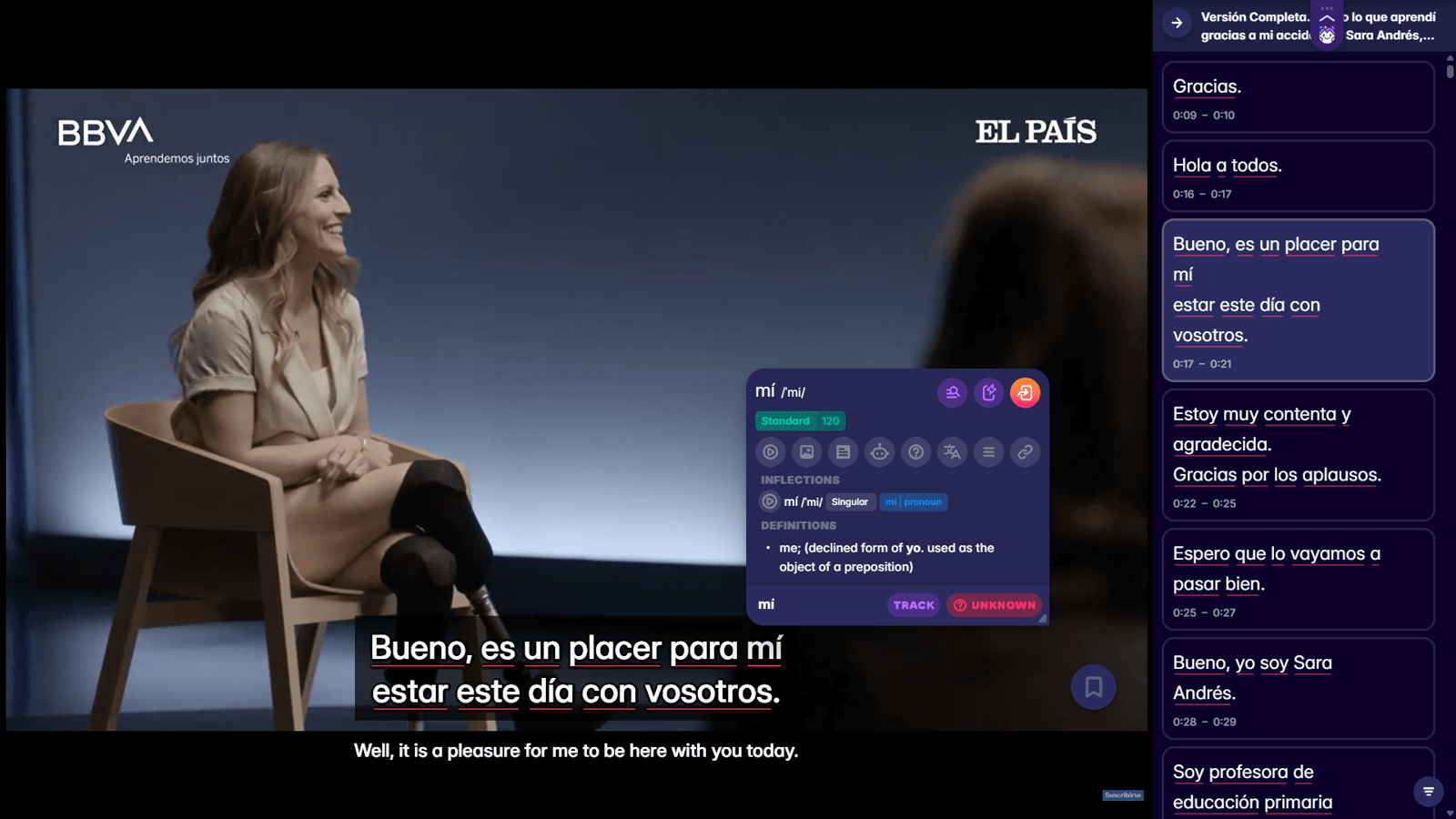
Anyway, if you want to actually use these strategies with real Spanish content, Migaku's browser extension and app let you look up words instantly while watching shows or reading articles. Makes immersion learning way more practical. There's a 10-day free trial if you want to check it out.
Your first 90 days matter most!
The first three months determine whether you'll actually learn Spanish or become another person who "tried to learn" but gave up. Set a specific daily time for Spanish. Find a tutor or conversation partner before you think you're ready. Consume Spanish content you genuinely enjoy, not just "educational" stuff.
If you consume media in Spanish, and you understand at least some of the messages and sentences within that media, you will make progress. Period.
Make these months count!