Dar Subjunctive Conjugation: Complete Guide With Conjugation Charts
Last updated: May 1, 2026

So you're learning Spanish and you've stumbled onto the verb dar (to give). It's one of those super common verbs you'll use constantly, but it is very irregular, especially in the subjunctive mood. I'm going to walk you through everything you need to know about dar subjunctive conjugation, plus throw in some other tenses so you can see how this verb behaves across the board. Let's get into it.
Present subjunctive of dar
Let's start with the present subjunctive since that's probably what brought you here. The present subjunctive of dar is used after expressions of doubt, emotion, desire, or uncertainty. You know, phrases like "espero que" (I hope that), "es importante que" (it's important that), or "dudo que" (I doubt that).
Here's how you conjugate dar in the present subjunctive:
Person | Present Subjunctive | English |
|---|---|---|
yo | dé | I give |
tú | des | You give (informal) |
él/ella/usted | dé | He/She gives, You give (formal) |
nosotros/nosotras | demos | We give |
vosotros/vosotras | deis | You all give (Spain) |
ellos/ellas/ustedes | den | They give, You all give |
Notice anything weird? The yo and él/ella/usted forms are identical: dé. Also, that accent mark on dé is crucial. Without it, you'd have "de" which is the preposition meaning "of" or "from." The accent distinguishes the verb form from the preposition.
Here are some example sentences:
- Espero que me des una respuesta pronto.
I hope you give me an answer soon. - Es importante que él dé su opinión.
It's important that he gives his opinion. - Quiero que ellos nos den más tiempo.
I want them to give us more time.
The present subjunctive gets used all the time in Spanish, so these forms will become second nature with practice.
Imperfect subjunctive of dar
The imperfect subjunctive is where things get interesting. This tense is used for hypothetical situations in the past, polite requests, or after certain expressions when the main verb is in a past tense.
The verb dar has two equally correct forms in the imperfect subjunctive. Yep, two complete sets of conjugations. Both are acceptable, though one might be more common depending on the region.
First form (more common in Spain):
Person | Imperfect Subjunctive | English |
|---|---|---|
yo | diera | I gave |
tú | dieras | You gave (informal) |
él/ella/usted | diera | He/She gave, You gave (formal) |
nosotros/nosotras | diéramos | We gave |
vosotros/vosotras | dierais | You all gave (Spain) |
ellos/ellas/ustedes | dieran | They gave, You all gave |
Second form (more common in Latin America):
Person | Imperfect Subjunctive (Dar) | English |
|---|---|---|
yo | diese | I gave |
tú | dieses | You gave (informal) |
él/ella/usted | diese | He/She gave, You gave (formal) |
nosotros/nosotras | diésemos | We gave |
vosotros/vosotras | dieseis | You all gave (Spain) |
ellos/ellas/ustedes | diesen | They gave, You all gave |
Both forms come from the third person plural preterite: dieron. You drop the -on ending and add the imperfect subjunctive endings.
Example sentences:
- Si me diera más dinero, compraría un coche nuevo.
If he gave me more money, I would buy a new car. - Dudaba que ellos nos dieran permiso.
I doubted they would give us permission. - Ojalá me dieras otra oportunidad.
I wish you would give me another chance.
The imperfect subjunctive shows up in conditional sentences, wishes about the past, and polite requests. You'll see it constantly once you start reading Spanish literature or watching Spanish shows.
Preterite tense of dar
The preterite tense covers completed actions in the past. This is where dar gets irregular again.
Person | Preterite | English |
|---|---|---|
yo | di | I gave |
tú | diste | You gave (informal) |
él/ella/usted | dio | He/she gave, You gave (formal) |
nosotros/nosotras | dimos | We gave |
vosotros/vosotras | disteis | You all gave (Spain) |
ellos/ellas/ustedes | dieron | They gave, You all gave |
Notice these forms look more like -er or -ir verb endings? That's the irregularity. The third person plural form dieron is what we used earlier to form the imperfect subjunctive.
Example:
- Ayer le di un regalo a mi hermana.
Yesterday I gave my sister a gift.
Conjugate dar in the future tense
The future tense is straightforward. You take the infinitive dar and add future endings. Dar is regular here.
Person | Future | English |
|---|---|---|
yo | daré | I will give |
tú | darás | You will give (informal) |
él/ella/usted | dará | He/She will give, You will give (formal) |
nosotros/nosotras | daremos | We will give |
vosotros/vosotras | daréis | You all will give (Spain) |
ellos/ellas/ustedes | darán | They will give, You all will give |
The form daré means "I will give."
Example:
- Mañana te daré una respuesta.
Tomorrow I will give you an answer.
Conditional tense of dar
The conditional expresses what would happen under certain conditions. Like the future, dar is regular in the conditional.
Person | Conditional | English |
|---|---|---|
yo | daría | I would give |
tú | darías | You would give (informal) |
él/ella/usted | daría | He/she would give, You would give (formal) |
nosotros/nosotras | daríamos | We would give |
vosotros/vosotras | daríais | You all would give (Spain) |
ellos/ellas/ustedes | darían | They would give, You all would give |
Example:
- Yo te daría mi coche, pero lo necesito.
I would give you my car, but I need it.
The conditional often pairs with the imperfect subjunctive in if-then statements:
- Si tuviera dinero, te daría cien euros.
If I had money, I would give you a hundred euros.
Compound forms: Adding haber to the mix
The compound tenses use a form of haber plus the past participle of dar, which is dado. These tenses add nuance about timing and completion.
Present Perfect Subjunctive:
This combines the present subjunctive of haber with dado. You use it for actions that may have happened recently or have relevance to the present.
Person | Present Perfect Subjunctive | English |
|---|---|---|
yo | haya dado | I have given |
tú | hayas dado | You have given (informal) |
él/ella/usted | haya dado | He/She has given, You have given (formal) |
nosotros/nosotras | hayamos dado | We have given |
vosotros/vosotras | hayáis dado | You all have given (Spain) |
ellos/ellas/ustedes | hayan dado | They have given, You all have given |
Example:
- Espero que ya te hayan dado la noticia.
I hope they have already given you the news.
Pluperfect Subjunctive (Past Perfect Subjunctive):
This uses the imperfect subjunctive of haber with dado. It expresses actions that had happened before another past action, within a subjunctive context.
Person | Pluperfect Subjunctive (Dar) | English |
|---|---|---|
yo | hubiera / hubiese dado | I had given |
tú | hubieras / hubieses dado | You had given (informal) |
él/ella/usted | hubiera / hubiese dado | He/She had given, You had given (formal) |
nosotros/nosotras | hubiéramos / hubiésemos dado | We had given |
vosotros/vosotras | hubierais / hubieseis dado | You all had given (Spain) |
ellos/ellas/ustedes | hubieran / hubiesen dado | They had given, You all had given |
Example:
- Si me hubiera dado cuenta antes, habría actuado diferente.
If I had realized earlier, I would have acted differently.
Common mistakes in dar verb conjugations
- Forgetting the accent on dé. The present subjunctive forms for yo and él/ella/usted need that accent mark. Without it, you've written the preposition "de" instead of the verb.
- Mixing up dar with estar. The present subjunctive of estar is esté, which sounds similar to dé when spoken quickly. Context usually clarifies, but be aware of this potential confusion.
- Using indicative when you need subjunctive. English speakers often forget to switch to subjunctive mood after expressions of doubt or emotion. "I hope he gives" becomes "Espero que dé" (subjunctive), not "Espero que da" (indicative).
- Overgeneralizing regular patterns. Because dar is irregular in several tenses, you can't just apply standard -ar verb endings across the board. Each tense needs individual attention.
Tips for mastering dar conjugation tables
Here's what helped me get comfortable with this verb:
- Practice the irregular forms separately. The present subjunctive forms (dé, des, dé, demos, deis, den) and the preterite forms (di, diste, dio, dimos, disteis, dieron) need special attention because they don't follow standard patterns.
- Connect the imperfect subjunctive to the preterite. Remember that dieron becomes the base for diera/diese forms. This connection makes the imperfect subjunctive easier to remember.
- Use flashcards or spaced repetition. The verb conjugation patterns stick better when you review them over time. Write out full conjugation tables, then test yourself.
- Read and listen actively. When you encounter dar in Spanish content, pause and identify which tense and mood it's in. This awareness builds intuition over time.
- Focus on common contexts. You'll use the present subjunctive of dar way more often than, say, the pluperfect subjunctive. Prioritize the forms you'll actually need in conversation.
Anyway, if you want to practice spotting these conjugations in real Spanish content, Migaku's browser extension and app let you look up verbs instantly while watching shows or reading articles. You can see dar in context across different tenses and build your understanding naturally. There's a 10-day free trial if you want to check it out.
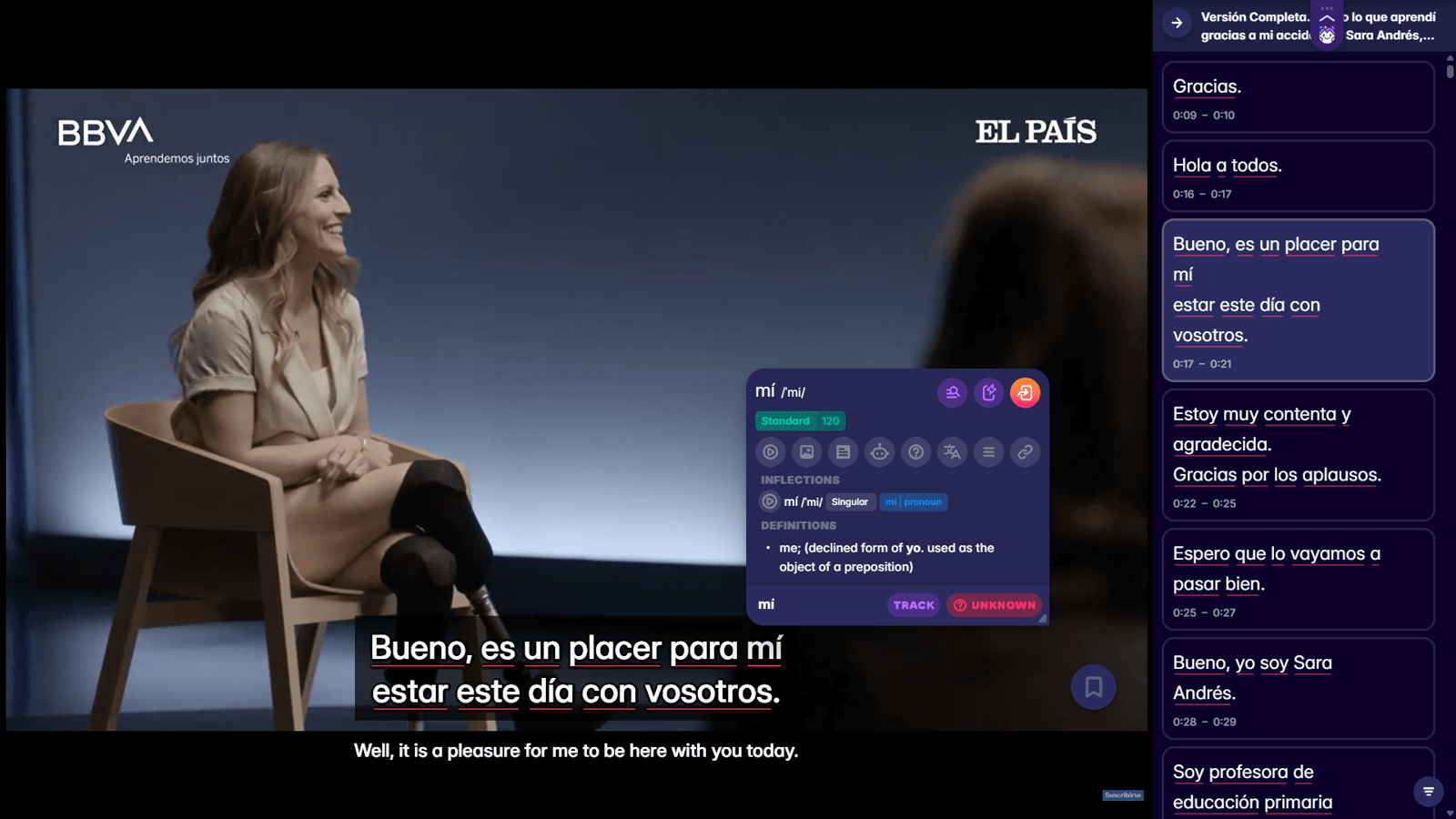
Using irregular verb dar in real contexts
Once you've got the conjugations down, the real work is getting enough input and using them naturally. Try creating your own sentences with dar in different tenses. Pause and try to understand the use of dar in Spanish media content. Keep practicing, stay patient with yourself, and remember that every Spanish learner struggles with the subjunctive at first.
If you consume media in Spanish, and you understand at least some of the messages and sentences within that media, you will make progress. Period.
Confusion is a normal part of the process. Keep going!