# Duolingo Spanish Review: Is Spanish Duolingo the Right App for You
> Honest Duolingo Spanish review after hundreds of hours. I break down what actually works, the major limitations, and whether it's worth your time in 2026.
**URL:** https://migaku.com/blog/spanish/duolingo-spanish-review
**Last Updated:** 2026-02-21
**Tags:** resources, discussion, deepdive
---
I've been using Duolingo on and off for [Spanish learning](https://migaku.com/learn-spanish) since 2023, and I know tons of people who swear by it while others completely trash it. The truth? It's actually somewhere in the middle. Duolingo works really well for certain things and falls short in others. After spending hundreds of hours with the app and talking to other learners, I'm going to break down exactly what works, what doesn't, and whether it's worth your time if you're serious about learning Spanish.
---
## What Duolingo does well for Spanish learners
Let me start with the good stuff, because Duolingo genuinely deserves credit for making language learning accessible to millions of people.
### The gamification of Duolingo lessons keeps you coming back
Here's the thing: consistency matters more than anything when you're trying to learn a new language. Duolingo absolutely nails this part. The streak system, XP points, and leagues create this addictive loop that keeps you opening the app daily. I've maintained a 487-day streak at one point, and yeah, some days I was just doing it for the streak. But you know what? Those "lazy" days still meant I was exposing myself to Spanish.
The path structure they introduced in 2022 (Replacing the old tree format) actually improved the experience. Instead of feeling overwhelmed by branches, you follow a clear progression through units. Each unit builds on previous vocabulary and grammar concepts in a way that feels natural.
### Vocabulary building is genuinely effective
Duolingo introduces new Spanish words at a reasonable pace and uses spaced repetition to reinforce them. After completing about 60% of the [Spanish course](https://migaku.com/blog/spanish/best-spanish-learning-apps), I had roughly 2,000-2,500 words in my passive vocabulary. That's not fluent, but it's enough to understand basic conversations and simple content.
The app mixes new vocabulary with review sessions automatically. You'll encounter the same words in different contexts, which helps with retention. Words like "manzana" (Apple) show up in various sentence structures, so you're not just memorizing isolated terms.
### Perfect for absolute beginners
If you've never studied Spanish before, Duolingo provides a gentle introduction. The app starts with [basic phrases](https://migaku.com/blog/spanish/get-started-in-spanish) like "Yo soy un hombre" (I am a man) and "El niño come pan" (The boy eats bread). The difficulty curve is gradual enough that you won't feel completely lost.
The pronunciation exercises help you recognize Spanish sounds early on. You hear native speakers (or pretty good AI voices) saying words and sentences, then you repeat them. It's basic, but it works for getting your ear adjusted to Spanish phonetics.
### It's free (mostly)
The free version of Duolingo gives you access to the entire Spanish course. You deal with ads and have limited hearts (Lives), but you can absolutely learn Spanish without paying a cent. That's pretty cool for people who can't afford expensive courses or tutors.
---
## Where Duolingo falls short for Spanish language learning
Okay, now for the reality check. Duolingo has some serious limitations that you need to understand before committing to it as your primary learning method.
### Grammar explanations are minimal
This is probably my biggest complaint. Duolingo teaches grammar implicitly through examples rather than explicit explanations. You'll encounter the subjunctive mood in Spanish sentences without really understanding why or when to use it yourself.
They added "guidebooks" for each unit that explain grammar concepts, but you have to actively seek them out. Most learners just tap through exercises without reading these guides. Even when you do read them, the explanations are pretty surface-level compared to what you'd get from a dedicated grammar resource.
For example, you'll practice sentences with "por" and "para" (Both mean "for" in different contexts), but Duolingo won't give you a comprehensive breakdown of when to use each one. You're supposed to absorb it through repetition, which works for some people but frustrates others.
### Speaking practice is extremely limited
Duolingo has speaking exercises where you repeat sentences, but this isn't real conversation practice. You're not forming your own thoughts or responding to unpredictable questions. You're just parroting pre-written sentences.
If your goal is to speak Spanish with real people, Duolingo alone won't get you there. I completed about 70% of the course before traveling to Mexico, and I could barely string together spontaneous sentences in actual conversations. Reading a sentence and repeating it is completely different from generating language on the fly.
### The sentence examples can be weird
Duolingo is kind of famous for bizarre sentences like "La mujer bebe vino" (The woman drinks wine) appearing way too often, or "El caballo come manzanas" (The horse eats apples). While these sentences do teach vocabulary and grammar, they're not always practical for real-world situations.
You'll spend time learning how to say "The duck wears a hat" before you can confidently order food at a restaurant or ask for directions. The prioritization of vocabulary feels off sometimes.
### Limited exposure to natural Spanish
Everything in Duolingo is scripted and simplified. You're not hearing how Spanish speakers actually talk in real life, with filler words, regional expressions, slang, or varying speeds. The Spanish you learn is technically correct but feels sterile.
This becomes obvious when you try to watch Spanish TV shows or listen to podcasts. The gap between Duolingo Spanish and authentic [Spanish content](https://migaku.com/blog/spanish/best-spanish-shows-guide) is massive. Native speakers don't talk in short, clear sentences with perfect pronunciation and textbook vocabulary.
---
## How the Spanish Duolingo course is structured in 2026
The Spanish course follows **a linear path divided into units**. Each unit focuses on specific themes like family, food, travel, or hobbies. Within each unit, you'll find multiple lessons that introduce new words and grammar patterns.
After completing lessons, you unlock **practice sessions** and **"legendary" levels**. The practice sessions use spaced repetition to review material you've learned. Legendary levels are harder versions of completed lessons that test your mastery.
The course also includes **stories**, which are short dialogues between characters. These are actually pretty useful because they show vocabulary in context and feel more natural than isolated sentences. You read along while listening, then answer comprehension questions.
Progress is measured in **XP** (Experience points) and **completion percentage**. The full Spanish course takes most learners 6-12 months to complete if they practice 15-20 minutes daily. That gets you to roughly an A2 or low B1 level on the CEFR scale, which is basic conversational ability.
---
## Super Duolingo: Is the premium version worth it
### Try Super Duolingo
Super Duolingo (The paid subscription) costs about $13 per month or $84 annually as of 2026. Here's what you get:
No ads, unlimited hearts (so you can make mistakes without being locked out), personalized practice sessions, and the ability to test out of levels. You also get a free trial period to test it out.
Honestly? For most learners, the free version is fine. The unlimited hearts are nice if you find the heart system annoying, but you can also just practice old lessons to restore hearts for free. The ad-free experience is cleaner, but the ads aren't that intrusive.
The one feature that might be worth it is personalized practice. Super Duolingo analyzes your mistakes and creates custom review sessions targeting your weak points. If you struggle with specific grammar concepts or vocabulary categories, this helps reinforce them.
### What is Duolingo Max
Duolingo Max (Available in limited markets) adds AI conversation practice and more detailed explanations. The AI feature lets you have basic conversations with a chatbot, which is closer to real speaking practice. If you have access to Max and can afford it, that's probably the most valuable upgrade.
---
## Comparing Duolingo to other Spanish apps
You're probably wondering how Duolingo stacks up against alternatives. I've tried most of the popular apps, so here's my take.
1. **Babbel** provides better grammar explanations and more practical vocabulary. The lessons feel more structured around real-world conversations. However, [Babbel costs money from the start (Around $14 monthly)](https://my.babbel.com/en/prices), and the gamification is less engaging. If you're a self-motivated learner who values clear instruction over game mechanics, Babbel might suit you better.
2. **Pimsleur** focuses entirely on audio-based learning and speaking practice. You spend 30 minutes per lesson listening and responding to prompts. It's excellent for pronunciation and conversational skills but doesn't teach reading or writing. Pimsleur also costs significantly more than Duolingo (Around $20 monthly).
3. **Busuu** combines lessons with community feedback. Native speakers correct your writing and speaking exercises. This is incredibly valuable, but the free version is quite limited. The full experience costs about $10 monthly.
For pure vocabulary acquisition, apps like **Anki** or **Memrise** with user-generated Spanish decks can be more efficient than Duolingo. They use more aggressive spaced repetition algorithms.
The reality is that most successful Spanish learners use multiple resources. Duolingo works well as one tool in your arsenal, not as your only method.
---
## Who should use Duolingo to learn Spanish
Duolingo works best for specific types of learners:
1. **Absolute beginners** who need a structured introduction to Spanish will benefit from Duolingo. The app removes the intimidation factor and makes those first steps approachable. If you've never studied a language before, starting with Duolingo is totally reasonable.
2. **People who struggle with consistency** should leverage Duolingo's gamification. The streak system and daily reminders genuinely help build a habit. Even 10 minutes daily adds up over months.
3. **Casual learners** who want [basic Spanish for travel](https://migaku.com/blog/spanish/best-spanish-podcasts-for-learners) or personal interest will find Duolingo sufficient. If your goal is to order food, ask directions, and have simple conversations, Duolingo can get you there (though you'll need to supplement with real conversation practice).
4. **Budget-conscious learners** get a complete course for free. You can't beat that value proposition.
Duolingo doesn't work as well for:
1. **Learners aiming for fluency or advanced proficiency**. You'll hit a ceiling around B1 level, and progressing beyond that requires different methods.
2. **People who need strong grammar foundations**. If you're studying Spanish for academic purposes or want to understand the "why" behind language rules, Duolingo won't satisfy you.
3. **Learners who prioritize speaking skills**. The conversation practice is too limited to develop real fluency.
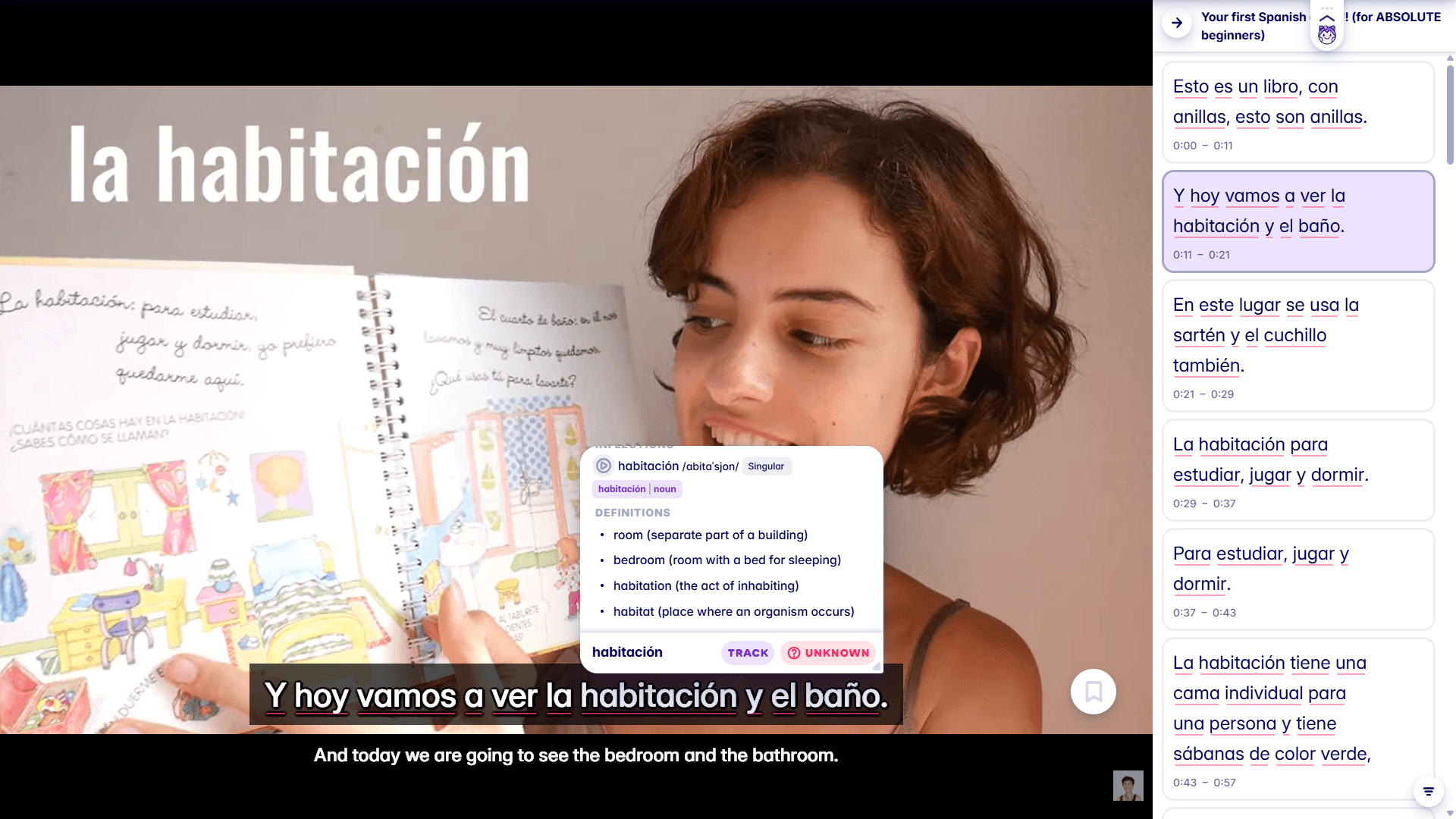
Anyway, if you're ready to move beyond Duolingo exercises and learn from actual Spanish content, Migaku's browser extension and app let you look up words instantly while watching shows or reading articles. It makes immersion learning way more practical. There's a 10-day free trial if you want to check it out.
 ---
## FAQs on Duolingo Spanish learning
Short answer: yes, Duolingo teaches accurate Spanish. The vocabulary and grammar are correct, and the pronunciation from native speakers is reliable. However, Duolingo primarily teaches Latin American Spanish with a neutral accent. If you want to learn Castilian Spanish (from Spain), you'll notice differences in pronunciation (like the "th" sound for "c" and "z") and some vocabulary choices. Duolingo does offer some regional variations, but the default is Latin American.
---
## Learn Spanish with Duolingo as a vocab tool, but don't rely on it exclusively
Here's what I'd recommend: Spend your first 2-3 months with Duolingo to build a foundational vocabulary and get comfortable with basic Spanish grammar. Keep using Duolingo for vocabulary review and to maintain your daily habit, but spend equal or more time with authentic Spanish content, including textbooks and other media content such as dramas, podcasts, shows, etc. Create a package of learning resources for Spanish skills for yourself!
> If you consume media in Spanish, and you understand at least some of the messages and sentences within that media, you will make progress. _Period_.
Customize your own study plan!
---
## FAQs on Duolingo Spanish learning
Short answer: yes, Duolingo teaches accurate Spanish. The vocabulary and grammar are correct, and the pronunciation from native speakers is reliable. However, Duolingo primarily teaches Latin American Spanish with a neutral accent. If you want to learn Castilian Spanish (from Spain), you'll notice differences in pronunciation (like the "th" sound for "c" and "z") and some vocabulary choices. Duolingo does offer some regional variations, but the default is Latin American.
---
## Learn Spanish with Duolingo as a vocab tool, but don't rely on it exclusively
Here's what I'd recommend: Spend your first 2-3 months with Duolingo to build a foundational vocabulary and get comfortable with basic Spanish grammar. Keep using Duolingo for vocabulary review and to maintain your daily habit, but spend equal or more time with authentic Spanish content, including textbooks and other media content such as dramas, podcasts, shows, etc. Create a package of learning resources for Spanish skills for yourself!
> If you consume media in Spanish, and you understand at least some of the messages and sentences within that media, you will make progress. _Period_.
Customize your own study plan!