Should You Learn to Speak English or Spanish First? Real Comparison
Last updated: April 12, 2026
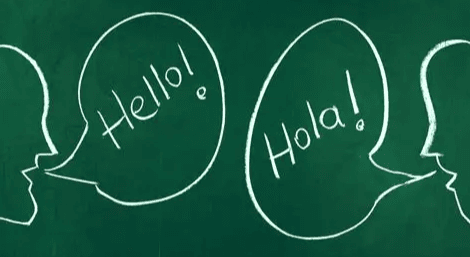
So you're standing at a crossroads, trying to figure out whether to dive into English or Spanish first. Maybe you've seen the "English or Spanish" meme floating around TikTok and wondered what all the fuss is about. Or maybe you're genuinely trying to make a practical decision about which language will serve you best. Either way, let me walk you through this decision with some real talk about both languages.
Grammar complexity: Which language plays nicer
Let's start with grammar because this is where things get interesting.
Spanish grammar
Spanish grammar follows pretty consistent rules once you learn them. Verbs conjugate in predictable patterns, and while there are irregular verbs (looking at you, "ser" and "ir"), the system makes logical sense. You've got masculine and feminine nouns, which English speakers find weird at first, but the patterns become natural after exposure.
Spanish verb conjugations are more complex than English on paper. You're dealing with different endings for yo, tú, él/ella, nosotros, vosotros, and ellos/ellas across multiple tenses. That's a lot of forms to memorize. But here's what makes it manageable: the patterns repeat. Once you nail the present tense regular verb endings, the other tenses follow similar logic.
English grammar
English grammar looks simpler at first glance. We don't conjugate verbs nearly as much (I run, you run, he runs, we run). No gendered nouns. Sounds easy, right? Wrong. English grammar is absolutely chaotic when you dig deeper. Our verb tenses are a mess of auxiliary verbs and irregular forms. Past tense alone will drive you crazy: "I went," "I have gone," "I had gone," "I was going," "I had been going." These all mean slightly different things, and explaining when to use each one? Good luck.
Phrasal verbs in English are particularly hard to learn. "Look up," "look down," "look into," "look after," "look over," "look through." Same verb, completely different meanings depending on the preposition. Spanish doesn't really do this, which is a huge relief for learners.
Pronunciation: Is it harder to speak English or Spanish
Spanish pronunciation
Spanish pronunciation is phonetically consistent, and this is where Spanish really shines for beginners. Once you learn the sound each letter makes, you can read almost any Spanish word correctly. There are about 24 phonemes in Spanish (the distinct sounds), and they map pretty directly to the letters. See a word written down? You know how to say it. Hear a word spoken? You can probably spell it.
English pronunciation
English pronunciation is a complete disaster. We have around 44 phonemes but only 26 letters to represent them. This means the same letter combination can sound completely different depending on the word. "Tough," "though," "through." Three different pronunciations of "ough." Why? Because English borrowed words from everywhere and kept their original spellings while the pronunciations shifted over centuries.
This irregularity makes English incredibly hard to master for speaking and listening. You can study English for years and still encounter words you've only read but never heard (or vice versa) and have no idea how they connect. Spanish doesn't do this to you.
The flip side: English speaking speed tends to be moderate, while Spanish speakers can talk incredibly fast. Native Spanish speakers often speak at 7-8 syllables per second compared to English's 6-7. When you're learning, fast Spanish can feel like a wall of sound where you can't pick out individual words. But at least when you do catch a word, you know how it's spelled.
Vocabulary size and learning curve
Spanish vocabulary
Spanish vocabulary is smaller than the English one, estimated around 93,000 words in common use. This makes the initial learning curve less steep. You need fewer words to express yourself competently in Spanish. Plus, if you already know English, about 30-40% of Spanish vocabulary will look familiar because both languages borrowed heavily from Latin. "Information" and "información," "animal" and "animal," "hospital" and "hospital." Pretty helpful.
The challenge with Spanish vocabulary comes from false friends. "Embarazada" doesn't mean embarrassed (it means pregnant). "Constipado" doesn't mean constipated (it means having a cold). These trip people up constantly.
English vocabulary
English has an absolutely massive vocabulary. We're talking over 170,000 words in current use, with new ones added constantly. This happened because English absorbed words from Latin, French, Germanic languages, and basically every culture Britain ever contacted. This means English has multiple words for the same concept, often with subtle differences. "Begin," "commence," "initiate," "start." All similar, all slightly different.
English vocabulary challenges are different. You need to learn more words to sound educated, and the irregularity means you can't always guess related word forms.
Usefulness and cultural benefits
English is the global lingua franca. About 1.5 billion people speak English to some degree, making it the most widely spoken language when you count non-native speakers. It dominates international business, science, technology, aviation, and entertainment. If you want to work in tech, publish research, or communicate across different countries, English is basically required.
Spanish is the second most spoken native language in the world, with about 475 million native speakers. It's the official language in 21 countries across Europe, the Americas, and Africa. For travel and cultural access in Latin America and Spain, Spanish is incredibly useful. The business case for Spanish is strong in the Americas, where Spanish-speaking markets represent huge economic opportunities.
Here's a practical way to think about it: English gives you width (you can communicate with more people across more countries), while Spanish gives you depth (you can deeply engage with a massive, culturally rich part of the world).
The learning time factor
How long does each language take to learn? The US Foreign Service Institute rates Spanish as a Category I language for English speakers, requiring about 600-750 class hours to reach professional proficiency. English is similar but moderately more difficult for Spanish speakers.
But here's the reality: your mileage will vary enormously based on your learning method, motivation, and exposure to the language. Someone doing intensive immersion can reach conversational fluency in Spanish in 6-12 months. Someone doing casual app-based learning might take years to reach the same level.
English takes longer to truly master because of the vocabulary size and irregularities, even if basic communication comes relatively quickly. You can get to "functional" in either language in similar timeframes, but "fluent" and "native-like" take years regardless.
So which should you learn first
Alright, here's my advice based on different situations:
- For maximum global utility, learn English first. It's the international language of business, science, and technology.
- But if you live in or near Spanish-speaking regions, or if your work connects to Latin American markets, Spanish makes more sense as a first choice.
- For career purposes: English wins in most fields, especially tech, science, and international business. Spanish wins if you're working in healthcare, education, or business specifically in the Americas.
- For travel: English is widely spoken in tourist areas globally, but Spanish lets you actually connect with locals across 21 countries.
If I'm being completely honest, most people should learn whichever language they'll actually use and enjoy. Motivation beats methodology every time. If you love Spanish music and want to travel through South America, learn Spanish. Your enthusiasm will carry you through the difficult parts. If you're obsessed with American movies, enjoy English media content, and want to work in tech, learn English. The "right" choice is the one you'll stick with.
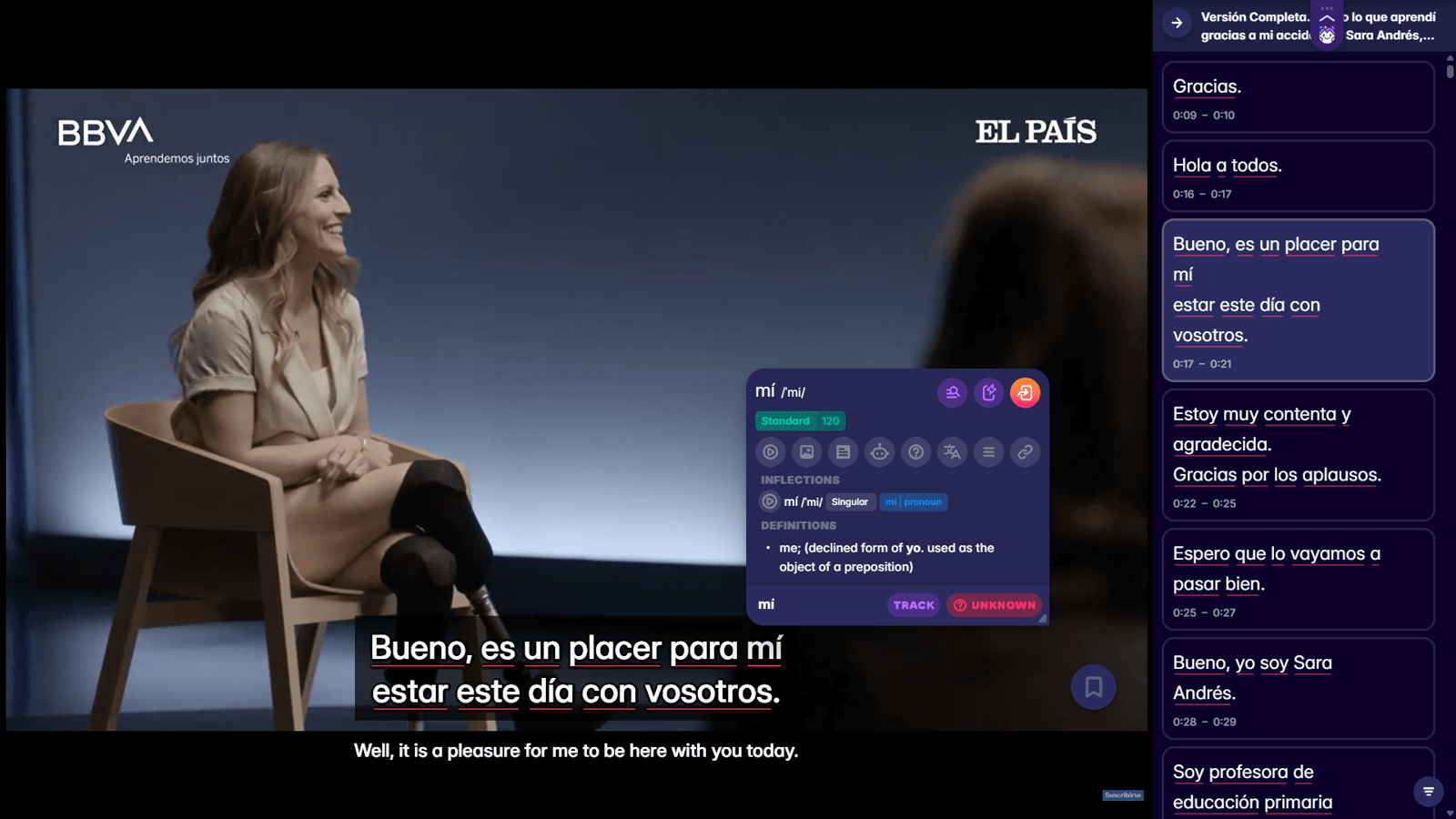
Anyway, if you want to actually learn either language through immersion, Migaku's browser extension and app let you look up words instantly while watching shows or reading articles in English or Spanish. Makes the whole process way more practical than pausing constantly to check a dictionary. There's a 10-day free trial if you want to check it out.
FAQs
No matter which one you choose to learn, the methods of learning languages online are the same
No matter which language you choose to learn first, the language learning methods you test and learn are going to help with your next language learning journey. Find a textbook or a course that can land you softly into the new language, make use of the internet resources like YouTube videos, films, and social media for immersion, and take your time to build up your knowledge little by little.
If you consume media in your target language, and you understand at least some of the messages and sentences within that media, you will make progress. Period.
No knowledge is ever wasted.