Estar Preterite Conjugation: How to Conjugate Estar in Spanish Preterite Tense
Last updated: April 27, 2026

The verb estar (to be) is super common in Spanish, and you'll use it constantly when learning Spanish and talking about temporary states, locations, and conditions. When you need to express these ideas in the past, specifically for completed actions, you need the preterite conjugation. And yeah, estar gets weird in the preterite. I'm going to walk you through exactly how to conjugate estar in the preterite tense, show you why it looks the way it does, give you tons of examples, and help you understand when to use this tense versus others. By the end, you'll have the conjugation table memorized and know how to use it naturally.
- The estar preterite conjugation chart
- Why estar is irregular in the preterite
- When to use the estar preterite tense with examples
- Estar preterite vs. Imperfect: What’s the difference
- Other tense conjugations of estar you should know
- Common mistakes with Spanish estar preterite conjugation
- Memorizing how to conjugate estar: Practical tips
The estar preterite conjugation chart
Let's just get straight to it. Here's how you conjugate estar in the preterite:
Person | Preterite (Estar) | English |
|---|---|---|
Yo | estuve | I was |
Tú | estuviste | You were (informal singular) |
Él/Ella/Usted | estuvo | He/She was, You were (formal) |
Nosotros/Nosotras | estuvimos | We were |
Vosotros/Vosotras | estuvisteis | You all were (informal plural, Spain) |
Ellos/Ellas/Ustedes | estuvieron | They were, You all were |
Pretty straightforward once you see it written out, right? The tricky part is that this verb doesn't follow the normal pattern you'd expect from an -ar verb. More on that in a second.
Why estar is irregular in the preterite
Okay, so I understand estar is irregular and becomes estuv, but why is it estuviste and estuvimos when it is an -ar verb?
Great question. This confuses a lot of Spanish learners because you'd expect an -ar verb to use the typical preterite endings: -é, -aste, -ó, -amos, -asteis, -aron. But estar is one of those irregular verbs that completely changes its stem in the preterite and then uses a different set of endings.
The stem changes from est- to estuv-. Then, instead of regular -ar endings, it uses what linguists call "preterite irregular endings": -e, -iste, -o, -imos, -isteis, -ieron. Notice there are no accent marks on these endings either, which is another telltale sign of this irregular pattern.
This same pattern shows up in other irregular verbs like tener (to have), which becomes tuve, tuviste, tuvo, and so on. Or poder (to be able), which becomes pude, pudiste, pudo. Once you learn this pattern for estar, you'll recognize it in about a dozen other common Spanish verbs.
The historical reason goes back to Latin, where these verbs had what's called a "strong preterite" or "perfective stem." But honestly, you don't need to know the linguistic history. You just need to memorize that estar uses the estuv- stem with these specific endings in the preterite tense.
When to use the estar preterite tense with examples
The preterite is all about completed actions in the past. When you use estar in the preterite, you're talking about a state or location that happened at a specific time and ended.
Here are some real examples:
- Estuve en Madrid el año pasado.
I was in Madrid last year. - ¿Dónde estuviste ayer?
Where were you yesterday? - Mi hermana estuvo enferma la semana pasada.
My sister was sick last week. - Estuvimos en la playa todo el día.
We were at the beach all day. - ¿Estuvisteis en la fiesta anoche?
Were you all at the party last night? (Spain) - Los estudiantes estuvieron nerviosos durante el examen.
The students were nervous during the exam.
Notice how each of these sentences refers to a specific, completed time in the past. The state of being somewhere or feeling something had a clear beginning and end.
Estar preterite vs. Imperfect: What’s the difference
This is where things get interesting. Spanish has two main past tenses, and choosing between them is one of the trickier aspects of learning Spanish.
The imperfect tense describes ongoing, habitual, or background states in the past. The preterite describes completed actions or states with a clear endpoint.
Compare these:
- Preterite: Estuve cansado ayer.
I was tired yesterday. (This emphasizes that you were tired at a specific point and that state is over) - Imperfect: Estaba cansado cuando llegaste.
I was tired when you arrived. (This describes an ongoing state that was happening when something else occurred) - Preterite: Estuvimos en México tres semanas.
We were in Mexico for three weeks. (The trip is complete, done, finished) - Imperfect: Estábamos en México cuando pasó el terremoto.
We were in Mexico when the earthquake happened. (This sets the scene for another action)
The imperfect conjugation of estar, by the way, is regular:
- estaba
- estabas
- estaba
- estábamos
- estabais
- estaban
Much easier to remember than the preterite forms.
Do you see the difference between era and fue as we use ser in the two past tenses here? Same principle applies. Ser (the other "to be" verb in Spanish) also has this preterite versus imperfect distinction. "Era" is imperfect (ongoing state), "fue" is preterite (completed state). The choice between preterite and imperfect depends on whether you're describing something that was ongoing or something that happened and ended.
Other tense conjugations of estar you should know
While we're focused on the preterite here, it helps to see how estar works in other tenses for comparison.
Tense | Yo | Tú | Él/Ella/Usted | Nosotros | Vosotros | Ellos/Ellas/Ustedes |
|---|---|---|---|---|---|---|
Present | estoy | estás | está | estamos | estáis | están |
Imperfect | estaba | estabas | estaba | estábamos | estabais | estaban |
Future | estaré | estarás | estará | estaremos | estaréis | estarán |
Conditional | estaría | estarías | estaría | estaríamos | estaríais | estarían |
Present Subjunctive | esté | estés | esté | estemos | estéis | estén |
The subjunctive is a whole other topic, but you'll use it for expressing wishes, doubts, or hypothetical situations. "Espero que estés bien." (I hope you're well.)
Common mistakes with Spanish estar preterite conjugation
I've seen learners make the same mistakes over and over with this verb. Here are the big ones:
- Using regular -ar endings ❎Wrong: Yo estaré (in preterite) ✅Right: Yo estuve
- Adding accent marks ❎Wrong: Él estuvó ✅Right: Él estuvo (no accent)
- Confusing preterite with imperfect If you're describing background information or an ongoing state, you want imperfect (estaba), not preterite (estuve).
- Forgetting the stem change ❎Wrong: Yo esté (mixing up with subjunctive) ✅Right: Yo estuve
- Mixing up with future tense The future tense of estar is estaré, estarás, estará, which looks similar to the wrong conjugations beginners sometimes create for preterite. Keep them separate.
Memorizing how to conjugate estar: Practical tips
Conjugation tables are useful reference tools, but you need to actually practice using these forms to remember them. Here's what works:
- Create personal sentences. Make up sentences about your own life using each pronoun. "Estuve en el gimnasio esta mañana." "Estuvimos en casa de mi abuela el domingo."
- Practice question and answer pairs. "¿Dónde estuviste?" "Estuve en el trabajo." This mimics real conversation.
- Group irregular verbs together. Learn estar alongside tener (tuve), poder (pude), poner (puse), and other verbs that follow the same irregular pattern.
- Use spaced repetition. Come back to these conjugations regularly over weeks and months. One study session won't cut it.
- Read and listen to Spanish content. You'll see and hear these forms constantly in real Spanish, which reinforces the patterns naturally.
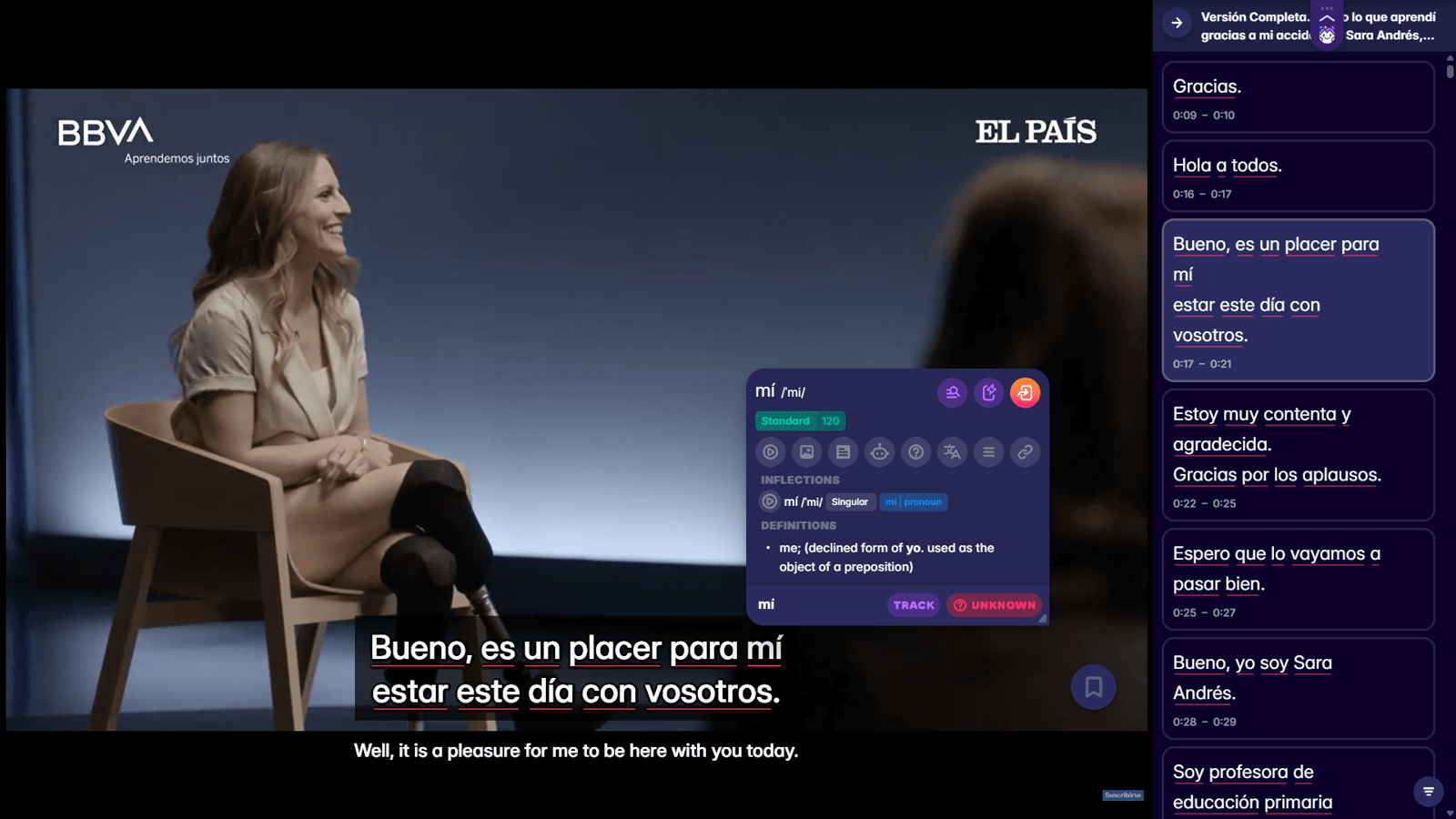
Anyway, if you want to practice reading and listening to real Spanish where you'll see these verb conjugations used naturally, Migaku's browser extension and app let you look up words and grammar instantly while watching shows or reading articles. Makes the whole immersion learning process way more practical. There's a 10-day free trial if you want to check it out.
Learning estar in the preterite tense is a milestone in your Spanish journey
This verb comes up constantly, and the preterite tense is essential for telling stories, explaining what happened, and talking about past experiences. The key is consistent exposure to real sentences, not just staring at conjugation charts. Pay attention to the estar conjugation in the text you are reading, the dramas and movies you are watching, and the podcasts you are listening to.
If you consume media in Spanish, and you understand at least some of the messages and sentences within that media, you will make progress. Period.
A few key words like estar can help you go a long way.