Fastest Way to Learn Spanish: Methods That Help You Become Fluent in Spanish
Last updated: April 27, 2026
Maybe you've got a trip to Spain coming up, maybe you're moving to Mexico for work, or maybe you just watched a Pedro Almodóvar film and thought "I need to understand this without subtitles." Whatever your reason, you're probably wondering how to learn Spanish quickly. I've seen people grind away with Duolingo for two years and barely string together a sentence, while others reach conversational fluency in six months using different strategies. Let me walk you through what actually works.
- The core truth about learning Spanish fast
- Immersion: The single most powerful approach to learning Spanish
- Speaking practice: You can’t skip this
- Use language learning apps to learn Spanish fast
- Spanish grammar: How much do you actually need
- Basic Spanish vocabulary acquisition strategy
- Pronunciation matters for beginners
- Setting realistic goals and timelines
- Staying motivated through the messy middle
- Common mistakes that slow you down
- The fastest way to learn Spanish: The practical routine
- FAQs
The core truth about learning Spanish fast
💡 What's the Fastest Way? 💡
The fastest way to learn Spanish comes down to one principle: maximize your exposure to comprehensible input while forcing yourself to produce output regularly. That sounds academic, but it just means you need to consume tons of Spanish content you mostly understand, and you need to speak it with real people as much as possible.
You could spend three years doing 15 minutes of Duolingo daily and reach maybe an A2 level. Or you could spend six months doing intensive immersion combined with regular tutoring sessions and hit B2. The time investment matters less than the intensity and method.
Immersion: The single most powerful approach to learning Spanish
Immersion remains the absolute fastest way to learn Spanish or learn any language. When I say immersion, I mean surrounding yourself with Spanish for multiple hours every day. If you can physically move to a Spanish-speaking country for a few months, that's ideal. You'll be forced to navigate daily life in Spanish, which accelerates learning like nothing else.
But most people can't just pack up and move to Barcelona or Buenos Aires. That's fine. You can create what I call "home immersion" that gets you maybe 70% of the benefits.
Here's what home immersion looks like:
- Change your phone and computer settings to Spanish. Yes, right now. You'll learn "configuración" (settings), "descargar" (download), and dozens of other practical words just by using your devices.
- Consume all your entertainment in Spanish. Watch Netflix shows in Spanish with Spanish subtitles. Listen to Spanish podcasts during your commute. Read news articles in Spanish over breakfast. You want to hit at least 2-3 hours daily of passive exposure.
- Label everything in your house. Stick notes on your "refrigerador" (refrigerator), "espejo" (mirror), and "escritorio" (desk). It sounds silly but you'll internalize these words fast.
The key with immersion is choosing content at the right level. As a beginner, you need stuff where you understand maybe 70-80% already. Too difficult and you'll just feel lost. Too easy and you won't progress. This is where most people mess up with immersion.
Speaking practice: You can’t skip this
You can consume Spanish content for years and still freeze up when someone asks you "¿De dónde eres?" (Where are you from?). Speaking is a separate skill that requires practice.
The best way to learn Spanish fast includes regular conversation with native speakers or advanced learners. You need this at least 3-4 times per week, ideally daily.
Working with an online Spanish tutor
Getting a tutor transforms your learning speed. A good Spanish tutor will:
- Correct your pronunciation in real-time
- Explain grammar points when you're confused
- Give you structured conversation practice
- Hold you accountable to showing up
You can find affordable tutors on italki or Preply for $10-15 per hour. Book 30-minute sessions four times per week. That's $160-240 monthly, which is way cheaper than traditional classes and infinitely more effective.
During tutor sessions, focus on conversational practice. Don't waste time on grammar lectures you could read yourself. Come prepared with topics you want to discuss. Ask your tutor to correct every mistake. Some tutors let errors slide to keep conversation flowing, but as a beginner you need those corrections.
One trick I recommend: record your tutor sessions (with permission) and review them later. You'll catch patterns in your mistakes.
Language exchange and conversation partners
If you can't afford a tutor, language exchange works too. Apps like Tandem or HelloTalk connect you with Spanish speakers learning English. You spend 30 minutes speaking Spanish, then 30 minutes speaking English with them.
The downside? Your exchange partner probably won't correct your mistakes as systematically as a paid tutor would. But free is free, and any speaking practice beats no speaking practice.
Use language learning apps to learn Spanish fast
Let's talk about Duolingo. Everyone asks about it. Here's my honest take:
- ✅Duolingo works fine for absolute beginners to learn basic vocabulary and get familiar with Spanish sentence structure. It gamifies learning, which helps some people stay consistent.
- ❎But Duolingo alone won't get you to fluency. It gives you maybe 10-15 minutes of passive engagement daily. That's not enough intensity. I've met people who completed the entire Duolingo Spanish course and still couldn't hold a basic conversation.
Use Duolingo if you want, but treat it as a supplement, not your main method. Do your 15-minute lesson, then spend another hour doing real immersion and speaking practice.
Better apps for serious Spanish learners
If you want to learn Spanish through apps, consider these:
- Anki for vocabulary building. It's a spaced repetition system that schedules flashcard reviews at optimal intervals. You can find pre-made Spanish decks with thousands of common words. Spend 20-30 minutes daily reviewing cards.
- LingQ or similar apps for reading practice. These let you click on words for instant definitions while reading Spanish articles or stories. Way better than looking up words in a separate dictionary.
- Language Transfer has a free Spanish course that teaches through audio lessons. Pretty solid for understanding grammar concepts intuitively.
The fastest way to learn Spanish online combines several tools. Don't put all your eggs in one app basket.
Spanish grammar: How much do you actually need
Everyone stresses about grammar when they want to learn Spanish. Should you memorize conjugation tables? Study subjunctive mood rules? Learn all the irregular verbs?
Here's what works: learn grammar just-in-time, not in advance. When you encounter a pattern repeatedly in your immersion and don't understand it, look it up. Read the explanation, do a few practice exercises, then get back to immersion.
You don't need to master Spanish grammar before speaking. You'll acquire most grammar naturally through exposure if you're getting enough comprehensible input. The grammar study just speeds up the process for tricky concepts.
Focus on high-frequency grammar first:
- Present tense conjugations (regular and top 20 irregular verbs)
- Past tenses (preterite and imperfect)
- Basic future constructions
- Common prepositions
- Gender and number agreement
That covers maybe 80% of what you'll use in everyday conversation. You can learn advanced grammar like subjunctive mood later.
Basic Spanish vocabulary acquisition strategy
You need around 2,000-3,000 words to reach conversational fluency in Spanish. That sounds like a lot, but it's achievable in a few months with the right approach.
- Learn the most common words first. Frequency lists exist showing the top 1,000 or 5,000 Spanish words. These high-frequency words appear constantly, so learning them gives you maximum return on investment.
- Use spaced repetition (like Anki) to memorize core vocabulary. Add 10-20 new words daily. Review your cards every day. You'll hit 1,000 - 2,000 words in about four months.
- Learn words in context, not isolation. Don't just memorize "hablar" (to speak). Learn it in sentences: "Necesito hablar contigo" (I need to speak with you). This helps you understand how words get used.
- Focus on verbs and nouns first. These carry the most meaning. Adjectives and adverbs can come later.
Pronunciation matters for beginners
Bad pronunciation will slow down your progress. If Spanish speakers can't understand what you're saying, conversations become frustrating for everyone.
Spanish pronunciation is pretty straightforward compared to English or French. The spelling mostly matches the sounds. But you still need to train your mouth to make unfamiliar sounds.
The "r" and "rr" sounds trip up most English speakers. The "j" sound (like in "jardín") doesn't exist in English. The vowels are purer and don't glide like English vowels.
Practice pronunciation from day one:
- Shadow native speakers. Play a Spanish audio clip, pause after each sentence, and repeat exactly what you heard, mimicking the accent and intonation.
- Record yourself speaking. Compare your recording to a native speaker saying the same thing. You'll hear the differences.
- Use your tutor for pronunciation drills. Have them repeat problem sounds with you until you get them right.
Good pronunciation helps you understand Spanish better too. When you can produce the sounds correctly, you'll recognize them more easily when listening.
Setting realistic goals and timelines
People always ask: "How fast can I become fluent in Spanish?"
It depends on your definition of fluent and your time investment. Here are realistic timelines:
- 3 months of intensive study (3-4 hours daily): You'll reach a solid A2 level, maybe low B1. You can have basic conversations, understand simple content, handle everyday situations like ordering food or asking directions.
- 6 months of intensive study: B1 to B2 level. You can discuss abstract topics, understand most TV shows and podcasts (with some gaps), and hold extended conversations. You'll still make mistakes, but you're clearly conversational.
- 12 months of intensive study: B2 to C1 level. You're genuinely fluent. You can work in Spanish, understand regional accents, engage with complex content, and express nuanced ideas.
These timelines assume you're doing immersion, regular speaking practice, and vocabulary study. If you're just doing 30 minutes of Duolingo daily, multiply these timelines by four or five.
Staying motivated through the messy middle
Learning Spanish follows a predictable pattern. The first month feels exciting. Everything is new. You're learning "hola" (hello) and "gracias" (thank you) and it feels like progress.
Months 2-4 are the messy middle. Progress feels slower. You're no longer a beginner, but you're not conversational yet either. This is where most people quit.
Here's how to push through:
- Track your progress concretely. Record yourself speaking once a month. You'll hear the improvement even when it doesn't feel like you're progressing.
- Celebrate small wins. Understood a full podcast episode? That's huge. Had a 5-minute conversation entirely in Spanish? Amazing.
- Connect Spanish to your interests. If you love cooking, watch Spanish cooking shows. Into soccer? Follow Spanish soccer podcasts. Learning feels easier when you're engaging with content you care about.
- Find a study buddy or join a community. Accountability helps. Plus you can commiserate about subjunctive mood together.
Common mistakes that slow you down
- Perfectionism kills progress. You'll make mistakes constantly. That's normal. Speak anyway. Make the mistakes. Get corrected. Move on.
- Translating everything in your head. Try to think directly in Spanish instead of translating from English. This gets easier with practice.
- Neglecting listening practice. Some people focus heavily on reading and speaking but don't spend enough time listening. You need all four skills.
- Studying grammar instead of using the language. Grammar study should take maybe 20% of your time max. The other 80% should be immersion and speaking.
- Giving up too early. Language learning requires hundreds of hours. You won't be fluent in 30 days no matter what some YouTube ad promises.
The fastest way to learn Spanish: The practical routine
Here's what a week of effective Spanish learning looks like for someone who wants to reach conversational fluency in 6 months:
Daily (7 days/week):
- 30 minutes of Anki vocabulary review
- 1-2 hours of Spanish content (TV shows, podcasts, YouTube, reading)
- Change all your device settings and social media to Spanish
4 times per week:
- 30-minute conversation session with a tutor or language partner
2-3 times per week:
- 30 minutes of focused grammar study (when you encounter concepts you don't understand)
That's roughly 2-3 hours daily, which is realistic if you're serious about learning fast. Replace your English entertainment with Spanish entertainment. Listen to Spanish podcasts instead of English ones during your commute. Read Spanish articles instead of English ones with your morning coffee.
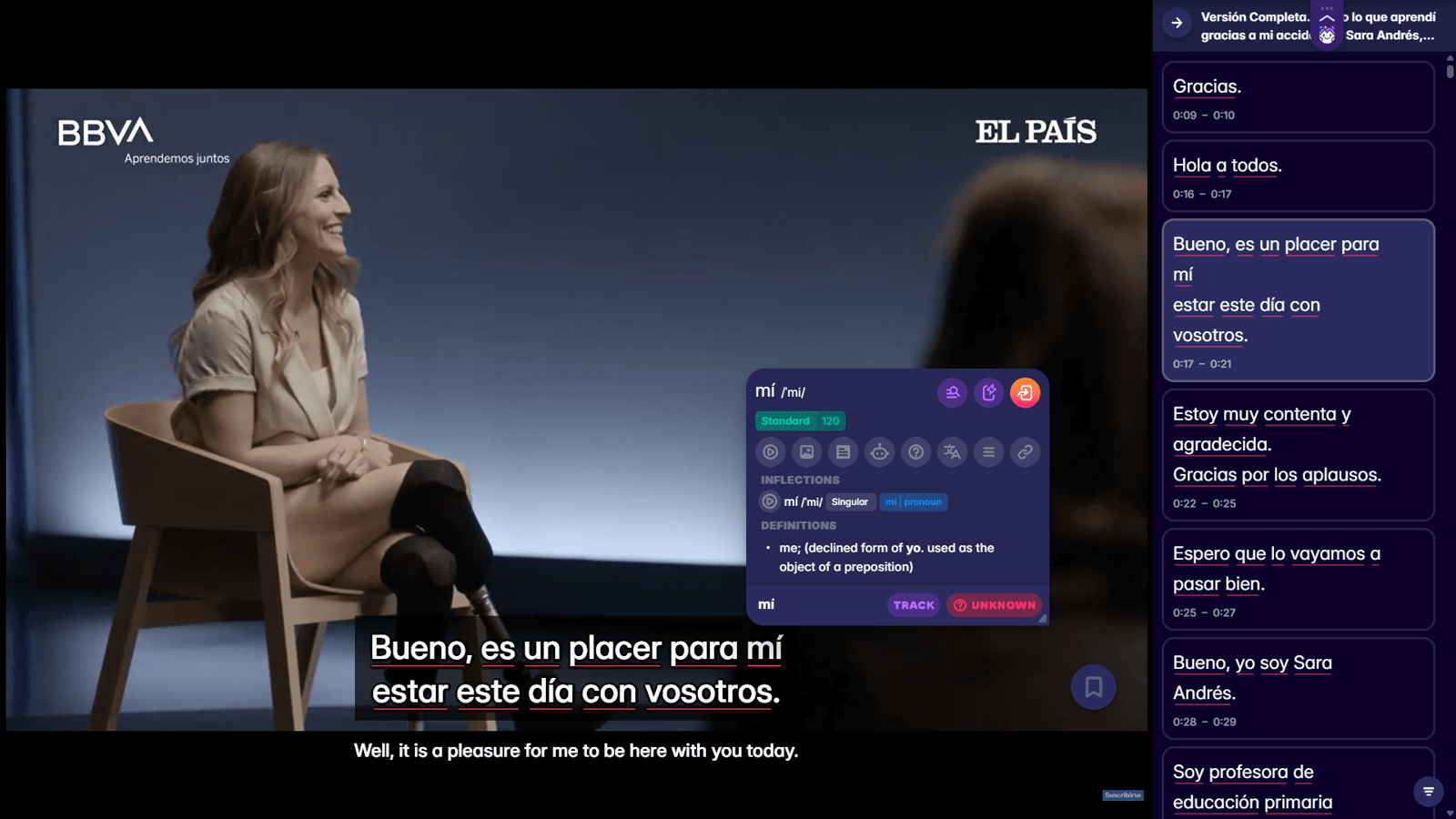
Anyway, if you're serious about using immersion to learn Spanish, Migaku's browser extension and app let you look up words instantly while watching Spanish shows or reading Spanish articles. Makes the whole immersion process way more practical since you're not constantly pausing to check a dictionary. There's a 10-day free trial if you want to check it out.
FAQs
Now you've got the answer to how to learn Spanish faster
The fastest way to learn Spanish combines high-intensity immersion with regular speaking practice, strategic vocabulary building, and just-enough grammar study. There's no shortcut around putting in the hours, but you can be smart about which hours you put in.
If you consume media in Spanish, and you understand at least some of the messages and sentences within that media, you will make progress. Period.
The key is starting today and staying consistent. Not perfect, just consistent.✅📖