Spanish Future Tense: Learn Spanish Future Tense With Verb Conjugation Rules
Last updated: April 13, 2026

So you want to talk about what's going to happen tomorrow, next week, or ten years from now in Spanish? Good news: the future tense in Spanish is actually one of the easier verb tenses to learn. The conjugation pattern is pretty straightforward, and once you get the hang of it, you'll be making plans and predictions like a native speaker. Spanish actually gives you a couple of different ways to express future actions, and knowing when to use each one makes a huge difference in sounding natural. Let me walk you through everything you need to know about the Spanish future tense, from the basic conjugation rules to the irregular verbs that'll try to trip you up when you learn Spanish.
What is the future tense in Spanish
💡 Definition 💡
The future tense (el futuro) in Spanish is what you use to express actions that will happen later. In English, we typically use "will" plus a verb: "I will eat," "she will study," "they will travel." Spanish has its own verb endings that do the same job.
The cool part about the Spanish future tense is that you attach the endings directly to the infinitive form of the verb. You don't need to drop anything or change the stem for most verbs. You just take the whole infinitive (hablar, comer, vivir) and add your future endings. This makes it way easier than some other tenses where you're constantly figuring out stem changes.
But before we get into the nitty-gritty of conjugation, you should know that Spanish speakers actually use multiple ways to talk about future events. The simple future tense is just one option, and depending on the situation, you might hear native speakers using other constructions instead.
The 4 types of future tense
When people talk about "four types of future tense" in Spanish, they're usually referring to these constructions:
- Simple Future (Futuro Simple): The conjugated future tense we've been focusing on. Example: Comeré (I will eat)
- Informal Future (Ir + a + Infinitive): The "going to" construction. Example: Voy a comer (I'm going to eat)
- Future Perfect (Futuro Perfecto): Used for actions that will have been completed by a certain point. Example: Habré comido (I will have eaten)
- Present Tense for Future: Sometimes Spanish uses the present tense to talk about scheduled future events. Example: Mañana salgo (Tomorrow I leave/I'm leaving tomorrow)
The simple future and the informal future are by far the most common. The future perfect is less frequent in everyday conversation, and using the present tense for future events is something you'll pick up naturally as you get more comfortable with Spanish.
The simple future tense conjugation
Let me show you how to conjugate regular verbs in the future tense. The pattern is the same for all three verb types (verbs ending in -ar, -er, and -ir), which is honestly pretty rare in Spanish grammar.
Here are the future tense endings you'll add to the infinitive:
- Yo: -é
- Tú: -ás
- Él/Ella/Usted: -á
- Nosotros/Nosotras: -emos
- Vosotros/Vosotras: -éis
- Ellos/Ellas/Ustedes: -án
Let's see this in action with three regular verbs:
Hablar (to speak):
- Yo hablaré
- Tú hablarás
- Él/Ella/Usted hablará
- Nosotros/Nosotras hablaremos
- Vosotros/Vosotras hablaréis
- Ellos/Ellas/Ustedes hablarán
Comer (to eat):
- Yo comeré
- Tú comerás
- Él/Ella/Usted comerá
- Nosotros/Nosotras comeremos
- Vosotros/Vosotras comeréis
- Ellos/Ellas/Ustedes comerán
Vivir (to live):
- Yo viviré
- Tú vivirás
- Él/Ella/Usted vivirá
- Nosotros/Nosotras viviremos
- Vosotros/Vosotras viviréis
- Ellos/Ellas/Ustedes vivirán
Notice how the endings are identical for all three verb types? You just slap them onto the infinitive and you're done. The accent marks on most of the endings help you know where to stress the word when speaking.
Irregular verbs in the future tense
Okay, so Spanish wouldn't be Spanish without throwing some irregular verbs into the mix. The good news is that even irregular verbs use the same endings I showed you above. The bad news is that some verbs change their stem before you add those endings.
Here are the main irregular verbs you need to memorize for the future tense:
Verbs that drop the "e" from the infinitive:
- Haber (to have): habr- (habré, habrás, habrá, habremos, habréis, habrán)
- Poder (to be able to): podr- (podré, podrás, podrá, podremos, podréis, podrán)
- Querer (to want): querr- (querré, querrás, querrá, querremos, querréis, querrán)
- Saber (to know): sabr- (sabré, sabrás, sabrá, sabremos, sabréis, sabrán)
Verbs that replace the vowel with "d":
- Poner (to put): pondr- (pondré, pondrás, pondrá, pondremos, pondréis, pondrán)
- Salir (to leave): saldr- (saldré, saldrás, saldrá, saldremos, saldréis, saldrán)
- Tener (to have): tendr- (tendré, tendrás, tendrá, tendremos, tendréis, tendrán)
- Venir (to come): vendr- (vendré, vendrás, vendrá, vendremos, vendréis, vendrán)
Completely irregular stems:
- Decir (to say): dir- (diré, dirás, dirá, diremos, diréis, dirán)
- Hacer (to do/make): har- (haré, harás, hará, haremos, haréis, harán)
These irregular verbs show up constantly in everyday Spanish, so you'll want to drill these conjugations until they're automatic. The stems might look weird at first, but you'll get used to them pretty quickly with practice.
Using ir + a + infinitive (The informal future)
Here's something that trips up a lot of Spanish learners: native speakers often use a different construction to talk about the future, especially in casual conversation.
💡Instead of the simple future tense, they'll use the verb ir (to go) in the present tense, followed by a, followed by an infinitive verb.
This construction works just like "going to" in English. When you say "I'm going to eat," you're talking about a future action using present tense forms. Spanish does the exact same thing.
Here's how to conjugate ir in the present tense:
- Yo voy
- Tú vas
- Él/Ella/Usted va
- Nosotros/Nosotras vamos
- Vosotros/Vosotras vais
- Ellos/Ellas/Ustedes van
Then you just add a plus any infinitive:
- Voy a estudiar.
I'm going to study. - Vas a comer.
You're going to eat. - Va a llover.
It's going to rain. - Vamos a viajar.
We're going to travel. - Van a llegar tarde.
They're going to arrive late.
In everyday Spanish conversation, you'll hear this construction way more often than the simple future tense. It sounds more natural and immediate, especially when talking about plans or intentions in the near future.
When to use the future tense vs. ir + a + infinitive
So if Spanish speakers use "voy a" so much, when do you actually use the simple future tense? Good question.
The simple future tense (futuro simple) typically gets used for:
Predictions and assumptions:
- Lloverá mañana.
It will rain tomorrow. - Tendrás unos veinte años, ¿no?
You must be about twenty years old, right?
Formal situations:
- El presidente hablará a las ocho.
The president will speak at eight. - La reunión comenzará puntualmente.
The meeting will begin promptly.
Promises and commitments:
- Te llamaré esta noche.
I will call you tonight. - No te mentiré.
I won't lie to you.
Distant future events:
- Algún día visitaré Japón.
Someday I will visit Japan. - Nos jubilaremos en diez años.
We will retire in ten years.
The "ir a" construction gets used more for:
Immediate plans:
- Voy a salir en cinco minutos.
I'm going to leave in five minutes.
Casual conversation:
- ¿Qué vas a hacer este fin de semana?
What are you going to do this weekend?
Intentions:
- Voy a empezar a hacer ejercicio.
I'm going to start exercising.
In practice, there's a lot of overlap, and you'll often hear both forms used interchangeably. But generally speaking, "voy a" sounds more conversational and immediate, while the simple future sounds more formal or distant.
Common mistakes to avoid
After helping people learn Spanish for years, I've noticed a few recurring mistakes with the future tense:
- Forgetting the accent marks: The accents matter for pronunciation and sometimes meaning. Hablara (imperfect subjunctive) is different from hablará (future tense).
- Using the wrong stem for irregular verbs: People often try to use teneré instead of the correct tendré. Those irregular stems just need to be memorized.
- Overusing the simple future in casual conversation: If you're chatting with friends about weekend plans, "voy a" will sound way more natural than the simple future.
- Confusing future tense with conditional: The conditional uses different endings (-ía, -ías, -ía, -íamos, -íais, -ían) and expresses "would" rather than "will."
Tips for mastering the Spanish future tense
Here's what works for getting comfortable with the future tense:
- Practice with time expressions: Combine future tense verbs with words like mañana (tomorrow), la próxima semana (next week), el año que viene (next year), dentro de (within/in), and pronto (soon). This helps cement the connection between the verb form and future meaning.
- Listen to how native speakers use it: Pay attention to when Spanish speakers choose the simple future versus "voy a." You'll start to develop an intuition for which sounds more natural in different contexts.
- Start with regular verbs: Get really comfortable with the regular conjugation pattern before you stress about irregular verbs. Once the endings are automatic, adding irregular stems becomes much easier.
- Make it personal: Practice by talking about your actual future plans. Estudiaré español todos los días (I will study Spanish every day), Viajaré a México el próximo año (I will travel to Mexico next year). When the sentences are relevant to your life, they stick better.
- Do conjugation drills: Yeah, they're boring, but spending 10 minutes a day drilling verb conjugations really does work. Write them out, say them out loud, quiz yourself.
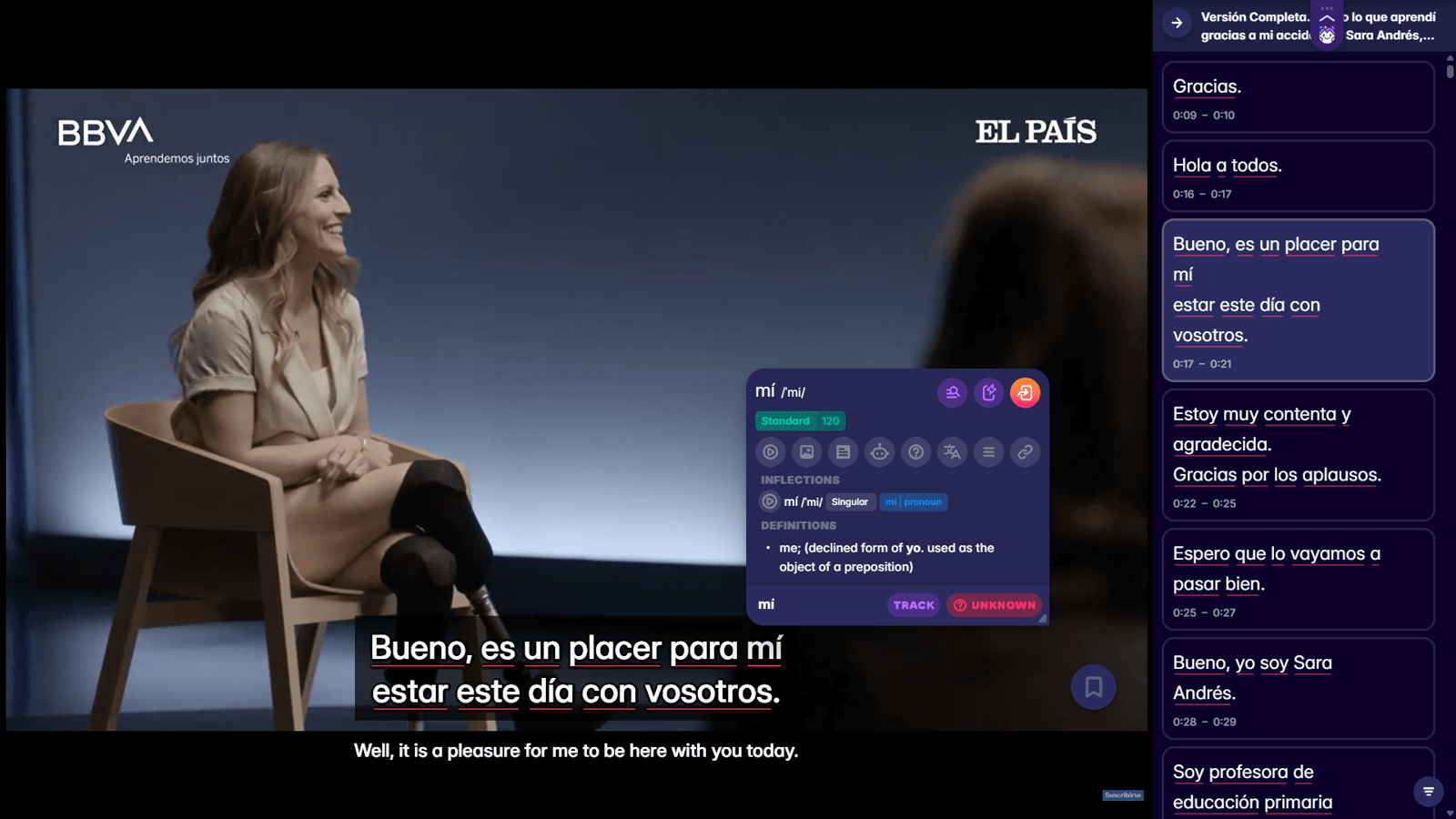
Anyway, if you want to see the future tense in action with real Spanish content, Migaku's browser extension and app let you look up conjugations and vocabulary instantly while watching Spanish shows or reading articles. Makes learning from native materials way more practical. There's a 10-day free trial if you want to check it out.
Use the Spanish future tense to talk about future events
Remember that you've got options when talking about the future in Spanish. The simple future tense works great for formal situations, distant plans, and predictions. The "ir a" construction sounds more natural in casual conversation and for immediate plans. As you get more comfortable with Spanish, you'll develop a feel for when each one fits best. The key is consistent practice. Conjugate verbs regularly, pay attention to how native speakers use the future tense in Spanish media, and look for opportunities to use it yourself when speaking or writing.
If you consume media in Spanish, and you understand at least some of the messages and sentences within that media, you will make progress. Period.
Time + Patience = Fluency.