Hacer Preterite Conjugation: Conjugate the Irregular Verb Hacer in Spanish
Last updated: April 28, 2026

If you're learning Spanish, you've probably run into the verb hacer (to do/to make) a million times already. It's one of those verbs that shows up everywhere. The thing is, when you need to talk about what you did or made in the past, hacer gets a little weird. Let me walk you through exactly how to conjugate hacer in the preterite tense, show you the full chart, and give you some real examples so this actually makes sense.
- The hacer preterite conjugation chart
- Why is hacer irregular in the preterite
- Subjunctive preterite forms
- Preterite tense vs. Other past tenses
- Common phrases and examples with hacer in the preterite
- Hacer preterite in different Spanish dialects
- Common mistakes with hacer in the preterite
- Memory tips for hacer preterite
The hacer preterite conjugation chart
Here's what you came for. The full conjugation table for hacer in the preterite tense:
Pronoun | Conjugation | English |
|---|---|---|
yo | hice | I did/made |
tú | hiciste | you did/made (informal singular) |
él/ella/usted | hizo | he/she did/made, you did/made (formal) |
nosotros/nosotras | hicimos | we did/made |
vosotros/vosotras | hicisteis | you all did/made (informal plural, Spain) |
ellos/ellas/ustedes | hicieron | they did/made, you all did/made |
Notice anything strange? The stem changes from "hac" to "hic" for most forms, and then to "hiz" for the third person singular. That's the irregular part. Regular verbs in Spanish would just keep their stem and add endings.
Why is hacer irregular in the preterite
Hacer is what we call an irregular verb in Spanish, specifically in the preterite tense. The irregularity comes from a stem change that affects all the conjugations.
Most regular Spanish verbs ending in -er would follow a predictable pattern in the preterite. Think of a verb like comer (to eat): comí, comiste, comió, comimos, comisteis, comieron. Clean and simple.
Hacer throws that pattern out the window. The stem becomes "hic" for most forms, but here's where it gets interesting: for the third person singular (él/ella/usted), it becomes "hizo" instead of "hició." Why? Because in Spanish, you can't have "ci" before "o" in this context. The language prefers "zo" to maintain the sound. It's a spelling convention that keeps pronunciation consistent.
Subjunctive preterite forms
Okay, this gets a bit more advanced, but if you're serious about learning Spanish, you should know that hacer also has preterite subjunctive forms. There are actually two sets: the imperfect subjunctive (which, confusingly, is based on the preterite) and the future subjunctive (which barely exists in modern Spanish).
The imperfect subjunctive has two acceptable forms in Spanish:
- -ra forms: hiciera, hicieras, hiciera, hiciéramos, hicierais, hicieran
- -se forms: hiciese, hicieses, hiciese, hiciésemos, hicieseis, hiciesen
Both are correct, though the -ra forms are more common in modern Spanish, especially in Latin America.
You'd use these in sentences like "Si hiciera buen tiempo, iríamos a la playa" (If the weather were good, we would go to the beach) or "Me pidió que hiciera la tarea" (He asked me to do the homework).
Preterite tense vs. Other past tenses
Here's the thing about Spanish grammar: there are multiple ways to talk about the past, and they're not interchangeable.
- The preterite tense (pretérito indefinido) is for completed actions at specific times in the past. "I made dinner last night." "She did her homework yesterday." These are done deals, finished actions.
- The imperfect tense (pretérito imperfecto) describes ongoing or habitual actions in the past. For hacer, the imperfect forms are: hacía, hacías, hacía, hacíamos, hacíais, hacían. You'd use this for things like "I used to do my homework every day" (Hacía mi tarea todos los días) or "She was making dinner when I arrived" (Ella hacía la cena cuando llegué). The difference matters. "Hice la cena" means you completed making dinner. "Hacía la cena" means you were in the process of making dinner, or you used to make dinner regularly.
- The present perfect (pretérito perfecto) uses the auxiliary verb haber plus the past participle hecho: he hecho, has hecho, ha hecho, hemos hecho, habéis hecho, han hecho. This is for actions that have relevance to the present or happened in a time period that includes now. "I have done my homework" (He hecho mi tarea) suggests it's done and maybe you're showing it to someone now.
Common phrases and examples with hacer in the preterite
Let me give you some real examples you'll encounter:
- ¿Qué hiciste?
What did you do? (Probably the most common question you'll hear with hacer in the preterite. People ask this all the time about your day, your weekend, your vacation) - Hice lo que pude.
I did what I could. (A super useful phrase when you tried your best but things didn't work out perfectly) - Ella hizo una pregunta.
She asked a question. (Literally "she made a question," which sounds weird in English but is totally normal in Spanish) - Hicimos un trato.
We made a deal. (Common in business or negotiation contexts) - ¿Quién hizo esto?
Who did this? (Useful when something happened and you need to know who's responsible) - No hice nada.
I didn't do anything. (The double negative is correct in Spanish, by the way. You need both "no" and "nada") - Hicieron un buen trabajo.
They did a good job. (Great for giving compliments)
Hacer preterite in different Spanish dialects
The conjugation stays the same across Spanish dialects, which is great news. Whether you're learning Mexican Spanish, Argentinian Spanish, or Spanish from Spain, "hice" is "hice" everywhere.
The main difference is with the vosotros form. In Latin America, vosotros isn't used in everyday speech. Instead, ustedes serves as both the formal and informal plural "you." So Latin American speakers would say "¿Qué hicieron ustedes?" where Spaniards might say "¿Qué hicisteis vosotros?"
Some regions also use "vos" instead of "tú" (mainly Argentina, Uruguay, and parts of Central America), but the preterite form stays the same: "vos hiciste" uses the same conjugation as "tú hiciste."
Common mistakes with hacer in the preterite
Let me tell you what trips people up:
- Using "hacío" instead of "hizo." This is super common because learners expect regular endings. Remember, it's "hizo" with a "z."
- Confusing preterite with imperfect. Saying "hacía" when you mean "hizo" changes your meaning completely. "Hacía la tarea" means you were doing or used to do homework. "Hice la tarea" means you completed it.
- Forgetting the accent on "hicisteis." In writing, that accent mark on the "i" matters. It shows where the stress falls.
- Mixing up "hice" and "hace." "Hice" is preterite (I did/made). "Hace" is present tense (he/she does/makes, or it makes as in weather). Totally different meanings.
Memory tips for hacer preterite
Here's what helped me remember these forms:
- First, memorize "yo hice" as your anchor. Once you have that first person singular down, the rest follow a pattern. The stem is "hic" for everything except that third person singular.
- Second, remember the "z" spelling in "hizo." Think of it as Spanish's way of keeping the pronunciation smooth. You can't have "hició" because it would sound weird, so it becomes "hizo."
- Third, practice with the question "¿Qué hiciste?" Say it out loud a bunch of times. Since this is such a common question, getting it into your muscle memory helps anchor the whole conjugation pattern.
- Fourth, write out sentences using each form. Don't just stare at the chart. Actually use the verb in context. "Ayer hice ejercicio. Mi hermano hizo lo mismo. Nosotros hicimos una carrera." (Yesterday I exercised. My brother did the same. We had a race.)
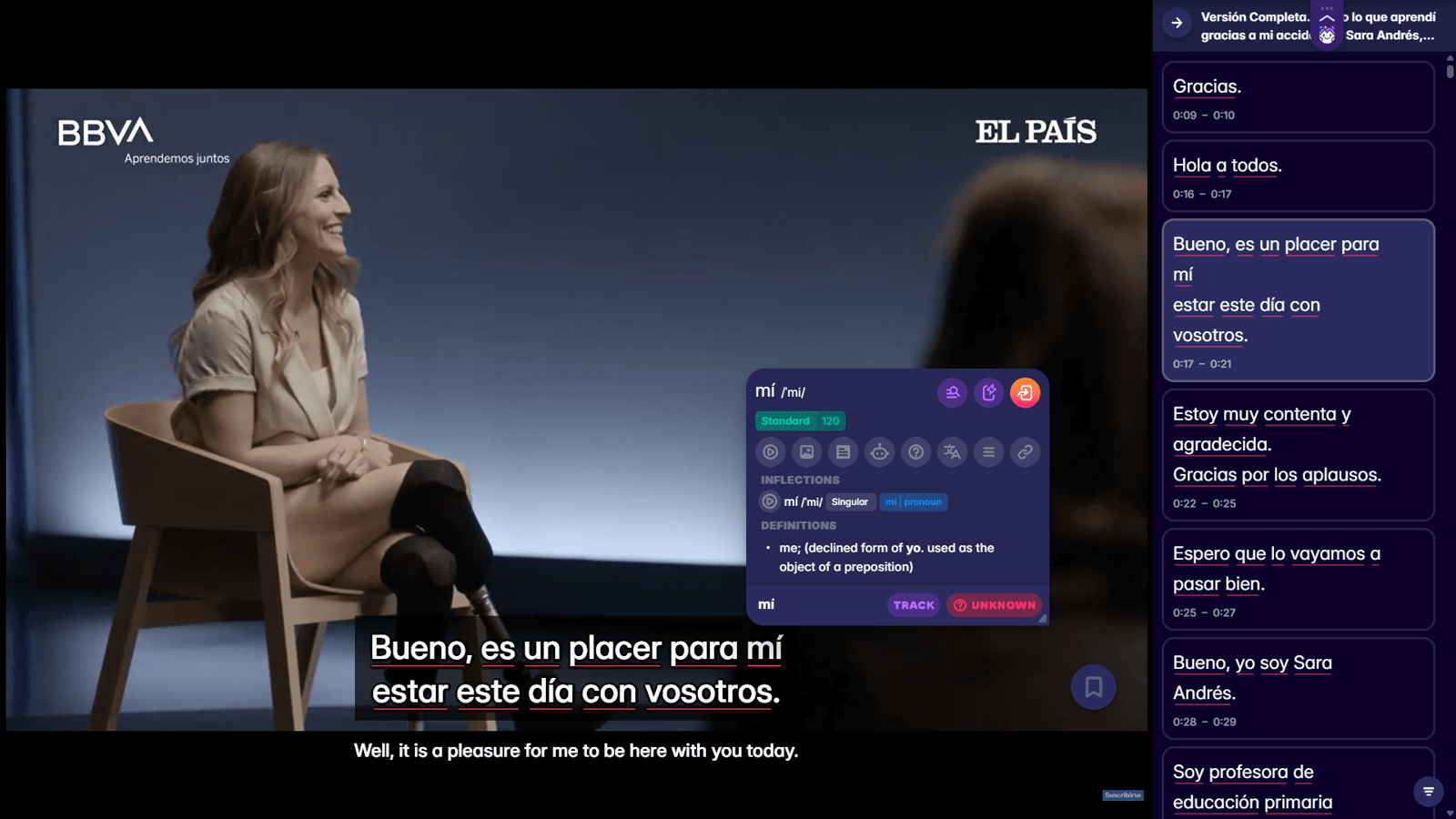
Anyway, if you're serious about learning Spanish through real content, Migaku's browser extension and app let you look up conjugations and vocabulary instantly while watching Spanish shows or reading articles. Makes the whole immersion learning process way smoother. There's a 10-day free trial if you want to check it out.
Practice makes perfect
Honestly, the best way to get comfortable with hacer in the preterite is to use it. A lot. Read Spanish content where you'll see these forms in context. Watch Spanish shows where characters talk about what they did. Have conversations with Spanish speakers (or practice partners) where you recount your day.
If you consume media in Spanish, and you understand at least some of the messages and sentences within that media, you will make progress. Period.
Exposure and practice. That's how you can learn!