Learn Spanish with Netflix: Tips to Learn a New Language with Netflix Shows
Last updated: April 5, 2026

You've probably heard that watching shows is a great way to learn a language, and honestly? It's true. Netflix has tons of Spanish content, from gripping dramas to lighthearted comedies, and if you use them right, you can actually improve your Spanish while enjoying genuinely good entertainment. The trick is knowing which shows to watch, how to set up your subtitles, and what to do when you hit new vocabulary. Let me walk you through exactly how to make Netflix your Spanish learning tool.
Can I learn Spanish by watching Netflix
Yes, you absolutely can learn Spanish by watching Netflix, but there's a catch.
You need to already understand at least some Spanish for this to work. If you're a complete beginner with zero Spanish knowledge, jumping straight into a show will probably just frustrate you. You'll hear rapid conversations and won't catch much of anything.
Language learning through media works when you're getting comprehensible input, which means you understand enough of what's happening to pick up new words and phrases from context. If you're catching maybe 60-70% of what's being said, you're in the sweet spot. The remaining 30-40% becomes learnable because you can guess meanings from the story, facial expressions, and words you already know.
Think of it like this. A complete beginner should probably spend a few weeks with a basic course or app to get fundamental vocabulary and grammar patterns down first. Once you can handle simple conversations and recognize common verbs, Netflix becomes incredibly valuable. You'll start noticing how real people actually use the language, which is pretty different from textbook Spanish.
Setting up your subtitles the right way
This is where most people mess up. They either use English subtitles the whole time (which means they're basically just watching an English show) or they turn subtitles off completely and get lost.
The best approach depends on your level.
- If you're intermediate, start with Spanish audio and Spanish subtitles. This lets you connect the spoken words with their written forms, which is super helpful for learning spelling and catching words you might miss in fast dialogue. Your brain is processing everything in Spanish, which is exactly what you want.
- For beginners who've finished a basic course, you might need English subtitles at first, but here's the key: focus on listening to the Spanish audio. Try to catch words and phrases you recognize before reading the English translation. Pause and rewind when you hear something interesting. The English subtitle is your safety net, but you're actively trying to understand the Spanish.
- Advanced learners can try Spanish audio with no subtitles, which forces your brain to work harder. You can always turn on Spanish subtitles if you get stuck on a particular scene.
One more thing. Netflix has a subtitle feature that lets you adjust the size and style, which makes reading easier if you're constantly glancing down at the text. Use it.
Best Spanish shows on Netflix for learners
Not all shows are equally good for learning. Some use clear dialogue and everyday vocabulary, while others throw slang and technical terms at you constantly.
Narcos
Narcos is probably the most famous Spanish show on Netflix, though it mixes English and Spanish throughout the series. The Spanish portions give you exposure to Colombian accents and vocabulary.
The show covers the drug trade in Colombia, so you'll hear a lot of crime and business-related terms. Fair warning: the Spanish in Narcos can be pretty fast and includes lots of slang, so this works better for intermediate learners who can handle challenging content.
The Colombia setting means you'll get familiar with Colombian Spanish specifically, which has its own flavor compared to Spanish from Spain or Mexico. If you're planning to travel to Colombia or just want to understand that regional variety, this show delivers.
Money Heist (La Casa de Papel)
La Casa de Papel became a massive international hit, and for good reason. The Spanish here is from Spain, so you'll hear the distinctive "th" sound for "c" and "z" that's characteristic of Castilian Spanish. The plot follows a group of robbers executing elaborate heists, which means lots of planning conversations, emotional exchanges, and action sequences.
The vocabulary is pretty accessible for intermediate learners. You'll pick up tons of useful phrases related to planning, relationships, and conflict. The show is engaging enough that you'll actually want to keep watching, which matters more than people realize. If you're bored, you won't stick with it.
Cable Girls (Las Chicas del Cable)
This one's set in 1920s Madrid and follows women working at a telephone company. The Spanish is clear and a bit more formal than modern shows, which actually makes it easier to understand. You'll learn vocabulary related to work, friendship, and social issues of the era.
The pacing is slower than action-heavy shows like Narcos, giving you more time to process what characters are saying. Good choice for intermediate learners who want something easier to follow.
Elite
Elite is a teen drama set in an exclusive private school in Spain. You'll get contemporary Spanish with lots of everyday vocabulary that young people actually use. The show deals with relationships, class differences, and mystery, so the dialogue covers a wide range of situations.
Because it's aimed at a younger audience, the language tends to be more accessible than shows with heavy professional or technical vocabulary. The episodes are engaging and not too long, which helps you stay focused.
The 80/20 rule for learning Spanish
The 80/20 rule, also called the Pareto Principle, suggests that 80% of your results come from 20% of your efforts. In language learning, this means focusing on the most common and useful words first.
For Spanish, roughly 1,000 words make up about 80% of everyday conversation. If you master these high-frequency words, you'll understand most of what you hear in normal situations. Netflix shows use these common words constantly, which is why they're so valuable for learners.
Instead of trying to learn every single word you encounter, focus on the ones that keep appearing. If you hear "sin embargo" (however) five times in one episode, that's a signal that it's a useful phrase worth learning. Words that show up once in a technical discussion about law or medicine? Maybe skip those unless you specifically need that vocabulary.
This approach keeps you from getting overwhelmed. You're building a foundation of practical vocabulary that you'll actually use, rather than memorizing obscure words you'll never need.
How to learn vocabulary from Netflix
Watching shows is fun, but if you want to improve your Spanish, you need a system for capturing and reviewing new words. Just passively watching won't cut it.
- When you hear a word or phrase you don't know, pause the show. Look it up. Write it down or save it somehow. This interrupts your viewing experience, yeah, but it's how you actually learn. If you just keep watching and tell yourself you'll look it up later, you won't.
- Create flashcards for new vocabulary. When you encounter a useful phrase, save the whole sentence, not just the individual word. Context matters. If someone says "me da igual" (I don't care), save that whole phrase with the scene context. You'll remember it way better than if you just saved "igual" by itself.
- After your viewing session, review what you saved. Try to use the new phrases in your own sentences. This active practice is what moves vocabulary from "I've seen that before" to "I can actually use this."
Combining Netflix with other language learning methods
Netflix shouldn't be your only Spanish learning tool. It works best when combined with other practice methods.
- Active speaking practice is crucial. You can't learn to speak just by watching shows. Find a language exchange partner, take online lessons, or at least practice speaking out loud to yourself. Try repeating lines from shows to work on your pronunciation and rhythm.
- Grammar study helps too. When you notice a verb tense or sentence structure you don't understand in a show, look up the grammar rule. Understanding why something is said a certain way makes it stick better than just memorizing phrases.
- Reading in Spanish reinforces what you're learning from shows. Articles, books, or even Spanish subtitles on shows you've already watched in English all help build your skills.
The combination of input (watching and reading) and output (speaking and writing) is what actually makes you fluent. Netflix provides excellent input, but you need to balance it with active practice.
If you want to level up your Netflix learning, Migaku's browser extension and app let you instantly look up words while watching and automatically create flashcards from what you're viewing. Makes the whole process way smoother than pausing and typing into a dictionary every two minutes. There's a 10-day free trial if you want to see how it works.
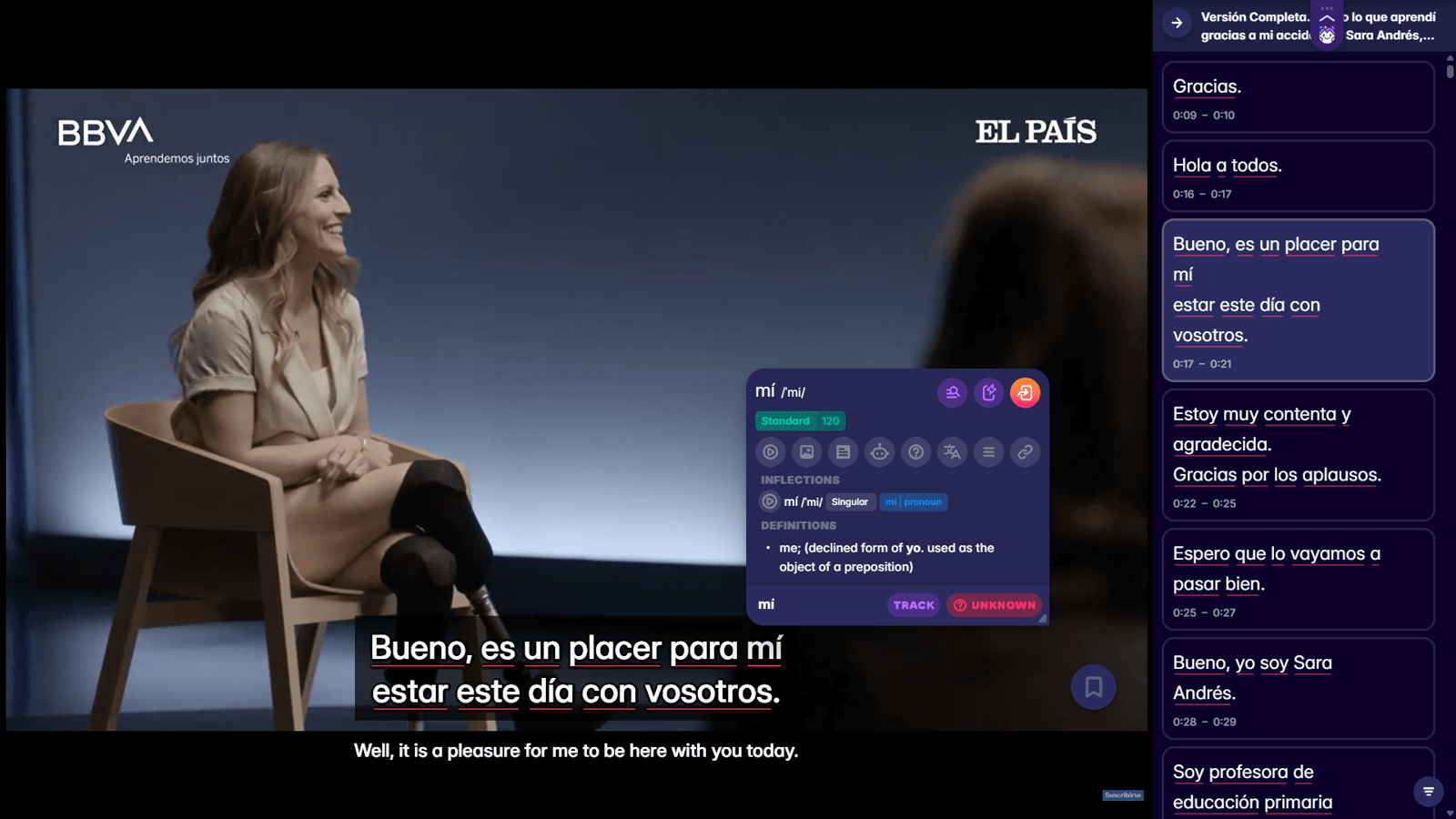
Who doesn't want to watch shows while learning Spanish?
The beauty of this approach is that you're learning while doing something enjoyable. Language learning doesn't have to be boring grammar drills and vocabulary lists. Watching a gripping drama or funny comedy in Spanish keeps you engaged, which means you'll stick with it longer.
If you consume media in Spanish, and you understand at least some of the messages and sentences within that media, you will make progress. Period.
We learn faster from things we enjoy.