Most Important Spanish Verbs for Everyday Conversations
Last updated: April 14, 2026

Learning Spanish verbs can feel overwhelming at first. You've got conjugations, irregular patterns, and what seems like a million different endings to memorize. Here's the thing, you don't actually need to master every single verb in the Spanish language to start having real conversations. Most native speakers rely on a core group of maybe 20 to 30 verbs for everyday communication. I'm going to walk you through the most important Spanish verbs, show you how to use them, and give you the patterns that make learning Spanish way easier than it looks.
- Understanding Spanish verb basics
- The essential super 7: Your foundation verbs
- Regular verb conjugation patterns you need to know
- The 20 most common Spanish verbs for everyday conversations
- Common irregular verbs and their quirks
- Reflexive verbs in Spanish
- Using verbs in context
- Practical tips for learning essential Spanish verbs
Understanding Spanish verb basics
Before we jump into specific verbs, you need to understand how Spanish verb conjugation works. Every Spanish verb ends in one of three ways: -ar, -er, or -ir. These endings tell you which conjugation pattern to follow.
When you conjugate a verb in Spanish, you're changing its ending to match the subject (who's doing the action) and the tense (when it's happening). For example, the verb "hablar" (to speak) changes to "hablo" when you want to say "I speak."
The good news? Regular verbs follow predictable patterns. Once you learn the pattern for -ar verbs, you can apply it to hundreds of other -ar verbs. Same goes for -er and -ir verbs.
The slightly annoying news? Spanish has plenty of irregular verbs that don't follow these patterns. But even irregular verbs often share similar quirks with each other, so you'll start recognizing patterns pretty quickly.
The essential super 7: Your foundation verbs
There's this concept in language teaching called the "Super 7" verbs. These are the absolute most frequent verbs in Spanish, and you'll use them constantly. Master these seven, and you'll already be able to construct tons of sentences.
1. Ser (to be - permanent states)
This verb describes permanent or defining characteristics. Think identity, origin, profession, and personality traits.
- Yo soy (I am)
- Tú eres (You are)
- Él/Ella es (He/She is)
- Nosotros somos (We are)
- Ellos son (They are)
Example sentence:
- Yo soy estudiante.
I am a student.
2. Estar (to be - temporary states)
This verb describes location, emotions, and temporary conditions. The ser vs. estar distinction trips up pretty much every Spanish learner at first.
- Yo estoy (I am)
- Tú estás (You are)
- Él/Ella está (He/She is)
- Nosotros estamos (We are)
- Ellos están (They are)
Example sentence:
- Ella está cansada.
She is tired.
3. Tener (to have)
This irregular verb is super useful because Spanish uses it in tons of expressions where English would use different verbs.
- Yo tengo (I have)
- Tú tienes (You have)
- Él/Ella tiene (He/She has)
- Nosotros tenemos (We have)
- Ellos tienen (They have)
Example sentence:
- Tengo hambre.
I am hungry (literally "I have hunger").
4. Ir (to go)
Another irregular verb that you'll use all the time, especially when talking about future plans.
- Yo voy (I go)
- Tú vas (You go)
- Él/Ella va (He/She goes)
- Nosotros vamos (We go)
- Ellos van (They go)
Example sentence:
- Voy al mercado.
I'm going to the market.
5. Hacer (to do/make)
This verb covers both doing and making, which makes it incredibly versatile.
- Yo hago (I do/make)
- Tú haces (You do/make)
- Él/Ella hace (He/She does/makes)
- Nosotros hacemos (We do/make)
- Ellos hacen (They do/make)
Example sentence:
- Hago mi tarea.
I do my homework.
6. Poder (to be able to/can)
This irregular verb is essential for expressing ability or possibility.
- Yo puedo (I can)
- Tú puedes (You can)
- Él/Ella puede (He/She can)
- Nosotros podemos (We can)
- Ellos pueden (They can)
Example sentence:
- Puedo hablar español.
I can speak Spanish.
7. Querer (to want)
Another irregular verb that you'll use constantly when expressing desires or preferences.
- Yo quiero (I want)
- Tú quieres (You want)
- Él/Ella quiere (He/She wants)
- Nosotros queremos (We want)
- Ellos quieren (They want)
Example sentence:
- Quiero aprender español.
I want to learn learn Spanish.
Regular verb conjugation patterns you need to know
Let me break down how regular verbs work in the present tense. Once you get these patterns down, you can conjugate hundreds of verbs without even thinking about it.
-ar verbs (The most common type)
About 80% of Spanish verbs are -ar verbs. Here's the pattern using "hablar" (to speak):
- Yo hablo (I speak)
- Tú hablas (You speak)
- Él/Ella habla (He/She speaks)
- Nosotros hablamos (We speak)
- Ellos hablan (They speak)
Other common -ar verbs include: trabajar (to work), estudiar (to study), comprar (to buy), cantar (to sing), bailar (to dance).
Example sentence:
- Trabajo en una oficina.
I work in an office.
-er verbs
These follow a similar but slightly different pattern. Here's "comer" (to eat):
- Yo como (I eat)
- Tú comes (You eat)
- Él/Ella come (He/She eats)
- Nosotros comemos (We eat)
- Ellos comen (They eat)
Other common -er verbs: beber (to drink), leer (to read), correr (to run), vender (to sell).
Example sentence:
- Como pan todos los días.
I eat bread every day.
-ir verbs
The -ir verbs are pretty similar to -er verbs, with just a couple of different verb endings. Here's "vivir" (to live):
- Yo vivo (I live)
- Tú vives (You live)
- Él/Ella vive (He/She lives)
- Nosotros vivimos (We live)
- Ellos viven (They live)
Other common -ir verbs: escribir (to write), abrir (to open), recibir (to receive).
Example sentence:
- Vivo en Madrid.
I live in Madrid.
The 20 most common Spanish verbs for everyday conversations
Beyond the Super 7, here are the verbs you'll encounter most frequently when learning Spanish. These cover the majority of everyday conversations:
Spanish Verb | English |
|---|---|
Ser | To be |
Estar | To be |
Tener | To have |
Hacer | To do / To make |
Ir | To go |
Poder | To be able to |
Decir | To say / To tell |
Dar | To give |
Saber | To know |
Querer | To want |
Llegar | To arrive |
Pasar | To pass / To happen |
Deber | To owe / Must |
Poner | To put |
Parecer | To seem |
Quedar | To remain / To stay |
Creer | To believe |
Hablar | To speak |
Llevar | To carry / To wear |
Dejar | To leave / To let |
Common irregular verbs and their quirks
Irregular verbs in Spanish don't follow the standard conjugation patterns, but they're absolutely essential. Here are some patterns you'll see:
- Stem-changing verbs keep their endings but change the vowel in the stem. For example, "pensar" (to think) becomes "pienso" (I think), where the e changes to ie.
- First-person irregular verbs are only irregular in the yo form. "Hacer" is a good example: "yo hago" is irregular, but "tú haces" follows a more predictable pattern.
- Completely irregular verbs like ser and ir just have to be memorized. There's no pattern that'll help you here. These verbs are so old and so frequently used that they've evolved into their own unique forms.
Reflexive verbs in Spanish
Reflexive verbs deserve a quick mention because they're everywhere in Spanish. These verbs indicate that the subject is performing an action on themselves. They always come with reflexive pronouns: me, te, se, nos, se.
Common reflexive verbs include:
- Llamarse (to be called): "Me llamo Juan" (My name is Juan, literally "I call myself Juan")
- Levantarse (to get up): "Me levanto a las siete" (I get up at seven)
- Ducharse (to shower): "Se ducha por la mañana" (He/She showers in the morning)
- Sentirse (to feel): "Me siento bien" (I feel good)
The reflexive pronoun changes based on who's doing the action, but the verb conjugates normally after that.
Using verbs in context
Knowing how to conjugate verbs is one thing. Using them naturally in sentences is another. Here's the thing about Spanish word order: it's way more flexible than English, but the most common pattern is still Subject-Verb-Object, just like English.
"Yo como manzanas" (I eat apples) follows the same order as English. But you could also say "Como manzanas" and drop the "yo" entirely, since the verb ending already tells you it's the "I" form. Spanish speakers do this constantly.
When you're building sentences, think about what action you want to express, who's doing it, and when it's happening. Pick your verb, conjugate it for the subject, and add whatever other information you need.
Example: You want to say "She speaks Spanish well."
- Subject: Ella (she)
- Verb: hablar (to speak) becomes "habla" (she speaks)
- Object/Details: español bien (Spanish well)
- Result: "Ella habla español bien"
Practical tips for learning essential Spanish verbs
After working with Spanish verbs for a while, here's what actually helps:
- Focus on frequency first. Don't try to memorize every verb you encounter. Stick with the top 20 to 30 verbs and really nail those conjugations. You'll use these verbs in probably 80% of your conversations.
- Learn verbs in context, not isolation. Memorizing "tener" means "to have" is way less useful than learning "tengo hambre" (I'm hungry) as a complete phrase. Your brain remembers things better when they're connected to meaning and usage.
- Practice with full sentences. Every time you learn a new verb or conjugation, write out three to five example sentences. This forces you to think about how the verb actually works in real communication.
- Group irregular verbs by pattern. Yeah, they're irregular, but many irregular verbs share similar quirks. Verbs like "tener," "venir," and "decir" all have irregular yo forms that end in -go (tengo, vengo, digo). Recognizing these patterns makes them easier to remember.
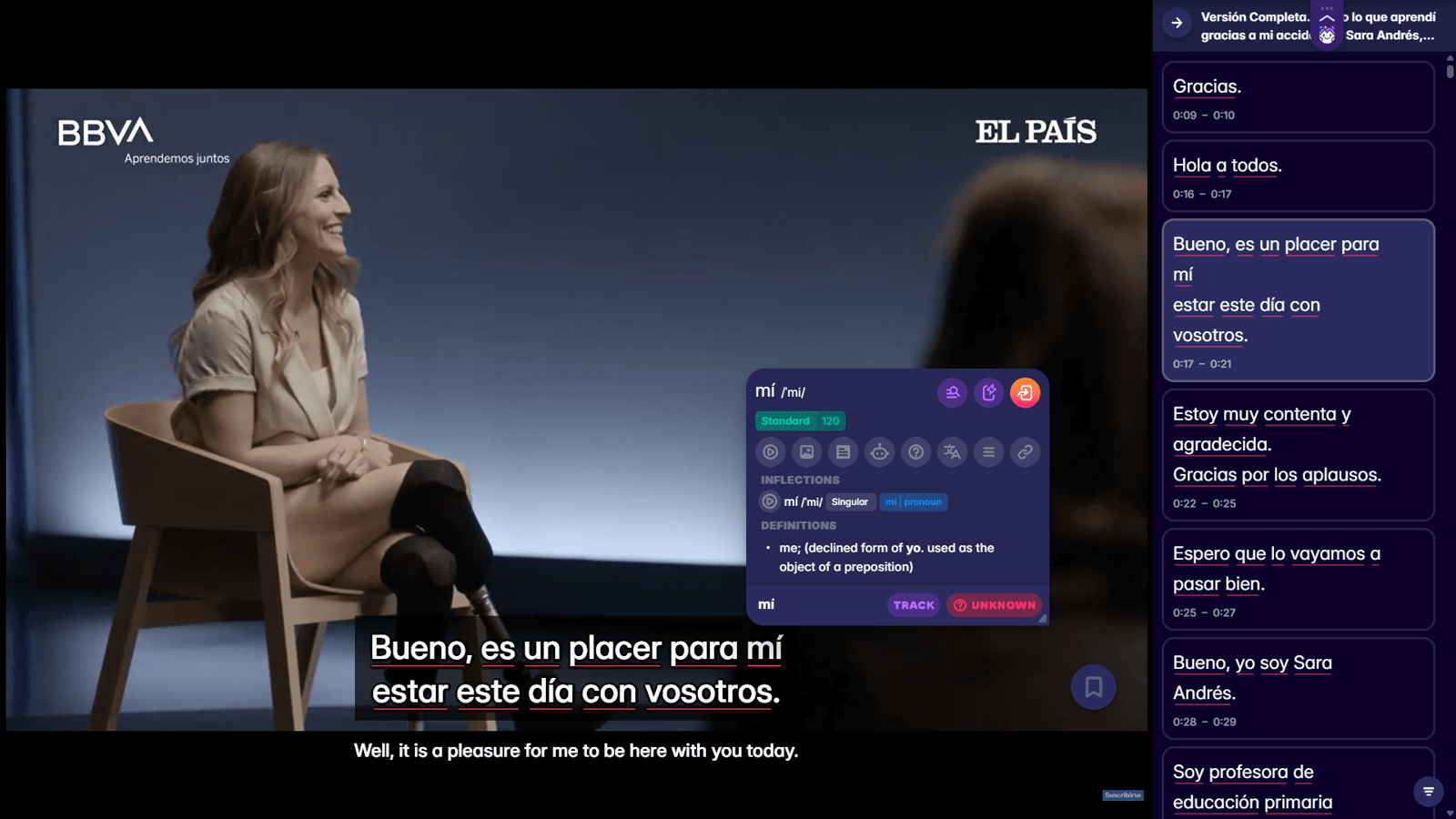
Anyway, if you want to practice these Spanish verbs with actual content, Migaku's browser extension and app let you look up conjugations and save vocabulary while watching Spanish shows or reading articles. Makes the whole process of learning verbs in context way more practical. There's a 10-day free trial if you want to check it out.
Start exploring other tenses as you continue to learn the language!
The preterite and imperfect past tenses open up storytelling. The future tense lets you make plans and predictions. The subjunctive mood (yeah, Spanish has that) lets you express doubt, wishes, and hypothetical situations. But honestly? You can have pretty solid conversations in Spanish with just the present tense and the top 30 verbs. Everything else builds on that foundation, so take your time getting comfortable with the basics, and try multiple resources (flashcards, Spanish media, immersion) to reinforce your memory.
If you consume media in Spanish, and you understand at least some of the messages and sentences within that media, you will make progress. Period.
A solid foundation holds everything you add later.📖