Please in Spanish: How Spanish Speakers Make Polite Requests
Last updated: March 26, 2026

Learning Spanish please is one of those fundamental skills that'll make your conversations way smoother. Whether you're ordering food, asking for directions, or just trying to be polite, knowing the right way to make requests matters. The good news? Spanish has some pretty straightforward ways to express politeness, plus a few casual shortcuts that native speakers use all the time. Let's break down everything you need to know about saying please and making polite requests in Spanish.
The basic translation: "por favor"
The direct translation of please in Spanish is "por favor." This is the standard term you'll use in pretty much any situation where you want to be polite. Spanish speakers use por favor constantly, and it works in both formal and informal contexts.
The pronunciation is pretty straightforward: "pohr fah-VOHR" with the stress on the second syllable of "favor." You can place por favor at the beginning or end of a sentence, though putting it at the end tends to be more common in everyday speech.
Here are some basic examples:
- Un café, por favor.
A coffee, please. - Por favor, ayúdame.
Please, help me. - ¿Puedes cerrar la puerta, por favor?
Can you close the door, please?
The word "favor" itself means favor in English, and "por" means for or by. So literally, you're saying "for a favor" or "by favor," which makes sense when you think about making a polite request.
Use other everyday expressions to say please
Here's the thing about real-world Spanish usage. While por favor is definitely the standard way to say please, native speakers have developed some informal shortcuts that you'll hear all the time, especially among friends and family.
- The most common informal version is "porfa." This is basically a shortened, casual way of saying por favor. Think of it like saying "pls" in a text message versus writing out "please." You'll hear porfa constantly in Spain and Latin America among younger speakers and in relaxed settings.
- Another cute variation you might encounter is "porfis," which adds an extra playful tone. This one's pretty informal and tends to be used when you're being a bit cheeky or sweet about your request. I wouldn't use this with your boss or in professional situations.
Formal polite requests in Spanish
When you need to be extra polite or formal, just saying por favor might not cut it. Spanish has specific verb constructions that make your requests sound more courteous and respectful.
The verb "podría" (could you) creates a formal polite request. This is the conditional form of "poder" (to be able to), and it automatically makes your sentence sound more respectful:
- ¿Podría ayudarme, por favor?
Could you help me, please? - ¿Podría decirme la hora?
Could you tell me the time? - ¿Podría repetir eso?
Could you repeat that?
You can also use "puede" (can you) for a slightly less formal but still polite request:
- ¿Puede hablar más despacio, por favor?
Can you speak more slowly, please? - ¿Puede pasarme la sal?
Can you pass me the salt?
For professional or very formal situations, you might use "¿Sería tan amable de...?" which translates to "Would you be so kind as to...?" This is pretty formal and works great in business settings or when addressing someone you want to show extra respect.
"Could I have..." sentences in Spanish
When you're asking for something specific, like ordering at a restaurant or requesting an item, there are a few natural ways to phrase it in Spanish.
The most common structure is "¿Me da...?" or "¿Me das...?" which literally means "You give me...?" but functions as "Could I have...?" The first version (da) is more formal, while the second (das) is informal:
- ¿Me da un vaso de agua, por favor?
Could I have a glass of water, please? - ¿Me das tu número?
Could I have your number?
Another option is "¿Puedo tener...?" (Can I have...?):
- ¿Puedo tener la cuenta, por favor?
Can I have the bill, please? - ¿Puedo tener un momento?
Can I have a moment?
For a more polite version, use "¿Podría darme...?" (Could you give me...?):
- ¿Podría darme el menú, por favor?
Could you give me the menu, please? - ¿Podría darme indicaciones?
Could you give me directions?
"Can we please..." sentences with examples in Spanish
When you want to make a group request or suggest something politely, you'll use "¿Podemos...?" (Can we...?) or "¿Podríamos...?" (Could we...?):
- ¿Podemos hablar un momento, por favor?
Can we talk for a moment, please? - ¿Podríamos cambiar de tema?
Could we change the subject? - ¿Podemos ir al parque?
Can we go to the park?
If you're being a bit more insistent or pleading, you might say:
- ¿Podemos por favor...?
Can we please...? - Por favor, ¿podemos quedarnos un poco más?
Please, can we stay a bit longer?
Regional variations and cultural context
Spanish varies quite a bit across different countries and regions. While por favor is universal, you might notice some regional preferences in how people make polite requests.
- In some Latin American countries, particularly Mexico, people tend to use more elaborate polite formulas. You might hear "si es tan amable" (if you would be so kind) or "si no es mucha molestia" (if it's not too much trouble) added to requests.
- In Spain, particularly in casual settings, people sometimes drop por favor entirely and rely on tone and context to convey politeness. The informal "porfa" is super common in Spanish conversations among friends.
- Argentina and Uruguay have their own linguistic quirks with the "vos" form instead of "tú," which affects how you conjugate verbs in informal requests. Instead of "¿Puedes...?" you'd say "¿Podés...?"
The level of formality also varies by culture. In general, Latin American Spanish tends to be a bit more formal in professional settings compared to Spain, where workplace culture can be more relaxed.
Common mistakes to avoid
- One thing I see language learners do is overuse por favor to the point where it sounds unnatural. While being polite is great, native speakers don't necessarily add por favor to every single sentence. Sometimes the verb construction itself (like using podría instead of puedes) provides enough politeness.
- Another mistake is mixing formal and informal language. If you're using usted (the formal you), make sure you're conjugating your verbs correctly. Don't say "¿Usted puedes...?" when it should be "¿Usted puede...?"
- Also, watch your placement. While you can put por favor at the beginning or end of a sentence, putting it in the middle can sound awkward. Stick to the ends or the beginning.
- Finally, don't forget that tone matters just as much as the words you use. You can say por favor in a rude tone, and it'll still sound impolite. Spanish speakers pay attention to how you say things, not just what you say.
Anyway, if you want to practice these phrases with real Spanish content, Migaku's browser extension and app let you look up words and save vocabulary while watching shows or reading articles. Makes learning from actual native content way easier. There's a 10-day free trial if you want to check it out.
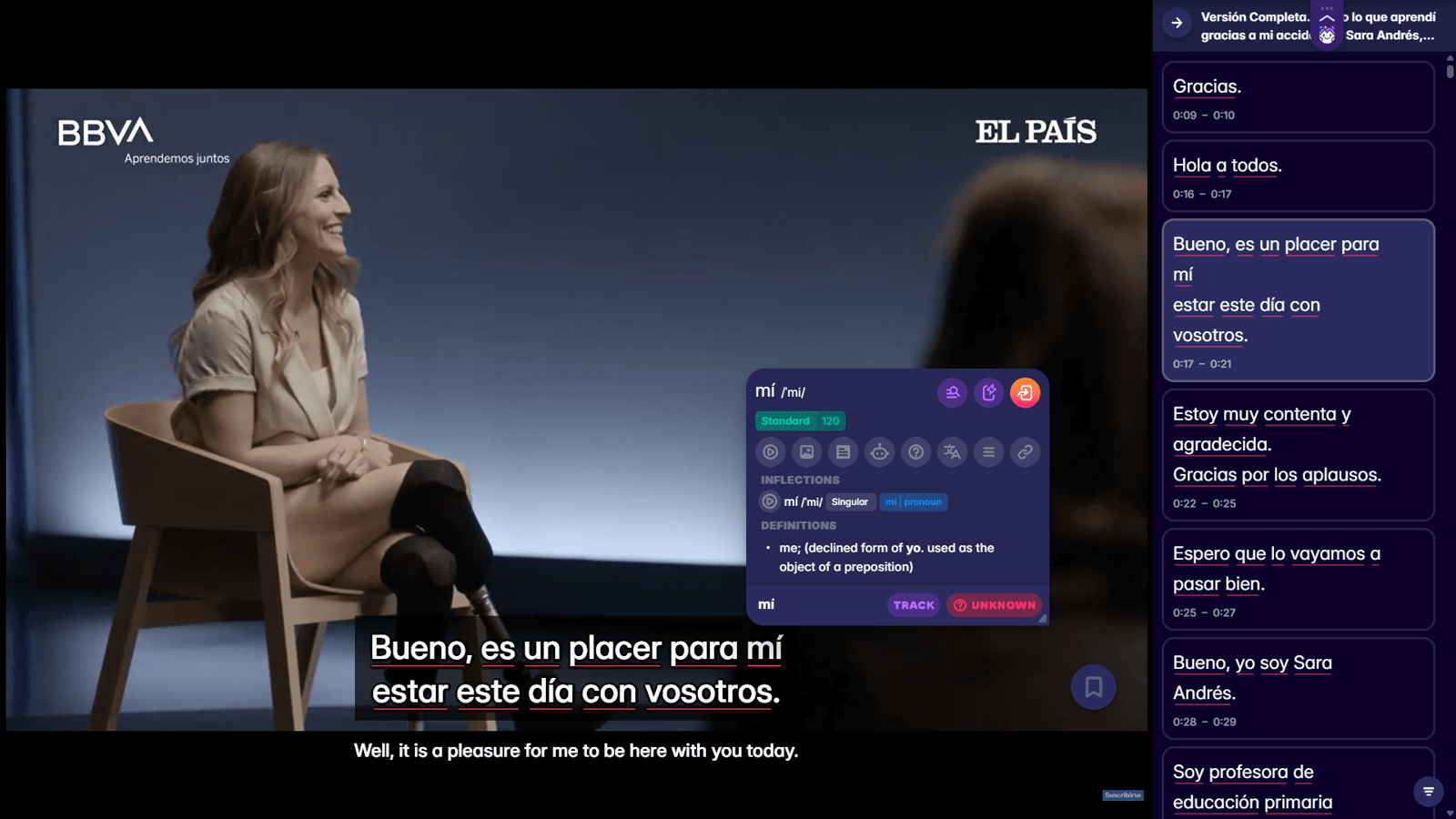
The best way to learn Spanish language is to use it in real context
If you can't get a chance to travel to Spanish-speaking countries yet, try extensive input practice first! Listen to how native speakers make requests in Spanish movies, TV shows, or podcasts. You'll pick up on the natural rhythm and context of when to use different levels of formality. Pay attention to whether people are using porfa, por favor, or more elaborate polite constructions.
If you consume media in Spanish, and you understand at least some of the messages and sentences within that media, you will make progress. Period.
Start with the basics, and gradually add more sophisticated polite phrases as you get more comfortable!