Present Indicative Spanish: Complete Verb Conjugation Guide
Last updated: April 26, 2026

You're learning Spanish and keep hearing about the present indicative. Here's the thing: this tense is probably the most important verb form you'll learn as a beginner. You'll use it constantly in everyday conversations, and getting comfortable with it makes everything else easier down the road. The present indicative in Spanish (el presente de indicativo) is basically how you talk about things happening right now, habits you have, general facts, and even some future plans. Think of it as your default tense for most normal conversations. When you say "I eat," "she walks," or "they live," you're using the present indicative. Let me break down everything you need to know.
- What is the Spanish present indicative
- Regular verb conjugation patterns
- Irregular verbs in present indicative conjugations
- Conjugate stem-changing verbs for Spanish present tense
- Spelling changes in certain verbs to form the present indicative
- When to use the present indicative
- Comparing to English present tense
- Common examples of present indicative in Spanish
- How to learn and practice the present indicative tense in Spanish
What is the Spanish present indicative
The present indicative is the mood and tense you use to state facts, describe current actions, talk about routines, and express general truths. In Spanish grammar, "indicative" refers to the mood that deals with reality and certainty, as opposed to the subjunctive mood which handles doubt, wishes, and hypotheticals.
When you conjugate a verb in the present tense, you're modifying the infinitive form to match the subject pronoun. Spanish has different verb endings for yo (I), tú (you informal), él/ella/usted (he/she/you formal), nosotros (we), vosotros (you all in Spain), and ellos/ellas/ustedes (they/you all formal).
The conjugation system might seem complicated at first, but once you get the patterns down, you can conjugate hundreds of verbs automatically.
Regular verb conjugation patterns
Spanish verbs come in three flavors based on their infinitive endings: -ar, -er, and -ir verbs. Each group follows its own conjugation pattern for regular verbs.
-ar verbs
Let's start with -ar verbs since they're the most common. Take hablar (to speak) as our example:
- Yo hablo (I speak)
- Tú hablas (you speak)
- Él/Ella/Usted habla (he/she speaks, you formal speak)
- Nosotros hablamos (we speak)
- Vosotros habláis (you all speak, Spain)
- Ellos/Ellas/Ustedes hablan (they speak, you all formal speak)
💡The pattern here is simple: drop the -ar and add the endings: -o, -as, -a, -amos, -áis, -an.
Other common -ar verbs include trabajar (to work), estudiar (to study), caminar (to walk), and bailar (to dance). Once you know this pattern, you can conjugate tons of verbs.
-er verbs
The -er verb pattern is pretty similar. Let's use comer (to eat):
- Yo como (I eat)
- Tú comes (you eat)
- Él/Ella/Usted come (he/she eats, you formal eat)
- Nosotros comemos (we eat)
- Vosotros coméis (you all eat, Spain)
- Ellos/Ellas/Ustedes comen (they eat, you all formal eat)
💡Drop the -er and add: -o, -es, -e, -emos, -éis, -en.
Common -er verbs include beber (to drink), leer (to read), correr (to run), and vender (to sell).
-ir verbs
The -ir verbs look almost identical to -er verbs, with just two differences. Here's vivir (to live):
- Yo vivo (I live)
- Tú vives (you live)
- Él/Ella/Usted vive (he/she lives, you formal live)
- Nosotros vivimos (we live)
- Vosotros vivís (you all live, Spain)
- Ellos/Ellas/Ustedes viven (they live, you all formal live)
💡The endings are: -o, -es, -e, -imos, -ís, -en. Notice that only the nosotros and vosotros forms differ from -er verbs.
Other -ir verbs include escribir (to write), abrir (to open), and decidir (to decide).
Irregular verbs in present indicative conjugations
Here's where things get interesting. Some Spanish verbs don't follow the regular patterns at all. These irregular verbs are super common, so you'll use them constantly.
- Ser (to be): This verb is completely irregular. Yo soy, tú eres, él/ella/usted es, nosotros somos, vosotros sois, ellos/ellas/ustedes son. You use ser for permanent characteristics, professions, origins, and telling time.
- Estar (to be): Another "to be" verb with different uses. Yo estoy, tú estás, él/ella/usted está, nosotros estamos, vosotros estáis, ellos/ellas/ustedes están. Estar describes locations, temporary states, and emotions. The estoy form (I am) is one you'll say dozens of times a day.
- Ir (to go): Totally irregular. Yo voy, tú vas, él/ella/usted va, nosotros vamos, vosotros vais, ellos/ellas/ustedes van. This verb is essential for talking about movement and future plans.
- Hacer (to do/make): Mostly regular except for the yo form. Yo hago (I do/make), but then tú haces, él/ella/usted hace, nosotros hacemos, vosotros hacéis, ellos/ellas/ustedes hacen. The hacer verb pops up in tons of expressions like "hace frío" (it's cold, literally "it makes cold").
- Tener (to have): Another high-frequency irregular verb. Yo tengo, tú tienes, él/ella/usted tiene, nosotros tenemos, vosotros tenéis, ellos/ellas/ustedes tienen.
Conjugate stem-changing verbs for Spanish present tense
Beyond completely irregular verbs, Spanish has stem-changing verbs where the vowel in the stem shifts in certain forms. The good news? The endings still follow the regular patterns. The stem change happens in all forms except nosotros and vosotros.
- E to IE changes: Querer (to want) becomes yo quiero, tú quieres, él/ella/usted quiere, nosotros queremos, vosotros queréis, ellos/ellas/ustedes quieren. Other verbs with this pattern include pensar (to think), preferir (to prefer), and empezar (to begin).
- O to UE changes: Poder (to be able to/can) becomes yo puedo, tú puedes, él/ella/usted puede, nosotros podemos, vosotros podéis, ellos/ellas/ustedes pueden. Same pattern shows up in dormir (to sleep), volver (to return), and encontrar (to find).
- E to I changes: This one only happens with some -ir verbs. Pedir (to ask for) becomes yo pido, tú pides, él/ella/usted pide, nosotros pedimos, vosotros pedís, ellos/ellas/ustedes piden. You'll see this in servir (to serve) and repetir (to repeat) too.
These stem changes might seem random, but they follow consistent patterns once you know which category a verb falls into.
Spelling changes in certain verbs to form the present indicative
Some verbs need spelling adjustments to maintain consistent pronunciation. These aren't really irregular, they're just following Spanish spelling rules.
- Verbs ending in -ger or -gir change the g to j before the letter o. So coger (to take/catch) becomes yo cojo in the first person. The g would make a hard sound before o, but Spanish wants to keep the soft "h" sound, so it switches to j.
- Verbs ending in -guir drop the u before o. Seguir (to follow) becomes yo sigo. Again, this maintains the pronunciation.
- Verbs ending in -cer or -cir after a vowel add a z before the c in the yo form. Conocer (to know) becomes yo conozco. This keeps the soft "s" sound instead of a hard "k" sound.
These spelling changes make sense once you understand Spanish pronunciation rules. The verb is trying to sound consistent across all its forms.
When to use the present indicative
The Spanish present tense covers way more ground than you might expect. Here are the main situations where you'll use it:
- Current actions happening right now: "Estoy en casa" (I am at home). The verb estar changes to estoy for the yo form, and you'd use this to describe where you are at this moment.
- Habitual actions and routines: "Como pan todos los días" (I eat bread every day). This describes something you do regularly, even if you're not doing it right this second.
- General facts and truths: "El sol sale por el este" (The sun rises in the east). Universal truths get the present indicative.
- Future plans that are pretty certain: "Mañana voy al cine" (Tomorrow I'm going to the movies). Spanish speakers often use the present indicative for near-future events, especially with time expressions like mañana (tomorrow) or la próxima semana (next week).
- Actions that started in the past but continue now: "Vivo aquí desde 2020" (I've been living here since 2020). When you pair the present tense with desde (since) or desde hace (for), you're describing something ongoing.
This versatility is why mastering the present indicative opens up so much of the language for you.
Comparing to English present tense
Spanish and English handle the present tense differently in some key ways. English actually has two present forms: the simple present ("I eat") and the present continuous ("I am eating"). Spanish uses the present indicative for both situations.
When you say "como" in Spanish, it can mean either "I eat" (habitual) or "I am eating" (right now), depending on context. Spanish does have a present progressive form (estoy comiendo), but it's used less frequently than English uses "I am eating."
Another difference: English adds an -s to third person singular verbs (he walks, she runs), but that's the only change. Spanish modifies the verb ending for every single pronoun, which gives you way more information about who's doing the action. You can actually drop the pronoun in Spanish because the verb ending tells you everything you need to know.
"Hablo español" works perfectly fine without "yo" because the -o ending clearly indicates first person singular. This flexibility makes Spanish more concise once you get comfortable with conjugation patterns.
Common examples of present indicative in Spanish
Let me show you how this actually sounds in everyday Spanish:
- ¿Qué haces?
What are you doing? (uses the tú form of hacer. You'd answer with "Trabajo" or "Leo un libro") - Tengo hambre.
I'm hungry. (uses the yo form of tener. Spanish says you "have hunger" rather than you "are hungry") - Vamos al parque.
We're going to the park. (uses the nosotros form of ir. Super common phrase for making plans) - Ella habla tres idiomas.
She speaks three languages. (uses the third person singular of hablar to state a fact about someone's abilities) - ¿Dónde vives?
Where do you live? (uses the tú form of vivir. The answer might be "Vivo en Madrid")
These examples show how the present indicative handles questions, statements, descriptions, and plans all with the same basic tense structure.
How to learn and practice the present indicative tense in Spanish
Learning to conjugate verbs smoothly takes repetition. Here's what works:
- Start with the most common verbs (ser, estar, tener, hacer, ir) and drill those until they're automatic. These five verbs probably make up 30% of what you'll say.
- Focus on the forms you'll use most. If you're not in Spain, you can basically ignore vosotros forms for now. That cuts your memorization by one-sixth right there.
- Practice with full sentences, not just isolated verb forms. "Yo como" by itself is boring and hard to remember. "Yo como tacos todos los viernes" (I eat tacos every Friday) gives you context and makes the grammar stick better.
- Read Spanish content at your level and notice how verbs work in context. Children's books, graded readers, or simple news articles all give you tons of present indicative examples. When you see a verb you don't recognize, break it down: what's the infinitive? Which pronoun is it conjugated for? What pattern does it follow?
- Talk to yourself in Spanish throughout the day. Narrate what you're doing: "Camino al trabajo" (I'm walking to work), "Bebo café" (I'm drinking coffee), "Escribo un email" (I'm writing an email). This builds automaticity way faster than studying charts.
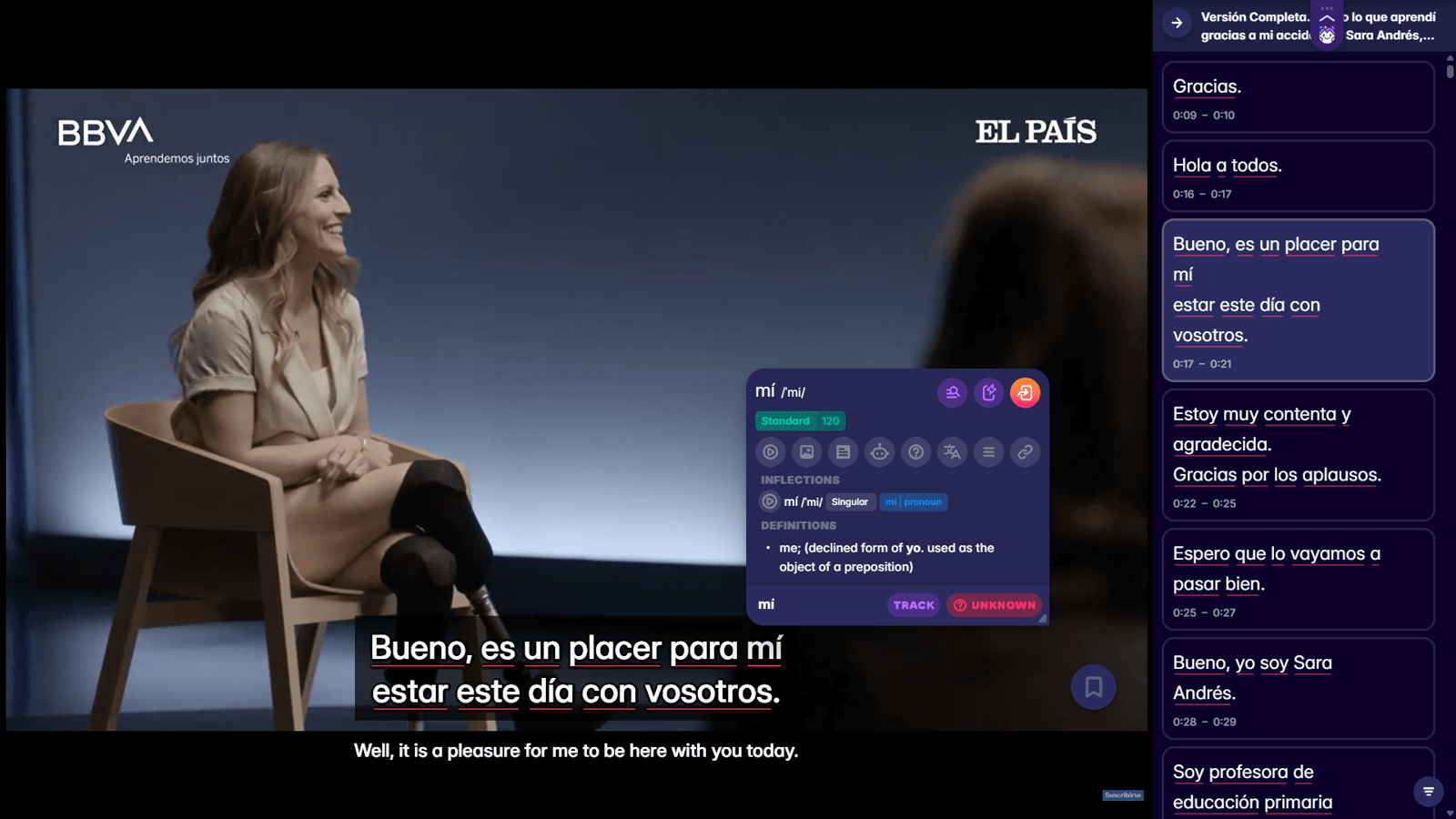
Anyway, if you want to practice these conjugations with real Spanish content, Migaku's browser extension and app let you look up verbs instantly while watching shows or reading articles. You can see how native speakers actually use the present indicative in context, which beats memorizing charts any day. There's a 10-day free trial if you want to check it out.
Moving forward with Spanish grammar
The present indicative forms the foundation for pretty much everything else in Spanish. Once you've got these conjugation patterns down, you'll find that other tenses follow similar logic. The preterite, imperfect, future, and conditional all build on the same concept of changing verb endings to match the subject. The methods of learning these grammar points are similar, too. Go through the general rules first, consume the Spanish content to get used to the conjugations in context, and use flashcards to drill the hard ones.
If you consume media in Spanish, and you understand at least some of the messages and sentences within that media, you will make progress. Period.
Grammar blocks stack. Every rule supports the next.📖☕