# Present Subjunctive in Spanish: Complete Grammar Guide with Examples
> Form and use the Spanish present subjunctive with clear conjugation rules, irregular verbs, common triggers, and real examples you'll actually use.
**URL:** https://migaku.com/blog/spanish/present-subjunctive-spanish-guide
**Last Updated:** 2026-04-28
**Tags:** fundamentals, grammar
---
So you've been [learning Spanish](https://migaku.com/learn-spanish) for a while, and suddenly your [textbook](https://migaku.com/blog/japanese/the-problem-with-textbooks) or teacher throws the subjunctive at you. Pretty confusing at first, right? The present subjunctive (el presente de subjuntivo) trips up tons of Spanish learners because English barely uses this verb form anymore. I'm going to walk you through exactly how to form the present subjunctive in Spanish, which verbs are irregular, and when you actually need to use it. By the end, you'll have the conjugation patterns down and understand the common triggers that tell you when to switch from indicative to subjunctive.
----
## How to form the present subjunctive in Spanish
Regular verb conjugations for the present subjunctive follow a pretty consistent pattern. You just need to know the trick.
Here's how you form the present subjunctive for regular verbs:
1. **Step 1:** Take the verb in its infinitive form (like hablar, comer, or vivir)
2. **Step 2:** Conjugate it to the first person singular (yo form) of the present indicative tense (hablo, como, vivo)
3. **Step 3:** Drop the final -o (habl-, com-, viv-)
4. **Step 4:** Add the subjunctive endings
And here's where it gets interesting. The endings for -ar verbs use the vowel "e," while -er and -ir verbs use the vowel "a." Yeah, they basically swap vowels with the present indicative.
### Regular -ar verbs
Let's use **hablar** (to speak) as our example:
- yo hable
- tú hables
- él/ella/usted hable
- nosotros hablemos
- vosotros habléis
- ellos/ellas/ustedes hablen
Notice how all those endings use "e" instead of the "a" you'd see in the present indicative (hablo, hablas, habla).
### Regular -er and -ir verbs
For **comer** (to eat) and **vivir** (to live), the pattern looks like this:
**Comer:**
- yo coma
- tú comas
- él/ella/usted coma
- nosotros comamos
- vosotros comáis
- ellos/ellas/ustedes coman
**Vivir:**
- yo viva
- tú vivas
- él/ella/usted viva
- nosotros vivamos
- vosotros viváis
- ellos/ellas/ustedes vivan
See? They use "a" endings instead of the "e" or "i" from the present indicative.
----
## Irregular verbs in the present subjunctive
Alright, so regular verbs follow a clean pattern. But Spanish wouldn't be Spanish without throwing some irregular verbs into the mix.
The good news is that many irregular verbs in the present subjunctive still follow the same rule: take the yo form of the present indicative, drop the -o, and add subjunctive endings. So even though these verbs have irregular yo forms in the indicative, they're actually predictable once you know that first person form.
### Irregular verbs that follow the pattern
- **Tener (to have):** yo tengo → tenga, tengas, tenga, tengamos, tengáis, tengan
- **Venir (to come):** yo vengo → venga, vengas, venga, vengamos, vengáis, vengan
- **Hacer (to do/make):** yo hago → haga, hagas, haga, hagamos, hagáis, hagan
- **Decir (to say):** yo digo → diga, digas, diga, digamos, digáis, digan
- **Poner (to put):** yo pongo → ponga, pongas, ponga, pongamos, pongáis, pongan
- **Conocer (to know):** yo conozco → conozca, conozcas, conozca, conozcamos, conozcáis, conozcan
### Completely irregular verbs
Some verbs just do their own thing completely. You've got to memorize these because they don't follow the standard pattern at all.
**Ser (to be):**
- yo sea
- tú seas
- él/ella/usted sea
- nosotros seamos
- vosotros seáis
- ellos/ellas/ustedes sean
**Estar (to be):**
- yo esté
- tú estés
- él/ella/usted esté
- nosotros estemos
- vosotros estéis
- ellos/ellas/ustedes estén
**Ir (to go):**
- yo vaya
- tú vayas
- él/ella/usted vaya
- nosotros vayamos
- vosotros vayáis
- ellos/ellas/ustedes vayan
**Haber (to have, auxiliary):**
- yo haya
- tú hayas
- él/ella/usted haya
- nosotros hayamos
- vosotros hayáis
- ellos/ellas/ustedes hayan
**Dar (to give):**
- yo dé
- tú des
- él/ella/usted dé
- nosotros demos
- vosotros deis
- ellos/ellas/ustedes den
**Saber (to know):**
- yo sepa
- tú sepas
- él/ella/usted sepa
- nosotros sepamos
- vosotros sepáis
- ellos/ellas/ustedes sepan
Yeah, these are the ones that'll take some practice. But honestly, after you've heard them in context a few dozen times, they start feeling natural.
----
## Stem-changing verbs in the present subjunctive
Stem-changing verbs keep their stem changes in the present subjunctive, just like they do in the present indicative. But there's one important difference: for -ir verbs, the nosotros and vosotros forms also change, which doesn't happen in the present indicative.
### E → ie changes
- **Pensar (to think):** piense, pienses, piense, pensemos, penséis, piensen
- **Querer (to want):** quiera, quieras, quiera, queramos, queráis, quieran
### O → ue changes
- **Poder (to be able):** pueda, puedas, pueda, podamos, podáis, puedan
- **Dormir (to sleep):** duerma, duermas, duerma, durmamos, durmáis, duerman
Notice how dormir has that "u" in durmamos and durmáis? That's the special -ir verb thing I mentioned.
### E → i changes
- **Pedir (to ask for):** pida, pidas, pida, pidamos, pidáis, pidan
- **Servir (to serve):** sirva, sirvas, sirva, sirvamos, sirváis, sirvan
These -ir verbs maintain the stem change throughout all forms.
----
## When to use the present subjunctive
Knowing how to conjugate the subjunctive is one thing. Knowing when to actually use it? That's where learners really struggle.
The subjunctive appears in specific grammatical situations. You can't just throw it in randomly. Here are the main triggers that tell you to switch from indicative to subjunctive.
### Expressing doubt and uncertainty
When you're expressing doubt or uncertainty about something, you need the subjunctive. The key phrase here is "dudo que" (I doubt that).
- Dudo que él venga mañana.
*I doubt that he'll come tomorrow.*
- No creo que sea verdad.
*I don't think it's true.*
Compare this to certainty, which uses the indicative: "Creo que es verdad" (I think it's true). See the difference? Certainty gets indicative, doubt gets subjunctive.
### Expressing wishes and desires
Whenever you want something to happen or hope for something, the subjunctive shows up. Common triggers include "querer que" (to want that), "esperar que" (to hope that), and "desear que" (to wish that).
- Quiero que estudies más.
*I want you to study more.*
- Espero que tengas un buen día.
*I hope you have a good day.*
- Deseo que seas feliz.
*I wish for you to be happy.*
### Expressing emotions and feelings
When you're reacting emotionally to something, you use the subjunctive. This includes being happy, sad, angry, surprised, or worried about something.
- Me alegra que estés aquí.
*I'm happy that you're here.*
- Es triste que no puedas venir.
*It's sad that you can't come.*
- Me sorprende que sepas eso.
*It surprises me that you know that.*
### Making recommendations and requests
Commands, suggestions, and recommendations trigger the subjunctive. Look for phrases like "es importante que" (it's important that), "es necesario que" (it's necessary that), or "recomiendo que" (I recommend that).
- Es importante que llegues a tiempo.
*It's important that you arrive on time.*
- Sugiero que hables con él.
*I suggest that you talk to him.*
- Es necesario que hagamos la tarea.
*It's necessary that we do the homework.*
### After certain conjunctions
Some conjunctions always trigger the subjunctive. The most common ones are "para que" (so that), "antes de que" (before), "sin que" (without), and "a menos que" (unless).
- Te lo explico para que entiendas.
*I'm explaining it to you so that you understand.*
- Llámame antes de que salgas.
*Call me before you leave.*
- No puedo hacerlo sin que me ayudes.
*I can't do it without you helping me.*
### Impersonal expressions
Phrases that express opinions, judgments, or general statements about what's good, bad, necessary, or possible use the subjunctive.
- Es posible que llueva mañana.
*It's possible that it'll rain tomorrow.*
- Es bueno que practiques español.
*It's good that you practice Spanish.*
- Es extraño que no haya llamado.
*It's strange that he hasn't called.*
----
## The difference between present indicative and present subjunctive
This confuses so many learners, so let me break it down clearly.
> 💡The present indicative talks about **facts, habitual actions, and things that are certain or real**. You use it for statements about what is, what happens regularly, or what you know to be true.
- María habla español.
*María speaks Spanish.* (This is a fact)
- Sé que viene mañana.
*I know he's coming tomorrow.* (This is certain information)
> 💡The present subjunctive expresses things that are **subjective, uncertain, desired, or hypothetical**. You use it for opinions, emotions, wishes, doubts, and possibilities.
- Quiero que María hable español.
*I want María to speak Spanish.* (This is a desire)
- Dudo que venga mañana.
*I doubt he's coming tomorrow.* (This expresses uncertainty)
The mood you choose completely changes the meaning. Compare these:
- Creo que es difícil.
*I think it's difficult.* (Indicative — You believe this is true)
- No creo que sea difícil.
*I don't think it's difficult.* (Subjunctive — You're expressing doubt)
----
## The four types of [subjunctive](https://migaku.com/blog/spanish/spanish-subjunctive-conjugation-guide) in Spanish
Quick side note: Spanish actually has four subjunctive tenses, and the present subjunctive is just one of them. You've also got the **imperfect subjunctive (past)**, **the present perfect subjunctive**, and **the pluperfect subjunctive**. Each one handles different time frames and levels of completion.
The present subjunctive deals with present or future actions that are uncertain, desired, or subjective. The other forms handle past situations with the same subjunctive triggers. But when you're starting out, focus on mastering the present subjunctive first. Once you've got this one down, the other tenses will make way more sense.
----
## Tips for learning Spanish present subjunctive
Here's what helped me when I was getting the hang of the subjunctive:
1. **Learn the trigger phrases.** Seriously, memorize the common expressions that require subjunctive. Once you recognize "quiero que," "es importante que," "dudo que," and others, you'll automatically know to use subjunctive.
2. **Practice the conjugations regularly.** The verb forms need to become automatic. Write them out, use flashcards, whatever works for you. You need to conjugate without thinking about it.
3. **Listen for it in real Spanish.** Watch shows, listen to podcasts, pay attention to how native speakers actually use the subjunctive. You'll start noticing the patterns everywhere.
4. **Start with common verbs.** Master the subjunctive forms of high-frequency verbs like ser, estar, tener, hacer, and ir before worrying about less common ones.
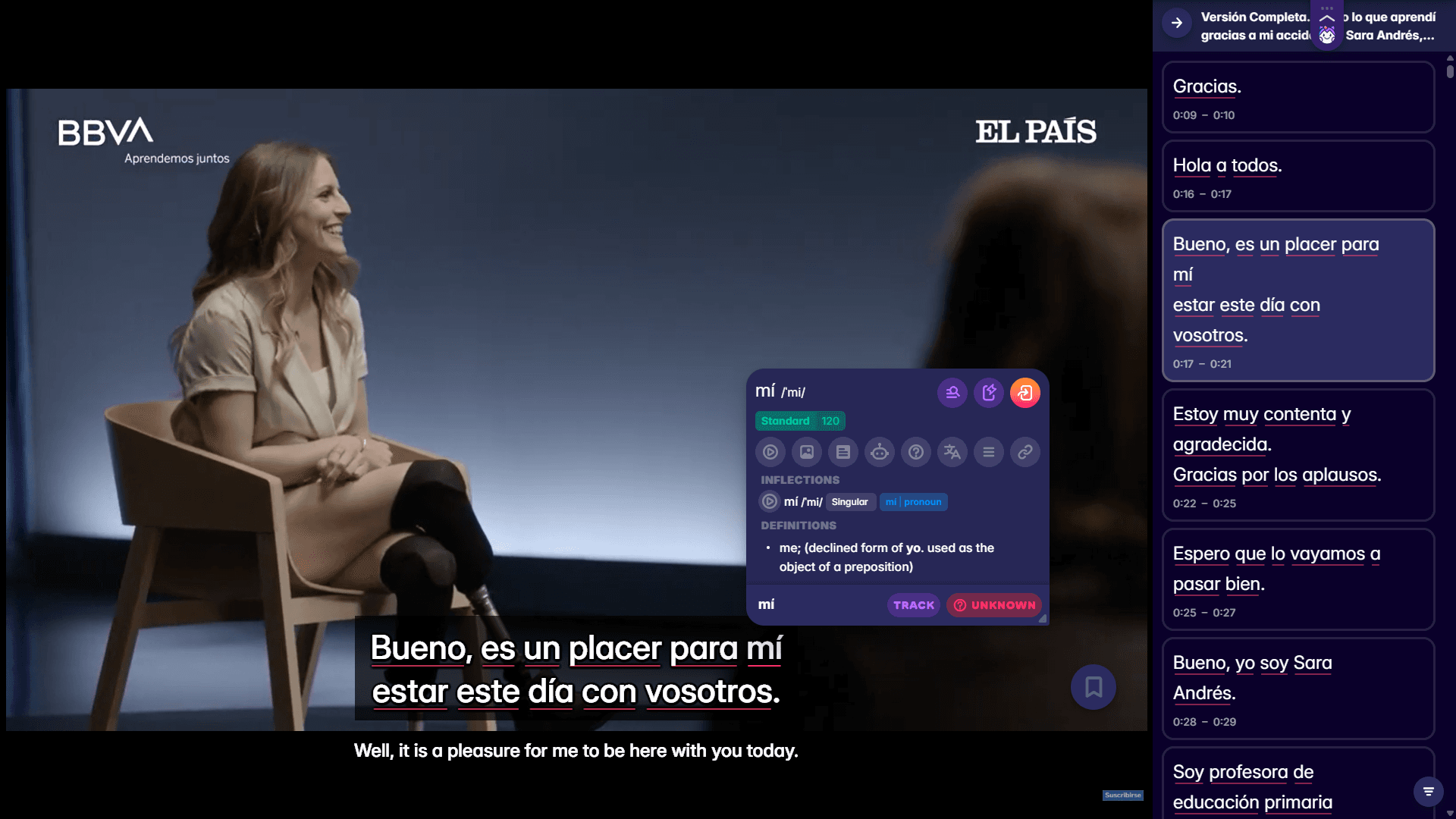
Anyway, if you want to actually see the present subjunctive in action while watching Spanish shows or reading articles, Migaku's browser extension and app let you look up verb forms instantly without breaking your immersion. Makes learning grammar in context way more practical. There's a 10-day free trial if you want to check it out.
 ----
## Getting comfortable with the subjunctive
The present subjunctive is one of those [grammar](https://migaku.com/blog/spanish/spanish-grammar-guide) topics that takes time to sink in. You can't just read about it once and expect to use it perfectly. You need exposure, practice, and patience. The key is recognizing the subjunctive in real context. When watching Spanish videos, reading Spanish articles, or listening to podcasts, ask yourself what the conjugation is and why using subjunctive when encountering it.
> If you consume media in Spanish, and you understand at least some of the messages and sentences within that media, you will make progress. _Period_.
Every rule that confuses you today will one day feel automatic.
----
## Getting comfortable with the subjunctive
The present subjunctive is one of those [grammar](https://migaku.com/blog/spanish/spanish-grammar-guide) topics that takes time to sink in. You can't just read about it once and expect to use it perfectly. You need exposure, practice, and patience. The key is recognizing the subjunctive in real context. When watching Spanish videos, reading Spanish articles, or listening to podcasts, ask yourself what the conjugation is and why using subjunctive when encountering it.
> If you consume media in Spanish, and you understand at least some of the messages and sentences within that media, you will make progress. _Period_.
Every rule that confuses you today will one day feel automatic.