# Preterite Tense Spanish: How to Form the Preterite Tense in Spanish Grammar
> Master the Spanish preterite tense with clear conjugation rules, irregular verb forms, and usage tips. Learn when to use preterite vs imperfect.
**URL:** https://migaku.com/blog/spanish/preterite-tense-spanish-guide
**Last Updated:** 2026-04-13
**Tags:** fundamentals, conjugation, grammar, verbs
---
So you're [learning Spanish](https://migaku.com/learn-spanish), and you've hit the preterite tense. Pretty much everyone struggles with this at first, and honestly, it makes sense why. Spanish has multiple ways to talk about the past, and figuring out when to use which one feels confusing at first. Let me walk you through everything you need to know about the **Spanish preterite tense**, from basic conjugation to those tricky irregular forms that everyone messes up at first.
----
## What is the preterite tense in Spanish
The **preterite tense** (also called pretérito indefinido or pretérito perfecto simple) is one of the main past tenses in Spanish. It's used to describe **actions that were completed at a specific point in the past**. When you use the preterite, you're talking about **events that started and finished, done and dusted**.
For example:
- Comí pizza anoche.
*I ate pizza last night.*
- Viajamos a México el año pasado.
*We traveled to Mexico last year.*
- Ella estudió tres horas.
*She studied for three hours.*
Each of these actions happened at a specific time and ended. That's the key to understanding what tense is preterite: it deals with completed actions that have clear boundaries in time.
----
## Regular verb conjugations in the preterite
Let's start with the foundation: **regular verbs**. Spanish verbs come in three flavors based on their infinitive ending: **-ar**, **-er**, and **-ir**. Each group has its own set of endings for the preterite tense.
### -ar verbs
For verbs ending in -ar (like hablar, trabajar, or caminar), you drop the **-ar** and add these endings:
- Yo: -é
- Tú: -aste
- Él/Ella/Usted: -ó
- Nosotros: -amos
- Vosotros: -asteis
- Ellos/Ellas/Ustedes: -aron
So hablar (to speak) becomes:
- Yo hablé (I spoke)
- Tú hablaste (You spoke)
- Él habló (He spoke)
- Nosotros hablamos (We spoke)
- Vosotros hablasteis (You all spoke)
- Ellos hablaron (They spoke)
Notice the accent marks on hablé and habló. Those are super important and I'll talk more about them later.
### -er and -ir verbs
Here's something that makes life easier: **-er** and **-ir** verbs share the same preterite endings. Take the infinitive, drop the ending, and add:
- Yo: -í
- Tú: -iste
- Él/Ella/Usted: -ió
- Nosotros: -imos
- Vosotros: -isteis
- Ellos/Ellas/Ustedes: -ieron
For comer (to eat):
- Yo comí (I ate)
- Tú comiste (You ate)
- Él comió (He ate)
- Nosotros comimos (We ate)
- Vosotros comisteis (You all ate)
- Ellos comieron (They ate)
For vivir (to live):
- Yo viví (I lived)
- Tú viviste (You lived)
- Él vivió (He lived)
- Nosotros vivimos (We lived)
- Vosotros vivisteis (You all lived)
- Ellos vivieron (They lived)
One thing that trips people up: vivimos looks identical in present and preterite for the nosotros form. Context is your friend here.
----
## Irregular verbs in the preterite tense
Alright, now we get to the fun part. And by fun, I mean the stuff that makes Spanish learners groan. **Irregular verbs** don't follow the regular conjugation patterns, and some of the most common Spanish verbs are irregular in the preterite.
### The big three: Ser, ir, and ver
**Ser** (to be) and **ir** (to go) are special because they share the exact same preterite form. Yep, you read that right. The context tells you which verb is being used.
- Yo fui (I was / I went)
- Tú fuiste (You were / You went)
- Él fue (He was / He went)
- Nosotros fuimos (We were / We went)
- Vosotros fuisteis (You all were / You all went)
- Ellos fueron (They were / They went)
So "Fui al mercado" means "I went to the market," while "Fui estudiante" means "I was a student."
**Ver** (to see) is slightly irregular but follows a simpler pattern:
- Yo vi (I saw)
- Tú viste (You saw)
- Él vio (He saw)
- Nosotros vimos (We saw)
- Vosotros visteis (You all saw)
- Ellos vieron (They saw)
Notice there are no accent marks on vi and vio. That's because these are single-syllable forms.
### Dar
**Dar** (to give) is weird because it's an -ar verb but uses -er/-ir endings in the preterite:
- Yo di (I gave)
- Tú diste (You gave)
- Él dio (He gave)
- Nosotros dimos (We gave)
- Vosotros disteis (You all gave)
- Ellos dieron (They gave)
Again, no accents on di and dio because they're single syllables.
### Stem-changing irregular preterite verbs
Some irregular verbs change their stem in the preterite and use a special set of endings. These are probably the trickiest group. Common ones include:
**Tener** (to have) becomes tuv-:
- Yo tuve, tú tuviste, él tuvo, nosotros tuvimos, ellos tuvieron
**Estar** (to be) becomes estuv-:
- Yo estuve, tú estuviste, él estuvo, nosotros estuvimos, ellos estuvieron
**Poder** (to be able) becomes pud-:
- Yo pude, tú pudiste, él pudo, nosotros pudimos, ellos pudieron
**Poner** (to put) becomes pus-:
- Yo puse, tú pusiste, él puso, nosotros pusimos, ellos pusieron
**Saber** (to know) becomes sup-:
- Yo supe, tú supiste, él supo, nosotros supimos, ellos supieron
**Hacer** (to do/make) becomes hiz- (with a spelling change in the third person):
- Yo hice, tú hiciste, él hizo, nosotros hicimos, ellos hicieron
**Querer** (to want) becomes quis-:
- Yo quise, tú quisiste, él quiso, nosotros quisimos, ellos quisieron
**Venir** (to come) becomes vin-:
- Yo vine, tú viniste, él vino, nosotros vinimos, ellos vinieron
The pattern for these stem-changing verbs is consistent: the new stem plus these endings: -e, -iste, -o, -imos, -isteis, -ieron. No accent marks on any of these forms.
### -ir verbs with vowel changes
Some -ir verbs change their stem vowel, but only in the third person singular and plural. This happens when the stem has an e or an o.
**Dormir** (to sleep): e changes to i in third person
- Yo dormí, tú dormiste, él durmió, nosotros dormimos, ellos durmieron
**Pedir** (to ask for): e changes to i in third person
- Yo pedí, tú pediste, él pidió, nosotros pedimos, ellos pidieron
**Preferir** (to prefer): e changes to i in third person
- Yo preferí, tú preferiste, él prefirió, nosotros preferimos, ellos prefirieron
----
## When to use the Spanish preterite tense
Understanding conjugation is one thing. Knowing when to actually **use the preterite** is another. The preterite form appears in specific situations:
**Completed actions at specific times:**
- Ayer compré un libro.
*Yesterday I bought a book.*
- El lunes pasado llovió.
*Last Monday it rained.*
**Actions with clear beginnings and endings:**
- La película empezó a las ocho.
*The movie started at eight.*
- Estudié durante dos horas.
*I studied for two hours.*
**Sequential actions in a narrative:**
- Me levanté, desayuné y salí de casa.
*I got up, ate breakfast, and left the house.*
**Sudden interruptions:**
- Leía cuando sonó el teléfono.
*I was reading when the phone rang.*
The preterite is your go-to tense for storytelling and recounting events. When you're telling someone what happened yesterday, last week, or ten years ago, you'll probably be using the preterite most of the time.
----
## Preterite vs. Imperfect: What’s the difference
This is where things get interesting. Spanish has two main past tenses: the preterite and the **imperfect**. They're both past tenses, but they're **used to describe** different types of past actions.
- The **preterite tense** handles completed actions with specific time frames.
- The **imperfect** handles ongoing actions, habitual actions, and descriptions in the past.
Compare these:
- Viví en Madrid por tres años.
*I lived in Madrid for three years.* (preterite, completed period)
- Vivía en Madrid cuando conocí a mi esposa.
*I was living in Madrid when I met my wife.* (imperfect, ongoing background action)
- Fui al gimnasio ayer.
*I went to the gym yesterday.* (preterite, one-time completed action)
- Iba al gimnasio todos los días.
*I used to go to the gym every day.* (imperfect, habitual action)
Think of the preterite as a photograph: it captures a moment, a completed event. The imperfect is more like a video: it shows ongoing action or sets the scene.
In narratives, you'll often see both **tenses in spanish** working together. The imperfect sets the scene and describes what was happening, while the preterite moves the story forward with specific actions:
- Era una noche oscura. Llovía mucho. De repente, escuché un ruido extraño y abrí la puerta.
*It was a dark night. It was raining a lot. Suddenly, I heard a strange noise and opened the door.*
Era and llovía are imperfect (setting the scene), while escuché and abrí are preterite (specific actions that moved the story forward).
----
## The four past tenses in Spanish
While we're talking about past tenses, you should know that Spanish actually has more than just two ways to talk about the past. There are four main past tense constructions:
1. **Preterite** (Pretérito indefinido): Completed actions at specific times
2. **Imperfect** (Pretérito imperfecto): Ongoing or habitual past actions
3. **Present Perfect** (Pretérito perfecto): Actions that happened recently or have relevance to the present (he comido - I have eaten)
4. **Past Perfect** (Pretérito pluscuamperfecto): Actions that happened before other past actions (había comido - I had eaten)
The preterite and imperfect are by far the most common in everyday conversation. The present perfect is used more in Spain than in Latin America, where the preterite often replaces it.
----
## Accent rules and common pitfalls in tense conjugations
Let's talk about those accent marks because they actually matter. In the preterite tense, accent marks distinguish verb forms from other words and show stress patterns.
For -ar verbs, the yo form and the él/ella/usted form both need accents:
- hablé (I spoke)
- habló (he/she spoke)
For -er and -ir verbs, the yo form and the él/ella/usted form need accents:
- comí (I ate)
- comió (he/she ate)
- viví (I lived)
- vivió (he/she lived)
Without these accents, you might confuse verb forms. "Hablo" (present tense, I speak) versus "habló" (preterite, he/she spoke). The accent makes all the difference.
**Common mistakes to avoid:**
1. Forgetting that -er and -ir verbs share endings. Students sometimes try to use -ar endings with -er verbs. Doesn't work.
2. Mixing up ser and estar in the preterite. "Fui" comes from ser, while "estuve" comes from estar. They mean different things.
3. Using the wrong tense when you need the preterite. If you're talking about a specific completed action, you need the preterite. "Ayer comía pizza" sounds weird because comía (imperfect) suggests ongoing or habitual action, but ayer (yesterday) indicates a specific time.
4. Pronouncing irregular forms wrong. "Hizo" is pronounced "EE-so" (the h is silent), not "HEE-zo."
5. Forgetting the stem changes in third person -ir verbs. "Él dormó" is wrong. It's "él durmió."
----
## Tips for mastering the Spanish preterite form
Learning to conjugate verbs in the preterite takes practice. Here are some tips to help you master Spanish past tenses.
1. **Group irregular verbs by pattern.** The stem-changing irregulars (tuve, estuve, pude, puse) all follow the same ending pattern. Learn one, and you've learned the template for all of them.
2. **Practice with real stories.** Reading or listening to stories in Spanish forces you to see the preterite in context. You'll start to internalize when native speakers choose the preterite versus other tenses.
3. **Focus on [high-frequency verbs](https://migaku.com/blog/spanish/best-spanish-anki-decks) first.** Verbs like ir, ser, estar, tener, hacer, decir, and ver appear constantly. Master these irregular forms before worrying about less common verbs.
4. **Pay attention to time markers.** Words like ayer (yesterday), anoche (last night), el año pasado (last year), and hace dos días (two days ago) are strong signals that you need the preterite.
5. **Write your own sentences.** Take events from your day and describe them in Spanish using the preterite. "Esta mañana me desperté a las siete. Desayuné cereal y salí de casa a las ocho." The more you produce, the more natural it becomes.
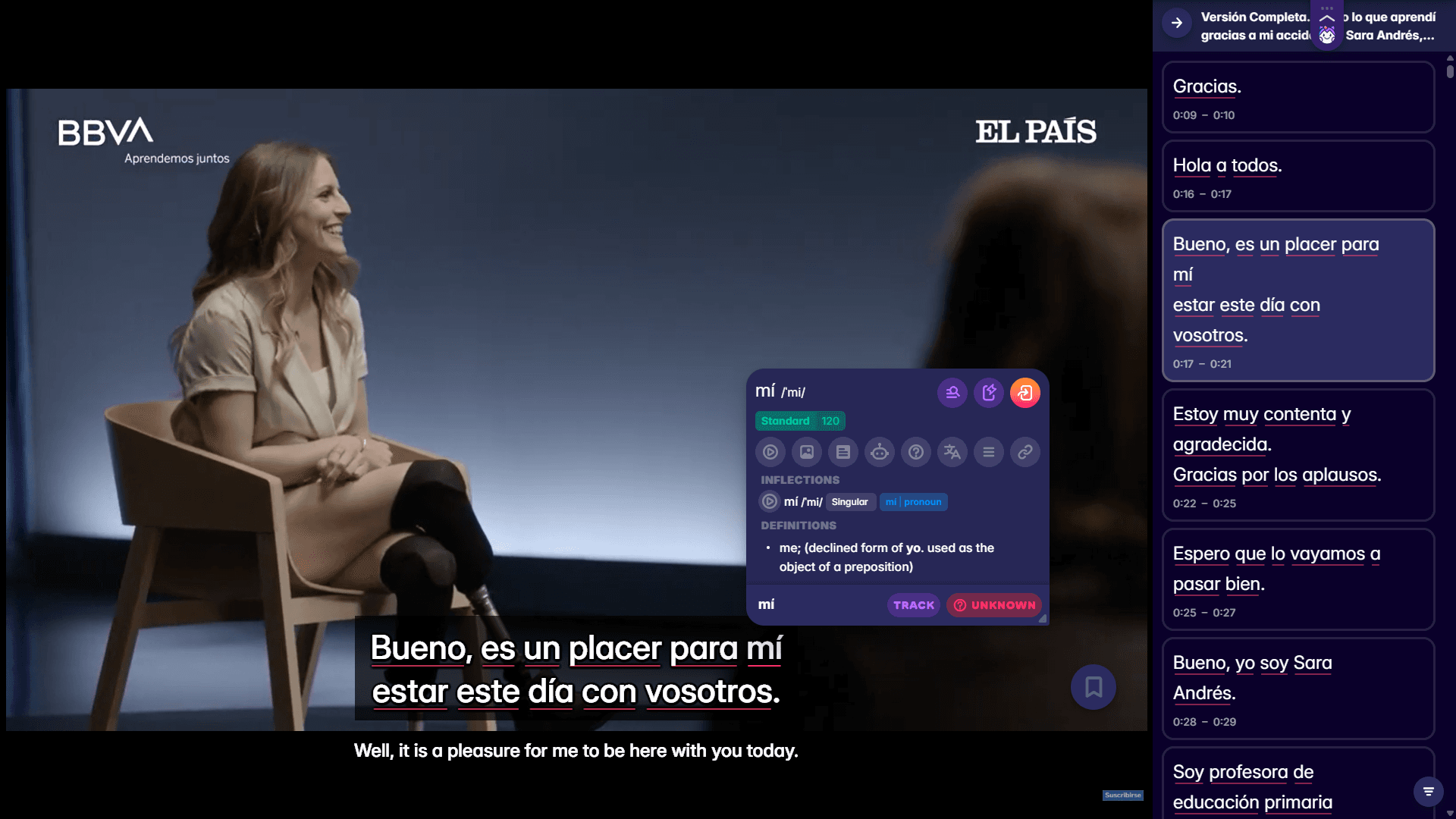
Anyway, if you want to see the preterite in action with real Spanish content, Migaku's browser extension and app let you look up verb forms instantly while watching shows or reading articles. You can click any word to see its meaning and conjugation, which makes learning from native content way more practical. There's a 10-day free trial if you want to check it out.
 ----
## The past tense verbs in Spanish seem overwhelming at first
They will become your second nature with exposure and practice. The key is to start using it. Read Spanish texts and notice when writers use the preterite. Listen to podcasts or watch shows and pay attention to how speakers talk about past events. And most importantly, practice producing your own sentences.
> If you consume media in Spanish, and you understand at least some of the messages and sentences within that media, you will make progress. _Period_.
Every grammar rule learned is a step toward fluency.🪜
----
## The past tense verbs in Spanish seem overwhelming at first
They will become your second nature with exposure and practice. The key is to start using it. Read Spanish texts and notice when writers use the preterite. Listen to podcasts or watch shows and pay attention to how speakers talk about past events. And most importantly, practice producing your own sentences.
> If you consume media in Spanish, and you understand at least some of the messages and sentences within that media, you will make progress. _Period_.
Every grammar rule learned is a step toward fluency.🪜