# Ser Preterite Conjugation: Complete Spanish Guide
> Master ser preterite conjugation with this guide. Learn all forms (fui, fue, fuimos), see real examples, and understand when to use the preterite tense.
**URL:** https://migaku.com/blog/spanish/ser-preterite-conjugation-spanish-guide
**Last Updated:** 2026-04-29
**Tags:** vocabulary, conjugation, grammar, verbs
---
If you're [learning Spanish](https://migaku.com/learn-spanish), you've probably already run into the verb ser (to be) about a million times. And here's the thing: conjugating ser in the preterite tense is one of those topics that trips up pretty much every Spanish learner at some point. In this guide, I'm going to walk you through everything you need to know about ser preterite conjugation. We'll cover the full conjugation chart, look at real examples, compare it with the imperfect tense, and clear up the confusion with ir. By the end, you'll actually understand when and how to use these forms.
----
## The ser preterite conjugation chart
Let's start with what you actually came here for: the conjugation chart. Here are all the preterite forms of ser:
| Person | Verb Form | English |
| - | - | - |
| Yo | fui | I was |
| Tú | fuiste | You were (informal) |
| Él / Ella / Usted | fue | He / She was, You were (formal) |
| Nosotros / Nosotras | fuimos | We were |
| Vosotros / Vosotras | fuisteis | You all were (Spain) |
| Ellos / Ellas / Ustedes | fueron | They / You all were |
Notice anything weird? These forms look nothing like the infinitive ser. That's because ser is one of the most irregular Spanish verbs out there. You just have to [memorize these forms](https://migaku.com/blog/spanish/best-spanish-anki-decks) because there's no pattern connecting them to the infinitive.
The stem changes completely to "fu-" and then you add these specific endings. The yo form is fui, tú gets fuiste, and so on. The good news is that once you memorize this verb conjugation, you've also learned ir in the preterite because they're identical.
----
## Understanding when to use the preterite tense
Before we dive deeper into examples, you need to understand what the preterite tense actually does. The preterite is used for actions that were completed in the past. Think of it as a snapshot of something that happened and ended.
When you use ser in the preterite, you're talking about states of being that existed at a specific time and are now over. For example:
- Fui estudiante durante cuatro años.
*I was a student for four years.*
That period of being a student is finished. It's a completed past state. [This is different from the imperfect tense](https://migaku.com/blog/spanish/spanish-preterite-vs-imperfect), which we'll get to in a minute.
The preterite tense shows up constantly in Spanish when you're narrating events, telling stories, or describing things that happened at specific moments. You'll use it way more than you might expect when speaking Spanish naturally.
----
## Real examples of ser in the preterite tense
Let's look at how these conjugations actually work in sentences. This is where the verb really comes alive:
- Yo fui el mejor estudiante de la clase.
*I was the best student in the class.*
- Tú fuiste muy amable conmigo.
*You were very kind to me.*
- Ella fue presidenta de la compañía.
*She was president of the company.*
- Nosotros fuimos amigos en la universidad.
*We were friends in college.*
- Vosotros fuisteis los ganadores del concurso.
*You all were the winners of the contest.*
- Ellos fueron mis profesores el año pasado.
*They were my teachers last year.*
- El concierto fue increíble.
*The concert was incredible.*
- Fuimos testigos del accidente.
*We were witnesses to the accident.*
- ¿Fuiste tú quien llamó anoche?
*Were you the one who called last night?*
See how each example describes a state of being that existed in the past but is now complete? That's the key to understanding when to use ser in the preterite.
----
## The confusing overlap of ser and ir
Alright, let's address the elephant in the room. **The preterite forms of ser and ir are completely identical.** Fui means both "I was" and "I went." Fue means both "he/she/it was" and "he/she/it went." This seems like a disaster waiting to happen, but in practice, context makes it pretty clear which verb you're dealing with.
Look at these sentences:
- Fui al supermercado.
*I went to the supermarket.*
- Fui estudiante.
*I was a student.*
The first one has to be ir because you go TO places (al supermercado). The second has to be ser because you can't "go" a student. The context tells you everything you need to know.
Here are more examples showing both verbs:
- Ella fue a Madrid el mes pasado.
*She went to Madrid last month.* (This is *ir*)
- Ella fue mi mejor amiga.
*She was my best friend.* (This is *ser*)
- Fuimos muy felices juntos.
*We were very happy together.* (This is *ser*)
- Fuimos a la playa ayer.
*We went to the beach yesterday.* (This is *ir*)
Once you get used to reading Spanish, your brain automatically figures out which verb is being used. It becomes second nature pretty quickly.
----
## Ser in preterite tense and imperfect tense: The big difference
Here's where things get interesting. Spanish has two main past tenses: the preterite and the imperfect. Both can translate to "was" or "were" in English, but they mean different things.
**The preterite (what we've been studying) is for completed past states.** The imperfect is for ongoing or habitual past states. Let me show you the imperfect forms of ser real quick:
**era, eras, era, éramos, erais, eran**
Now compare these sentences:
- Fui estudiante durante cuatro años.
*I was a student for four years.* (Preterite: completed period)
- Era estudiante cuando nos conocimos.
*I was a student when we met.* (Imperfect: ongoing state)
The first sentence emphasizes that the period of being a student is over and done. The second sentence describes what you were in the middle of being at a particular moment in the past.
Another comparison:
- El examen fue difícil.
*The exam was difficult.* (Preterite: the exam happened and it was difficult)
- Los exámenes eran difíciles.
*The exams were difficult.* (Imperfect: describing a general characteristic)
The preterite tense treats the state as an event that happened. The imperfect treats it as a description or background information. This distinction exists throughout [Spanish verb conjugation](https://migaku.com/blog/spanish/spanish-verb-conjugation-chart), and it's one of the trickier things for English speakers to master because English doesn't make this difference as clearly.
----
## Common mistakes with the verb ser
After teaching Spanish for years, I've seen the same mistakes pop up over and over with ser preterite conjugation. Here are the big ones:
**Mistake 1: Using present tense forms**
❌Wrong: **Yo soy estudiante ayer** (mixing present with past time marker)
✅Right: **Yo fui estudiante** (I was a student)
**Mistake 2: Confusing preterite and imperfect**
❌Wrong: **Era un buen día ayer** (imperfect doesn't work with specific completed time)
✅Right: **Fue un buen día ayer** (It was a good day yesterday)
**Mistake 3: Trying to make ser regular**
❌Wrong: **Yo serí** (doesn't exist)
✅Right: **Yo fui** (I was)
**Mistake 4: Getting fue and fui mixed up**
❌Wrong: **Yo fue** (wrong person)
✅Right: **Yo fui** (I was) or **Él fue** (He was)
----
## Tips for remembering how to conjugate
Here are some strategies that work for memorizing ser preterite conjugation:
1. **Practice with real sentences.** Don't just memorize the chart. Use each form in a sentence that means something to you. Fui estudiante en Boston (I was a student in Boston). Make it personal.
2. **Write them out repeatedly.** Yeah, it's old school, but writing the conjugations by hand helps cement them in your memory. Write out the full chart five times while saying each form out loud.
3. **Create associations.** Notice that fui and fue sound similar. Fuiste has "te" in it, just like tú. Fuimos sounds like "we most." These little tricks help.
4. **Use them immediately.** As soon as you learn these forms, try to use them in conversation or writing. The more you actually use ser in the preterite, the faster it becomes automatic.
5. **Read Spanish content.** When you see these forms in context over and over, they start to feel natural. Reading helps you internalize the patterns without actively studying.
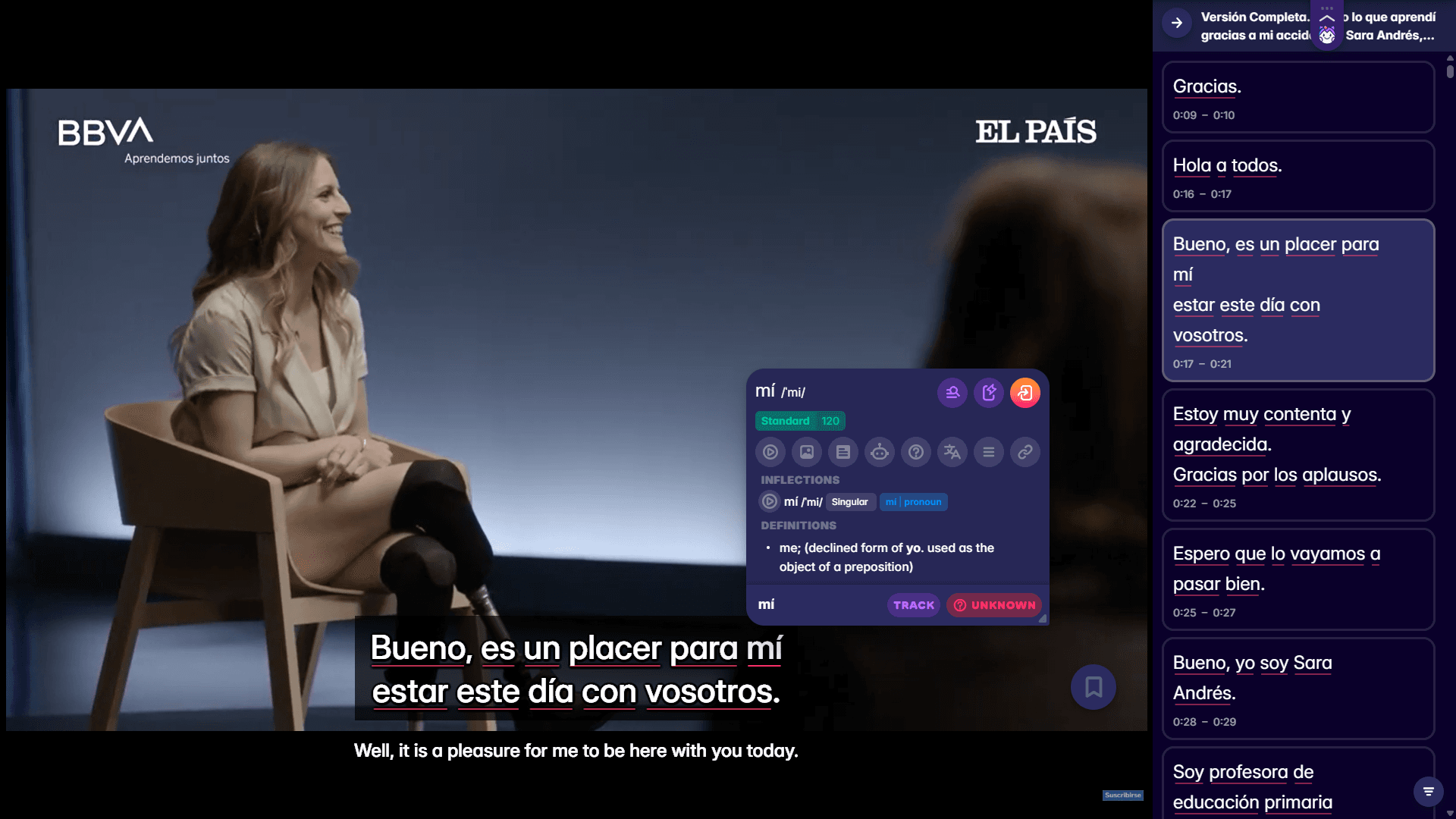
Anyway, if you want to practice these conjugations with real Spanish content, Migaku's browser extension and app let you look up words and see verb forms instantly while watching Spanish shows or reading articles. Makes learning way more practical than just staring at conjugation charts. There's a 10-day free trial if you want to check it out.
 ----
## FAQs
Yes, absolutely. Ser is one of the most irregular Spanish verbs in the preterite tense. The conjugation changes completely from the infinitive, and you have to memorize each form. There's no regular pattern to follow.
Yeah, you really should memorize it. Since ser is one of the most common verbs in Spanish and it's completely irregular, there's no shortcut. The good news is that once you memorize it, you use it so often that it sticks in your brain pretty quickly.
You use the stem "fu" and add the specific endings: fui, fuiste, fue, fuimos, fuisteis, fueron. Each form needs to be learned individually because the conjugation doesn't follow regular patterns.
----
## Remember that context is your friend in learning verb conjugations
Keep practicing these forms in real-life context until they feel natural. The more you use these forms in context, the more natural they become. Reading Spanish content and paying attention to how native speakers use the preterite tense helps a ton.
> If you consume media in Spanish, and you understand at least some of the messages and sentences within that media, you will make progress. _Period_.
Expose. Repeat. Retain!
----
## FAQs
Yes, absolutely. Ser is one of the most irregular Spanish verbs in the preterite tense. The conjugation changes completely from the infinitive, and you have to memorize each form. There's no regular pattern to follow.
Yeah, you really should memorize it. Since ser is one of the most common verbs in Spanish and it's completely irregular, there's no shortcut. The good news is that once you memorize it, you use it so often that it sticks in your brain pretty quickly.
You use the stem "fu" and add the specific endings: fui, fuiste, fue, fuimos, fuisteis, fueron. Each form needs to be learned individually because the conjugation doesn't follow regular patterns.
----
## Remember that context is your friend in learning verb conjugations
Keep practicing these forms in real-life context until they feel natural. The more you use these forms in context, the more natural they become. Reading Spanish content and paying attention to how native speakers use the preterite tense helps a ton.
> If you consume media in Spanish, and you understand at least some of the messages and sentences within that media, you will make progress. _Period_.
Expose. Repeat. Retain!