# Spanish Banking Vocabulary: Essential Banking and Financial Terms
> Knowing Spanish banking vocabulary for accounts, ATMs, and other financial services can make your trip way easier. Learn terms you'll definitely use here.
**URL:** https://migaku.com/blog/spanish/spanish-banking-vocabulary
**Last Updated:** 2026-03-24
**Tags:** vocabulary, phrases
---
Walking into a bank in a [Spanish-speaking](https://migaku.com/learn-spanish) country can feel pretty intimidating if you don't know the right words. You might need to open an account, withdraw cash from an ATM, or ask about a transaction, and suddenly you're stuck trying to remember if "cuenta" means account or bill. Here's the thing: banking vocabulary in Spanish is super practical stuff, whether you're [traveling, living abroad](https://migaku.com/blog/spanish/spanish-travel-phrases-essential-guide), or just trying to handle financial stuff in Spanish. Let me walk you through the essential banking terms and phrases you need to know.
----
## Most important Spanish banking vocabulary you should know
The most important Spanish banking vocabulary falls into a few key categories. You need words for basic bank locations and staff, different types of accounts and cards, common transactions, and the verbs you'll use to describe what you're doing with your money.
Start with **"banco" ** (bank) and **"cuenta" ** (account). These two words show up constantly. When someone asks "¿Tiene una cuenta?" they're asking if you have an account. The phrase **"abrir una cuenta" ** means to open an account, which is probably one of the first things you'll need to do.
For accounts specifically, you've got **"cuenta de ahorros" ** (savings account) and **"cuenta corriente" ** (checking account). In some [Spanish-speaking countries](https://migaku.com/blog/spanish/get-started-in-spanish), they might say "cuenta de cheques" instead of cuenta corriente, but both mean the same thing.
Currency matters too. **"Dinero" ** means money in general, while **"efectivo" ** specifically means cash. If you're dealing with foreign currency exchange, that's **"cambio de divisas" ** or just "cambio."
----
## Bank locations and staff
When you're looking for a bank in Spanish, you need to know where to go and who to talk to.
The main office is the **"banco" ** or **"sucursal" ** (branch). The ATM has a few different names depending on where you are: **"cajero automático" ** is universal, but you might also hear "cajero" for short.
Inside the bank, you'll interact with different people. The **"cajero" ** or **"cajera" ** is the teller (Yeah, same word as ATM, context matters). A **"gerente" ** is the manager, and an **"empleado del banco" ** is a general bank employee. When a bank employee greets you and asks "¿En qué puedo servirle?" they're saying "How can I help you?"
The **"ventanilla" ** is the teller window where you conduct transactions. If there's a line, you'll wait in the **"fila" ** or **"cola" ** depending on the country.
----
## Essential account and card vocabulary
Beyond basic cuenta terms, you need to know the different types of cards in your wallet.
- **"Tarjeta de crédito" ** is a credit card.
- **"Tarjeta de débito" ** is a debit card.
- **"Tarjeta bancaria" ** is just a general bank card.
Other banking phrases related to the procedures are:
| Spanish | English |
| - | - |
| documentos | Documents |
| identificación / documento de identidad | ID |
| comprobante de domicilio | Proof of address |
| número de cuenta | Account number |
| saldo | Balance |
| depósito inicial | Initial deposit |
| saldo mínimo | Minimum balance |
| cargos | Charges |
| comisiones | Fees |
----
## Transactions and ATM operations
Here's where Spanish banking vocabulary gets really practical.
The verb **"depositar" ** means to deposit, while **"retirar" ** means to withdraw. So "retirar dinero" is to withdraw money, and "hacer un depósito" is to make a deposit.
You can practice the common ATM terms:
| Spanish | English |
| - | - |
| cajero automático | ATM |
| Ingrese su PIN | Enter your PIN |
| Seleccione el monto | Select the amount |
| monto | Amount |
| consulta de saldo | Balance inquiry |
| transferencia | Transfer |
| comprobante / recibo | Receipt |
| transferir dinero / hacer una transferencia | Transferring money |
| transferencia bancaria / transferencia electrónica | Wire transfer |
| transferir fondos | Sending money between accounts |
| transacción / operación | Transaction |
| historial de transacciones / movimientos de cuenta | Transaction history |
----
## Payment methods and financial actions
Beyond deposits and withdrawals, you need verbs for other banking actions.
| Spanish | English |
| - | - |
| pagar | To pay |
| cobrar | To charge / To cash |
| cobrar un cheque | To cash a check |
| pagar | To pay (verb) |
| hacer un pago | To make a payment |
----
## Loans, credit, and other finance terms in Spanish
| Spanish | English |
| - | - |
| préstamo | Loan |
| hipoteca | Mortgage |
| préstamo personal | Personal loan |
| solicitar un préstamo | To apply for a loan |
| interés / intereses | Interest |
| tasa de interés / tipo de interés | Interest rate |
| TAE (Tasa Anual Equivalente) | APR equivalent (in Spain) |
| crédito | Credit |
| línea de crédito / límite de crédito | Credit line / Credit limit |
| deuda | Debt |
| pagar una deuda / saldar una deuda | Paying off debt |
----
## Regional variations in Spanish banking phrases
Spanish banking vocabulary can vary between countries.
- In Spain, people often say "sacar dinero" (to take out money) while in Latin America "retirar dinero" is more common.
- The ATM is universally "cajero automático," but in some places you'll just hear "cajero."
- For checking accounts, Spain uses "cuenta corriente" while Mexico and other countries might say "cuenta de cheques." Both work, but knowing the local term helps.
- Currency names vary by country: "peso" in Mexico, Argentina, and several others; "sol" in Peru; "bolívar" in Venezuela; "euro" in Spain. When traveling to Spanish-speaking countries, learn the local currency name.
- Some countries use "plata" as slang for money instead of the formal "dinero."
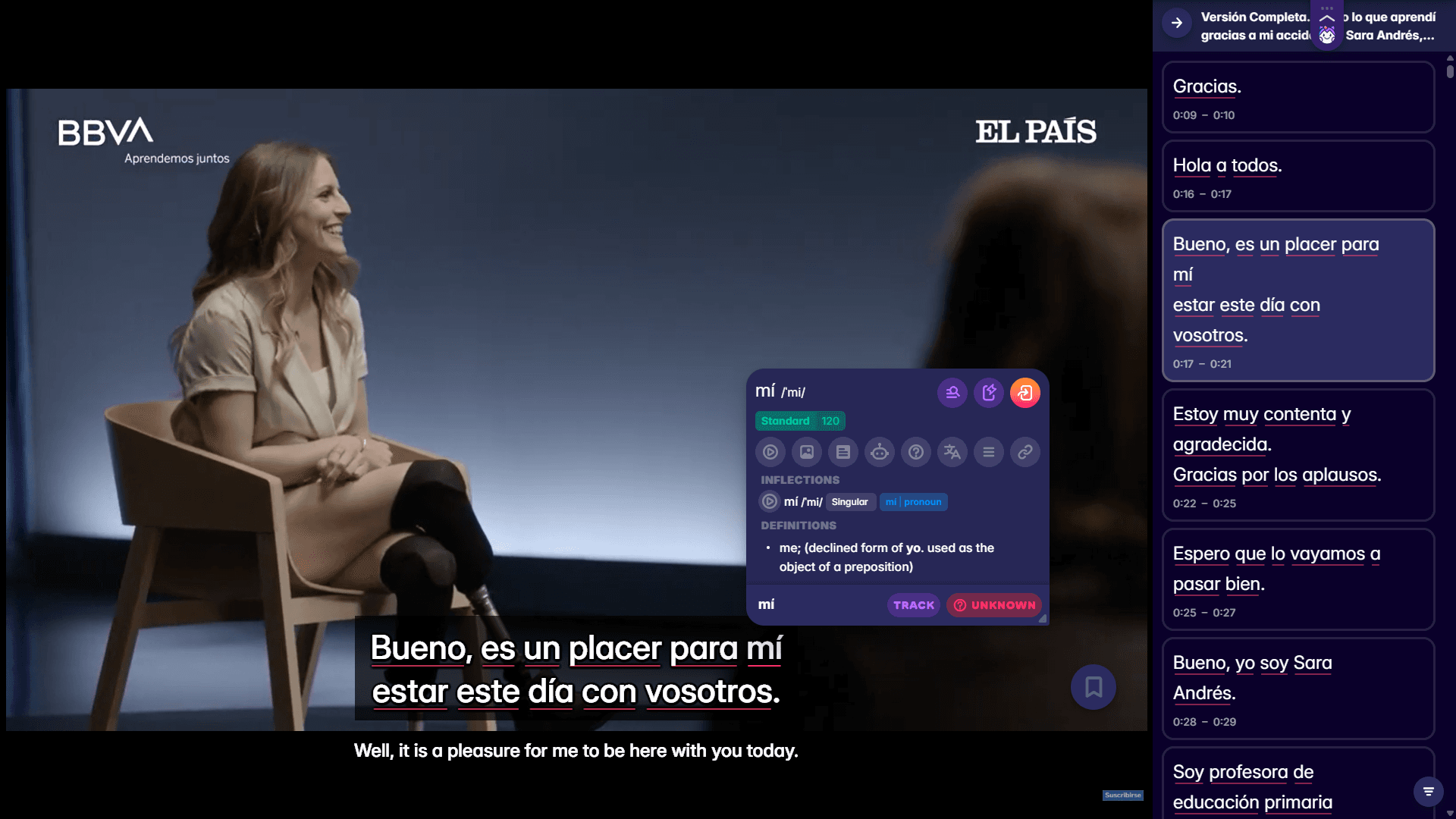
Anyway, if you want to [build your Spanish vocabulary](https://migaku.com/blog/spanish/best-spanish-learning-apps) beyond just banking terms, Migaku's browser extension and app let you look up words instantly while [watching Spanish shows](https://migaku.com/blog/spanish/best-spanish-shows-guide) or reading articles. Makes learning from real content way more practical. There's a 10-day free trial if you want to check it out.
 ----
## Banking terms in Spanish are practical knowledge you'll use in real situations
Unlike some vocabulary that you might only encounter in books, these words and phrases solve actual problems: getting cash, paying bills, and managing your accounts. The good news is that banking vocabulary is pretty limited. You don't need thousands of words. Maybe 100-150 terms and phrases will cover 95% of banking situations. That's totally manageable.
Once you know these banking and financial terms in Spanish, you can understand Spanish financial news, read contracts, and handle other money-related situations more easily.
> If you consume media in Spanish, and you understand at least some of the messages and sentences within that media, you will make progress. _Period_.
Learning Spanish takes time, but you can start with the parts that are most relevant to your life!💸💰
----
## Banking terms in Spanish are practical knowledge you'll use in real situations
Unlike some vocabulary that you might only encounter in books, these words and phrases solve actual problems: getting cash, paying bills, and managing your accounts. The good news is that banking vocabulary is pretty limited. You don't need thousands of words. Maybe 100-150 terms and phrases will cover 95% of banking situations. That's totally manageable.
Once you know these banking and financial terms in Spanish, you can understand Spanish financial news, read contracts, and handle other money-related situations more easily.
> If you consume media in Spanish, and you understand at least some of the messages and sentences within that media, you will make progress. _Period_.
Learning Spanish takes time, but you can start with the parts that are most relevant to your life!💸💰