# Spanish Definite and Indefinite Articles: El La Los Las Explained With Gender and Number Rules
> Consider these strategies to learn how Spanish definite and indefinite articles work. Clear examples, gender rules, and omission rules provided.
**URL:** https://migaku.com/blog/spanish/spanish-definite-and-indefinite-articles
**Last Updated:** 2026-02-21
**Tags:** fundamentals, vocabulary, phrases, grammar
---
If you're [learning Spanish](https://migaku.com/learn-spanish), you've probably noticed those little words that come before nouns and wondered why they matter so much. Articles like el, la, los, las, un, una, unos, and unas might seem confusing at first, but they're pretty straightforward once you understand the basic rules. They tell you whether something is specific or general, and whether you're talking about one thing or many. Let's break down exactly how Spanish definite and indefinite articles work so you can use them correctly every time.
---
## What are definite and indefinite articles in Spanish
Spanish uses two types of articles that come before nouns, just like English does.
- Definite articles point to specific things (like "the" in English).
- Indefinite articles refer to non-specific things (like "a" or "an" in English).
The tricky part for English speakers is that Spanish articles change based on whether the noun is masculine or feminine, and whether it's singular or plural.
Here's the complete list:
| Article Type | Masculine Singular | Feminine Singular | Masculine Plural | Feminine Plural |
| - | - | - | - | - |
| Definite | el | la | los | las |
| Indefinite | un | una | unos | unas |
So while English only has "the" as a definite article, Spanish has four different forms. Same deal with indefinite articles in Spanish, where English just uses "a" or "an" but Spanish needs four variations.
### What's the difference between definite and indefinite articles in Spanish
> 💡The main difference comes down to specificity.
> - Definite articles point to something particular that both the speaker and listener can identify.
> - Indefinite articles introduce something new or non-specific.
Compare these sentences:
- "Quiero el libro" (I want the book) means you want a specific book, probably one you've mentioned before or that's visible.
- "Quiero un libro" (I want a book) means any book will do, you're just looking for something to read.
- "Los estudiantes llegaron tarde" (The students arrived late) refers to a specific group of students.
- "Unos estudiantes llegaron tarde" (Some students arrived late) means a few students from a larger group, but you're not specifying exactly which ones.
This distinction exists in English too, but Spanish requires you to match the article to the gender and number of the noun, which adds an extra layer of complexity.
---
## Understanding definite articles: el, la, los, las
The definite article in Spanish tells you that you're talking about something **specific**. If I say "el libro," I mean "the book," a particular book we both know about. The form you use depends on the gender and number of the noun.
| Article | Noun Type | Spanish Example | English Translation |
| - | - | - | - |
| el | Masculine singular | el perro
el coche
el libro | The dog
The car
The book |
| la | Feminine singular | la casa
la mesa
la ciudad | The house
The table
The city |
| los | Masculine plural | los perros
los coches
los libros | The dogs
The cars
The books |
| las | Feminine plural | las casas
las mesas
las ciudades | The houses
The tables
The cities |
Here's something interesting about Spanish that differs from English. You actually use definite articles when talking about things in general. If you want to say "Dogs are friendly," you'd say "Los perros son amigables." In English, we drop "the," but Spanish keeps it. This applies to abstract nouns too. "Love is important" becomes "El amor es importante."
---
## When to use definite articles in Spanish
Spanish speakers use definite articles way more often than English speakers do. You'll need them in situations where English wouldn't bother.
1. Use definite articles when talking about **[body parts](https://migaku.com/blog/spanish/spanish-body-parts-vocabulary-guide) with reflexive verbs**. Instead of saying "I wash my hands," you say "Me lavo las manos" (Literally "I wash myself the hands"). The reflexive pronoun already shows possession, so you don't need "my."
2. **Days of the week** take definite articles too. "I'll see you on Monday" is "Te veo el lunes." If you're talking about repeated actions, you use the plural form: "On Mondays I study" becomes "Los lunes estudio."
3. **Languages** get definite articles when they're the subject of a sentence. "Spanish is difficult" is "El español es difícil." But after the verb "hablar" (To speak), you drop it: "Hablo español."
4. **Titles** use definite articles when you're talking about someone, but not when addressing them directly. You'd say "El doctor García es inteligente" (Doctor García is intelligent), but when speaking to him, just "Buenos días, doctor García."
---
## Understanding indefinite articles: un, una, unos, unas
The indefinite article refers to non-specific things. When you say "un libro," you mean "a book," any book, not a particular one.
| Article | Noun Type | Spanish Example | English Translation |
| - | - | - | - |
| un | Masculine singular | un perro
un coche
un problema | A dog
A car
A problem |
| una | Feminine singular | una casa
una mesa
una ciudad | A house
A table
A city |
| unos | Masculine plural | unos perros
unos coches
unos problemas | Some dogs
Some cars
Some problems |
| unas | Feminine plural | unas casas
unas mesas
unas ciudades | Some houses
Some tables
Some cities |
The plural forms unos and unas translate to "some" or "a few" in English. They're less common than the singular forms but still useful. "I have some friends in Madrid" would be "Tengo unos amigos en Madrid."
---
## How articles work with other parts of speech
Articles interact with other [grammar](https://migaku.com/blog/spanish/spanish-grammar-guide) elements in ways that affect how you build sentences.
When an **adjective** comes before a noun, the article still goes first: "el buen libro" (The good book), "una casa grande" (A big house). The article matches the noun, not the adjective.
With **possessive adjectives**, you typically don't use articles. You say "mi casa" (My house), not "la mi casa." But in some emphatic constructions, you might say "la casa mía" (That house of mine), where the possessive comes after the noun.
**Demonstrative pronouns** replace articles. You use either "este libro" (This book) or "el libro," but not both together. The demonstrative already specifies which book you mean.
After **prepositions**, articles contract in two cases. "A + el" becomes "al": "Voy al parque" (I'm going to the park). "De + el" becomes "del": "El libro del profesor" (The teacher's book). This doesn't happen with la, los, or las.
---
## When to omit articles in Spanish grammar
Spanish drops articles in certain situations where English might use them.
1. **After the verb "ser"** when talking about professions, religions, or nationalities: "Soy profesor" (I am a teacher), "Es católica" (She is Catholic), "Somos mexicanos" (We are Mexican). But if you add an adjective, you need the article: "Soy un profesor excelente" (I am an excellent teacher).
2. **With certain fixed expressions** and after prepositions in set phrases: "en casa" (At home), "a pie" (On foot), "con permiso" (With permission).
3. In **lists** or when **counting**: "Necesito papel, lápiz y goma" (I need paper, pencil, and eraser).
4. After **"de"** when describing what something **is made of or its purpose**: "una mesa de madera" (A wooden table), "un vaso de agua" (A glass of water).
---
## Common mistakes English speakers make
English speakers learning Spanish tend to make predictable errors with articles because the systems don't match perfectly.
1. Forgetting articles with abstract nouns is super common. In English, we say "Life is beautiful," but in Spanish, you need "La vida es hermosa." Same with "El tiempo es dinero" (Time is money) and "La música es universal" (Music is universal).
2. Another frequent mistake is dropping the article before body parts. English speakers want to say "Me duele cabeza," but it should be "Me duele la cabeza" (My head hurts).
3. Using articles after "ser" with professions trips people up. You'll hear learners say "Soy un estudiante," copying the English "I am a student," but Spanish just uses "Soy estudiante."
4. Mixing up gender causes article errors constantly. Since English doesn't have gendered nouns, remembering that "el problema" is masculine and "la mano" is feminine takes practice.
---
## Regional variations and usage
Spanish usage of articles stays pretty consistent across different countries, but you'll notice some regional preferences.
In Spain, you'll hear "la Marta" or "el Pedro" in casual conversation, adding the definite article before people's names. This sounds weird to Latin American speakers, who would just say "Marta" or "Pedro."
Some regions use articles with possessives more than others. You might hear "la mi casa" in some dialects instead of just "mi casa," though this is considered non-standard.
The use of articles with countries varies. Some countries take articles ("la Argentina," "el Perú," "los Estados Unidos") while others don't ("España," "México," "Colombia"). This isn't really regional variation, just specific to each country's name.
---
## Tips for mastering Spanish articles
Getting comfortable with articles takes time because you need to internalize both the gender system and the usage rules.
1. Always learn nouns with their articles from day one. When you see a new word, write it as "el coche" or "la mesa," not just "coche" or "mesa." This builds the association automatically.
2. Read a lot of Spanish content. You'll absorb the patterns naturally when you see thousands of examples. Notice which articles appear with which nouns and in which contexts.
3. Practice with minimal pairs. Take a sentence and change just the article to see how the meaning shifts. "Quiero el café" versus "Quiero un café" teaches you the practical difference.
4. Don't stress too much about making mistakes. Native speakers will understand you even if you mix up el and la occasionally. The gender system is arbitrary anyway, so you're not saying something illogical, just non-standard.
5. Pay attention to exceptions as you encounter them. When you learn that "el agua" uses el despite being feminine, make a note. These exceptions are limited in number, so you can memorize them.
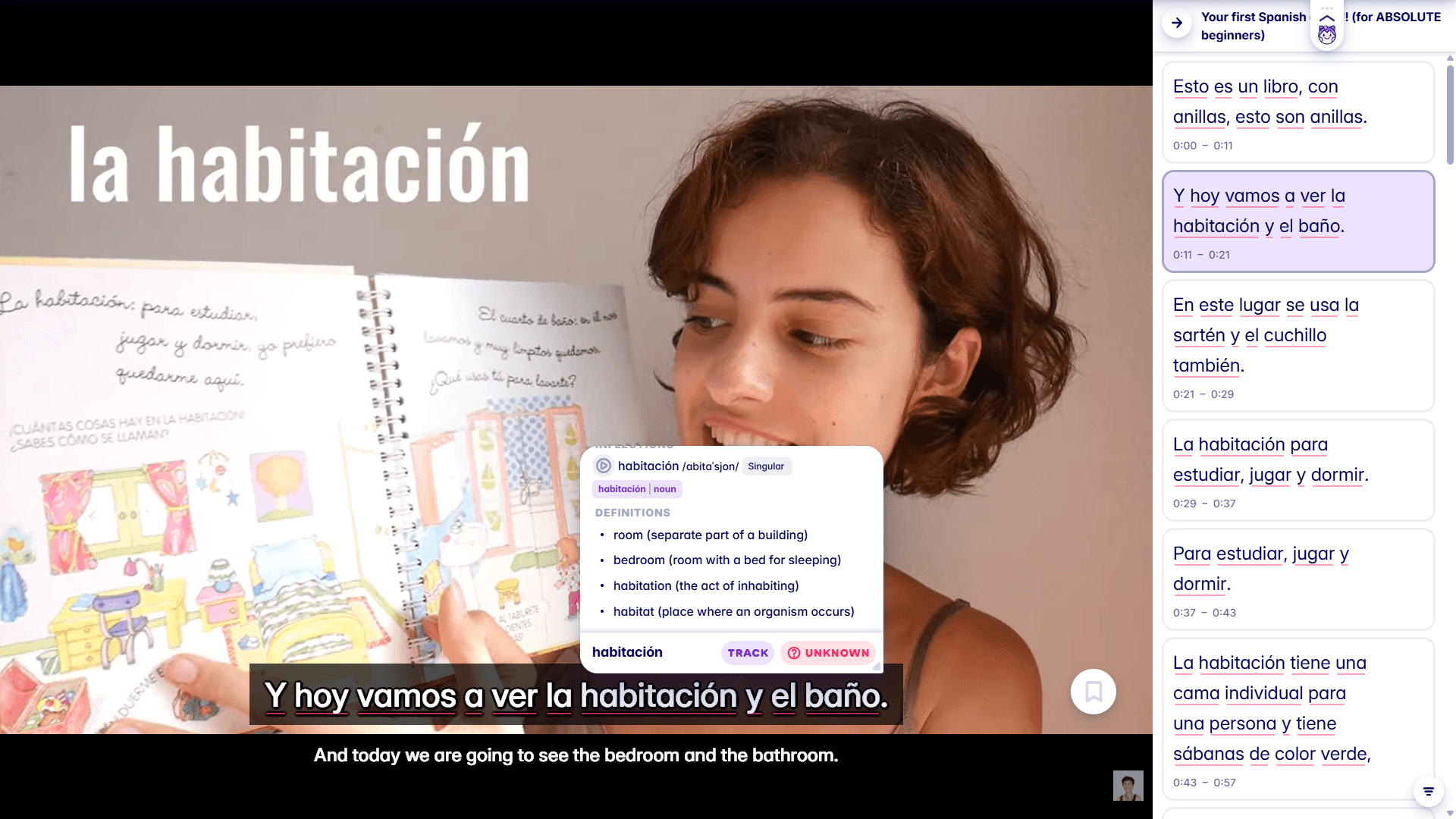
If you want to practice articles with real Spanish content, Migaku's browser extension and app let you look up any word instantly while watching shows or reading articles online. You can see exactly which article goes with each noun in context, which beats memorizing lists any day. There's a 10-day free trial if you want to check it out.
 ---
## Learning articles of Spanish language is a challenge
Simply considering the sheer amounts and considerations concerning Spanish definite articles and indefinite ones, it would be more difficult to acquire these grammar points than learning English grammar. It requires a whole different strategy of combining each noun with its designated articles as a pair. Moreover, because memory does not work with random lists, you need to actually see these pairs in practice in media content. Immersion plays a critical role in internalizing this information.
> If you consume media in Spanish, and you understand at least some of the messages and sentences within that media, you will make progress. _Period_.
Acknowledge the challenge, and conquer it!
---
## Learning articles of Spanish language is a challenge
Simply considering the sheer amounts and considerations concerning Spanish definite articles and indefinite ones, it would be more difficult to acquire these grammar points than learning English grammar. It requires a whole different strategy of combining each noun with its designated articles as a pair. Moreover, because memory does not work with random lists, you need to actually see these pairs in practice in media content. Immersion plays a critical role in internalizing this information.
> If you consume media in Spanish, and you understand at least some of the messages and sentences within that media, you will make progress. _Period_.
Acknowledge the challenge, and conquer it!