Spanish Directional Words: How to Ask for and Give Directions in Spanish
Last updated: March 23, 2026

Getting lost in a Spanish-speaking country is pretty much a rite of passage for language learners. You step off the bus, pull out your phone, realize you have no signal, and suddenly you're standing on some random calle with zero idea which way to go. Knowing how to ask for directions and actually understand the response can save you hours of wandering around. Let's break down the vocabulary and phrases you need to navigate Spanish-speaking countries without ending up three neighborhoods away from your hotel.
- Basic Spanish directional words you'll use constantly
- Verbs for movement and navigation
- How to ask for directions in Spanish language
- How to give directions in Spanish
- Spanish vocabulary for prepositions and location words
- Landmarks and street vocabulary to help you find your way
- Master regional variations across Spanish-speaking countries
- Practical tips for understanding direction words in Spanish
Basic Spanish directional words you'll use constantly
Let's start with the core vocabulary. These are the direction words that show up in pretty much every set of directions you'll ever get.
Spanish | English |
|---|---|
izquierda | Left |
derecha | Right |
todo recto | Straight ahead |
atrás | Back / Behind |
adelante | Forward / Ahead |
arriba | Up |
abajo | Down |
al lado de | Next to |
enfrente de | In front of |
detrás de | Behind |
cerca | Near / Close |
lejos | Far |
aquí | Here |
allí | There |
The pronunciation can trip people up at first. "Izquierda" has that "z" sound (like "th" in Spain or "s" in Latin America) followed by "kee-ehr-dah". Practice saying "a la izquierda" and "a la derecha" until they roll off your tongue naturally.
Verbs for movement and navigation
Direction words alone won't cut it. You need the verbs that describe the movement to find your way. These are the action words that make directions functional.
- Girar means to turn. You'll hear "gira" (informal command) or "gire" (formal command) all the time. "Gira a la derecha en el semáforo" means turn right at the traffic light.
- Seguir means to continue or follow. "Sigue todo recto" means keep going straight. This verb is super common because most directions involve continuing along a street for a while.
- Cruzar means to cross. "Cruza la calle" means cross the street. You'll use this when navigating intersections or when someone tells you to cross a plaza or bridge.
Other useful movement verbs:
Spanish | English |
|---|---|
caminar | To walk |
tomar | To take (as in take a street or bus) |
pasar | To pass |
doblar | To turn (alternative to girar) |
subir | To go up |
bajar | To go down |
These verbs usually appear in command form when someone's giving you directions. The informal commands are what you'll hear most often in casual situations: gira, sigue, cruza, toma.
How to ask for directions in Spanish language
Knowing the vocabulary is one thing; asking for help is another. You need a few useful phrases to ask for directions without sounding like you're reading from a textbook.
The most common way to ask is "¿Dónde está...?" (Where is...?). Simple and direct. "¿Dónde está la estación de metro?" means where is the metro station?
You can also use "¿Cómo llego a...?" (How do I get to...?). This one's great because it naturally leads into someone giving you step-by-step directions. "¿Cómo llego al museo?" means how do I get to the museum?
Here are some different ways to ask for directions:
- Perdone, busco...
Excuse me, I'm looking for... - ¿Hay un banco cerca de aquí?
Is there a bank near here? - ¿Me puede decir dónde está...?
Can you tell me where... is? - ¿Está lejos?
Is it far? - ¿Cuánto tiempo se tarda?
How long does it take? - ¿Está cerca?
Is it close?
The phrase "cerca de aquí" (near here) is super useful. You can ask "¿Hay una farmacia cerca de aquí?" and locals will immediately understand you're looking for something nearby. Using "aquí" makes it clear you're asking about the immediate area.
How to give directions in Spanish
At some point, you might be the one giving directions. Maybe another tourist asks you, or you're explaining to a taxi driver where you need to go. Having a few essential phrases ready makes this way easier.
Start with location establishment: "Estás aquí" (You are here) or "Estamos aquí" (We are here). Then build from there.
Basic phrases for giving directions:
- Sigue todo recto.
Keep going straight. - Gira a la izquierda.
Turn left. - Gira a la derecha.
Turn right. - Está al final de la calle.
It's at the end of the street. - Cruza el puente.
Cross the bridge. - Toma la segunda calle.
Take the second street. - Está en la esquina.
It's on the corner. - Pasa el semáforo.
Pass the traffic light. - Está a dos cuadras.
It's two blocks away.
You can combine these into longer directions: "Sigue todo recto hasta el semáforo, luego gira a la derecha. Está cerca, a la izquierda." That means keep going straight until the traffic light, then turn right. It's close, on the left.
Spanish vocabulary for prepositions and location words
Prepositions are what connect all the pieces together. They tell you where something is in relation to landmarks.
Spanish | English |
|---|---|
al lado de | Next to |
enfrente de | In front of |
detrás de | Behind |
entre | Between |
junto a | Next to |
frente a | Facing / In front of |
cerca de | Close to |
lejos de | Far from |
a la derecha de | To the right of |
a la izquierda de | To the left of |
al otro lado de | On the other side of |
Landmarks and street vocabulary to help you find your way
Real directions reference things you can see. Nobody says "go 400 meters northeast." They say "turn at the pharmacy" or "it's past the big church."
The word "calle" means street. You'll hear it constantly. "Toma la calle principal" means take the main street. "Está en la calle Bolívar" means it's on Bolívar street.
Essential landmark vocabulary you should master:
Spanish | English |
|---|---|
semáforo | Traffic light |
esquina | Corner |
cuadra / manzana | Block |
plaza | Square / Plaza |
puente | Bridge |
avenida | Avenue |
cruce | Intersection |
rotonda | Roundabout |
estación | Station |
parada de autobús | Bus stop |
edificio | Building |
tienda | Store |
restaurante | Restaurant |
hotel | Hotel |
parque | Park |
When someone gives you directions, they'll usually reference multiple landmarks. "Pasa el semáforo, cruza la plaza, y está al lado del restaurante italiano." That's pass the traffic light, cross the plaza, and it's next to the Italian restaurant.
Master regional variations across Spanish-speaking countries
Spanish isn't uniform everywhere. Different countries use different words for the same things, and directional vocabulary has some regional quirks.
- In Spain, you'll hear "todo recto" for straight ahead. In Mexico and much of Latin America, "derecho" or "todo derecho" is more common. Both work fine, but knowing the local preference helps you understand responses faster.
- The word for block varies. In Mexico, it's "cuadra." In Spain, it's "manzana." In some South American countries, you might hear "cuadra" or just distance measurements.
- Bus terminology changes too. "Autobús" works everywhere, but you'll hear "camión" in Mexico, "colectivo" in Argentina, "guagua" in the Caribbean and Canary Islands, and "buseta" or "micro" in various South American countries.
These variations won't stop you from being understood by the native Spanish speakers, but they might confuse you when listening. If someone says "toma la guagua" and you've only learned "autobús," you might miss that they're telling you to take the bus.
Practical tips for understanding direction words in Spanish
Even with solid vocabulary, understanding rapid-fire directions from a local can be tough. Here are some strategies that can help you with understanding directions.
- Don't be afraid to ask people to repeat. "¿Puede repetir, por favor?" (Can you repeat, please?) is totally acceptable. Most people will slow down and simplify if they see you're struggling.
- Ask for clarification on specific parts. If you caught most of it but missed where to turn, ask "¿Giro a la derecha o a la izquierda?" (Do I turn right or left?). It'd be better to know how to ask in smaller confirmations.
- Use your phone strategically. You can ask for the name of the street or landmark, then look it up on maps. "¿Cómo se llama la calle?" (What's the street called?) gives you something concrete to reference when you are in new places.
- Pay attention to gestures. People usually point when giving directions. Even if you miss some words, watching where they're pointing fills in gaps.
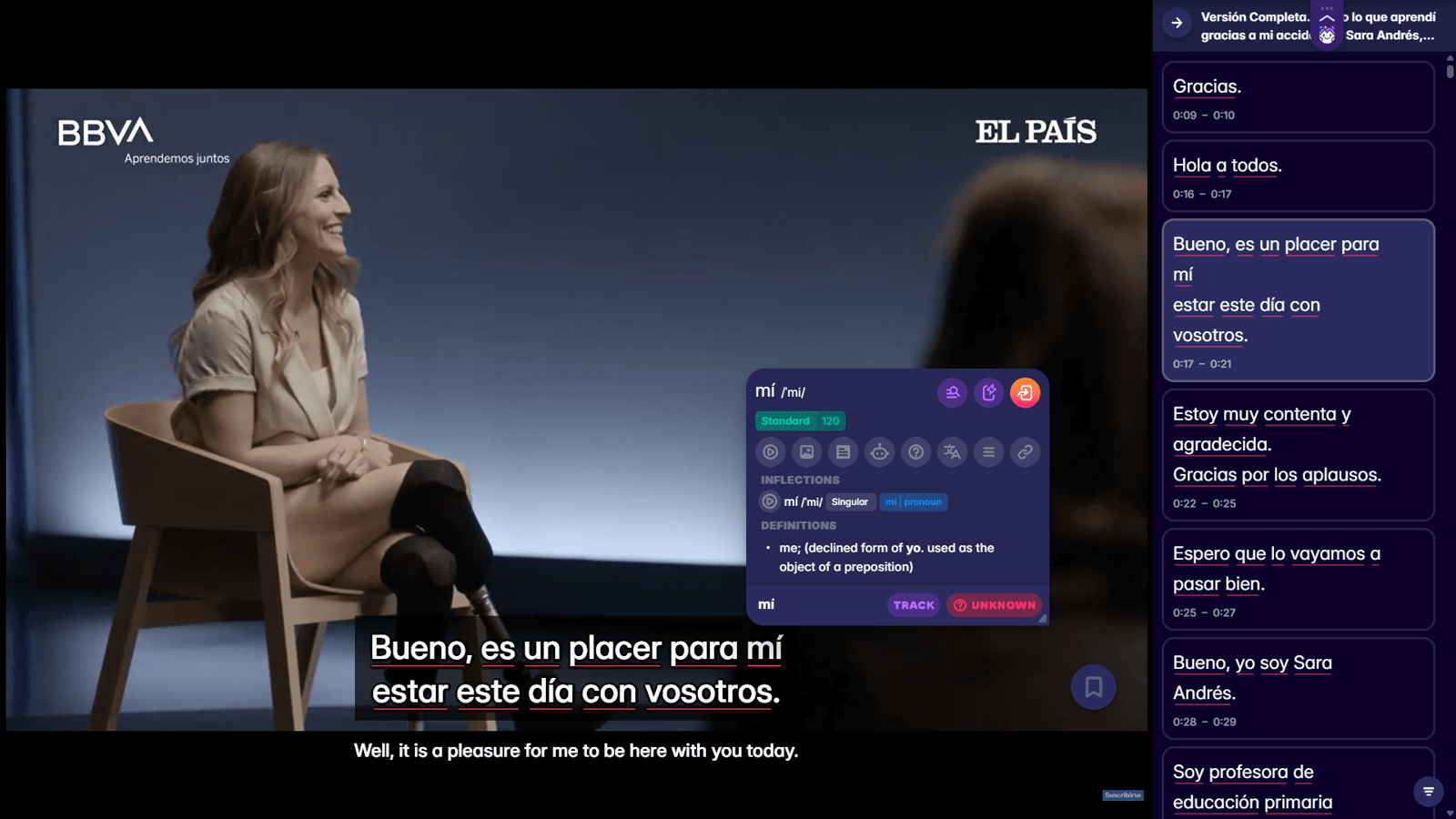
Anyway, if you want to practice these directional phrases with real Spanish content, Migaku's browser extension and app let you look up words instantly while watching shows or reading articles. Makes learning vocabulary way more practical than flashcards alone. There's a 10-day free trial if you want to check it out.
Basic directions are genuinely helpful for real-life situations
You'll hear them when asking where the nearest bus stop is, when a local is explaining how to find a restaurant, or when you're trying to locate your Airbnb in a maze of similar-looking streets. The vocabulary itself isn't complicated. Most Spanish words for directions are pretty straightforward once you've seen them a few times. When you're watching Spanish content, pay attention to any scenes where characters are navigating or asking for directions. You'll pick up natural phrasing and regional variations.
If you consume media in Spanish, and you understand at least some of the messages and sentences within that media, you will make progress. Period.
Confidence comes from repeated practice!💪