Spanish Job Interview Phrases: Learn Common Questions and How to Answer
Last updated: March 29, 2026

You've been learning Spanish for a while, and now you're ready to put those skills to work in the real world. Landing a job in a Spanish-speaking country or with a Spanish-speaking company is exciting, but the interview process can feel intimidating. Here's the thing: you don't need to be perfectly fluent to nail a job interview in Spanish. You just need the right phrases, a solid understanding of common questions, and enough confidence to show you can communicate professionally. Let's break down exactly what you need to know.
- Why preparing specific phrases matters for interviews in Spanish
- Greetings and first impressions
- Introducing yourself professionally
- Common interview questions you'll definitely face
- Talking about your resume and experience in Spanish interviews
- Describing your skills and qualifications
- Discussing salary and benefits
- Asking your own questions
- Handling difficult or unexpected questions
- Closing the interview professionally
- Cultural considerations for Spanish-speaking countries
- Building your interview vocabulary systematically
Why preparing specific phrases matters for interviews in Spanish
When you're interviewing for trabajo in another language, your brain is already working overtime. You're translating, thinking about grammar, and trying to sound professional all at once. That's why having specific phrases memorized helps you perform better.
I've talked to plenty of people who tried to wing Spanish job interviews, thinking their conversational skills would carry them through. Most of them said the same thing: they froze when asked standard questions because they hadn't practiced the formal vocabulary. The interviewer asks "¿Cuáles son sus fortalezas?" and suddenly you're blanking on how to say "strengths" or whether to use "mi" or "mis."
Preparing phrases ahead of time frees up mental space during the actual entrevista. You can focus on connecting with the interviewer instead of scrambling for basic vocabulary.
Greetings and first impressions
The first 30 seconds of any job interview set the tone. In Spanish-speaking contexts, this initial greeting carries even more weight because formality matters.
Start with "Buenos días" (good morning) or "Buenas tardes" (good afternoon) depending on the time. Follow up with "Mucho gusto" (pleased to meet you) or "Es un placer conocerle" (It's a pleasure to meet you). The "le" at the end shows you're using the formal "usted" form, which is pretty much required in professional settings.
When they invite you to sit, say "Gracias" and take your seat. If you want to add a bit more, "Gracias por recibirme" (thank you for receiving me) or "Gracias por la oportunidad de entrevistarme" (thank you for the interview opportunity) works well.
Here's a phrase that sounds super professional: "Estoy muy emocionado/a de estar aquí" (I'm very excited to be here). It shows enthusiasm without sounding overly casual.
Introducing yourself professionally
After the initial greeting, you'll almost always get asked to introduce yourself. The phrase you'll hear is usually "Hábleme de usted" or "Cuénteme sobre usted" (tell me about yourself).
Your response should hit three main points:
- who you are professionally,
- your relevant experience,
- and why you're interested in this position.
Here's a template that works:
"Me llamo (your name) y soy (your profession). Tengo (number) años de experiencia en (field). Actualmente trabajo en (current company/situation), donde me especializo en (specialization). Estoy buscando nuevas oportunidades porque (reason)."
That translates to:
"My name is (name) and I'm a (profession). I have (number) years of experience in (field). Currently I work at (company), where I specialize in (area). I'm looking for new opportunities because (reason)."
Some useful vocabulary for this section:
Spanish | English |
|---|---|
experiencia laboral | Work experience |
formación académica | Academic background |
habilidades | Skills |
trayectoria profesional | Professional trajectory |
Common interview questions you'll definitely face
Every job interview in Spanish follows similar patterns. These questions come up again and again, so preparing answers ahead of time makes a huge difference.
- "¿Por qué quiere trabajar aquí?" (Why do you want to work here?) is basically guaranteed. Your answer should reference specific things about the company. Use phrases like "Me impresiona que" (I'm impressed that), "Admiro su enfoque en" (I admire your focus on), or "La reputación de la empresa en (area)" (the company's reputation in (area)).
- "¿Cuáles son sus fortalezas?" (What are your strengths?) needs concrete examples. Start with "Una de mis principales fortalezas es" (One of my main strengths is) or "Me considero una persona" (I consider myself a person who is). Follow up with "Por ejemplo" (for example) and give a specific situation.
- The weakness question, "¿Cuáles son sus debilidades?" always feels awkward in any language. In Spanish, frame it positively: "Un área en la que estoy trabajando para mejorar es" (An area I'm working to improve is) or "Anteriormente tuve dificultades con (weakness), pero he tomado pasos para" (Previously I had difficulties with (weakness), but I've taken steps to).
- "¿Dónde se ve en cinco años?" (Where do you see yourself in five years?) wants to hear about growth. Use "Me gustaría" (I would like), "Espero" (I hope), or "Mi objetivo es" (My goal is).
Talking about your resume and experience in Spanish interviews
The word for resume in Spanish varies by region. In Spain, it's "currículum" or "CV." In Latin America, you might hear "hoja de vida" or "currículum vitae."
- When discussing your resume, you can say "Como pueden ver en mi currículum" (As you can see in my resume).
- When describing past trabajo, use the preterite or imperfect tenses. "Trabajé en" (I worked at), "Fui responsable de" (I was responsible for), "Logré" (I achieved), and "Desarrollé" (I developed) are your go-to phrases.
- To describe accomplishments, try "Durante mi tiempo en (company), pude" (During my time at (company), I was able to) or "Uno de mis logros principales fue" (One of my main achievements was).
- If you're asked about gaps in employment, be direct: "Durante ese período, me dediqué a" (During that period, I dedicated myself to) or "Tomé un tiempo para" (I took time to).
Describing your skills and qualifications
Spanish has specific vocabulary for professional skills that you should know cold. "Capacidades" and "habilidades" both mean skills. "Conocimientos" refers to knowledge or expertise in specific areas.
When listing skills, structure it like this:
- Tengo experiencia en
I have experience in - Domino
I master / am proficient in - Cuento con conocimientos de
I have knowledge of
For soft skills, use phrases like:
- Trabajo bien en equipo
I work well in teams. - Tengo buenas habilidades de comunicación
I have good communication skills. - Soy organizado/a
I'm organized. - Me adapto fácilmente a nuevos entornos
I adapt easily to new environments.
Technical skills need specific vocabulary.
Spanish | English |
|---|---|
Manejo de software | Software proficiency |
Conocimientos técnicos | Technical knowledge |
Certificaciones | Certifications |
Dominio de idiomas | Language proficiency |
Discussing salary and benefits
Money talk feels awkward in any language, but you need to be prepared. The word "salario" or "sueldo" means salary. Benefits are "beneficios" or "prestaciones."
If they ask about salary expectations ("¿Cuáles son sus expectativas salariales?"), you can deflect politely:
- Estoy abierto/a a discutir el salario según las responsabilidades del puesto.
I'm open to discussing salary according to the position's responsibilities. - Me gustaría conocer más sobre el puesto antes de hablar de números.
I'd like to know more about the position before discussing numbers.
If you need to name a number, use:
- Basándome en mi experiencia y el mercado actual, esperaría un salario entre (X) y (Y).
Based on my experience and the current market, I would expect a salary between (X) and (Y).
For discussing contrato terms, know these phrases:
- ¿Qué tipo de contrato ofrecen?
What type of contract do you offer? - ¿Cuándo comenzaría el puesto?
When would the position start? - ¿Hay oportunidades de crecimiento?
Are there growth opportunities?
Asking your own questions
Every interviewer in a Spanish-speaking country will ask "¿Tiene alguna pregunta?" (Do you have any questions?). Never say no. Asking questions shows genuine interest.
Good questions to ask:
- ¿Cómo es un día típico en este puesto?
What's a typical day like in this position? - ¿Cuáles son los mayores desafíos de este rol?
What are the biggest challenges of this role? - ¿Cómo describiría la cultura de la empresa?
How would you describe the company culture?
About the team:
- ¿Con quién trabajaría directamente?
Who would I work with directly? - ¿Cómo está estructurado el equipo?
How is the team structured?
About next steps:
- ¿Cuáles son los próximos pasos en el proceso?
What are the next steps in the process? - ¿Cuándo puedo esperar tener noticias suyas?
When can I expect to hear from you?
Handling difficult or unexpected questions
Sometimes you'll get a question you didn't prepare for. Having stalling phrases helps you think.
- Esa es una buena pregunta.
That's a good question. - Déjeme pensar un momento.
Let me think for a moment. - Si entiendo correctamente, me está preguntando sobre...
If I understand correctly, you're asking about...
If you genuinely don't understand something, don't fake it. Say:
- Disculpe, ¿podría repetir la pregunta?
Excuse me, could you repeat the question? - No estoy seguro/a de haber entendido, ¿podría explicarlo de otra manera?
I'm not sure I understood, could you explain it another way?
Closing the interview professionally
The end of the interview matters just as much as the beginning. When you sense things wrapping up, you want to leave a strong final impression.
Express gratitude:
- Muchas gracias por su tiempo.
Thank you very much for your time. - Agradezco mucho la oportunidad de conocer más sobre la empresa.
I really appreciate the opportunity to learn more about the company.
Reaffirm interest:
- Estoy muy interesado/a en este puesto.
I'm very interested in this position. - Creo que sería una excelente oportunidad para mí.
I believe this would be an excellent opportunity for me.
End with "Que tenga un buen día" (Have a good day) or "Hasta pronto" (See you soon) if they've indicated you'll speak again.
Cultural considerations for Spanish-speaking countries
Here's something people don't talk about enough: interview culture varies significantly across Spanish-speaking countries. What works in Spain might feel weird in Mexico or Argentina.
In Spain, interviews tend to be more formal and structured. They stick to professional topics and expect you to use "usted" throughout. In many Latin American countries, interviewers might switch to "tú" partway through, especially in startup environments. Follow their lead.
Punctuality expectations differ too. In Spain, arriving exactly on time is expected. In some Latin American contexts, arriving 5-10 minutes early shows enthusiasm. Research the specific Spanish-speaking country you're interviewing in.
Small talk before getting down to business is more common in Latin America than Spain. Be prepared to chat briefly about your journey there, the weather, or general pleasantries before diving into interview questions.
Building your interview vocabulary systematically
Learning random phrases doesn't help much. You need to learn Spanish in context, building vocabulary around specific interview scenarios.
- Start with action verbs you'll use to describe experience: "dirigir" (to lead/manage), "desarrollar" (to develop), "implementar" (to implement), "lograr" (to achieve), "colaborar" (to collaborate), "supervisar" (to supervise).
- Learn adjectives that describe professional qualities: "responsable" (responsible), "proactivo/a" (proactive), "dedicado/a" (dedicated), "eficiente" (efficient), "creativo/a" (creative), "analítico/a" (analytical).
- Know industry-specific terms for your field. A software developer needs different vocabulary than a marketing professional or teacher. Make a list of the 20-30 most common terms in your industry and learn them in Spanish.
- Record yourself answering common interview questions in Spanish. Listen back and notice where you stumble or pause awkwardly. Those are the phrases you need to drill more.
- If possible, do a mock interview with a native Spanish speaker. Even 15 minutes of practice with someone who can correct your grammar and suggest more natural phrasing makes a huge difference.
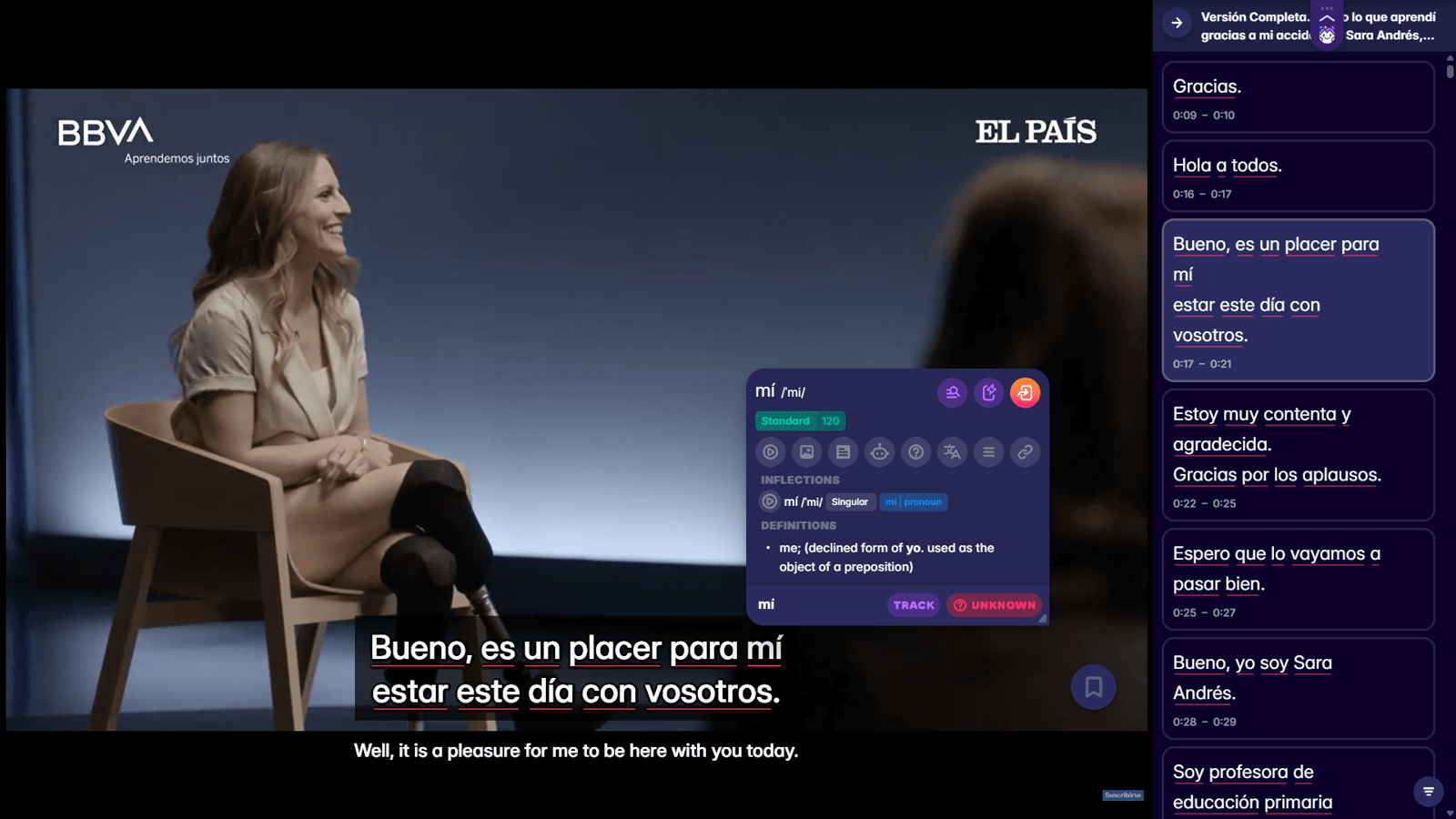
- Watch actual job interviews in Spanish on YouTube. Pay attention to the rhythm, the formality level, and how people structure their answers. You'll pick up on patterns that textbooks don't teach.
If you want to build your Spanish vocabulary faster for professional contexts, Migaku's browser extension and app let you save phrases directly from Spanish job sites, business articles, or interview videos into your flashcards. Makes it way easier to learn the exact vocabulary you need. There's a 10-day free trial if you want to check it out.
Ready to ace that Spanish job interview
Preparing for a job interview in Spanish takes work, but you don't need perfect fluency. You need the right vocabulary, practiced answers to common questions, and enough confidence to have a professional conversation. The phrases above give you a solid foundation, but the real learning happens when you consume Spanish media to collect relevant expressions, practice speaking them out loud, and adapt them to your specific situation and industry. Whether you're interviewing in Madrid, Mexico City, or Buenos Aires, these core phrases will help you communicate professionally and land that job.
If you consume media in Spanish, and you understand at least some of the messages and sentences within that media, you will make progress. Period.
Prepare thoroughly, and go in with confidence!👍